-
-
Conversations with bambu
Inspiration
Grief is one of the most universal human experiences, yet most people face it completely alone. When someone loses a loved one, they're hit with two overwhelming things at once — the emotional weight of loss, and a avalanche of practical things they suddenly have to handle. We wanted to build something that could sit with someone in that moment. Not a hotline, not a checklist app, not a chatbot that feels like a customer service rep. Something that actually felt present. Bambu was born from the question: what if technology could feel like a friend?
What it does
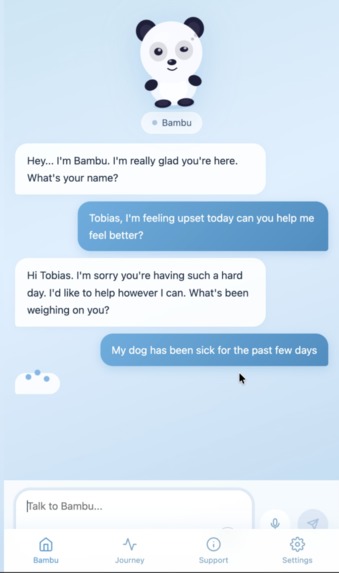
Bambu is an AI-powered emotional support companion for people navigating grief and loss. At its heart is an animated panda named Bambu who listens to you, speaks out loud, remembers your name and your story, and checks in on how you're doing over time. You don't fill out forms or answer surveys — you just talk. Bambu responds with warmth and empathy through natural conversation, voice input, and text-to-speech. Over time he tracks your emotional patterns, surfaces gentle insights, and reflects back what he's noticed about your journey on the Journey page.
How we built it
Bambu is built with React and Vite for the frontend, with a fully custom animated SVG panda that has 7 emotional states — idle, listening, thinking, speaking, happy, sad, and comfort — each with unique animations and expressions. The AI is powered by Claude (Anthropic) using a carefully engineered system prompt designed to feel warm, restrained, and human. Voice input uses the Web Speech API and text-to-speech uses the browser's SpeechSynthesis API. Emotional memory is stored in localStorage so Bambu remembers you between sessions. The mood timeline is built with Recharts. The app is deployed on Vercel.
Challenges we ran into
Getting Bambu to feel genuinely warm rather than robotic was the hardest engineering challenge — not in code, but in prompt design. Early versions felt too clinical, too eager to help, too full of advice nobody asked for. We had to strip the prompt back repeatedly until Bambu learned that silence and presence are often more powerful than words. We also had to solve persistent memory across sessions without a backend — using localStorage with a structured memory extraction system so Bambu never asks for your name twice. Getting the animated panda to feel alive and emotionally reactive in pure SVG was another unexpected challenge that took significant iteration.
Accomplishments that we're proud of
We're proud that Bambu genuinely feels different from other AI apps. Most AI companions feel transactional. Bambu feels like someone is actually there. We're proud of the panda — fully custom SVG with blinking eyes, emotional expressions, reactive animations, and a bamboo accessory. We're proud of the memory system that makes Bambu remember returning users and greet them personally. And we're proud that the entire app works with no backend, no database, and no accounts — everything private on your device.
What we learned
We learned that the hardest part of building an emotional AI isn't the technology — it's the restraint. Teaching an AI when NOT to respond, when NOT to give advice, and when to just sit with someone is far harder than teaching it to be helpful. We also learned that animation and voice are not nice-to-haves in an emotional support context — they are the product. Bambu without voice and animation is just a chatbot. With them, it becomes something people actually feel safe talking to.
What's next for Babu - Emotional Support AI
We want to expand Bambu beyond grief to support anyone going through a difficult life transition — divorce, job loss, illness, loneliness. We want to add ElevenLabs voice integration for a truly realistic, warm voice. We want to build a mobile app so Bambu is available whenever someone needs him — especially late at night. Longer term, we want to explore partnerships with grief counselors and therapists so Bambu can serve as a bridge between someone who is struggling and professional support — lowering the barrier to getting help rather than replacing it.


Log in or sign up for Devpost to join the conversation.