-
-
cover
-
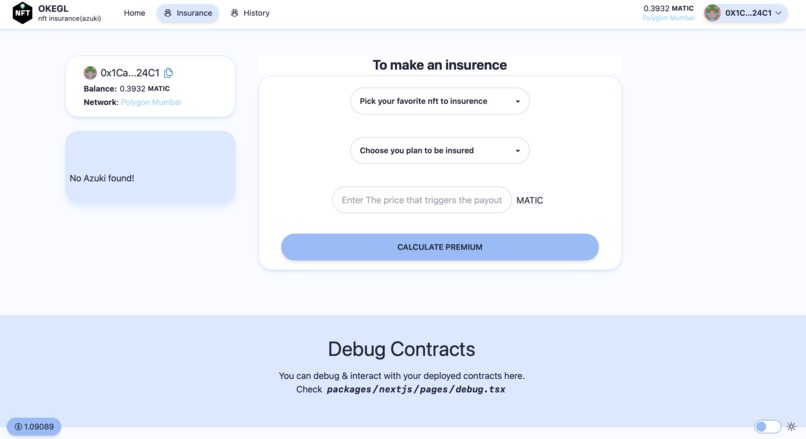
Page of insurance plan choices and submit for DAO in proof (insured item/duration/claim amount/pay system calculated premium)
-
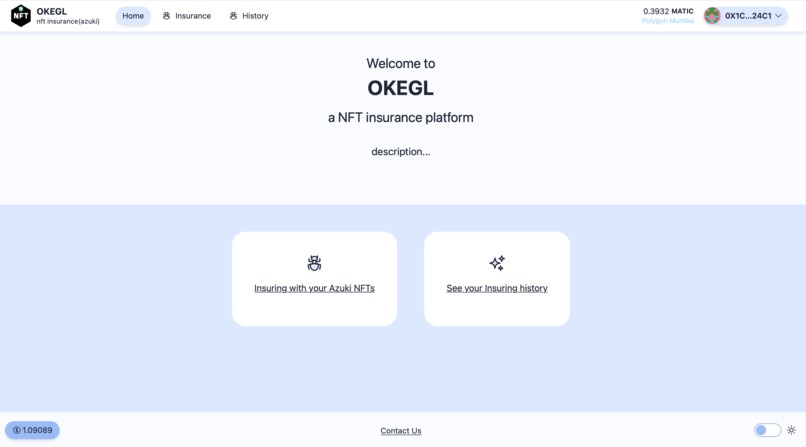
Homepage of Azuki insurance portal (wallet login and NFT holder verification)
-
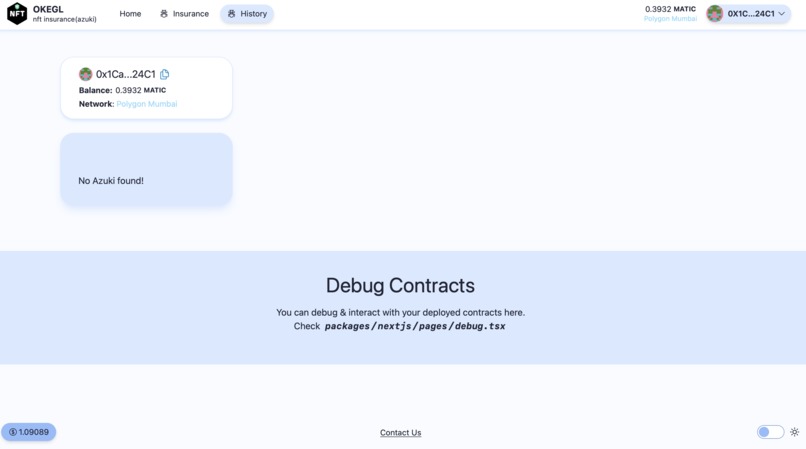
All histories of requests' status and claim status/process will be shown here


Inspiration
Which is your favorite nft to trade on the opensea platform, our group all like azuki the most! The Azuki series nft is a bullish blue chip but who knows? I just entered the market with no intention of holding for the long term and I don't want to lose too much when I sell due to changing market conditions. With reference to the floor price fluctuations it looks like the market price is going down, my azuki doesn't have a lot of flashy features so I feel sure the price will fluctuate downward with the market. Get insurance for the future, it's not that expensive.
What it does
After verifying the nft holding account address, a qualified insurer can select one of five expected selling prices provided and one of five insurance duration, then successfully pay the premium calculated by the system and submit the request for insurance. At the same time, the liquidity providers, our DAO members, will vote on the approval of this insurance, as well as stake their ETH. Once the insurance is activated which is more yes votes within a short period, the insurer can check the status of their insurance in the system. When the system detects that the insured nft has been successfully sold at opensea within the insured period, the system will automatically credit the insurer's account if the actual sale price obtained is lower than the expected sale price initially selected for a certain amount of ETH. Otherwise, the insurer will not be covered by this insurance.
How we built it
Our team consists of smart contract engineers, front-end engineers, back-end engineers, and product managers. Everyone is involved in the code as well as the planning discussions. The plan is to use the wallet address to verify the nft owner, the chainlink function to retrieve the floor price of the corresponding nft as part of the premium calculation, functions to access external API to get the actual transaction price of the opensea, and smart contracts to execute automatically as a solution for the user after the payout is triggered.
Challenges we ran into
When using functions to access external APIs and obtain actual transaction prices, I encountered an error in the API data return and analyzed it to determine that the opensea api had returned a successful transaction price. Difficulties were encountered in the selection of DAO members and in the design of liquidity pledges. It was a huge challenge to choose the VRF function of chainlink and how to implement the liquidity pool construction, and when testing, an overly complex front-end system was chosen, leading to many difficulties in the construction process. The final challenge is the implementation of the business model: how to make a profit and by what criteria. The determination of insurance rates and payout ratios will be key to profitability. Once the premium calculation uses complex formulas or the volume of calculations increases and the efficiency of in-chain calculations is required too much, there is a high risk of insurance requests not being approved on time, claims taking too long to be triggered and ultimately not being paid automatically.
Accomplishments that we're proud of
All contract calculations, data acquisition and premium formulas are currently implemented in polygon testnet, making it transparent and efficient.
What we learned
Less code, fewer mistakes. Make it simple as stupid.
What's next for Azuki parametric insurance -price protection
This asset-light insurance model can be extended to other blue chip nft. As the nft pricing model is still unclear, rarity and floor price alone are far from sufficient as a solid reference, and until a more mainstream pricing approach is available, the most effective way to control risk in the face of market changes is insurance.
Built With
- api
- automation
- azuki
- dao
- feed
- floorprice
- javascript
- nft
- solidity
- vrf


Log in or sign up for Devpost to join the conversation.