-
-
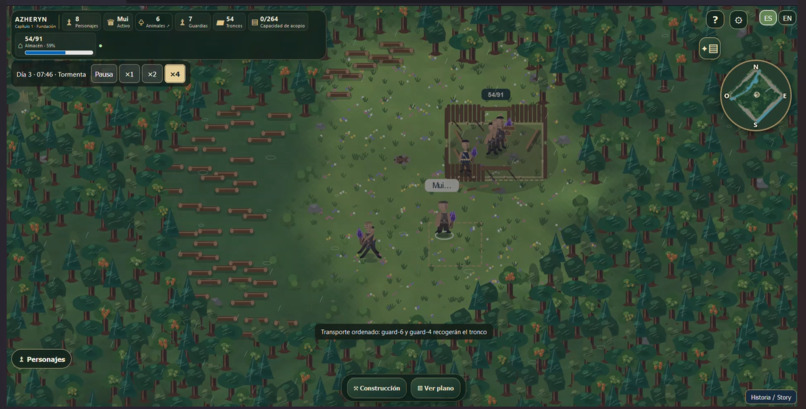
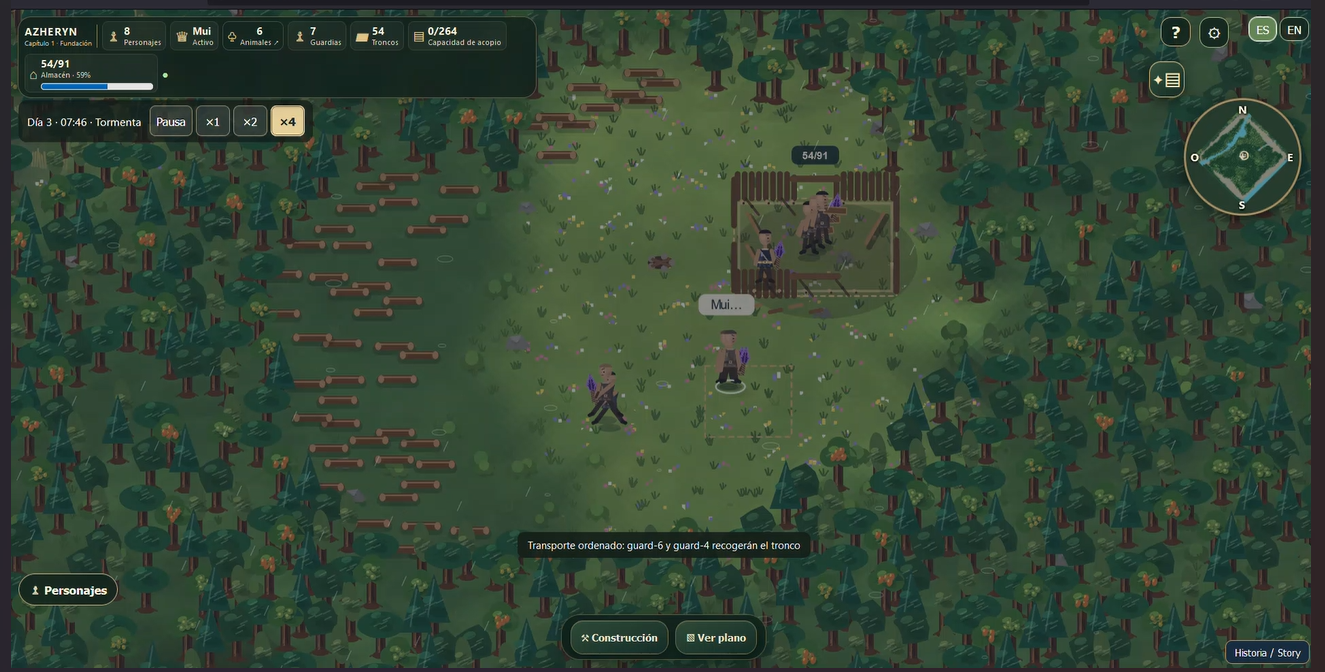
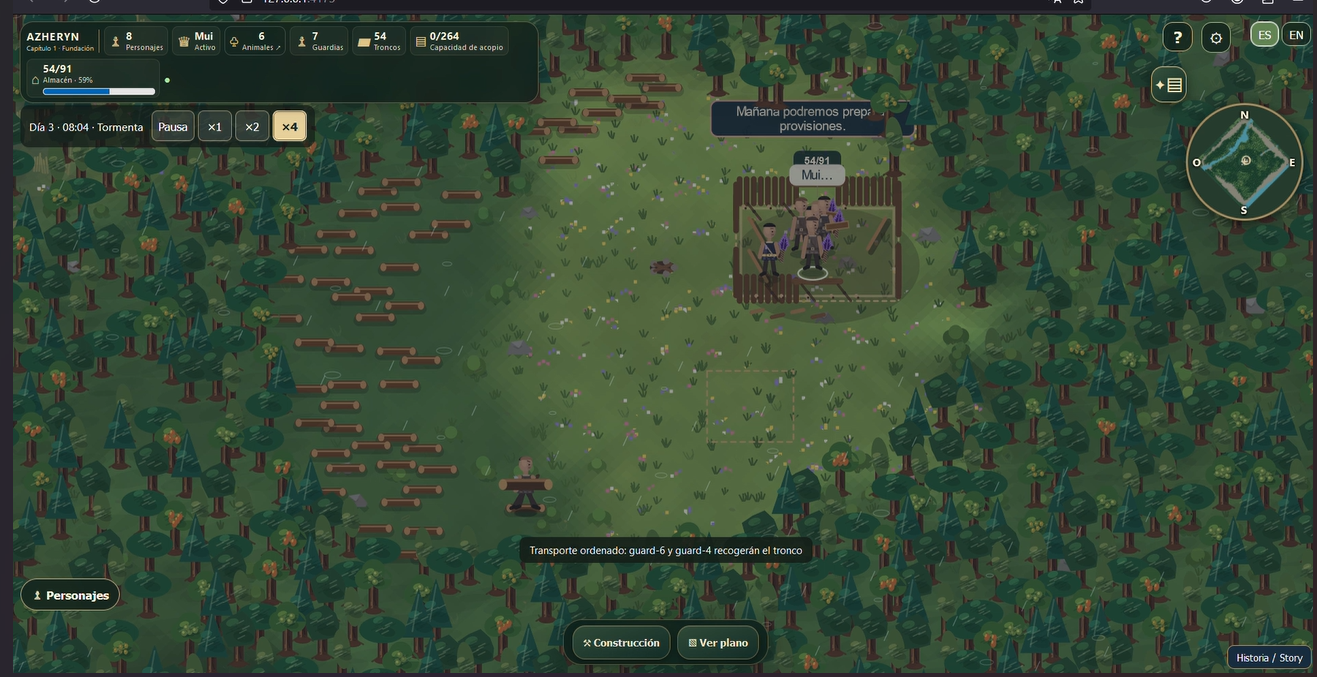
Mui and his guards working on warehouse construction during a storm. Progress: 54 of 91 logs.
-
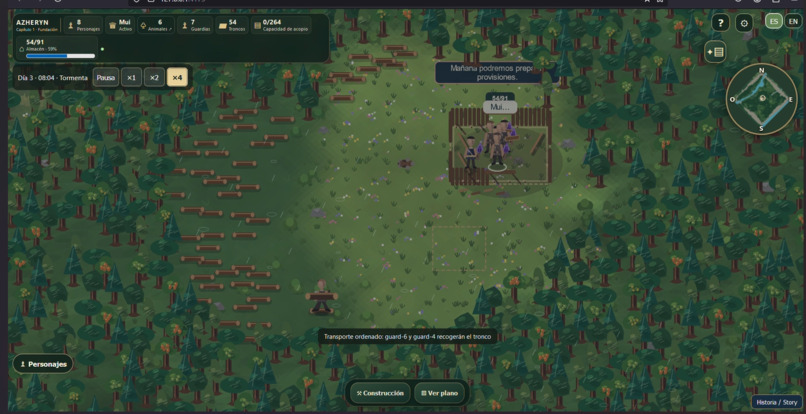
A guard transporting a log through the forest while other characters continue working on the warehouse.
-
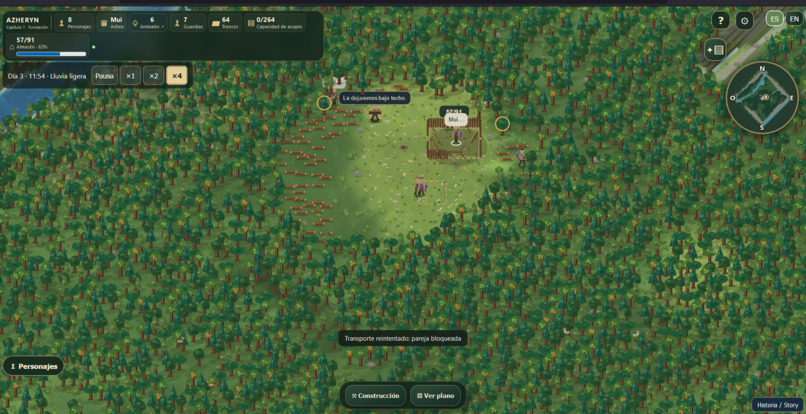
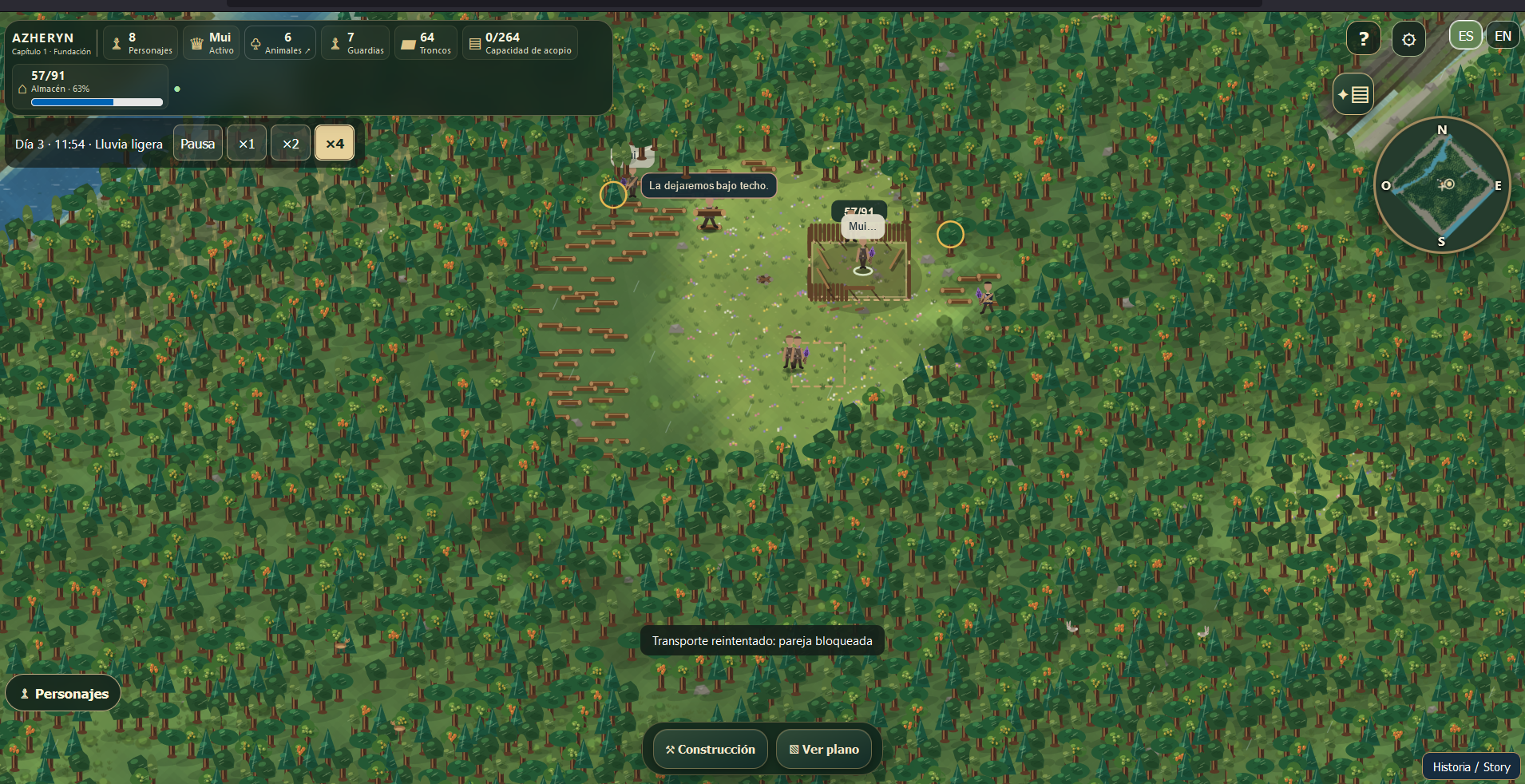
Forest overview with Mui, his guards, and warehouse construction at 63%.
Inspiration
AZHERYN V2 was born from a much larger creative vision: a fantasy universe I am developing for an extensive literary saga, provisionally named AZHERIN.
The saga is still in development, and its books have not yet been completed or published. It contains many stories, characters, territories, mysteries, and events that will take time to fully develop.
My goal is to connect the literary saga and the video game while allowing each to explore the universe in its own way. The books will tell the broader story, while the game will eventually allow players to participate in that world and influence its development through their decisions.
I decided to begin with something simple: a small group of characters surviving and working together in a forest. What starts with building a warehouse is intended to become the foundation of a much larger adventure.
What it does
AZHERYN V2 — Chapter 1 is a fantasy strategy game where players direct Mui and seven guards in a forest environment.
Players can select characters, assign tasks, mark trees for cutting, collect logs, transport resources, and work toward constructing a warehouse.
The game includes autonomous guard behaviors, task management, fatigue and rest, a day-and-night cycle, environmental changes, and wildlife moving through the forest.
The characters make programmed decisions within the game's rules. They do not use independent generative AI.
The current chapter focuses on basic resource management and construction, establishing the foundation for the future Academy of Azherin.
How we built it
I developed AZHERYN V2 with the assistance of artificial intelligence tools, using technologies including TypeScript, React, Vite, and HTML5 Canvas.
I defined the game's creative vision, characters, mechanics, objectives, and desired behavior. AI tools helped with programming, organizing the project, identifying errors, and implementing changes.
Throughout development, I reviewed the results, tested the game, identified problems, and decided what needed to be improved.
The process involved repeated revisions to character movement, resource transportation, construction mechanics, forest distribution, wildlife, and the user interface.
Challenges we ran into
One of the biggest challenges was making multiple game systems work together correctly.
For example, transporting a log requires coordinating two workers, checking their availability, and moving the resource to its destination.
I also encountered problems with character movement, task assignments, nighttime behavior, animal placement, and visual presentation.
The prototype still has limitations. In some situations, two workers carrying a log may overlap instead of appearing clearly separated. The graphics, animations, and certain interface details also need further improvement.
Rather than presenting the game as a finished product, I chose to focus on establishing a functional prototype that can continue evolving.
These challenges helped me understand the importance of testing and refining a game beyond simply writing code.
Accomplishments that we're proud of
One of my greatest accomplishments is transforming an idea from an unpublished fantasy universe into a playable strategy game prototype.
I am particularly proud of bringing Mui and his seven guards into an interactive environment, creating systems for tree cutting, cooperative resource transportation, warehouse construction, and autonomous character activities.
Another important achievement was connecting multiple systems—including character behavior, resources, wildlife, and the passage of time—within a single game experience.
The project also gave me a foundation that I can continue improving after the competition.
What we learned
The most important lesson I learned was the value of organization.
Breaking a large project into smaller, verifiable objectives helped me make progress, identify errors, and prioritize improvements.
I also learned that something that appears correct in code may behave differently during gameplay, making real testing essential.
Working with AI helped me better understand the relationship between creative direction, programming, testing, and game design.
I learned that AI can be a valuable development assistant, but clear goals, critical evaluation, and human decisions remain essential.
What's next for AZHERYN V2 — Chapter 1
My immediate goal is to improve the current prototype by correcting remaining technical issues, especially the positioning of workers during log transportation, character animations, graphical quality, and interface details.
In future chapters, I want to expand the world, introduce more complex decisions, develop relationships between characters, and gradually build the Academy of Azherin.
Mui's leadership will become increasingly important, and the player's choices may eventually influence the community and its future.
These are planned features, not capabilities included in the current competition version.
The long-term vision is to connect the game with the developing AZHERIN literary saga, allowing players to explore an increasingly complex fantasy universe.
The story of this universe is much bigger than its first chapter, but every great story has a beginning.
Built With
- canvas
- chatgpt
- github
- github-copilot
- html5
- javascript
- react
- typescript
- visual-studio-code
- vite

Log in or sign up for Devpost to join the conversation.