-
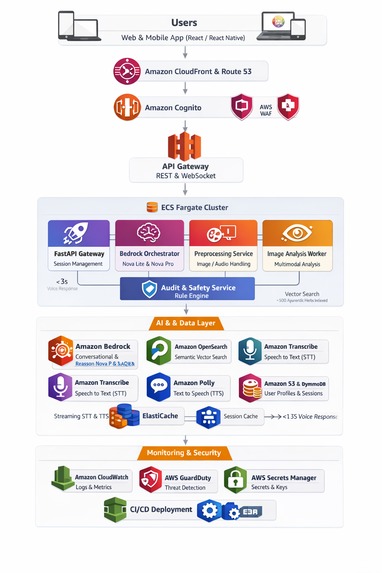
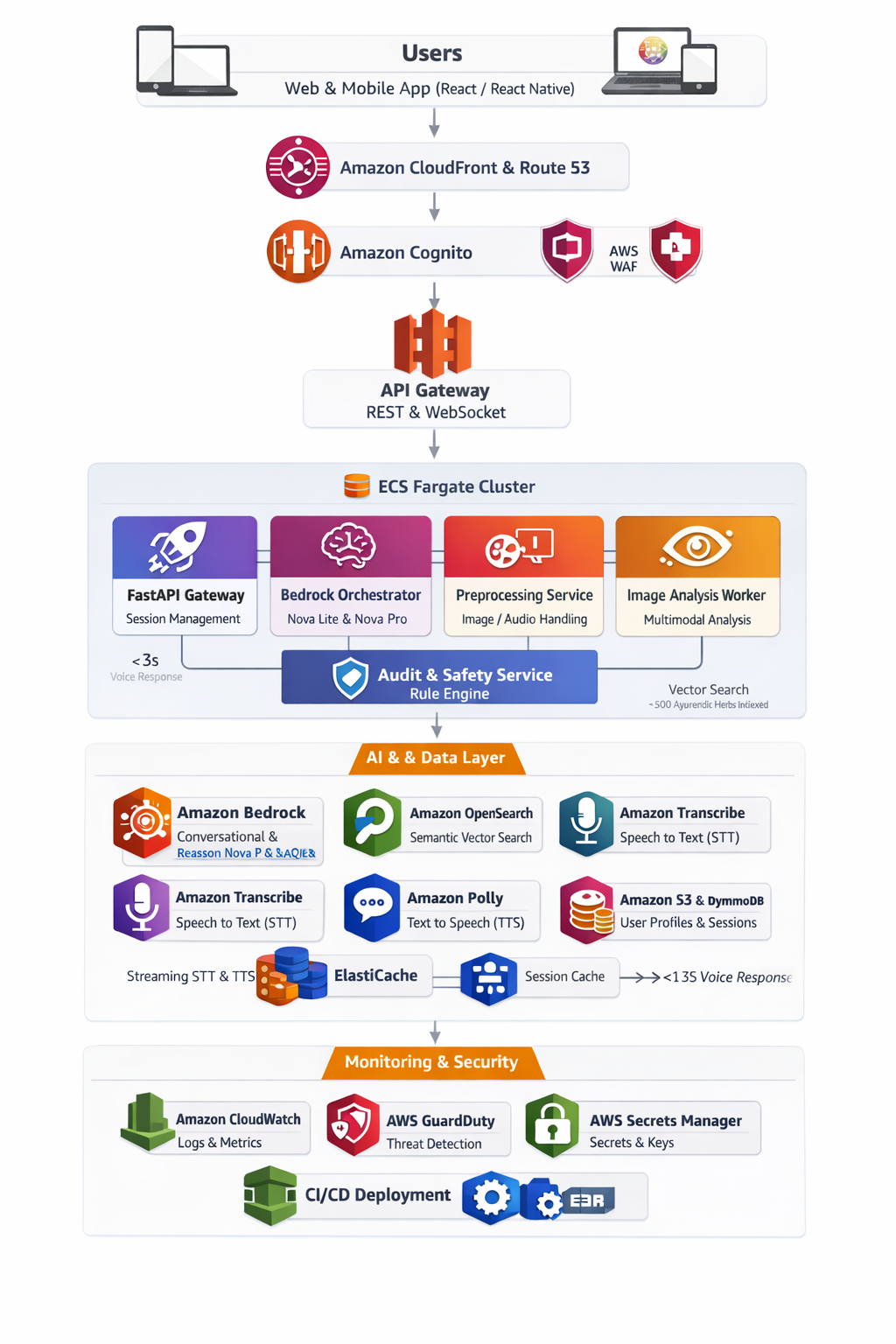
AWS Architecture AyurVani
Inspiration : Growing up in an Indian household, I watched my grandmother treat everything from fevers to stomach aches with her knowledge of Ayurveda — turmeric milk for colds, ajwain for digestion, ashwagandha for stress. But when I moved to a city, I realized how disconnected my generation had become from this wisdom. Worse, when my mother tried searching online for Ayurvedic guidance in Hindi, she barely found anything reliable.
That's when it hit me — India has over a billion people speaking dozens of languages, yet almost all health-tech serves only English speakers. Meanwhile, this 5,000-year-old system of medicine sits locked away in Sanskrit texts that most people can't read. I wanted to change that. I wanted to build something my grandmother would be proud of and my mother could actually use — an AI that speaks her language and understands the medicine she grew up trusting.
What it does :AyurVani (meaning "Voice of Ayurveda") is a multilingual Ayurvedic healthcare assistant powered by Amazon Nova. It lets users have natural voice conversations about their health in 13 Indian languages — Hindi, Tamil, Telugu, Kannada, Malayalam, Bengali, Marathi, Gujarati, Punjabi, Odia, Urdu, Sanskrit, and English.
Here's what it can do: when a user describes their symptoms, AyurVani analyzes them through the lens of Tridosha theory (Vata, Pitta, Kapha) and provides personalized herb recommendations from a database of 500+ Ayurvedic medicines, along with dietary advice, yoga suggestions, and lifestyle changes. It also offers a comprehensive Prakriti (body constitution) assessment through a guided questionnaire, so recommendations are truly tailored to the individual. I also built multimodal features — users can upload photos for tongue analysis, which is a traditional Ayurvedic diagnostic method. The entire knowledge base is grounded in classical texts like Charaka Samhita and Sushruta Samhita, so every recommendation has roots in authentic Ayurvedic literature, not random internet advice. And importantly, it always reminds users to consult a real doctor when needed. I never wanted this to replace healthcare — just make traditional wellness knowledge more accessible.
How we built it: I built AyurVani on AWS, with Amazon Bedrock at its core. For the AI brain, I used Amazon Nova Lite for fast multilingual conversations, Amazon Nova Pro for complex reasoning when generating treatment plans, and Nova's multimodal capabilities for image-based analysis like tongue diagnostics. I embedded the entire Ayurvedic knowledge base using Nova Embeddings and stored them in OpenSearch for semantic search.
For voice, I integrated Amazon Polly for text-to-speech and Amazon Transcribe for speech-to-text across Indian languages. The backend runs on FastAPI with Python, with DynamoDB handling sessions and S3 storing audio files. On the frontend, I built a React.js web app with Vite and styled it with Tailwind CSS. I also developed a mobile version using React Native/Expo. The whole thing is containerized with Docker and deployed through a GitHub Actions CI/CD pipeline. The trickiest part of the architecture was the AI pipeline itself — detecting the user's language, pulling relevant Ayurvedic context through vector search, applying dosha-based reasoning, personalizing the output, running it through safety checks, and delivering it all in under 3 seconds. Getting that flow smooth took a lot of late nights.
Challenges we ran into: The biggest headache was multilingual Ayurvedic terminology. Sanskrit medical terms don't translate neatly into Tamil or Bengali. Words like "Ojas" or "Agni" carry deep philosophical meaning, and I spent hours building terminology mappings for each language so the AI wouldn't lose nuance in translation.
Knowledge base accuracy was another beast. I had to digitize and chunk classical Ayurvedic texts, embed them properly, and then manually verify that the AI's therapeutic recommendations actually matched what the texts said. One wrong herb suggestion could be genuinely harmful, so I couldn't afford to be careless. Voice quality frustrated me more than I expected. Indian accents vary wildly even within a single language, and background noise in typical Indian households made transcription unreliable at first. I had to implement noise reduction and test extensively with real regional speech patterns. The ethical tightrope was constant. I wanted AyurVani to be genuinely helpful, but I also didn't want anyone skipping a hospital visit because an AI told them to drink turmeric water. Building the safety layer — knowing when to recommend professional help and when to offer traditional guidance — was one of the hardest design decisions I made.
Accomplishments that we're proud of :I'm genuinely proud that I built what I believe is the first multilingual Ayurvedic AI assistant supporting 13 Indian languages. That alone feels meaningful.
I'm proud of the knowledge base — 500+ herbs with their effects, dosages, and contraindications, 200+ yoga practices, and thousands of passages from classical texts, all searchable through semantic search. It feels like I've built a digital library of my grandmother's wisdom. The sub-3-second response time for voice interactions makes me happy because it actually feels like a real conversation, not a frustrating wait. I'm also proud that the Prakriti assessment with 50+ questions genuinely produces useful, personalized results — I tested it on my family and they were surprised by how accurate it felt. Most of all, I'm proud that my mother could actually use it. She spoke to it in Hindi, asked about her joint pain, and got a thoughtful response about Vata imbalance with practical suggestions. She smiled and said, "This sounds like Nani." That moment made the entire project worth it.
What we learned : I learned more about Amazon Nova than I ever expected to. Figuring out optimal prompting strategies for multilingual medical content, understanding when to use Nova Lite vs. Pro, and leveraging streaming responses for real-time voice — all of this deepened my understanding of modern AI infrastructure.
I learned that building for Indian languages is hard in ways I hadn't anticipated. Script rendering, tokenization, dialect variations, code-switching (people mix Hindi and English constantly) — these aren't edge cases in India, they're the norm. On the domain side, I developed a real appreciation for Ayurvedic medicine as a system. It's not random folk remedies — it's a structured, logical framework for understanding health. Learning Tridosha theory, Prakriti classification, and seasonal lifestyle guidance (Ritucharya) made me understand why my grandmother's advice always worked. The most important lesson was about responsibility. Building a health AI forced me to think carefully about what I say, how I say it, and what I leave out. I learned that good AI isn't just technically impressive — it's trustworthy. I mastered prompting Amazon Nova for medical multilingual tasks and used its Pro version for deep Ayurvedic reasoning. Vector search became second nature—I tuned embeddings and chunking for ancient texts. Designing cross-cultural AI showed me how context shapes outputs, and I learned to prioritize ethics with safety nets and disclaimers. 📚 Ayurveda and Beyond I immersed myself in dosha theory, Prakriti, and how Ayurveda views the whole person. Handling Indian languages revealed script challenges and dialect quirks. For UX, I figured out simple designs for all literacy levels, making health tech inclusive. On a personal note, it reinforced patience—balancing innovation with respect for tradition isn't easy, but it's vital.
What's next for AyurVani :
I'm just getting started; AyurVani has so much potential, and I'm excited to evolve it. 🚀 Near-Term Plans (3-6 Months) 🔬 Better Diagnostics: I'll add wearable integrations for pulse tracking, advanced vision for eyes/nails, and even urine analysis via phone camera—classic Ayurvedic checks powered by AI. 📱 User-Friendly Expansions: WhatsApp bot for easy rural access, offline capabilities, and family profiles considering genetic traits. 🩺 Pro Tools: A dashboard for Ayurvedic docs, with decision support, citations, and patient tracking to bridge AI and practice. 🌟 Big-Picture Vision (1-2 Years) 🌍 Going Global: Add languages like Thai or Tibetan, link with other traditional systems, and partner with WHO for wider impact. 🧬 Super Personalization: Tie in genetics, microbiomes, and location-based adaptations for truly custom advice. 🔬 Research Push: Run trials to validate suggestions, publish findings, and set AI standards for traditional medicine. 🤝 Ecosystem Ties: Integrate with EHRs, hospitals for holistic programs, and insurers for preventive coverage. 💡 My Innovation Ideas Focus on prevention with lifestyle nudges, promote sustainable herbs, build communities for similar Prakriti types, and collect anonymized data to advance Ayurveda research.
Built With
- amazon-s3-vectors-(opensearch-service)-voice-processing:-amazon-polly
- amazon-transcribe-frontend:-react.js
- api-gateway
- aws-lambda-database:-amazon-dynamodb
- cloudfront)-additional:-docker
- core-ai-models:-amazon-nova-2-sonic-(voice)
- fastapi
- github-actions
- nova-2-lite-(reasoning)
- nova-multimodal-embeddings-framework:-langchain
- react-native-(mobile)-cloud-infrastructure:-aws-(bedrock
- strands-agents-backend:-python
- terraform


Log in or sign up for Devpost to join the conversation.