Inspiration
Traditional medicinal systems such as Ayurveda, Siddha, and Unani contain centuries of knowledge about medicinal plants and their uses. However, connecting this traditional knowledge with modern scientific research is often difficult. Information is scattered across historical texts, scientific publications, chemical databases, and biodiversity resources.
We were inspired to bridge this gap by creating a platform where traditional knowledge and modern molecular science can be explored together. We wanted to make it easier for researchers to investigate medicinal plants, understand their phytochemicals, trace experimental evidence, and identify unanswered research questions.
This vision led to AYURGRAPH-X: BioCultural Intelligence & Discovery Platform.
What it does
AYURGRAPH-X is an integrated research intelligence platform that connects traditional medicinal knowledge with molecular, biological, literature, and biodiversity information.
Its central innovation is the Evidence-to-Discovery Pathway, which connects:
Traditional Use → Medicinal Plant → Plant Part → Phytochemical → Biological Target → Pathway → Disease-related Evidence → Research Hypothesis
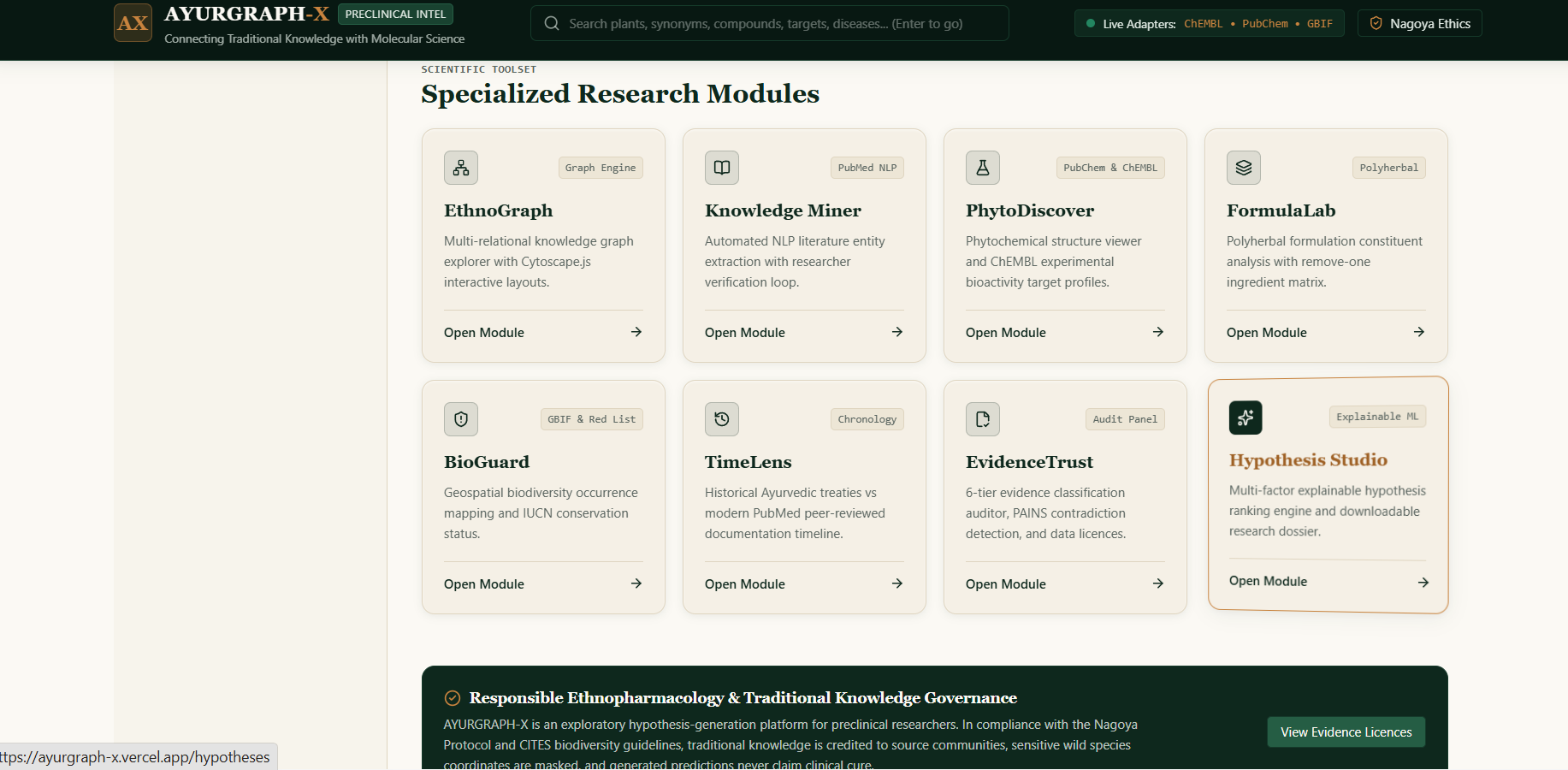
The platform includes eight specialized modules:
- EthnoGraph: Explores relationships between medicinal plants, traditional uses, phytochemicals, targets, and diseases through an interactive knowledge graph.
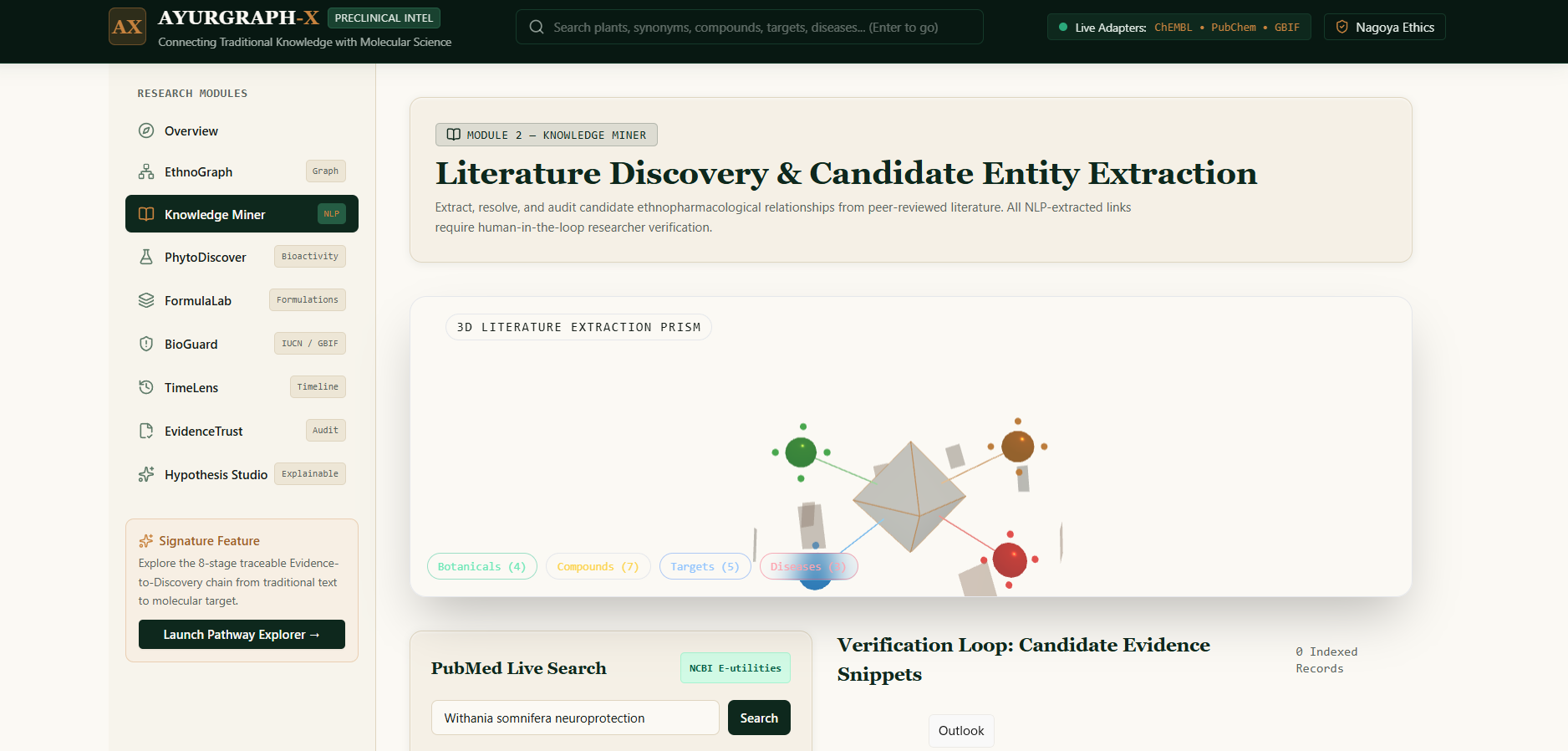
- Knowledge Miner: Discovers relevant scientific literature and identifies candidate relationships for human review.
- PhytoDiscover: Explores phytochemicals, molecular properties, chemical structures, and experimentally studied bioactivities.
- FormulaLab: Examines polyherbal formulations, their ingredients, and shared phytochemical classes.
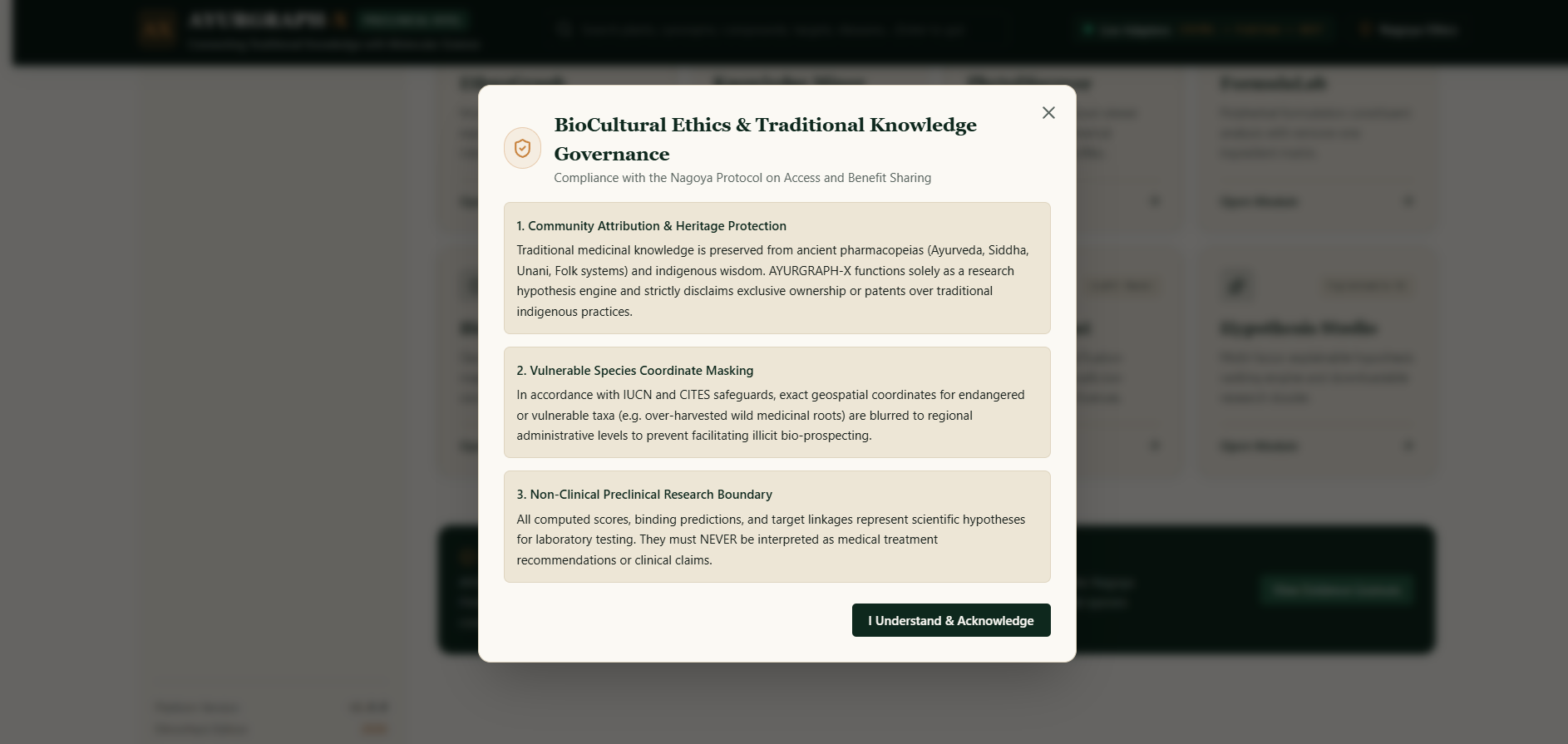
- BioGuard: Provides biodiversity and conservation intelligence while protecting sensitive species-location information.
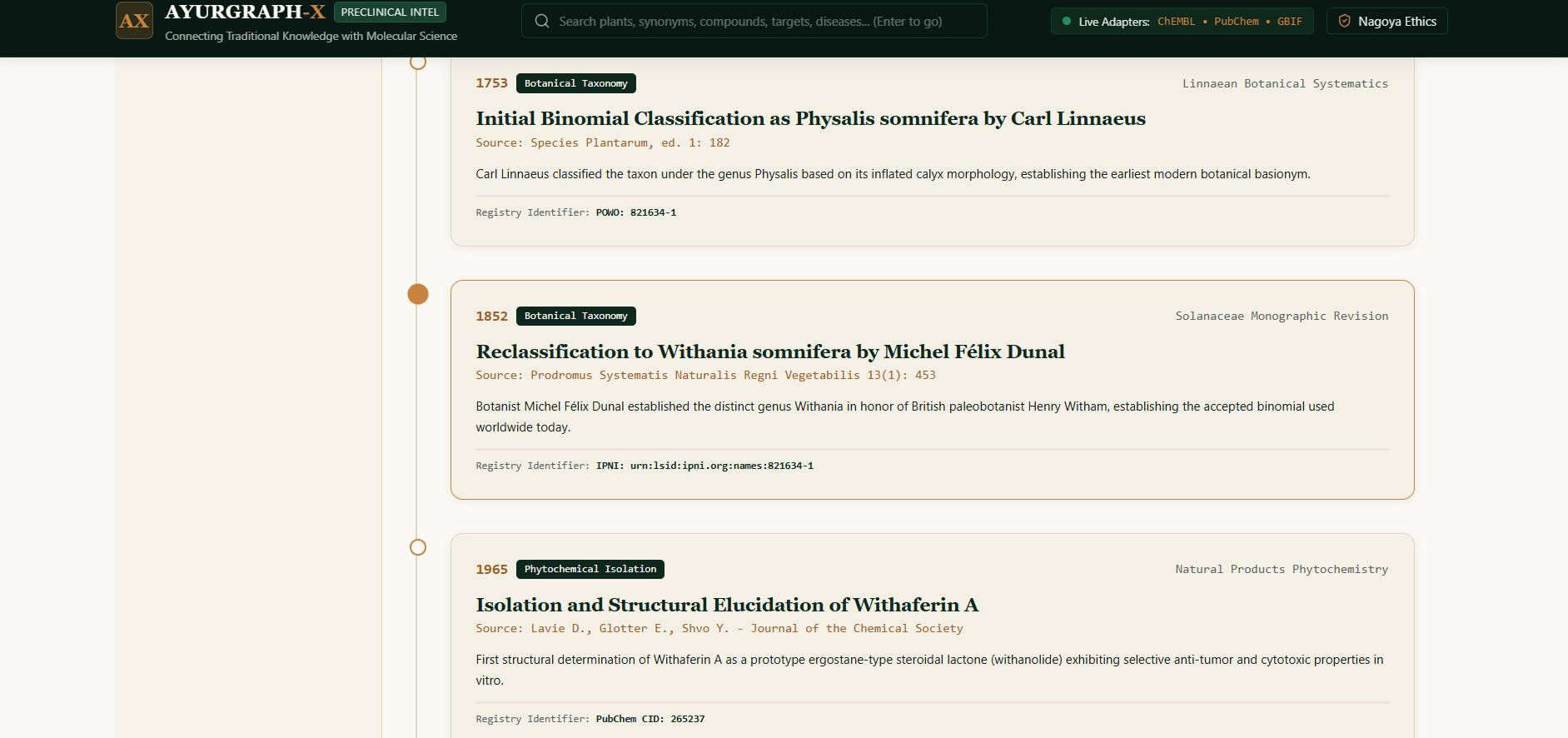
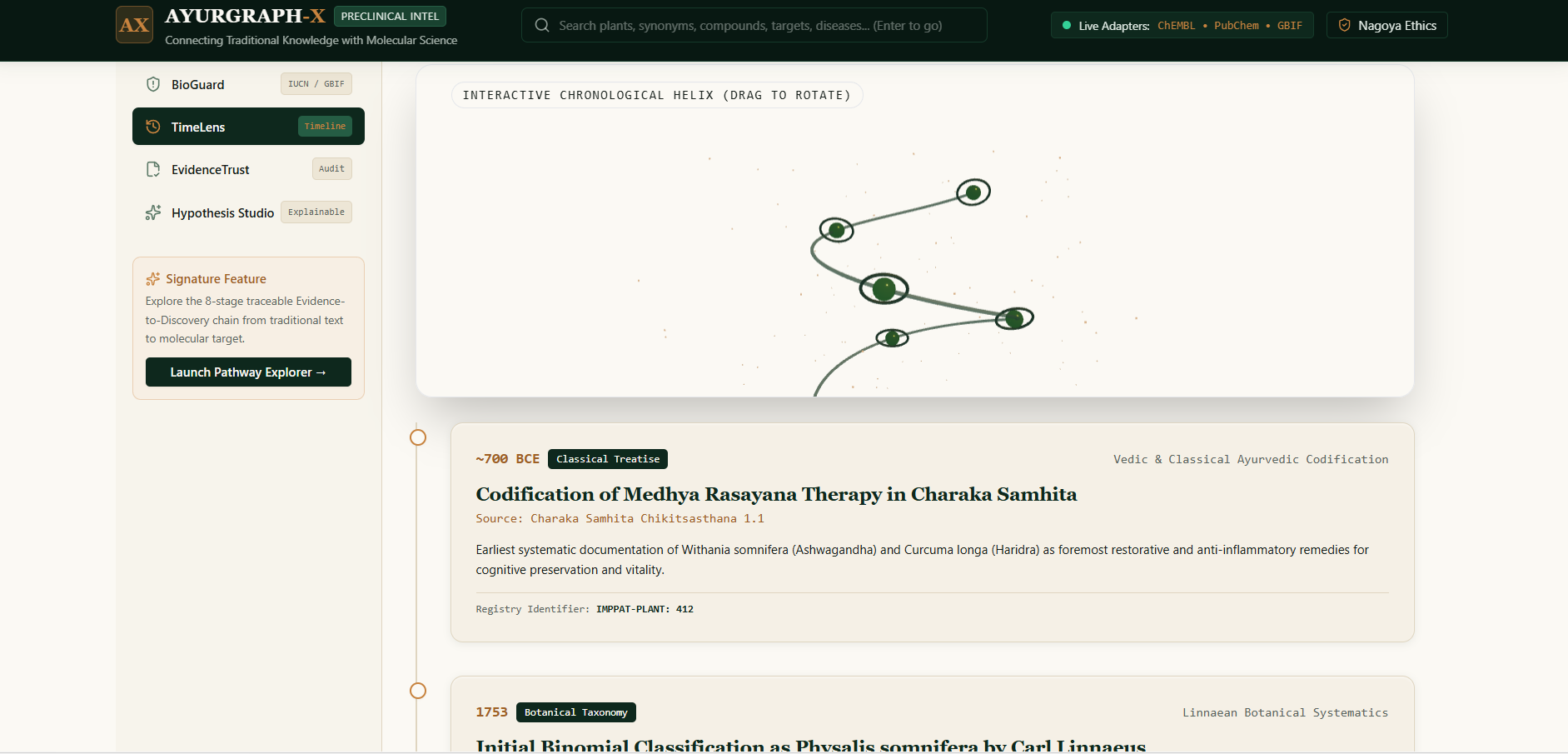
- TimeLens: Presents the historical development of traditional medicinal knowledge and related scientific discoveries.
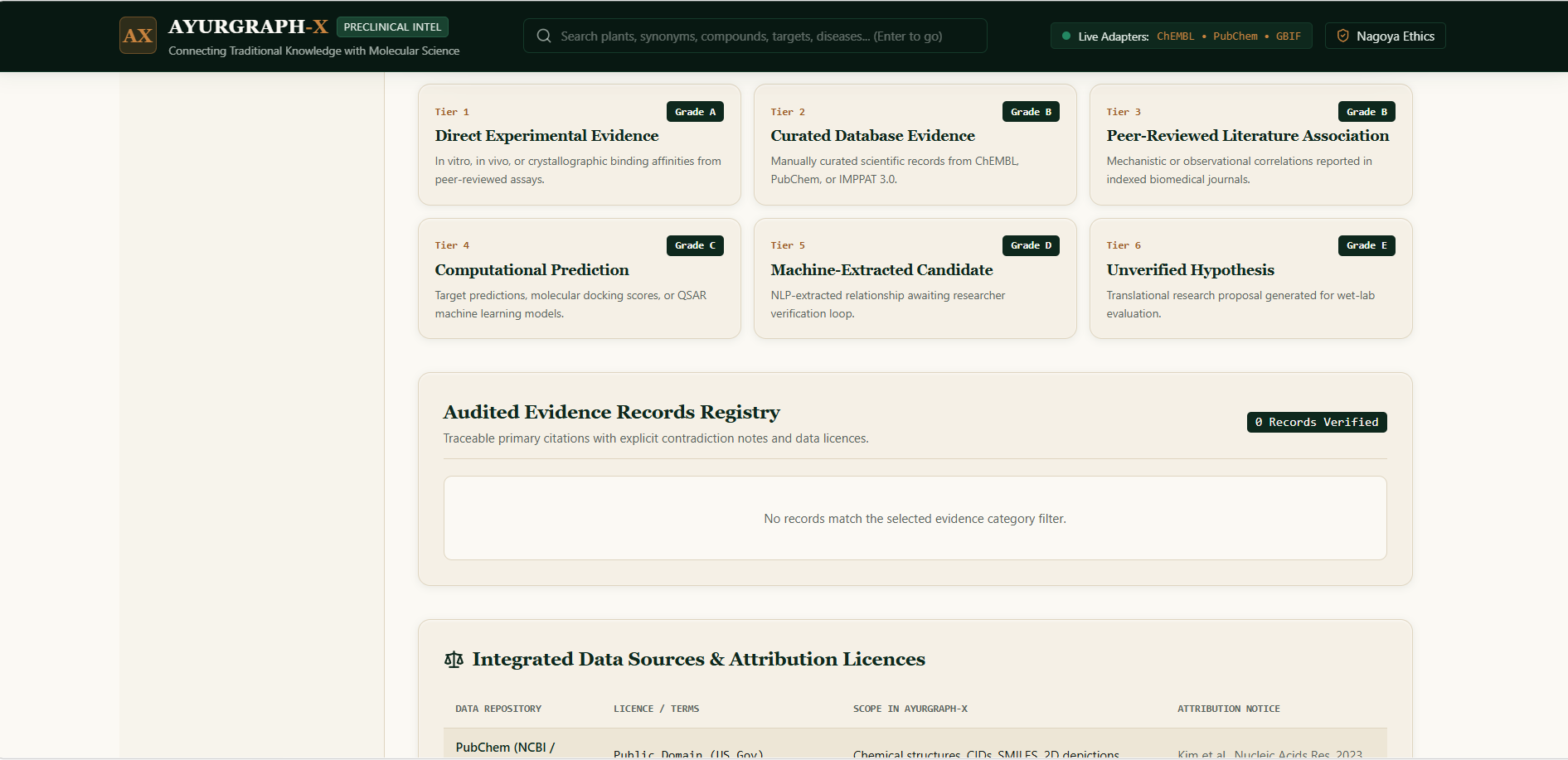
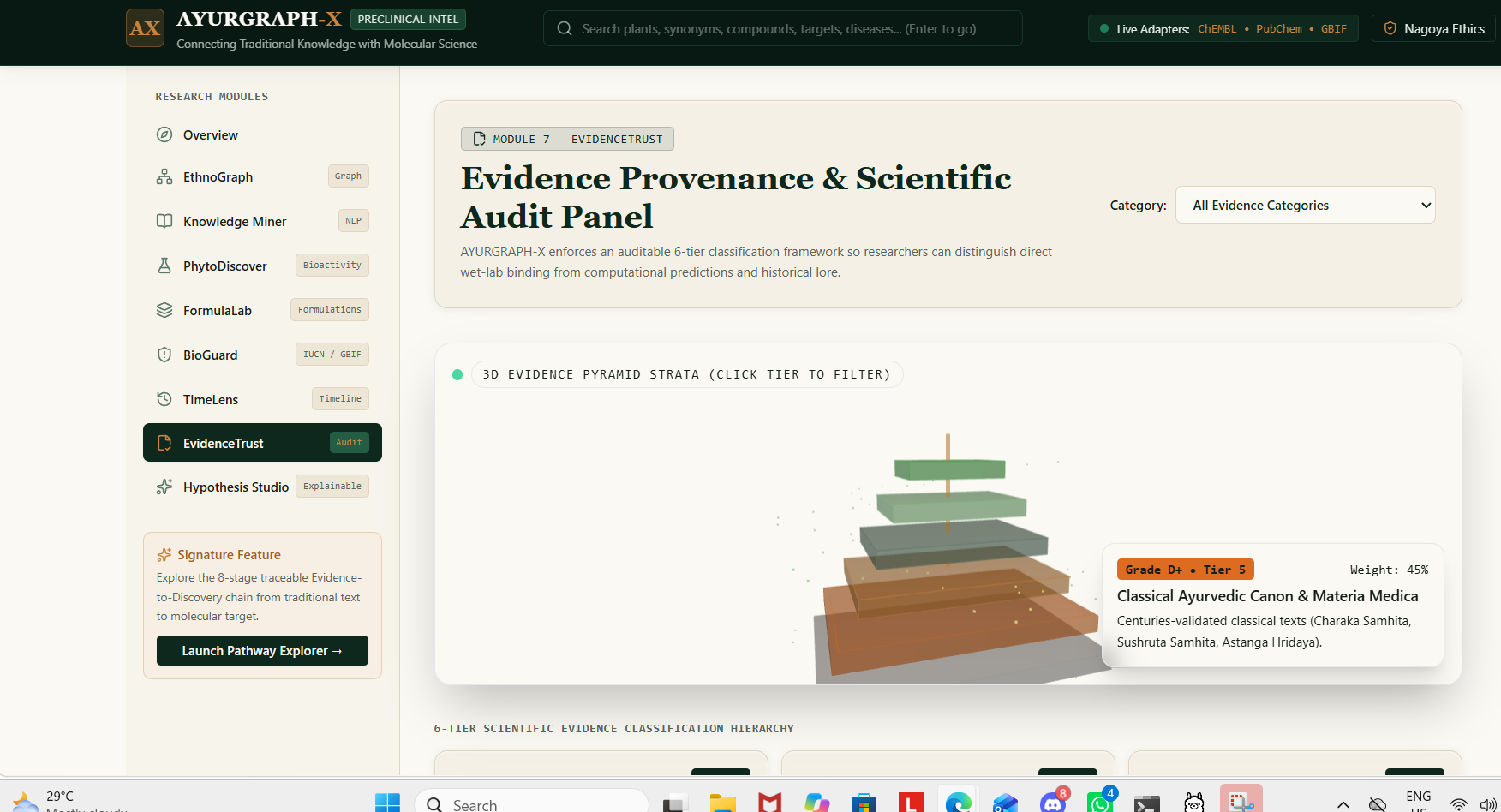
- EvidenceTrust: Displays evidence categories, source provenance, limitations, and licensing information.
- Hypothesis Studio: Generates explainable, research-oriented hypotheses with transparent ranking factors and downloadable research dossiers.
Rather than presenting traditional uses as proven medical treatments, AYURGRAPH-X distinguishes experimental findings, curated database records, published literature, computational predictions, and unverified hypotheses.
How we built it
We developed AYURGRAPH-X using a modular full-stack architecture.
Frontend:
- Next.js and React with TypeScript.
- Tailwind CSS for responsive interface design.
- Framer Motion for interactions and animations.
- Cytoscape.js for interactive knowledge graph visualization.
- Three.js for the custom CorollaGleam visual experience.
Backend:
- Python and FastAPI for API development.
- Pydantic for data validation.
- NetworkX for knowledge graph processing.
- HTTPX for external data retrieval.
- Pytest for automated backend testing.
We designed integrations around scientific resources such as PubChem, ChEMBL, PubMed, and GBIF to connect chemical, bioactivity, literature, and biodiversity information.
We also implemented evidence-aware processing, source attribution, missing-evidence detection, and explainable hypothesis ranking.
The platform was organized into independent research modules so that each part could be developed, tested, and improved without disrupting the complete application.
Challenges we ran into
One of our biggest challenges was connecting information from different scientific resources. Botanical names, synonyms, compound identifiers, and biological target descriptions are not always consistent across databases.
Another challenge was distinguishing strong experimental evidence from computational predictions and indirect associations. We did not want the platform to create misleading scientific relationships simply to produce a complete knowledge graph.
External APIs also introduced challenges involving response formats, network availability, rate limits, and incomplete records. We addressed these through validation, caching, fallback handling, and clear evidence-status distinctions.
We also had to balance an advanced research interface with usability. Presenting complex scientific relationships in a way that researchers can understand and navigate required careful interface design.
Finally, protecting traditional knowledge, respecting data licences, and avoiding misleading medical claims were essential considerations throughout development.
Accomplishments that we're proud of
We are proud to have developed a unified platform that brings traditional medicinal knowledge, phytochemical information, experimental bioactivity, literature discovery, and biodiversity intelligence into one research workflow.
Our biggest accomplishment is the Evidence-to-Discovery Pathway, which makes scientific relationships traceable instead of presenting disconnected information.
We are also proud of:
- Developing eight interconnected research modules.
- Creating an interactive botanical knowledge graph.
- Implementing evidence classification and provenance inspection.
- Building explainable hypothesis ranking.
- Supporting research dossier generation.
- Introducing conservation-aware biodiversity exploration.
- Developing a distinctive visual identity with the custom CorollaGleam component.
- Creating an architecture with automated backend tests and a production frontend build.
Our goal was not simply to build another medicinal plant database, but to create a platform that helps researchers ask better scientific questions.
What we learned
Through this project, we learned that integrating scientific data requires much more than collecting information from APIs. Entity matching, data quality, provenance, evidence classification, licensing, and uncertainty are equally important.
We gained practical experience with full-stack development, REST API integration, interactive graph visualization, scientific data processing, and automated testing.
Most importantly, we learned that technology should not overstate scientific certainty. A research hypothesis is not a clinical conclusion, and transparent limitations are just as important as successful discoveries.
What's next for AYURGRAPH-X: BioCultural Intelligence
We envision AYURGRAPH-X evolving into a broader research ecosystem for ethnopharmacology and natural-product discovery.
Our future plans include:
- Expanding verified traditional medicinal knowledge datasets with appropriate attribution and permissions.
- Improving botanical synonym resolution and compound identification.
- Integrating additional scientific databases and research publications.
- Strengthening literature extraction with researcher-in-the-loop validation.
- Improving evidence-quality assessment and contradiction detection.
- Expanding biodiversity monitoring and conservation intelligence.
- Enabling collaborative research workspaces and shared evidence dossiers.
- Evaluating hypothesis-ranking performance against expert-reviewed datasets.
Ultimately, we want AYURGRAPH-X to help researchers move from traditional knowledge to transparent, evidence-linked, and testable scientific research questions.
AYURGRAPH-X — Connecting Traditional Knowledge with Molecular Science.
