-
-
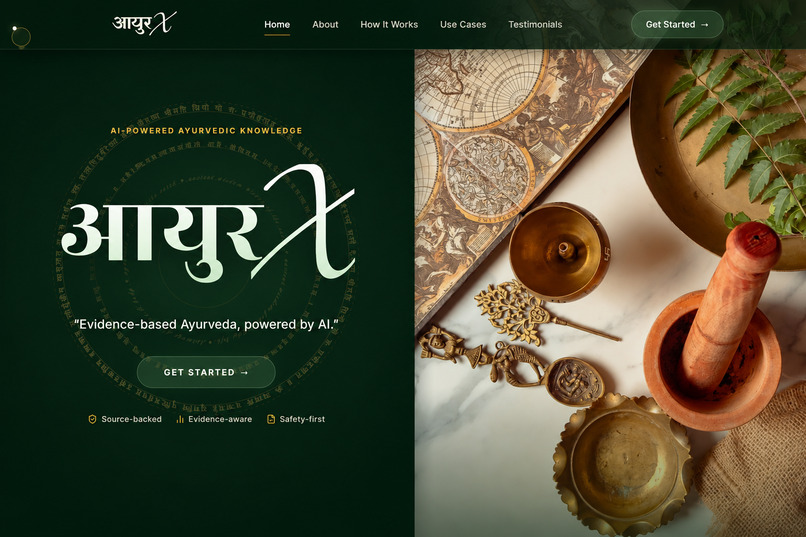
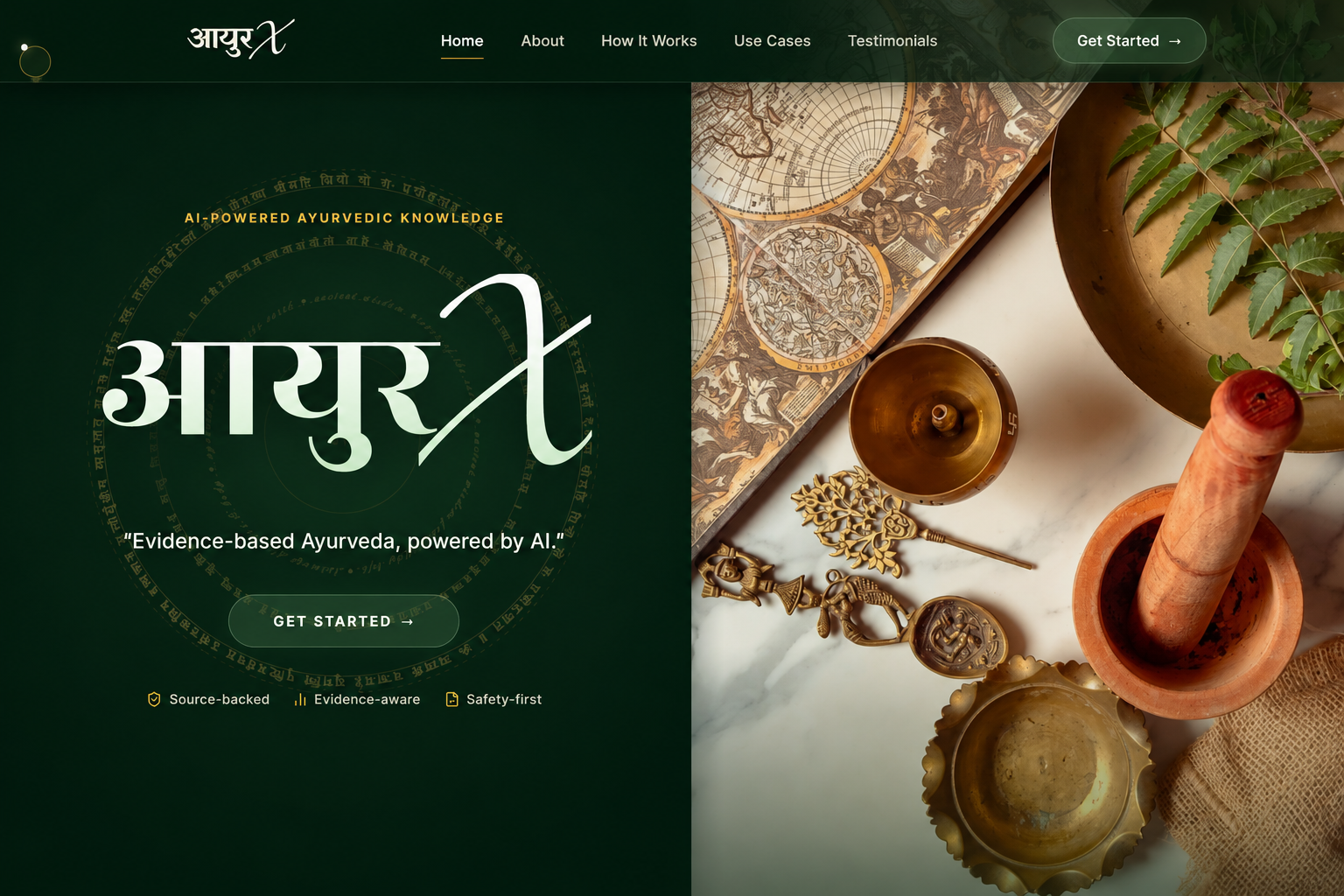
1. Home Page AyurX Ancient wisdom meets modern AI for evidence-based Ayurvedic knowledge and trusted insights.
-
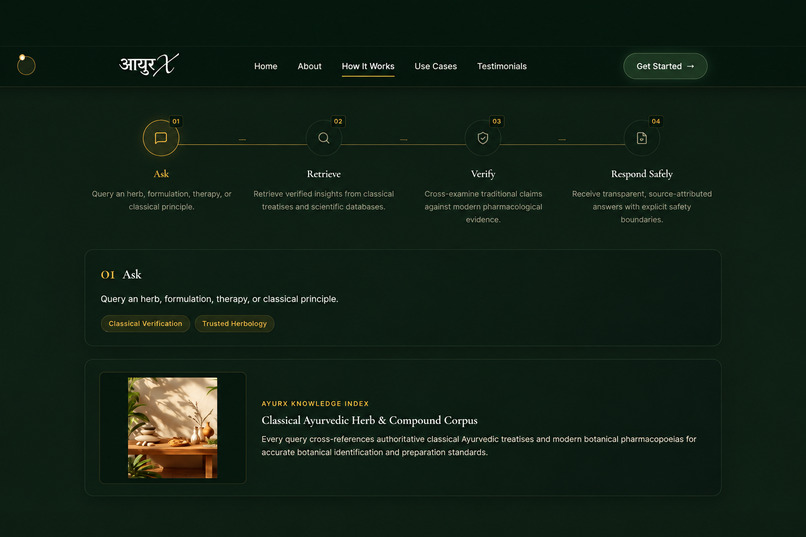
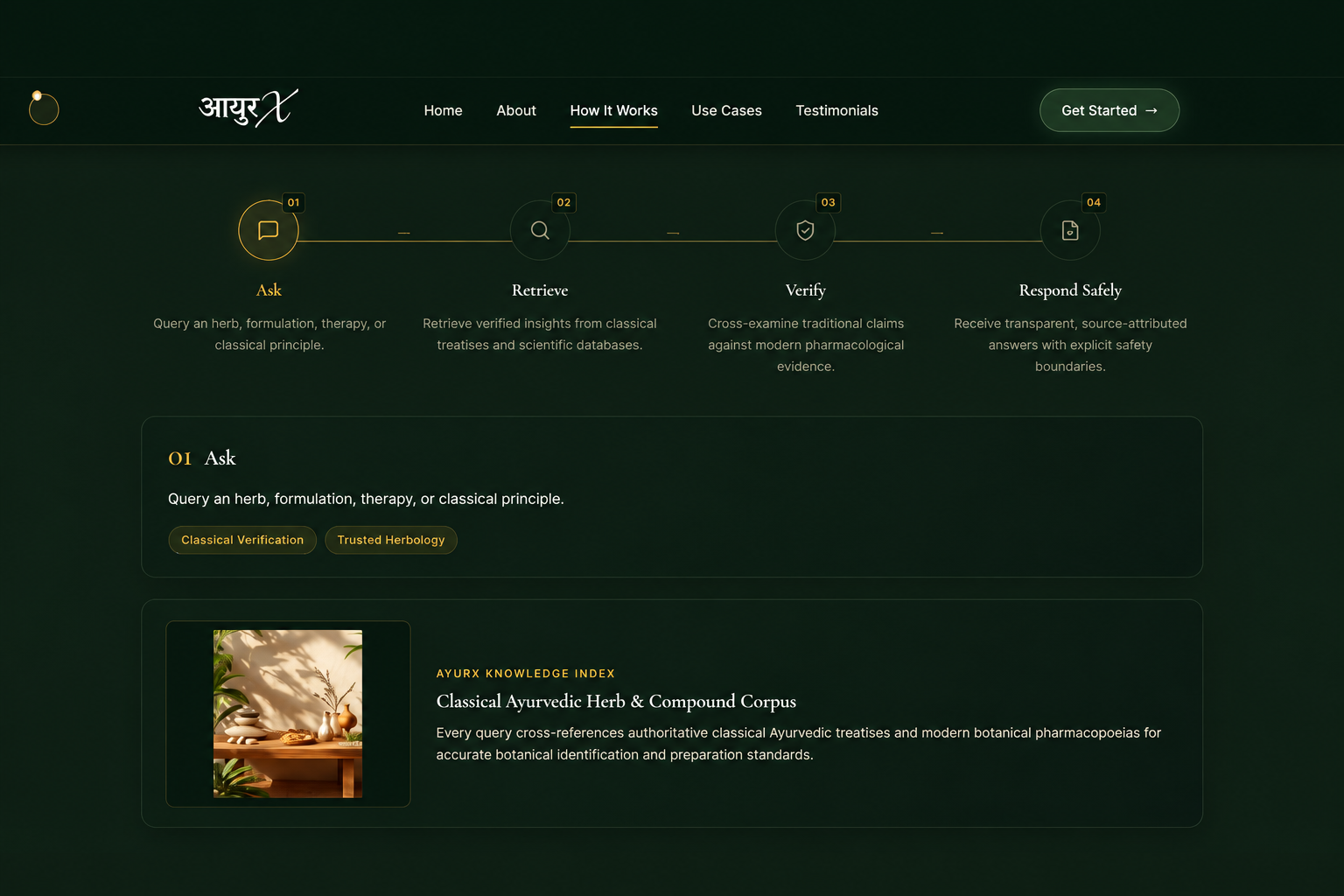
2. How It Works From query to clarity Discover how AyurX retrieves, verifies, and delivers source-backed Ayurvedic insights.
-
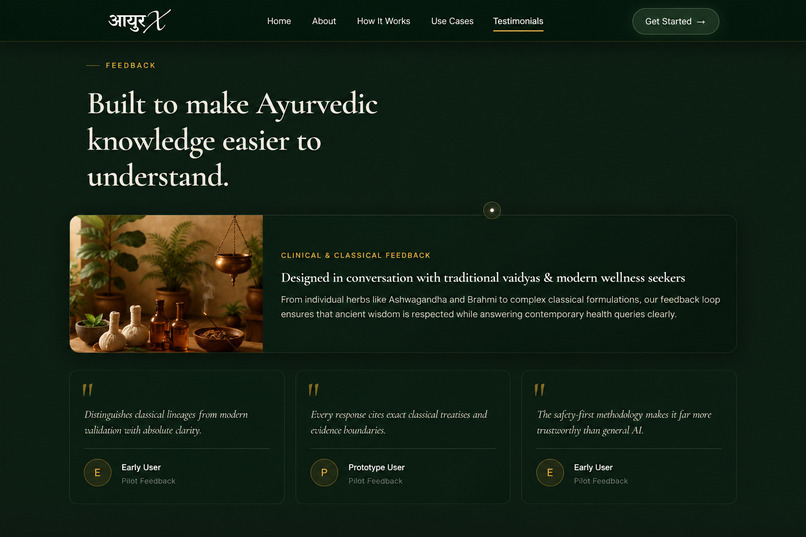
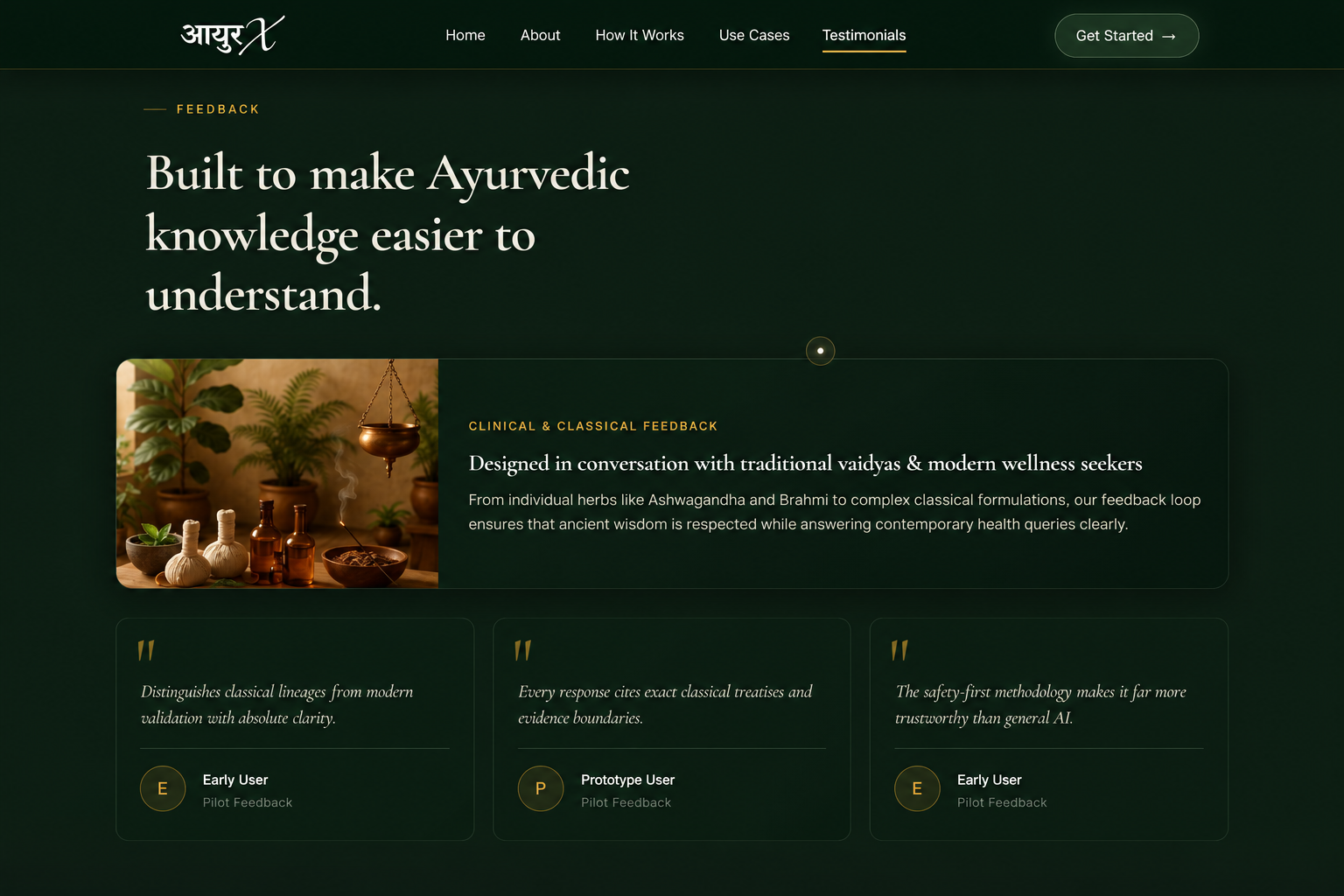
3. Testimonials Built on trust Combining classical Ayurvedic wisdom, modern validation, and safety-first AI.
-
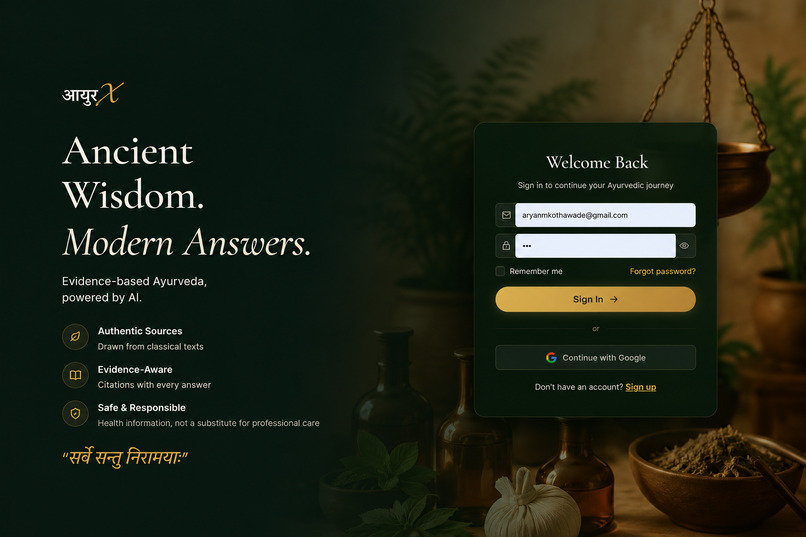
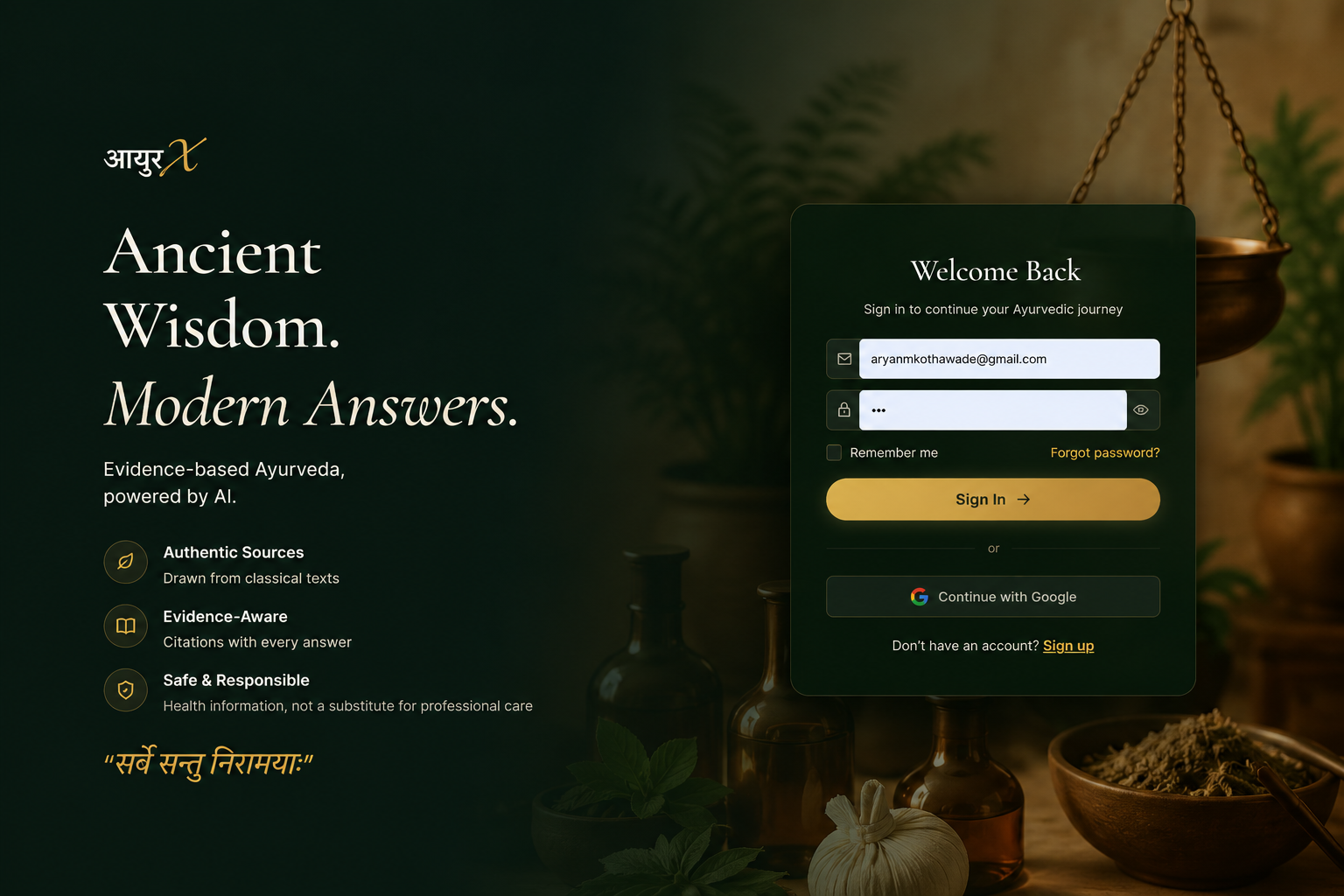
4. Login Page Your journey to Ayurvedic knowledge begins here Secure access to smarter, evidence-based wellness insights.
-
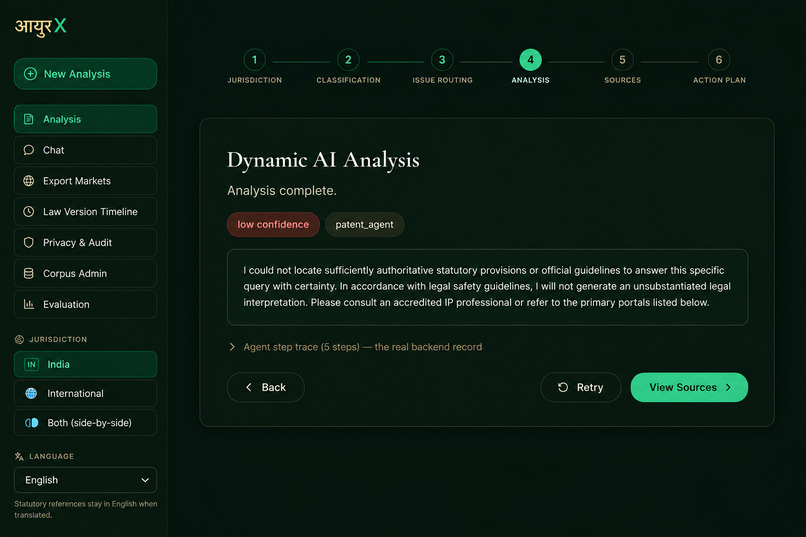
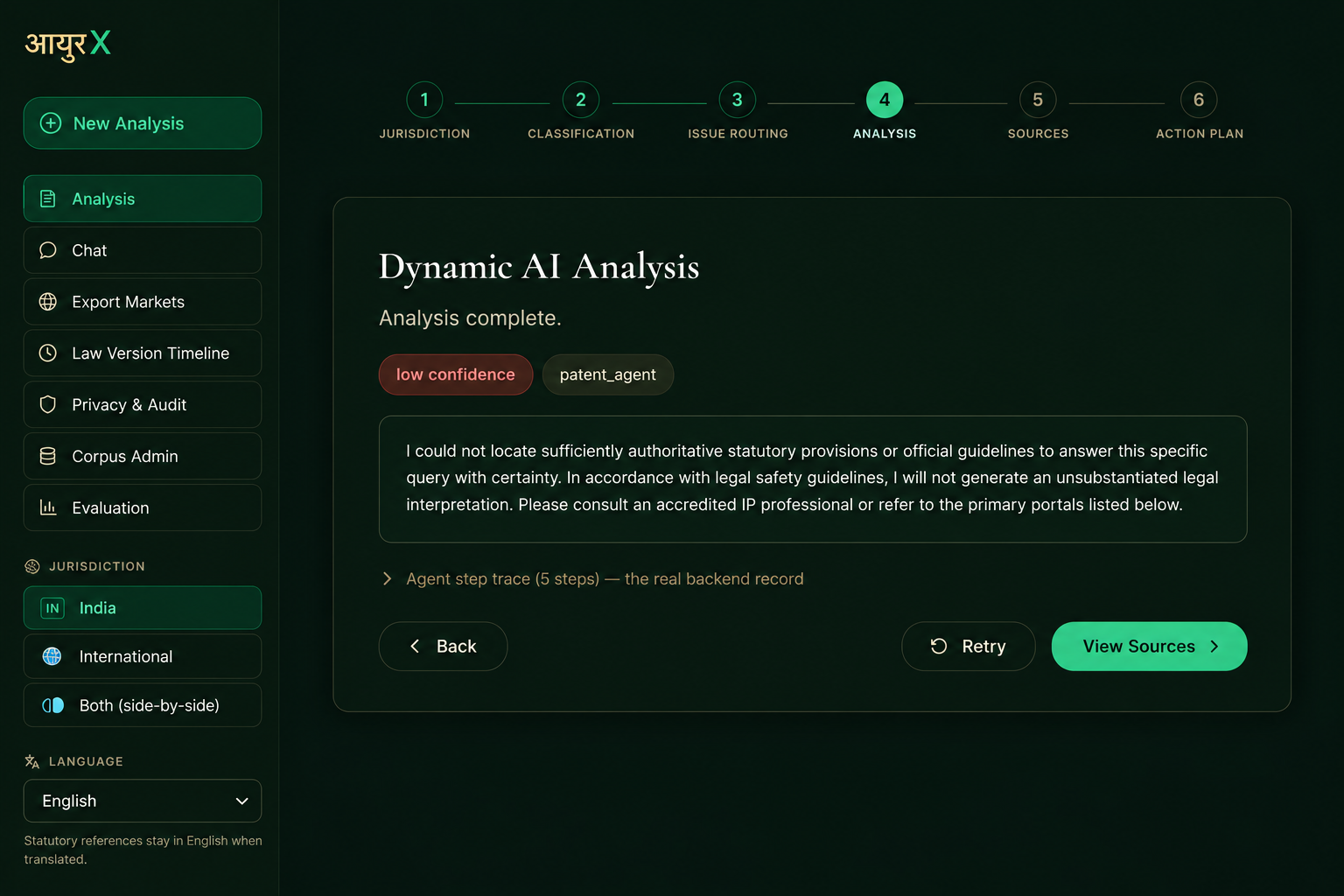
5. AI Analysis Dashboard Intelligent analysis, responsible AI Transparent evidence-backed insights without unsupported claims.
-
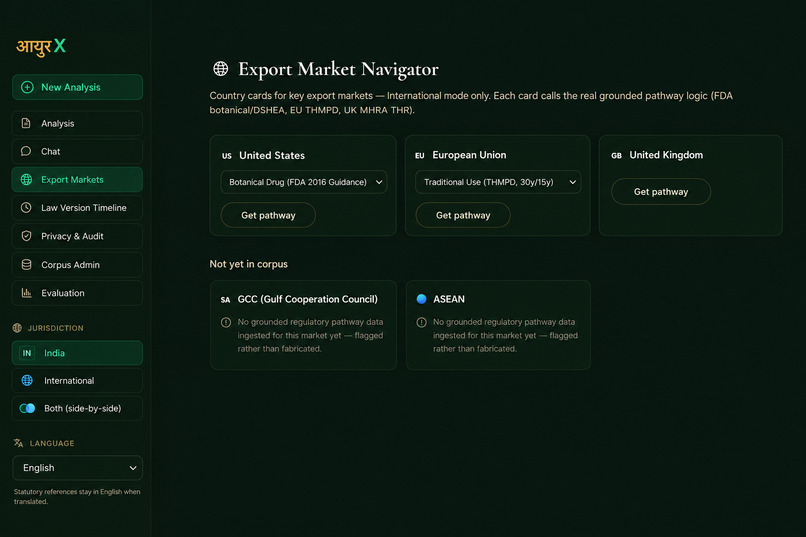
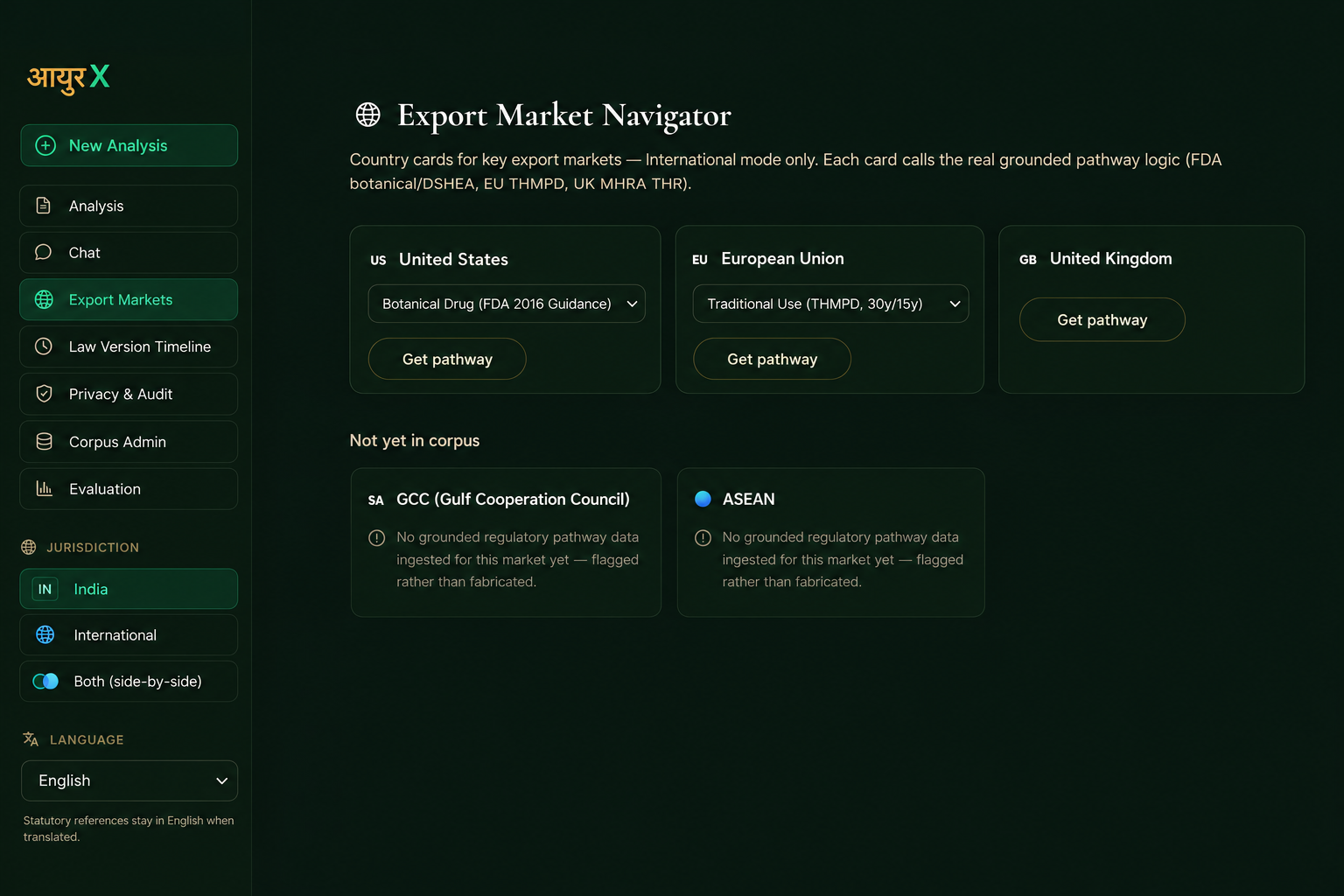
6. Export Market Navigator Taking Ayurveda global Explore regulatory pathways across the US, EU, and UK with transparent evidence coverage.
Inspiration
We kept coming back to one question:
Why should protecting an Ayurveda innovation feel harder than creating one?
Ayurveda has passed knowledge from generation to generation. But today, an innovator working on a new formulation can quickly run into patents, trademarks, GI, biodiversity, traditional knowledge, and regulatory requirements.
The information exists. What doesn't exist is a simple way to experience it.
Most of the resources we found felt like they were designed for someone who already understood the legal system. Long documents. Complicated terminology. Scattered information. Too many places to look.
We thought the problem wasn't just access to information.
It was the experience of accessing it.
That became the inspiration for Ayur-X: an interface that makes a complicated domain feel approachable, visual, and human.
What it does
Ayur-X is an AI-powered experience for navigating Ayurveda IP and regulatory information.
Instead of making users figure out which law or database to search first, we let them start naturally:
“Can this Ayurvedic formulation be patented?”
Ayur-X then helps connect that question to the relevant IP and regulatory areas and presents the information progressively.
The experience is built around a simple flow:
Ask → Understand → Explore → Verify → Act
We deliberately avoided making it look like a traditional legal portal or another generic chatbot.
Instead, we created a visual, conversational interface where complex relationships can be explored without overwhelming the user.
How we built it
We started with the interface, not the model.
Before building the backend, we mapped the user's journey and asked what an Ayurveda innovator would actually need at each step.
That led us to several core design decisions:
- Conversational entry point instead of a complicated search form
- Progressive disclosure instead of showing everything at once
- Visual cards and relationships for complex IP and regulatory concepts
- Clear hierarchy between answers, evidence, and next steps
- Contextual interactions that let users explore rather than simply read
- A visual language inspired by Ayurveda and nature, without making the product feel traditional or outdated
The goal was to make users feel like they had a guide, not a database.
Behind the interface, we built a RAG pipeline using LlamaIndex, Qdrant, NVIDIA embeddings, and an LLM to retrieve relevant information from our curated knowledge base.
The technical architecture can be complex.
The interface doesn't have to be.
Challenges we ran into
Making complexity disappear without hiding it
This was our biggest design challenge.
We had a huge amount of information we could show, but showing everything would make the experience unusable.
We kept asking:
“Does the user need this right now?”
That question helped us simplify screens, remove unnecessary content, and introduce information only when it became relevant.
Designing for trust
AI-generated answers can feel convincing even when users don't know where they came from.
For a domain involving IP and regulation, that isn't enough.
So we designed the experience around context and evidence, allowing users to understand and explore the basis of the guidance instead of treating the AI as an unquestionable authority.
Making Ayurveda feel modern
We didn't want to build something that looked like a traditional government portal, but we also didn't want to remove the identity of Ayurveda completely.
Finding that balance between heritage and modern digital design became one of our most enjoyable challenges.
Accomplishments that we're proud of
We're proud that we didn't treat UI/UX as a layer added on top of the technology.
The experience was the product.
We built a complete journey around a real user problem and turned a document-heavy, intimidating domain into something that can be explored visually and conversationally.
We're especially proud of:
- A purpose-built experience for Ayurveda innovation
- A guided journey through complex IP and regulatory concepts
- Progressive disclosure that reduces information overload
- Evidence-aware AI interactions
- A distinctive visual identity inspired by Ayurveda without feeling outdated
- A polished frontend connected to a real AI retrieval system
Most importantly, we made a product where the user doesn't need to understand the system before they can use it.
What we learned
We started thinking the hardest part would be the AI.
It wasn't.
The hardest part was deciding what not to show.
We learned that good UI/UX isn't about making a complicated system look impressive. It's about making the person using it feel less overwhelmed and more capable.
We also learned that information architecture can be a form of problem-solving in itself.
When information is organized well, users don't have to work as hard to understand it.
That changed the way we approached the entire project.
What's next for Ayur-X
We want Ayur-X to become more than an information assistant.
The next step is helping innovators move from “Can I protect this?” to “How do I protect this?”
We envision features such as prior-art exploration, patent landscape discovery, biodiversity guidance, personalized compliance journeys, multilingual interaction, and eventually assistance through the actual protection process.
Our vision is simple:
Make protecting Ayurveda innovation feel as intuitive as creating it.
Because the people carrying Ayurveda into the future shouldn't have to get lost in the complexity of protecting it.


Log in or sign up for Devpost to join the conversation.