-
-
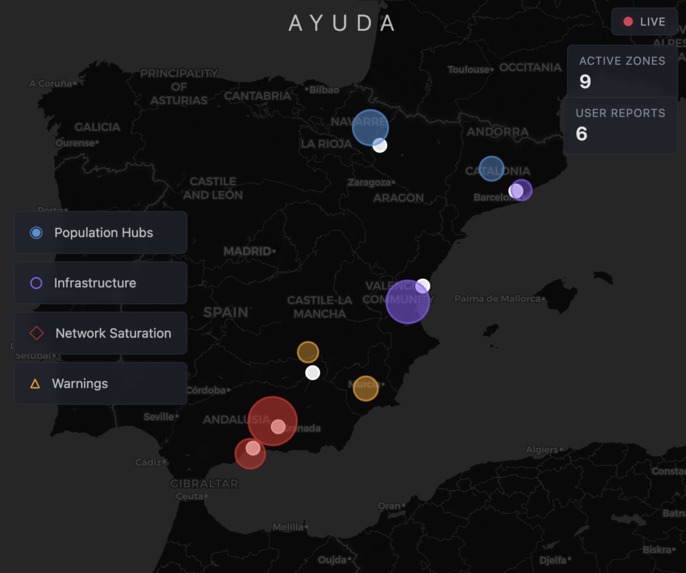
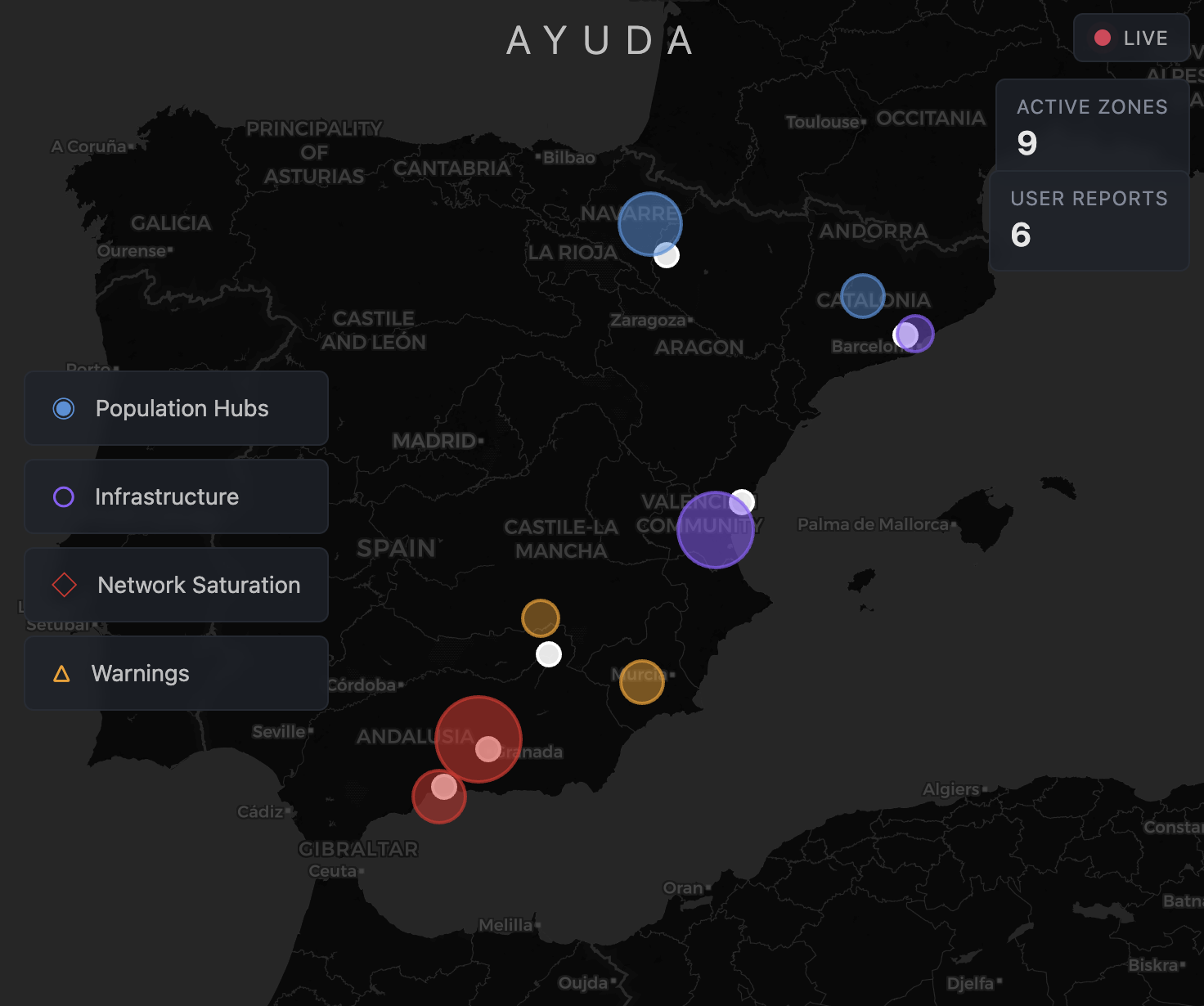
Dashboard Mock-Up
Inspiration
One of our co-founders is Spanish. When the DANA floods hit Valencia in October 2024, killing 223 people, it wasn't an abstract news story, it was family, friends, and neighbours underwater. The regional government sent mobile alerts 12 hours after the national weather agency raised the alarm. By then, water was already filling homes. Over half the victims were over 70.
What struck us wasn't just the government failure. It was what happened next: thousands of ordinary people self-organised on WhatsApp. Youth groups coordinated street clearance. Volunteers from across Spain drove down with supplies. They were the real first responders. But all of that local intelligence, who was trapped, which roads were passable, where water was rising, existed only in fragmented group chats. None of it reached the coordinators making resource allocation decisions.
Valencia wasn't unique. The same pattern repeats in London floods, Grenfell Tower, Hurricane Katrina, the Turkey earthquake. Communities hold the ground truth. Systems ignore it.
The concept: open democracy in crisis
We grounded AYUDA in Hélène Landemore's Open Democracy framework from Yale. Her argument is simple: democratic systems work better when they tap into the distributed intelligence of all citizens, not just elites. Regimes that exclude people "condemn themselves to blind spots."
Crisis management is the ultimate blind spot. The moment an emergency is declared, participatory governance gets suspended. Decisions go top-down. The people most affected, elderly residents, non-native speakers, people in areas off the official radar, become recipients, not participants.
AYUDA flips this. It treats every citizen with a phone as a sensor, a reporter, and a participant. WhatsApp is the entry point because it's already the default crisis communication tool for 2 billion people. No app to download. No account to create. No barrier.
What we built
A citizen sends a WhatsApp message , text, photo, GPS location, to the AYUDA bot. The bot is calm, short, and human (these people are in danger, we never send walls of text or robotic responses). It gently asks for location if missing, tags urgency and crisis type, and routes the report to a live geospatial coordinator dashboard.
The dashboard overlays citizen reports on top of official data sources, NASA FIRMS satellite fire detections, flood zone data, active weather alerts. This is where the magic happens: coordinators can see where citizen ground truth diverges from official data. A family reporting fire in Petaluma when the nearest satellite detection is 15km away. A flooded street that doesn't show on any evacuation map. Those gaps are invisible without community intelligence.
One-click triage. One-click export to CAP XML (the standard FEMA and EU crisis systems use), GeoJSON (for GIS tools), and CSV. AYUDA isn't a closed prototype, it's designed to plug into the systems governments already run.
What we learned
- Empathy is a design constraint. Writing a chatbot for someone in danger is fundamentally different from writing one for customer service. Every word matters. We cut our bot responses to under 160 characters and rewrote the tone five times.
- The gap between citizen knowledge and official data is enormous. When we overlaid our demo reports against real NASA fire data, the discrepancy reports, the ones that don't match official sources, were the most valuable. That's the whole point.
- Open democracy isn't just for peacetime. Landemore's five principles (participation, deliberation, representation, majoritarian rule, transparency) map naturally onto crisis management. We didn't have to force the framework, it fit.
Challenges
- Getting Twilio's WhatsApp sandbox reliably connected through ngrok during live development, the URL changes on every restart.
- Designing a state machine that handles the messy reality of crisis messages: people send photos without text, text without location, locations without context, rapid-fire updates, messages in multiple languages.
- Keeping scope tight. We wanted to build post-crisis deliberation tools, AI-powered report clustering, and SMS fallback. We cut all of it to ship a working prototype in under 3 hours.
- Balancing the demo between "looks impressive" and "actually works end-to-end." We chose working. You can send a WhatsApp message right now and watch it appear on the dashboard. ```
Built with:
Python, Flask, Twilio, Leaflet.js, HTML, CSS, NASA FIRMS API, ngrok, Railway

Log in or sign up for Devpost to join the conversation.