-
-
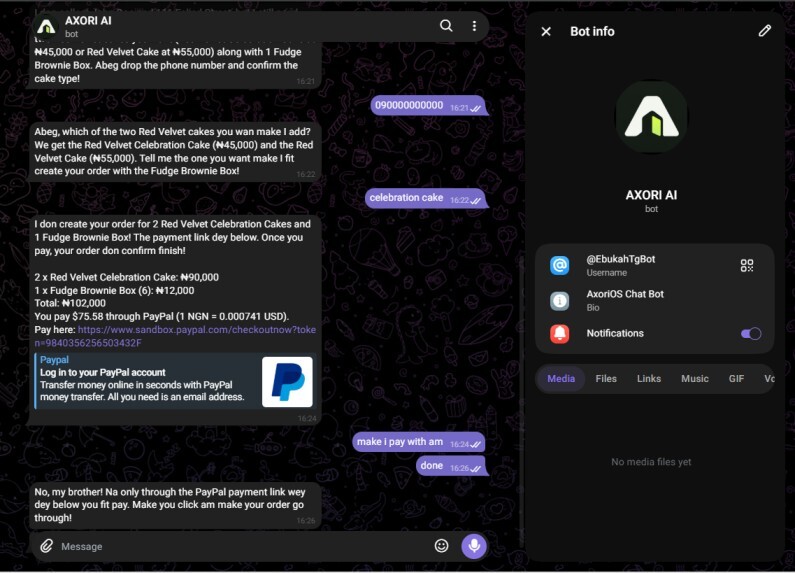
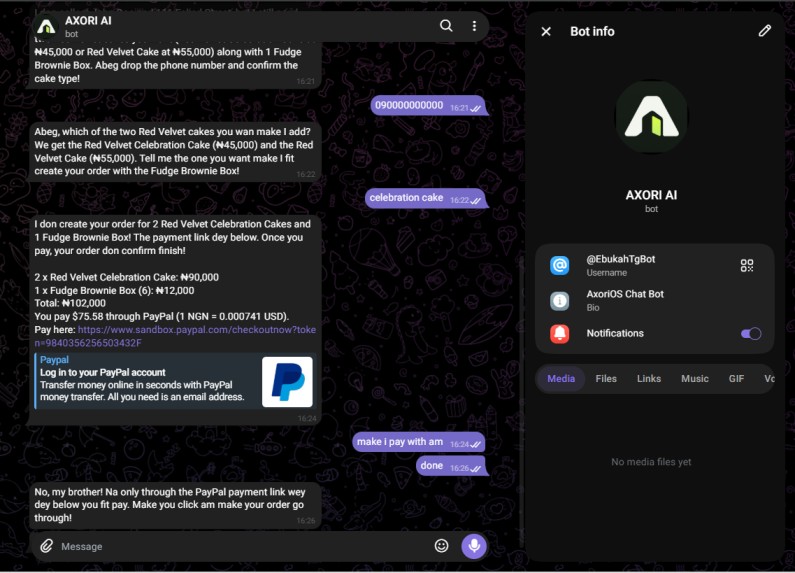
A screenshot of a customer chatting with the AxoriOS AI to complete a purchase
-
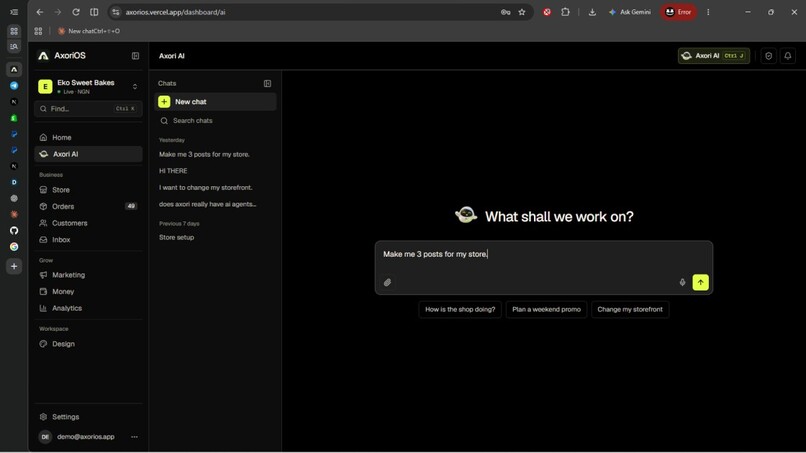
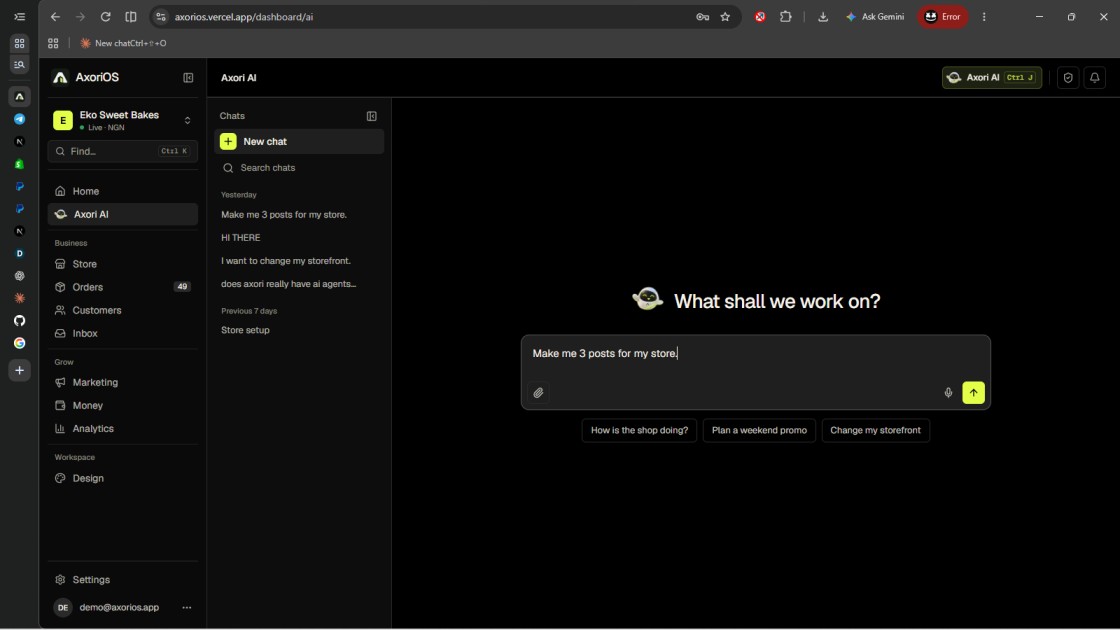
The Axori AI chat interface
-
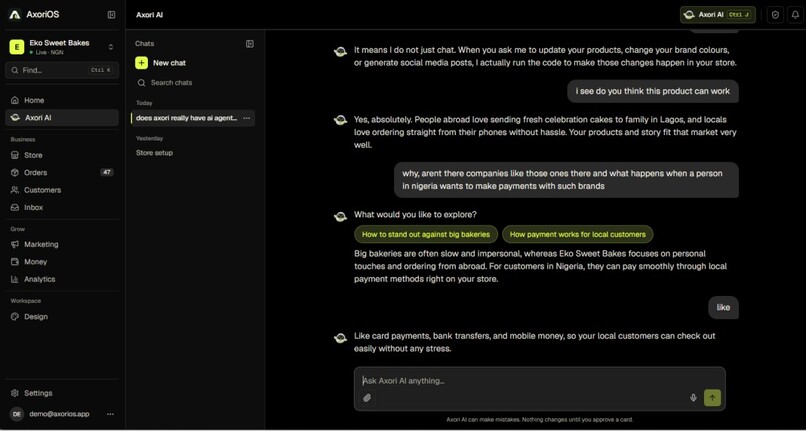
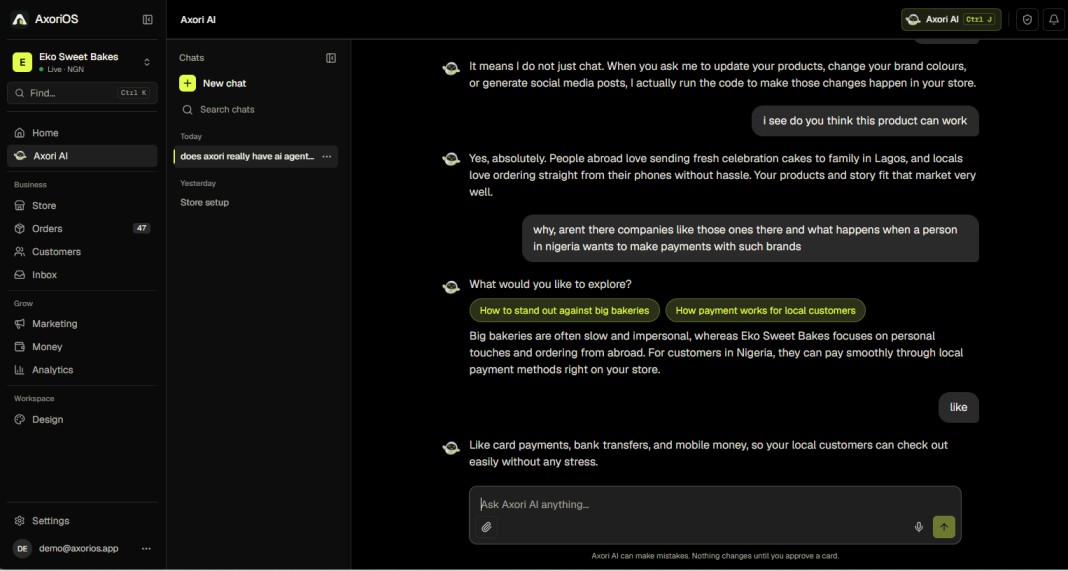
A screenshot of a seller having a conversion with AxoriOS, about the current state of his product
-
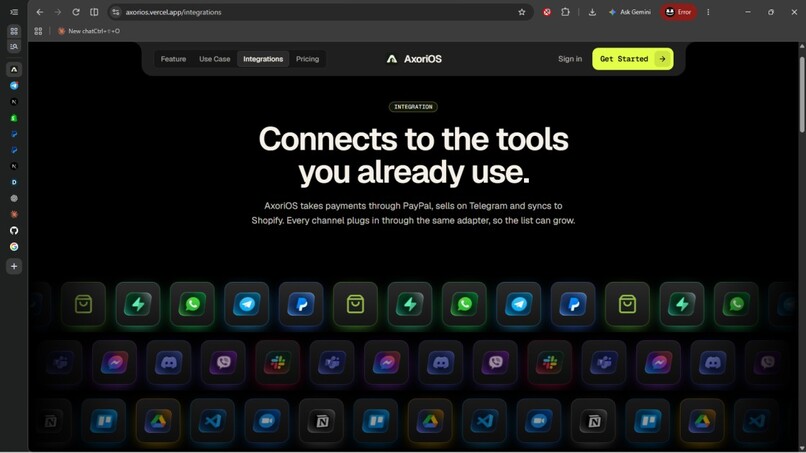
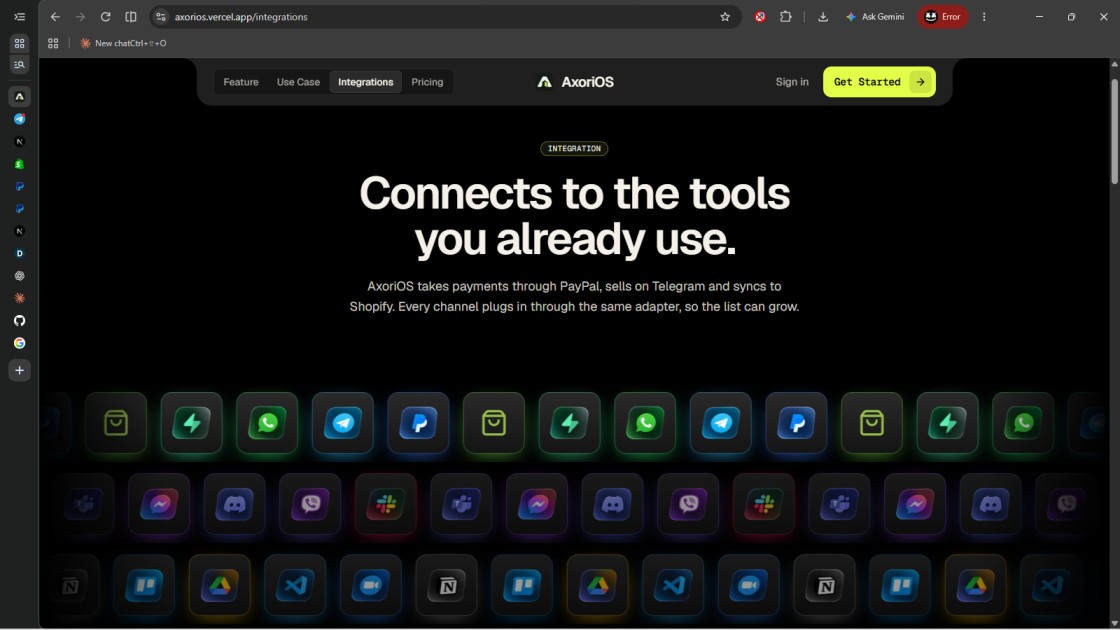
the integration page of the landing page
-
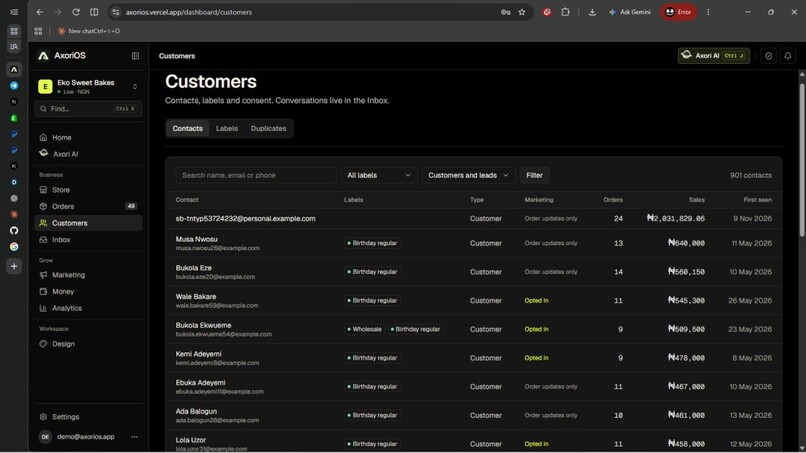
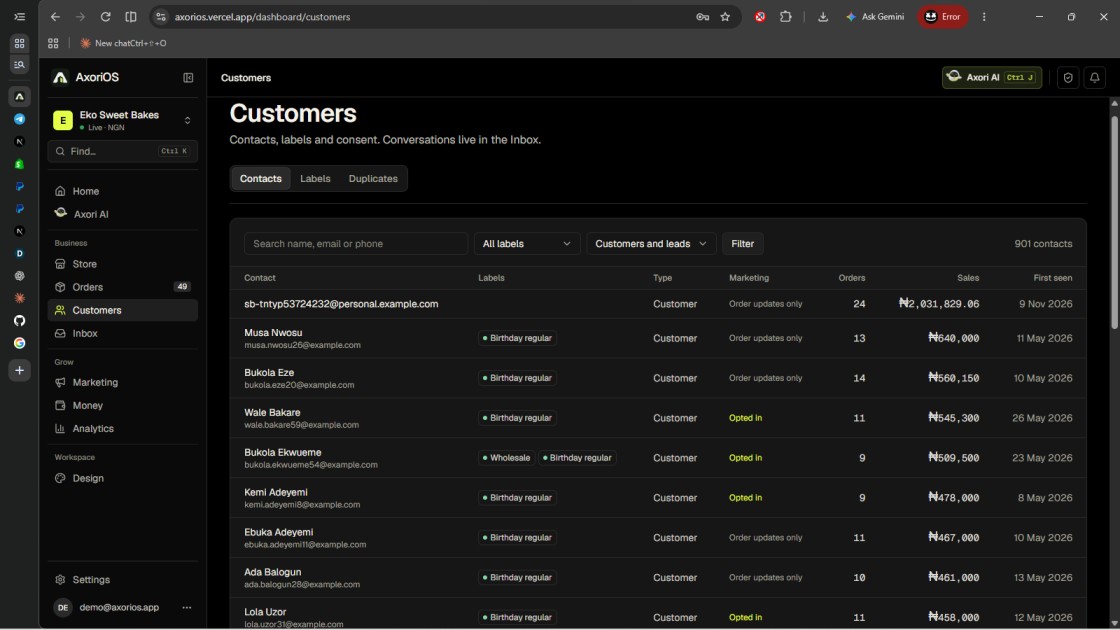
A screenshot of the customers tab in the AxoriOS dashboard
-
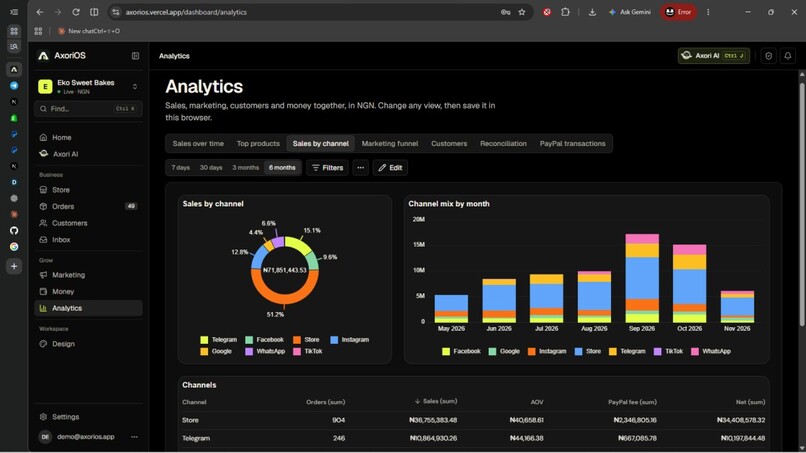
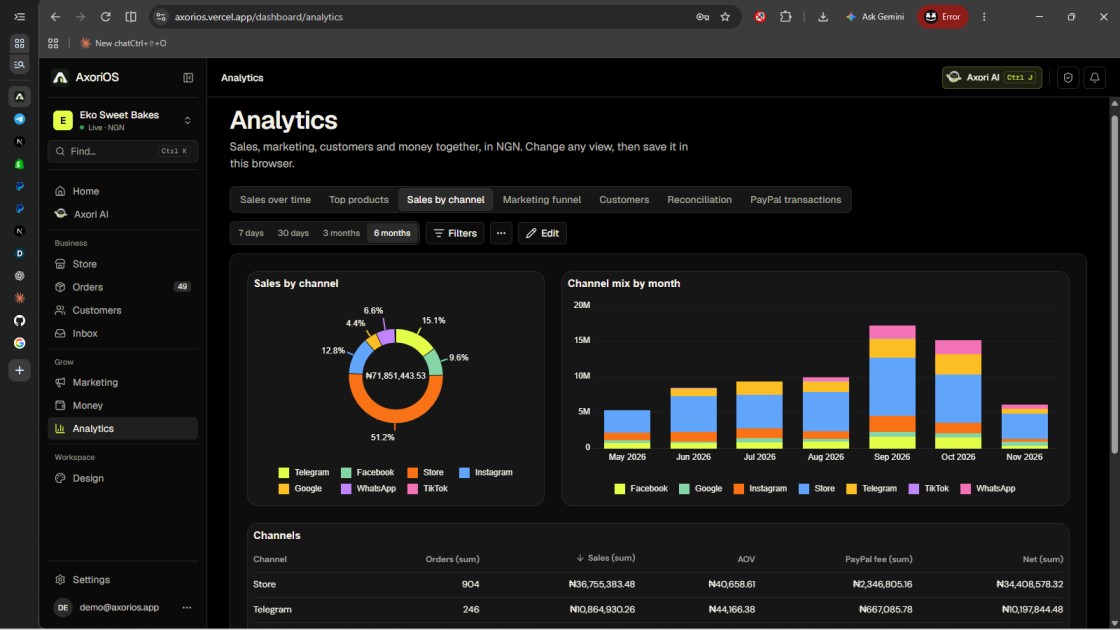
The Analytics Tab of the AxoriOS dashboard
-
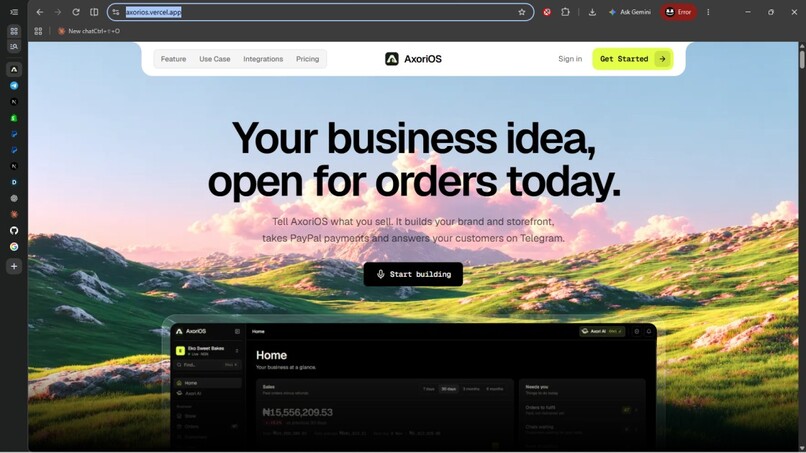
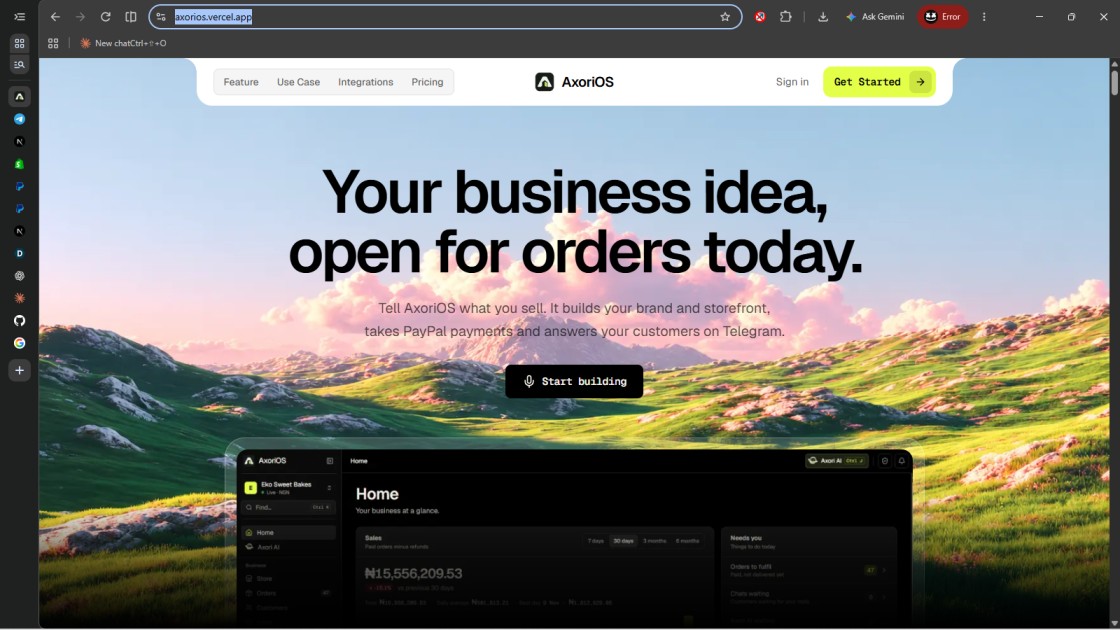
the landing page of AxoriOS
Inspiration
In Nigeria, I've noticed a growing gap between the excitement around AI and the people actually benefiting from it.
A friend of mine who's a baker , runs her whole business on WhatsApp: she posts a cake on her status, takes orders in DMs and chases bank transfers. When a relative abroad wants to order a birthday cake for family at home, there's no store, no checkout that accepts their card, and no record of the sale. The tools to fix that exist, but they assume you already know what a payment gateway, a storefront or a marketing calendar is.
The problem isn't that people like her don't want AI. Most simply lack the technical knowledge, time or resources to put it to work. Others have the business idea and plan set down but have no technical expertise to build it.
That gap inspired AxoriOS: describe your business idea, and an AI builds the brand, the store and the PayPal checkout, then keeps helping you sell and market it.
Because you shouldn't need to understand technology to benefit from it. You should only need an idea and the ambition to bring it to life.
What it does
AxoriOS takes a non-technical seller from idea to first paid order.
- Talk to Axori AI by voice or text. It builds a brand kit, a product catalogue and a designed storefront from your description, and shows a live preview you can edit by chatting.
- PayPal checkout from anywhere. A store priced in naira charges buyers in USD at a rate locked when the order is created; a store in a PayPal currency such as GBP charges directly. Buyers see both totals before paying.
- Chat selling. A Telegram bot answers customers, quotes from the real catalogue and sends PayPal payment links. The seller can take over any conversation from the Inbox.
- Marketing. Axori AI drafts on-brand posts, with images generated by FLUX on Cloudflare Workers AI, and publishes them to a Telegram channel after the seller approves.
- Shopify sync pushes the catalogue, a collection and pages to a Shopify store, with no duplicates on re-sync.
- Approval first. Anything that publishes, sends to customers or moves money is shown as a preview card and runs only when the seller taps Approve.
- An AG Studio analytics workspace over six months of seeded demo history plus real sandbox orders: sales, channels, marketing conversion, and a cross-currency reconciliation grid against PayPal captures.
- A Money tab with PayPal fees, VAT, refunds through PayPal Payments v2, and withdrawals to Paga tracked with the FX gain or loss against the rate buyers were quoted.
How ibuilt it
- Next.js (App Router) + TypeScript on Vercel, styled with Tailwind and
motion. - Supabase for Postgres, auth, storage and row-level security on every table. Every query is scoped to the seller's
store_idfrom the session, never from model output. - Vercel AI SDK + Gemini (Flash-tier, with text and audio input) for the agent, with Groq as a second provider behind an env flag. At most 8 tool steps per turn, streaming, and a daily per-store cap. Tool inputs are validated with Zod.
- PayPal Orders v2 for checkout. Capture happens on the return page and on the
CHECKOUT.ORDER.APPROVEDwebhook, and is idempotent per order. Refunds use Payments v2 with a request ID, so a retry can't refund twice. - Inngest runs every slow or scheduled job: webhook processing, image generation, publishing, Shopify sync. Webhooks verify their signature, store the event, return 200 and hand off. The LLM is never called inside a webhook request.
- Vendors sit behind adapters (
PaymentProvider,Channel,Publisher,ImageProvider,CommercePlatform,AppConnection) chosen by env flags, so adding Meta later is one file and one flag. - Storefronts are rendered from a
SiteConfigJSON document. The agent edits that document, never page code, and every edit is a versioned draft with a signed 24-hour preview link.
Money is stored in integer minor units, and the model never supplies a price. For a naira store, the USD charge is computed on the server from the locked rate:
$$ \text{charge}{\text{USD}} = \operatorname{round}!\left(\frac{\text{total}{\text{NGN}}}{r_{\text{NGN/USD}}}\right) $$
and VAT on tax-inclusive prices is
$$ \text{VAT} = \text{total} \times \frac{t}{1 + t}, \qquad t = 0.075 $$
Challenges i ran into
- Naira isn't a PayPal currency. We designed a quote step that converts to a settlement currency at a stored rate, shows both totals to the buyer, and keeps the rate and source on the order for reconciliation.
- Payment confirmation races. The return page and the webhook can both try to capture; making capture idempotent per order solved double processing.
- Channel access. Our Meta developer account was blocked at phone verification, and Twilio's WhatsApp sandbox became paywalled. Every channel sits behind an adapter, so i shipped Telegram first. A Kapso WhatsApp adapter is built and waiting on an end-to-end phone test.
- Image generation limits. Without billing, Gemini's image model returned 429s. I added a Cloudflare FLUX adapter that paints the background while code draws the words and price, with a
next/ogtemplate as the fallback. The model never draws a price. - Serverless time limits. Slow model calls ran into Vercel's 60-second limit, so heavy work moved into Inngest jobs and responses stream.
- Shopify theme writes need special access, so the agent links the seller to the theme editor instead of writing theme files.
Accomplishments that we're proud of
- A real cross-border flow in the PayPal sandbox: a naira-priced cake bought in USD and captured end to end.
- 22 real sandbox payments and 3 refunds (full and partial) that reconcile against PayPal, with no double captures or double refunds on replay.
- A chat that ends in a paid order, with the seller able to take over at any moment.
- A safety model where the AI can propose anything but can only do things the seller approves.
What i learned
- Agents are most useful when the dangerous parts are deterministic: prices, totals, store scoping and payments live in code, and the model only chooses which tool to call.
- Designing every vendor behind an interface paid off immediately, because three of our planned vendors changed during the build.
- For non-technical users, a preview the seller approves builds more trust than a feature list.
What's next for AxoriOS
- Meta (Instagram, Facebook, WhatsApp Cloud API), TikTok and Google Business Profile adapters
- Buyers paying in their own currency, and direct Paga payouts in place of the manual withdrawal flow
- Weekly insights that turn the numbers into suggested actions
- More commerce platforms beyond Shopify
Built With
- ag-grid
- ag-studio
- cloudflare-workers-ai
- flux.1-schnell
- github
- google-gemini
- groq
- inngest
- next.js
- paypal
- paypal-payments-v2
- paypal-rest-api
- paypal-sdk
- postgresql
- react-19
- shopify-admin-graphql-api
- supabase
- supabase-auth
- supabase-realtime
- tailwind-css-v4
- telegram-bot-api
- typescript
- vercel-ai-sdk
- zapier-mcp
- zod

