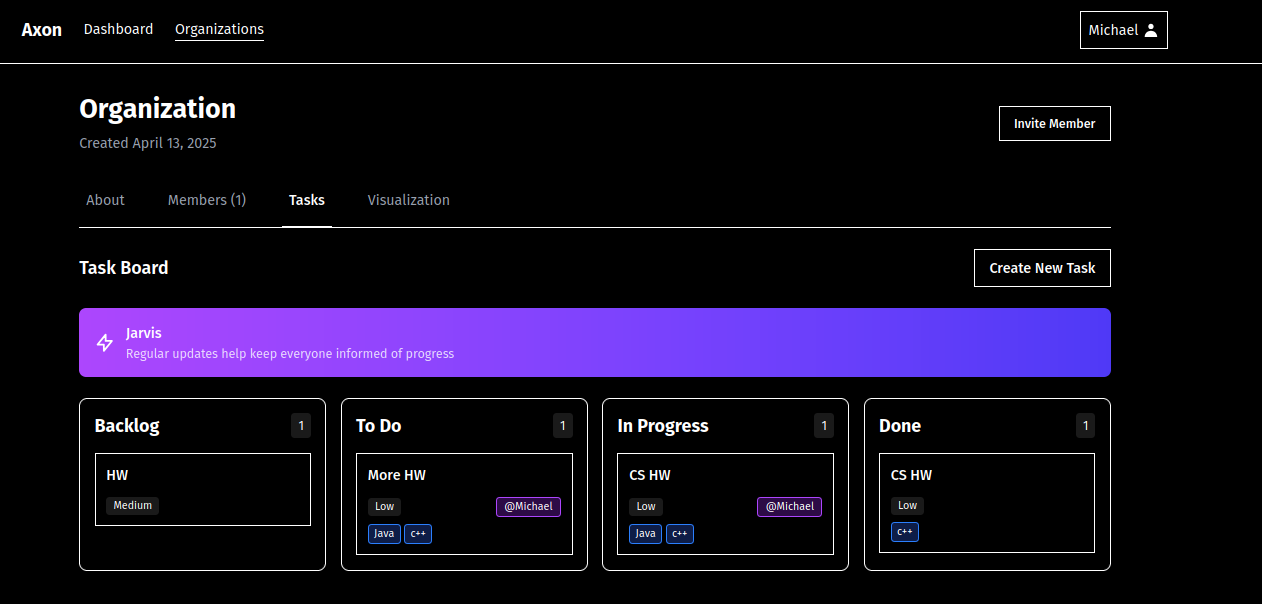
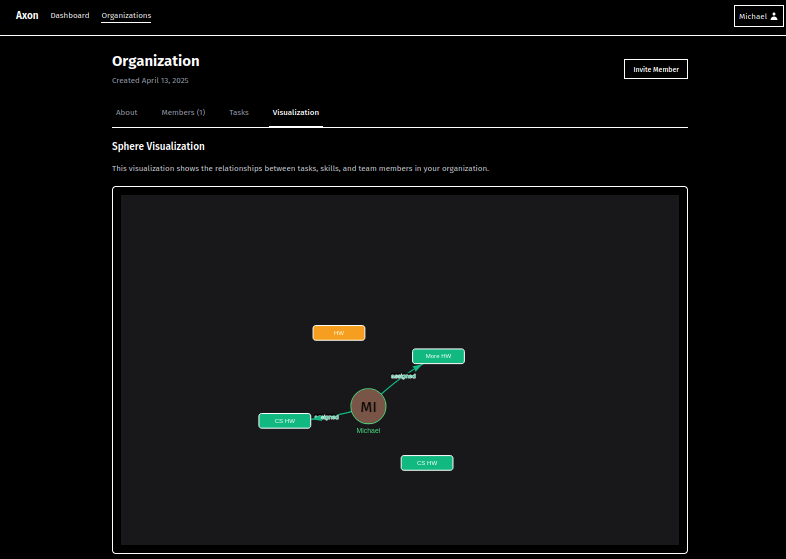
Design Brief Project Title: Axon: AI-Powered Task & Connection Hub The Prompt: Build something that connects people, strengthens crews, or makes collaboration better. Vision: To create a dynamic and intelligent platform that seamlessly integrates task management with proactive human connection, transforming how teams collaborate and discover shared interests. Problem: Teams often operate in silos, struggling with efficient task assignment and unaware of valuable skills or shared interests among colleagues outside their immediate circle. Traditional Kanban boards manage tasks but don't foster deeper connections. Finding the right person for a task or a potential collaborator/friend can be inefficient and rely on chance. Solution: Axon combines a natural language-powered AI Kanban system with an interactive visualization layer. Users input tasks conversationally. The AI parses tasks, identifies required skills, suggests suitable collaborators based on skills and analyzes user profiles/public interactions (opt-in) to uncover latent shared interests. The platform offers both a familiar Kanban view for workflow management and a "Sphere" view – a dynamic graph visualizing tasks, people, skills, and their interconnections, including shared interest links. It proactively suggests task pairings and serendipitous connections. Target Audience: Software development teams, creative agencies, research groups, distributed companies, online communities – any group needing better collaboration and stronger internal networks. Key Features & Requirements: ○ Natural Language Task Input (Text/Voice). ○ AI-Powered Task Parsing & Skill Tagging. ○ Standard Kanban Board View (Columns, Cards, Drag & Drop). ○ Interactive "Sphere" Visualization View (Nodes: People, Tasks, Skills, Interests; Edges: Relationships). ○ User Profiles (Skills, Declared Interests, Collaboration Preferences). ○ AI Skill Matching & Collaborator Suggestions (within Kanban). ○ AI Interest Matching Engine (analyzing profiles/public messages - opt-in, privacy-focused). ○ Visual Highlighting of Shared Interests on Profiles & Suggestions. ○ Proactive Connection Suggestions (Notifications/Feed based on shared interests, potentially triggered by task context). ○ Filtering/Search capabilities in both views. Success Metrics: ○ Time saved in task assignment/finding collaborators. ○ Increase in cross-team collaborations initiated through the platform. ○ Number of successful "serendipitous connections" reported by users. ○ User engagement (daily active users, features used).
Task throughput velocity.
Constraints: Hackathon timeframe (focus on core MVP), available APIs, team skills.
Ethical Considerations: User privacy (explicit opt-in for interest analysis), data security,
potential biases in AI matching (skill/interest recognition), transparency in how
suggestions are made.
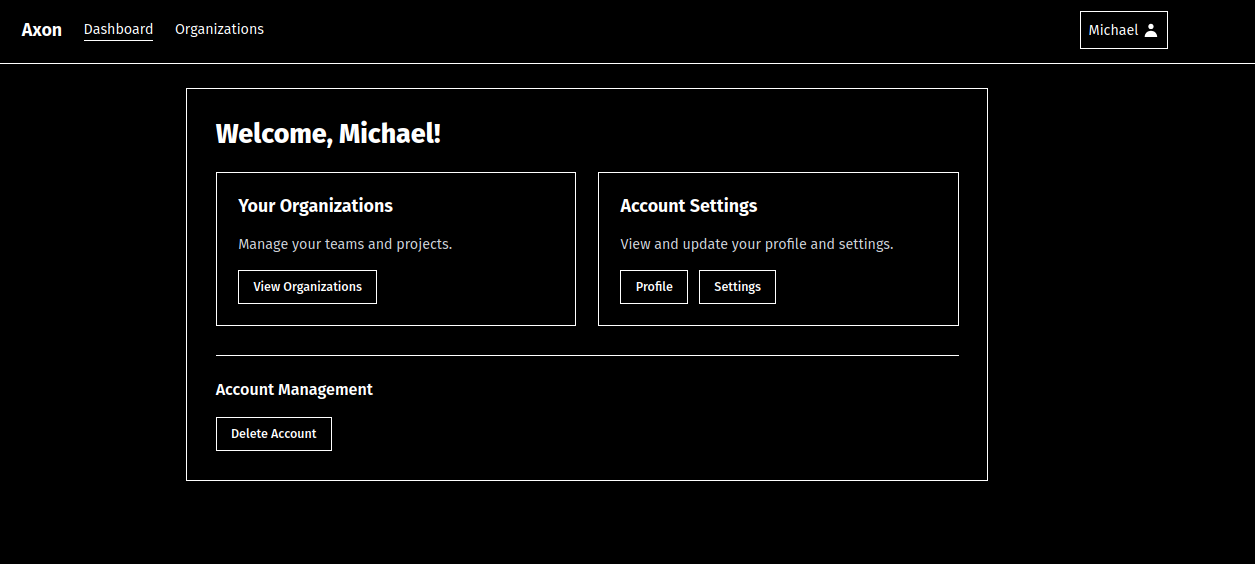
Summary Axon is an innovative collaboration hub designed to enhance both productivity and interpersonal connection within teams or communities. It merges an AI-driven Kanban system, where users can add tasks using natural language, with a unique "Sphere" visualization. The AI not only identifies necessary skills for tasks and suggests suitable collaborators but also leverages opt-in analysis of user profiles and public interactions to uncover shared non-work interests. The traditional Kanban view manages workflow, while the interactive Sphere view provides a dynamic map of people, tasks, skills, and their relationships, highlighting potential synergies and hidden connections (both professional and personal). By proactively suggesting task pairings based on skills and fostering serendipitous connections based on shared interests, Axon aims to break down silos, streamline collaboration, and build stronger, more connected crews. Feature Ideas Base Ideas (Core MVP for Hackathon): 1. NL Task Input to Kanban: User types/speaks "Create task: Debug login form CSS". AI parses this and creates a basic Kanban card with the title in a default "Backlog" column. 2. Manual Skill/Interest Tagging: Users can manually add skills (e.g., "Python", "UX Design") and simple interests (e.g., "Hiking", "Sci-Fi") to their profiles. 3. Basic Kanban View: Functional drag-and-drop Kanban board (e.g., To Do, In Progress, Done). Cards display title and assigned user (if any). 4. Simple Skill Matching: When viewing a task card, a button "Suggest Collaborator" queries profiles for users with manually tagged skills matching basic keywords derived from the task title (or manually added skill tags to the task). 5. Static Sphere Visualization: A basic graph view showing nodes for people and skills (from profiles). Lines connect people to the skills they possess. Maybe includes task nodes assigned to people. (Less interactive, more of a snapshot). 6. Interest Display on Profile: Show manually tagged interests on user profile pop-ups/pages. Basic matching: If viewing User A's profile, highlight interests shared with User B (the viewer). Addition Ideas (Enhancements):
- AI Skill Extraction from Tasks: AI analyzes the task description (not just title) to automatically suggest relevant skill tags for the task.
- AI Interest Analysis (Opt-in): Allow users to connect (e.g., Slack, Discord public channels, GitHub profile). AI performs NLP analysis (with clear user consent and privacy controls) to identify potential latent interests and adds them as suggestions to profiles.
- Interactive Sphere View: Allow zooming, panning, clicking nodes (people, tasks, skills) to get more info. Filter the view (e.g., "Show only people skilled in Python", "Show connections related to Project X").
- Integration with Status/Calendar: Show basic availability indicators on user nodes/profiles. Reach Ideas (Highly Innovative / Difficult):
- Real-time Sphere Updates: The Sphere dynamically updates as tasks move across the Kanban, people's statuses change, or even based on real-time communication patterns (requires deep integration).
- Collaboration Style Matching: Users define preferred work styles (async, sync, focused, collaborative). AI considers this along with skills and interests when suggesting collaborators, potentially even suggesting how they might best work together.
- Predictive Team Synergy Score: AI analyzes skill distribution, task load, communication patterns (if integrated), and shared interests within a team assigned to a project, providing a score or insight into potential synergy or friction points.
- Cross-Silo Opportunity Finder: AI identifies tasks or knowledge needs in one team/area that strongly match skills/interests of people in entirely different teams, proactively suggesting cross-functional collaboration or knowledge sharing.
- AI-Generated Conversation Starters: Based on a suggested connection (shared task context + shared interest), the AI generates a low-pressure, relevant opening message suggestion.
- Graph-Based Navigation: Allow users to "walk the graph" from a task to required skills, to people with those skills, to other tasks they are working on, to their other skills and interests, facilitating exploration.
- Sentiment Analysis Layer: If integrated with communication tools, visualize aggregated (anonymous) team sentiment related to specific projects or tasks as a property of the nodes/edges in the Sphere (e.g., color intensity). 4. Potential Tools, Languages & Frameworks
● Frontend: ○ UI Framework: Svelte (for building the interactive interface, including the Kanban board). ○ Visualization Library: Vis.js (Vis.js Network) (easier for network graphs), Three.js (for potential 3D sphere). ○ Database: ■ Relational: PostgreSQL (stores user data, tasks, basic relations). ■ Graph Database: Neo4j. Could be used alongside a relational DB. ○ API: RESTful API or GraphQL (might be suitable for querying graph-like data). ● AI/ML: ○ NLP: Python libraries like spaCy or NLTK for text processing, intent recognition, entity (skill) extraction. Transformers library from Hugging Face for more advanced models. ○ Matching/Recommendation: Standard ML libraries like Scikit-learn (for similarity calculations, basic recommendation models) or custom algorithms. Could leverage embeddings. ○ Cloud AI Services (Optional): Google Cloud AI Platform (Natural Language API, Vertex AI), AWS SageMaker/Comprehend, Azure Cognitive Services. ● Real-time Communication (for Reach ideas): WebSockets (Socket.IO library). ● Integrations: APIs for Slack, Discord, Microsoft Teams/Graph API, GitHub (for interest analysis/status). ● Deployment: Docker, Kubernetes, Cloud Platforms (AWS, Google Cloud, Azure, Heroku).
Built With
- drizzle-orm
- npm
- svelte
- sveltekit
- tailwind-css
- typescript
- vite

Log in or sign up for Devpost to join the conversation.