Inspiration
AxisLab began with a problem I experienced personally while studying robotics.
Many concepts in my course were still explained through hand-drawn diagrams, static slides, and equations. These methods are useful, but for topics such as coordinate transformations, DH parameters, wrist orientation, Jacobians, and forces, I often found myself understanding the algebra without truly seeing the motion.
Whenever I could manipulate a three-dimensional model and watch the equations change with it, the learning process became dramatically shorter. Sometimes a concept that had felt abstract for hours suddenly became intuitive.
Generative AI can explain these topics, but asking it to create a 3D robotics model directly is not reliable enough for learning. The geometry may be inconsistent, the coordinate frames may be wrong, and the result may change every time it is generated. Existing accurate robotics tools are usually designed for research or engineering, not for interactive explanation and personalized learning.
That led to the idea behind AxisLab: build a verified library of interactive robotics components that AI can safely customize. The AI interprets a student's question and chooses how to teach it, while deterministic mathematics and reviewed visualization components preserve accuracy and consistency.
I built AxisLab as the learning tool I wished I had—a way for robotics students to ask their own questions and reach a faster, deeper understanding of the concepts behind the equations.
What it does
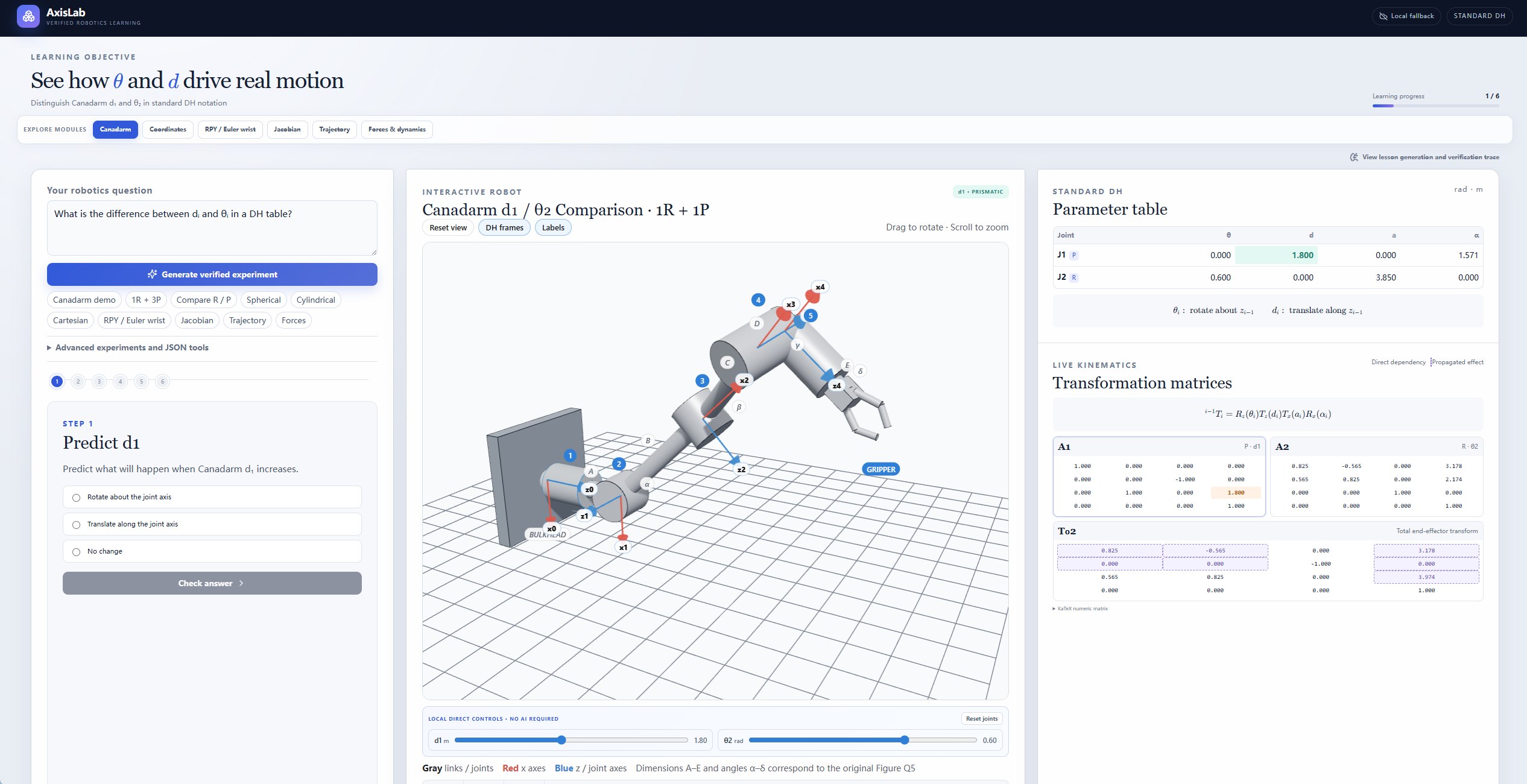
AxisLab is the interactive robotics tutor I wanted while taking my own robotics course. It transforms a student's question into a customized learning experience that connects equations, visible motion, direct manipulation, and meaningful assessment.
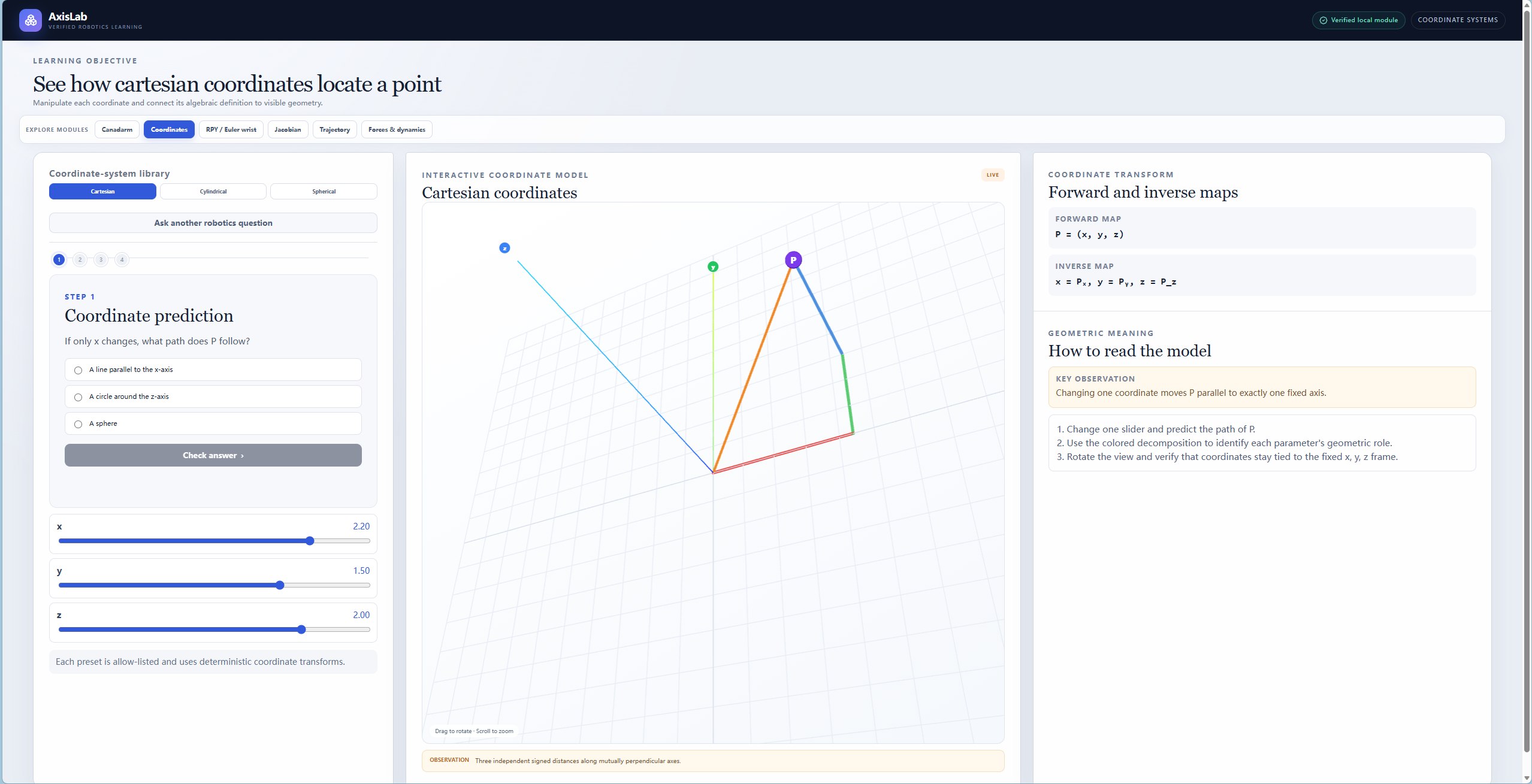
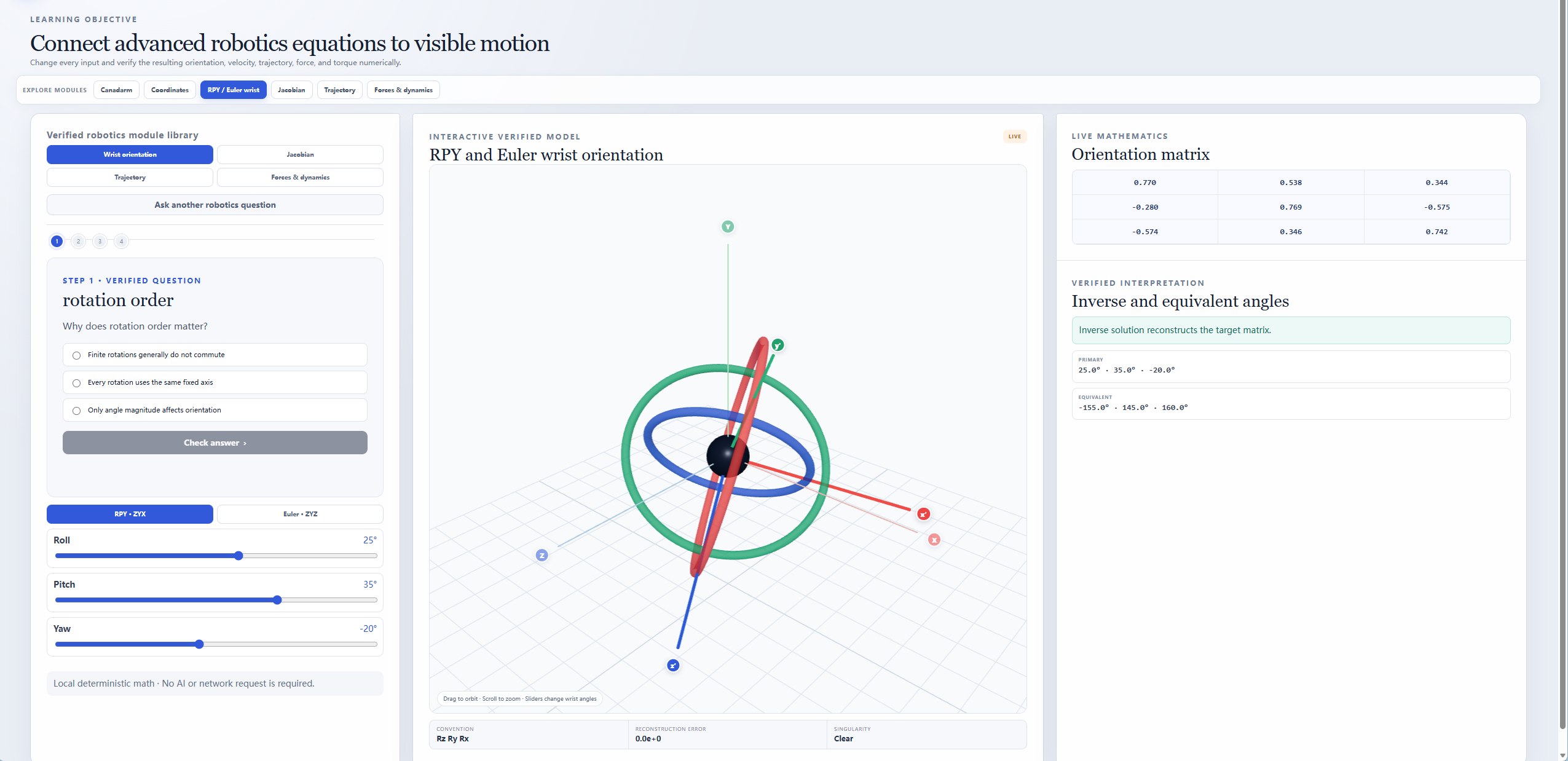
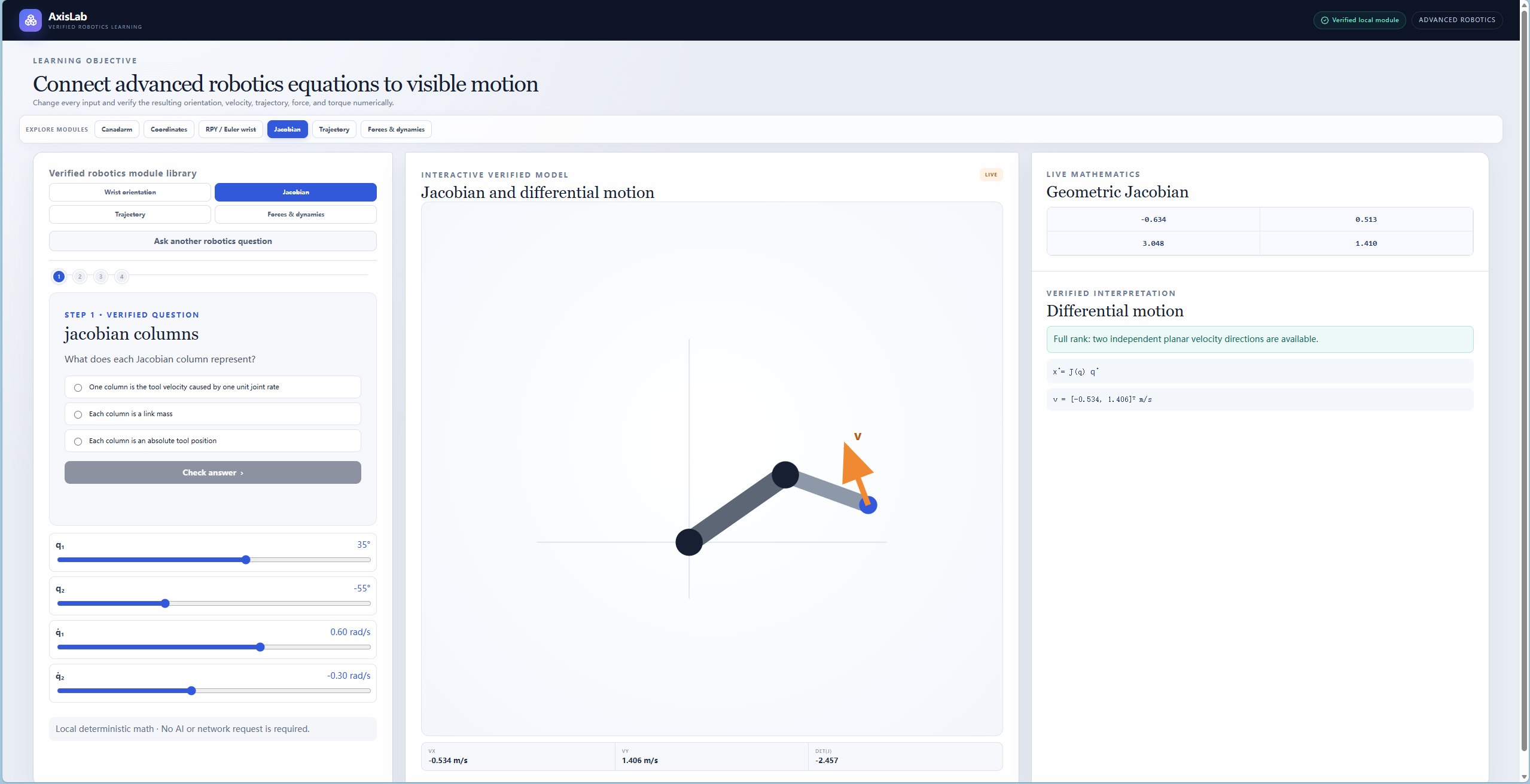
It provides six connected learning modules:
- Standard-DH robot motion and mixed revolute/prismatic joints
- Cartesian, cylindrical, and spherical coordinates
- RPY and Euler wrist orientation
- Jacobian differential motion and singularities
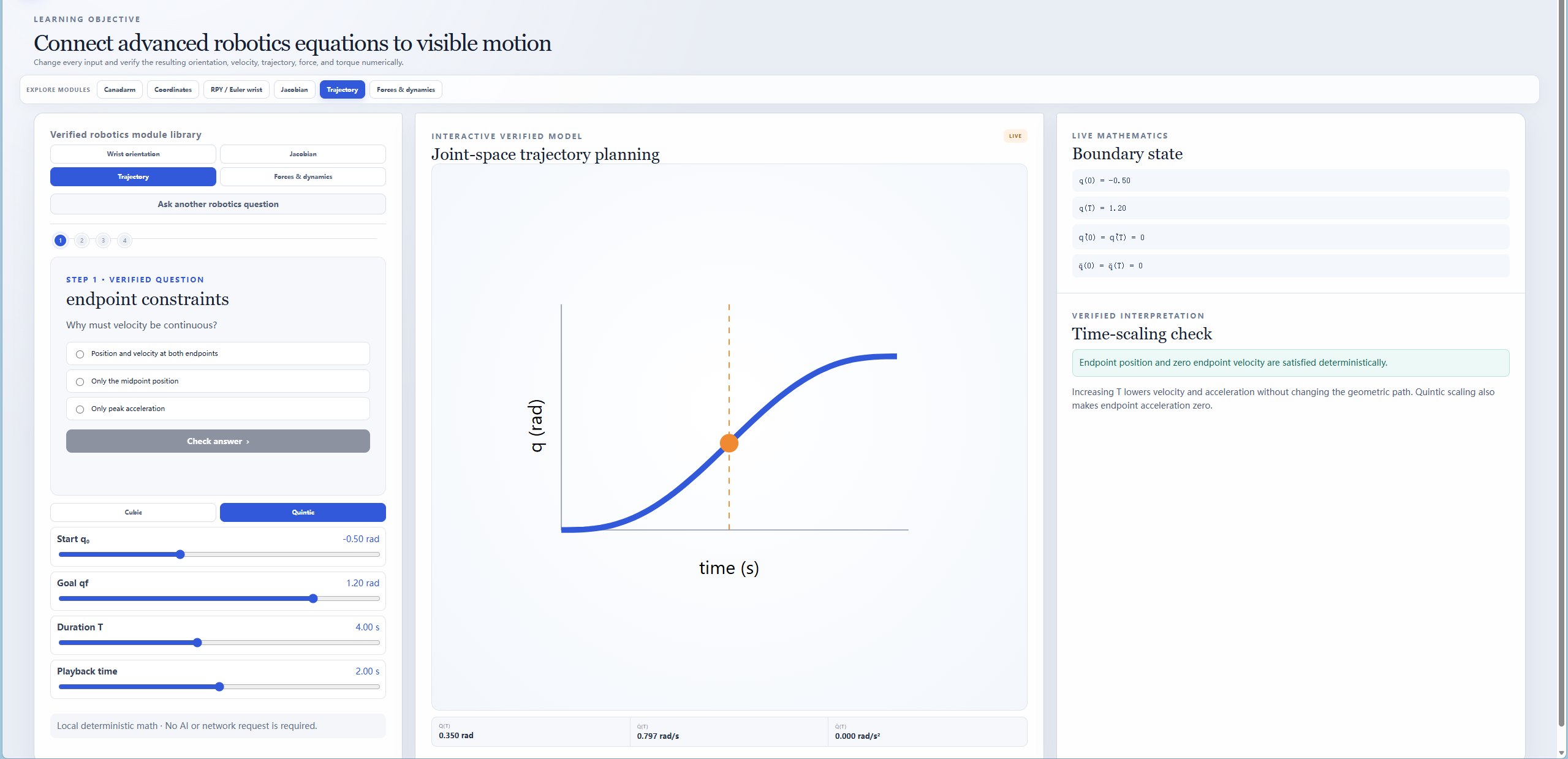
- Cubic and quintic trajectory planning
- Forces, Jacobian transpose, and gravity compensation
Students interact with 3D models, sliders, coordinate frames, transformation matrices, equations, and scored questions.
Natural-language questions can generate customized lessons. Generative AI selects teaching prompts and bounded initial parameters, while deterministic code verifies the mathematics, expected answers, and scoring before the lesson reaches the student.
How we built it
The frontend uses React, TypeScript, Vite, Three.js, and React Three Fiber. FastAPI and Pydantic provide strict backend contracts, deterministic verification, lesson generation, and evidence-based feedback.
The production application is packaged in Docker and deployed as a single HTTPS service on Railway. It also includes reviewed local lessons, allowing the core demonstrations to work when an external model provider is unavailable.
Codex was our implementation partner throughout development. It helped us analyze the original project, design the learning architecture, implement the React and FastAPI modules, review robotics mathematics, write automated tests, debug interactions, improve the responsive interface, migrate deployment, and prepare the release.
The primary development session used GPT-5.6 Sol inside Codex for the final Build Week extension and verification work.
Challenges we ran into
The largest challenge was allowing AI to customize a lesson without giving it authority over mathematical truth.
A generated robot can appear visually reasonable while containing inconsistent frames, invalid parameters, or questions that do not match the scene. We addressed this with narrow schemas, bounded parameters, allow-listed renderers, deterministic mathematical verification, one structured revision attempt, and reviewed fallback lessons.
Another challenge was presenting advanced robotics concepts through one coherent interface. We created a reusable predict–manipulate–observe–check learning cycle that works across robot motion, coordinate systems, orientation, velocity, trajectories, and forces.
Accomplishments that we're proud of
We are proud that AxisLab has grown beyond a visualization into a working educational product.
Key accomplishments include:
- Six directly accessible robotics learning modules
- Real answer evaluation instead of always-correct template feedback
- A draggable RPY/Euler wrist with inverse-angle and singularity explanations
- AI-customized lessons with deterministic parameter verification
- A reliable no-AI demonstration path
- Synchronized 3D geometry, equations, matrices, and numerical state
- 21 passing backend tests and 20 passing frontend tests
- A public, no-login HTTPS deployment
Most importantly, model-generated code is never executed, and generative output never controls numerical answers or scoring.
What we learned
We learned that generative AI is most useful in technical education when it controls variation and teaching strategy, while deterministic software retains mathematical authority.
We also learned that interaction alone does not create a lesson. Prediction, targeted questions, meaningful scoring, and evidence-based feedback are what transform a 3D visualization into an active learning experience.
Codex helped us iterate across mathematics, pedagogy, interface design, testing, and deployment without losing the connection between these parts.
What's next for AxisLab
Next, we plan to add instructor-authored lesson packs, accessibility improvements, learner-progress analytics, and classroom-ready assignment workflows.
We also want to expand the mathematical coverage with inverse kinematics, more complete robot dynamics, collision-aware motion planning, and additional manipulator configurations.
A longer-term goal is to conduct a controlled study comparing AxisLab lessons with static textbook diagrams and measure their effect on conceptual understanding.
Built With
- docker
- edtech
- education
- gpt-5.6
- human-ai
- kinematics
- planning
- pytest
- python
- railway
- react
- robotics
- sqlite
- stem
- three.js
- trajectory
- typescript
- vite
- vitest


Log in or sign up for Devpost to join the conversation.