-
-
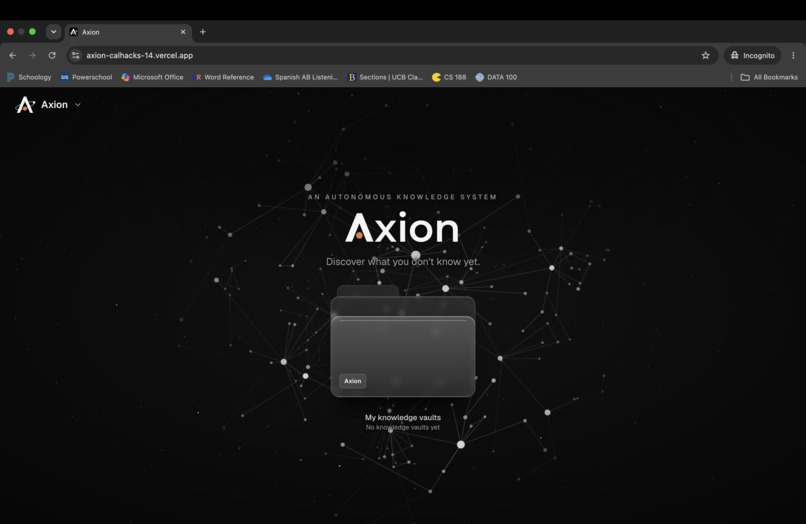
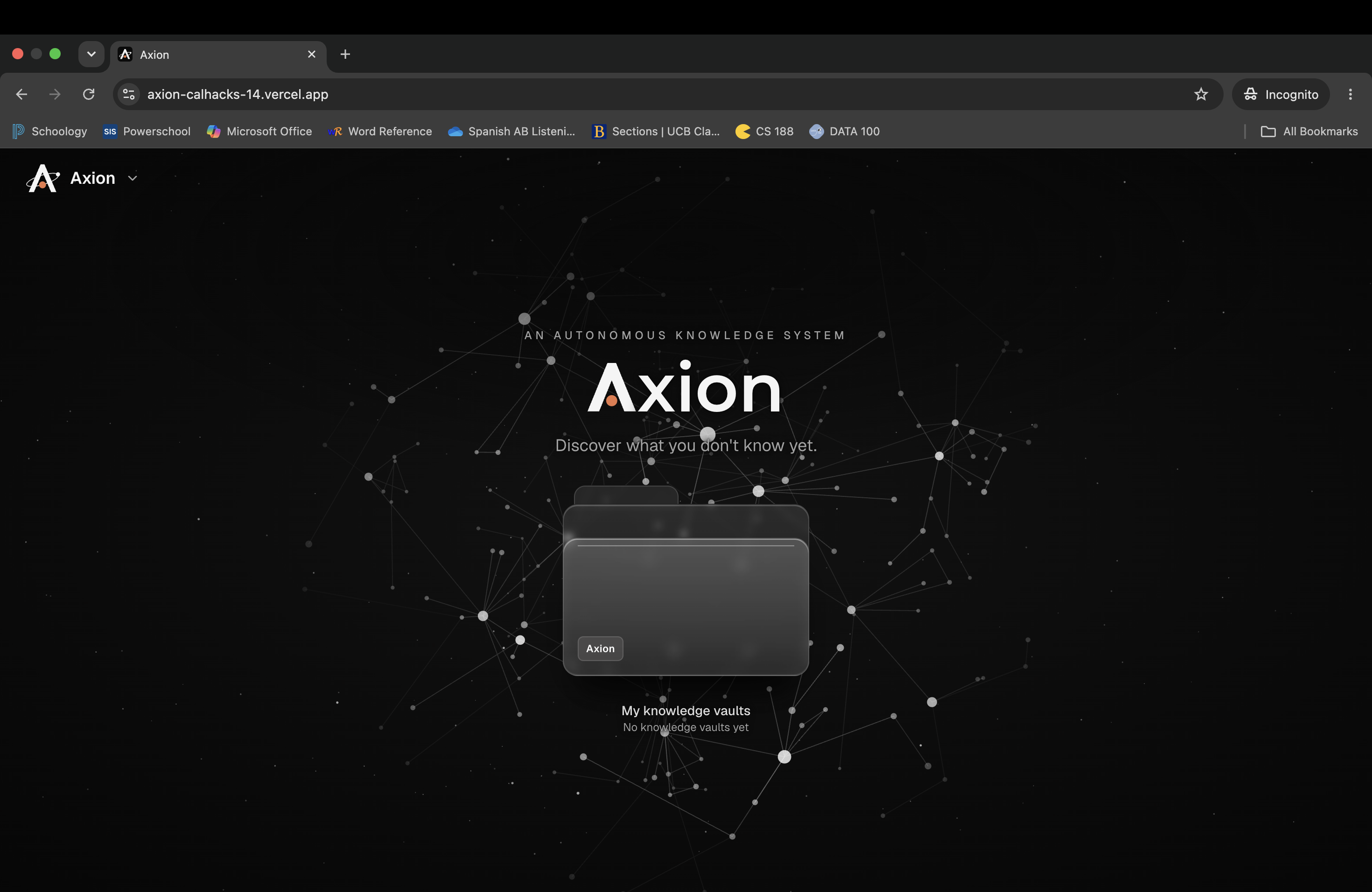
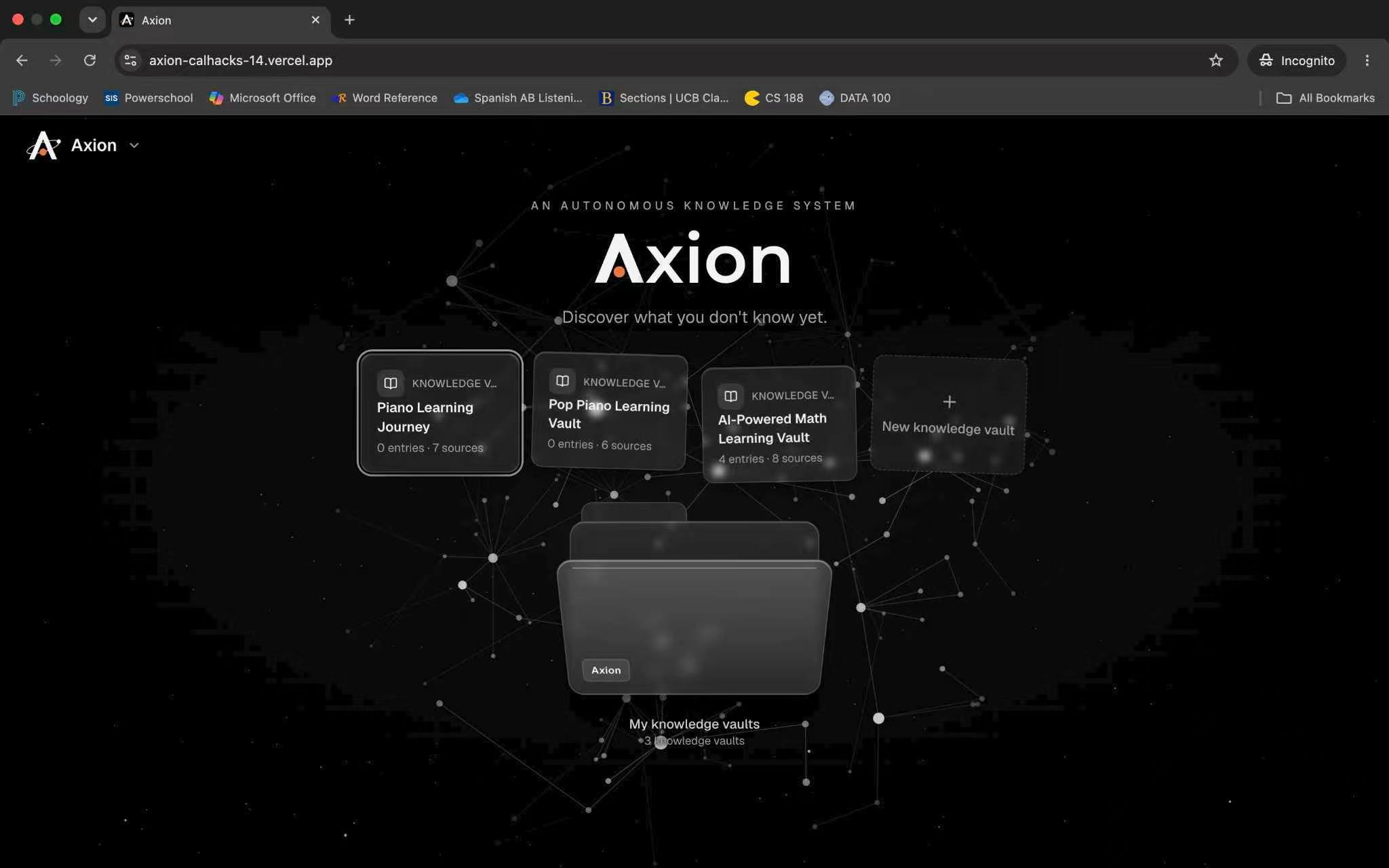
0th Page
-
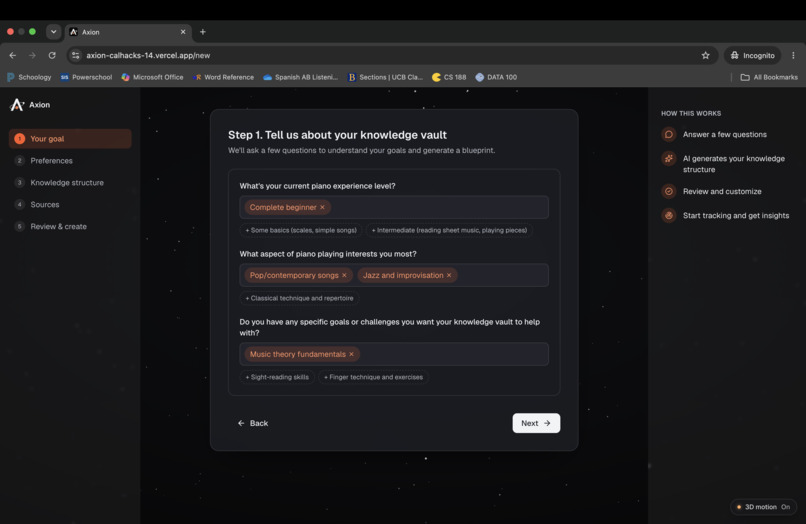
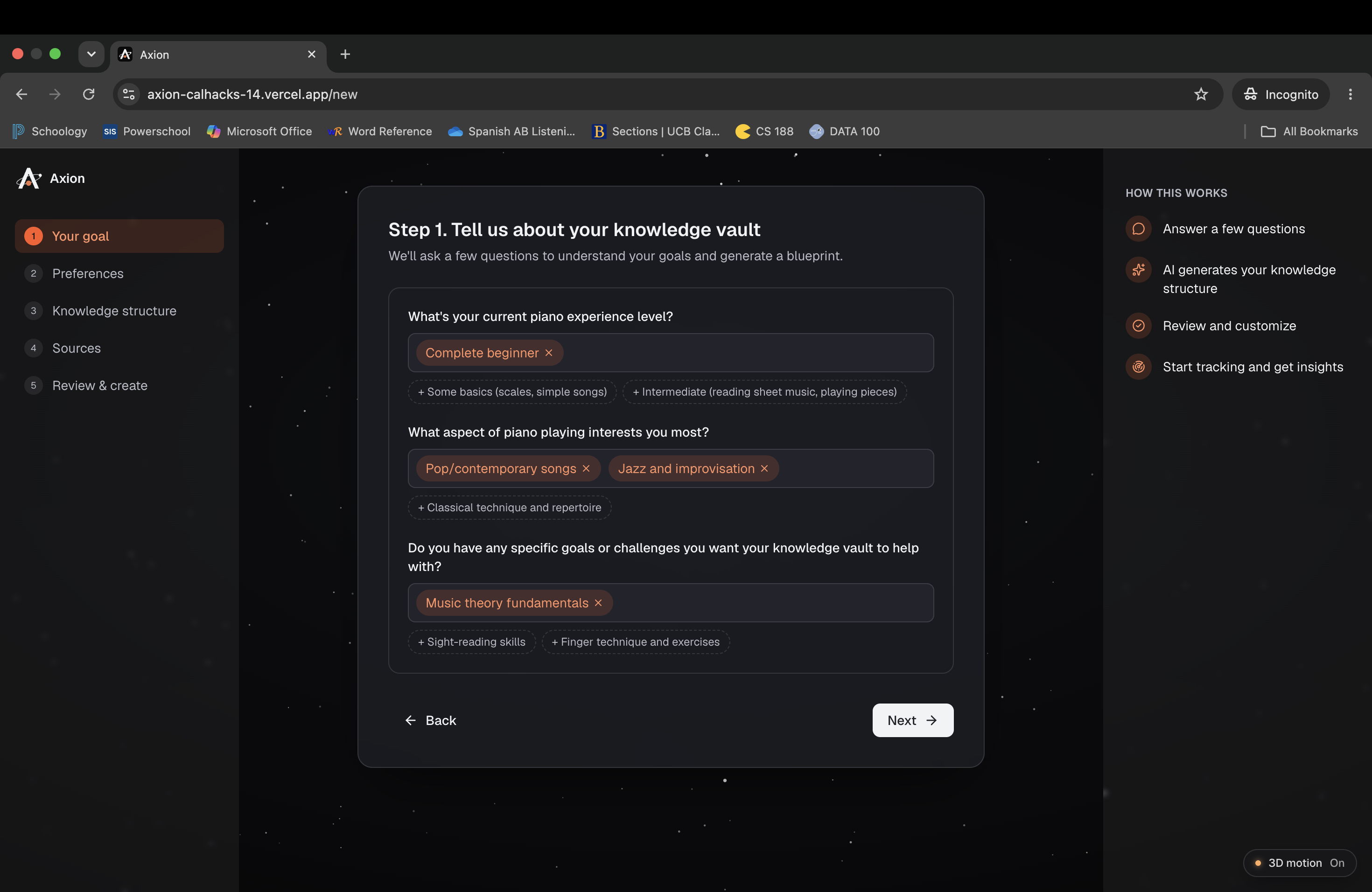
Creating a New Vault 1
-
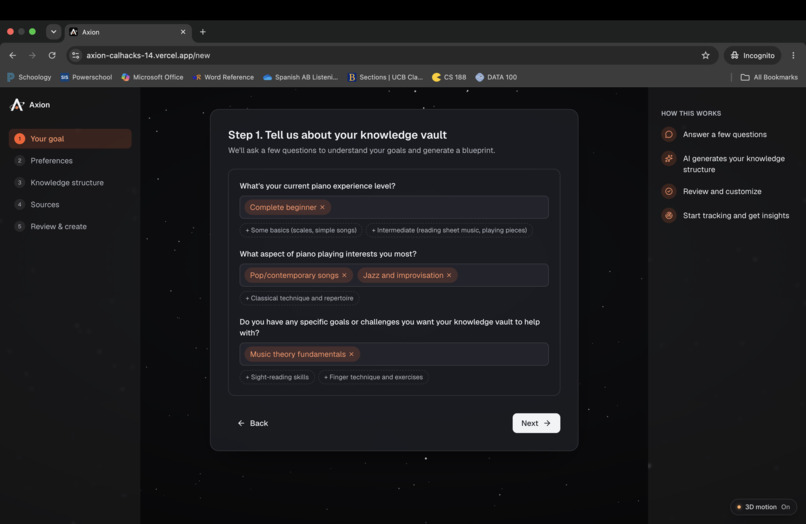
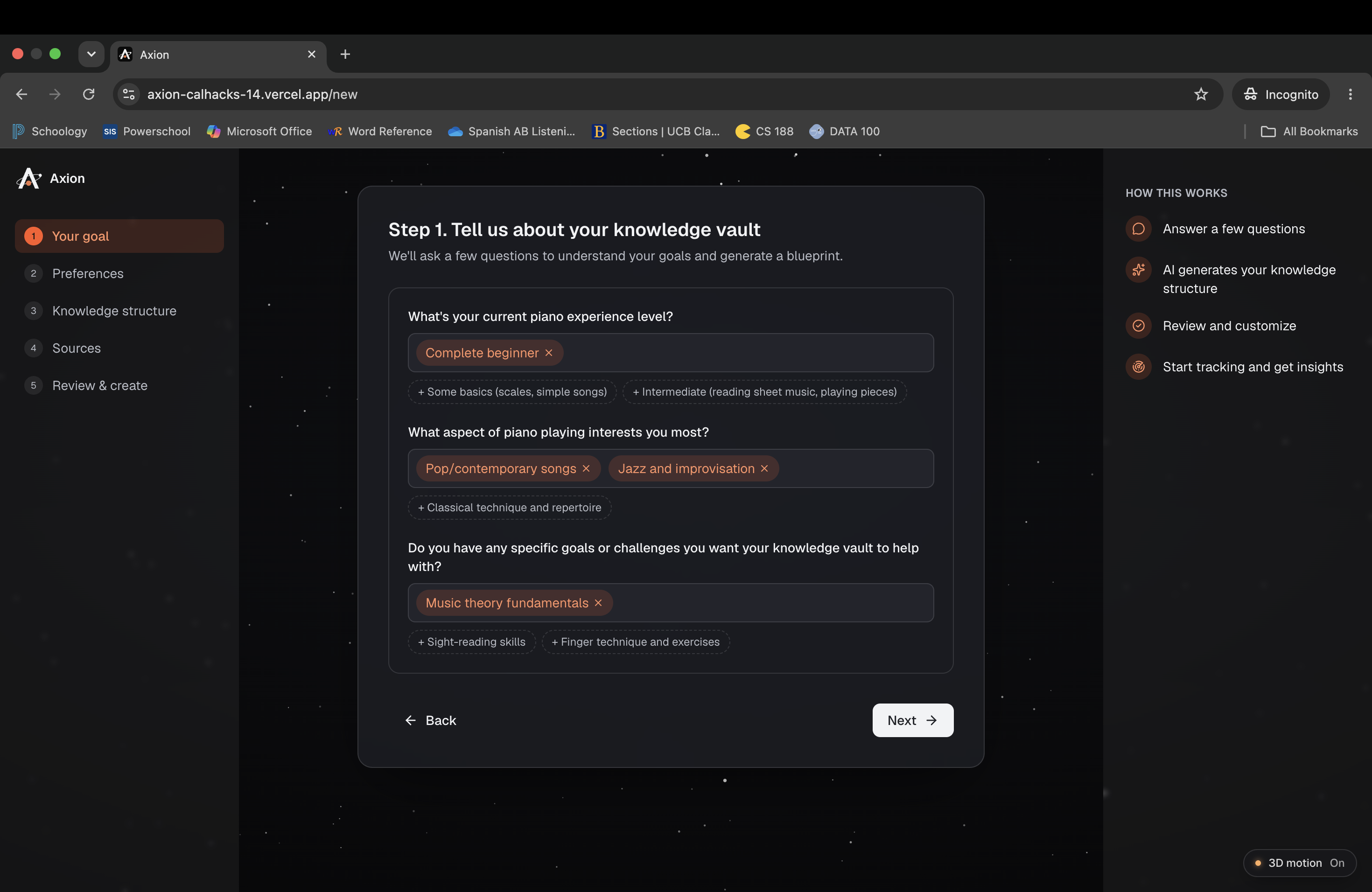
Creating a New Vault 2
-
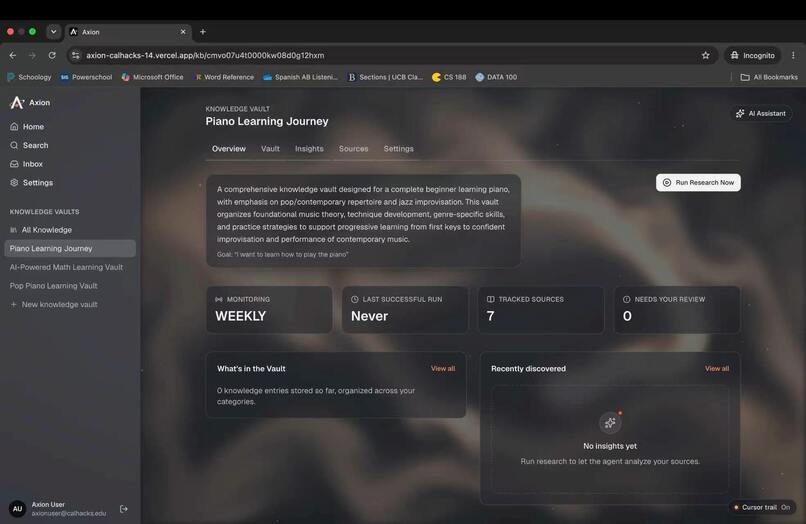
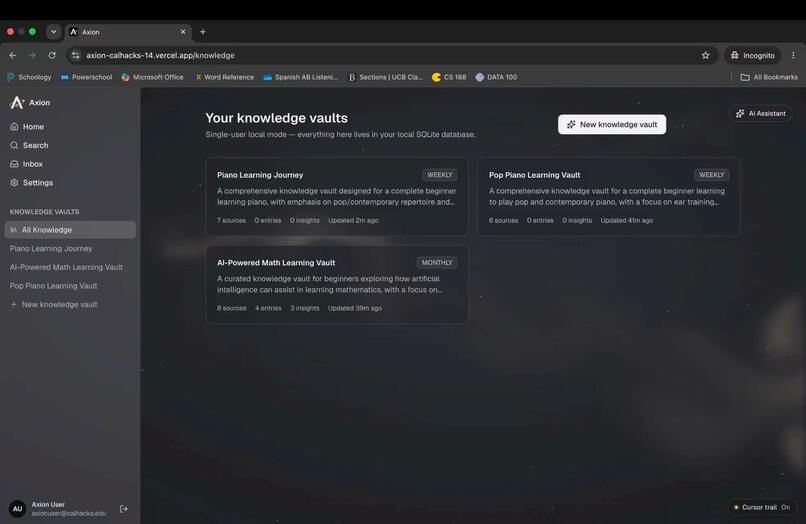
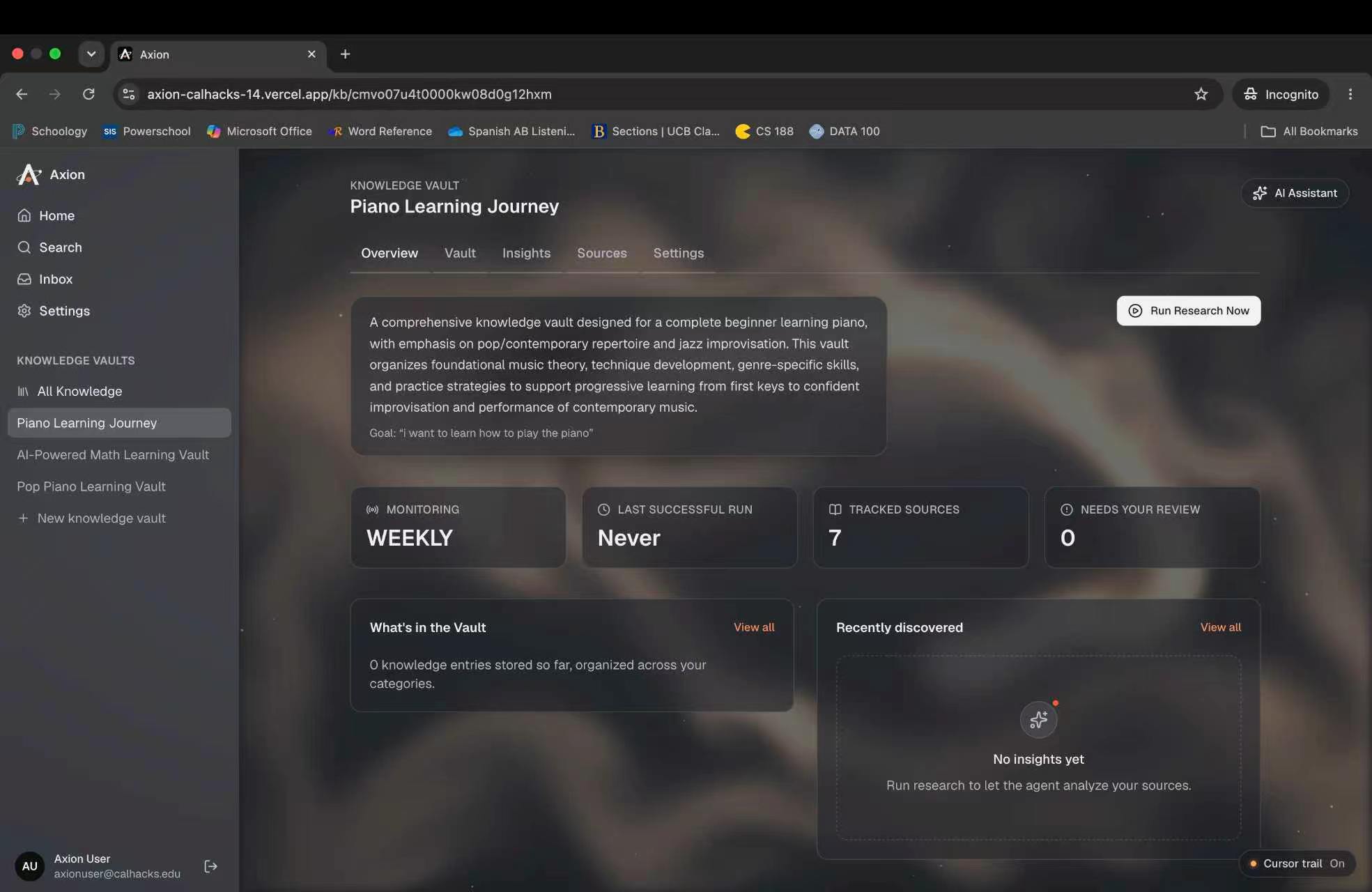
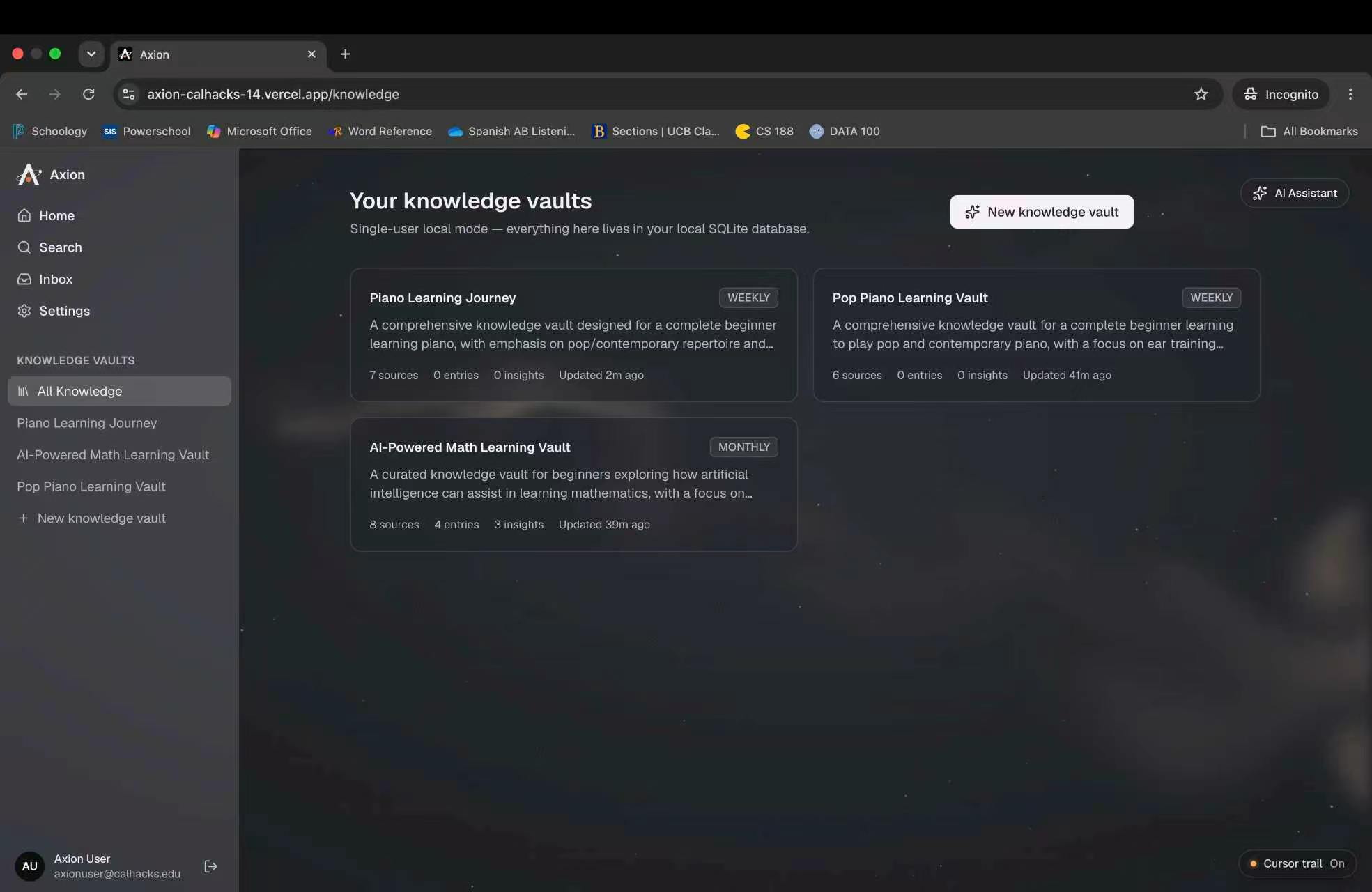
Home Page for Each Vault
-
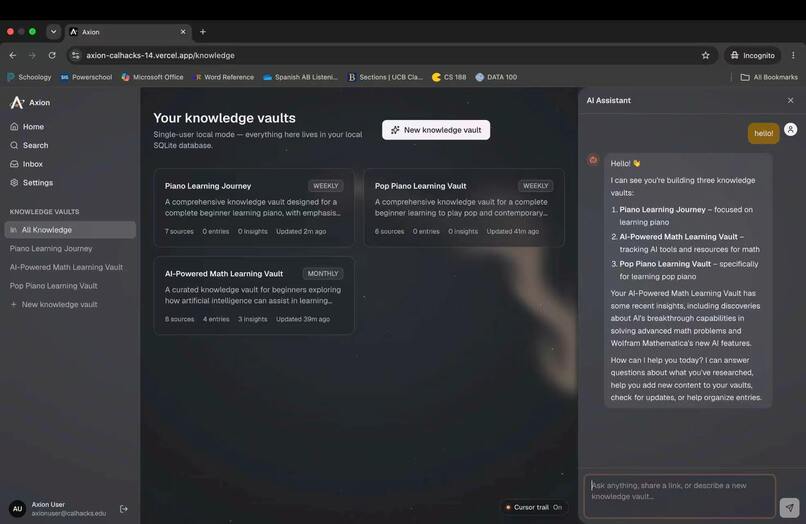
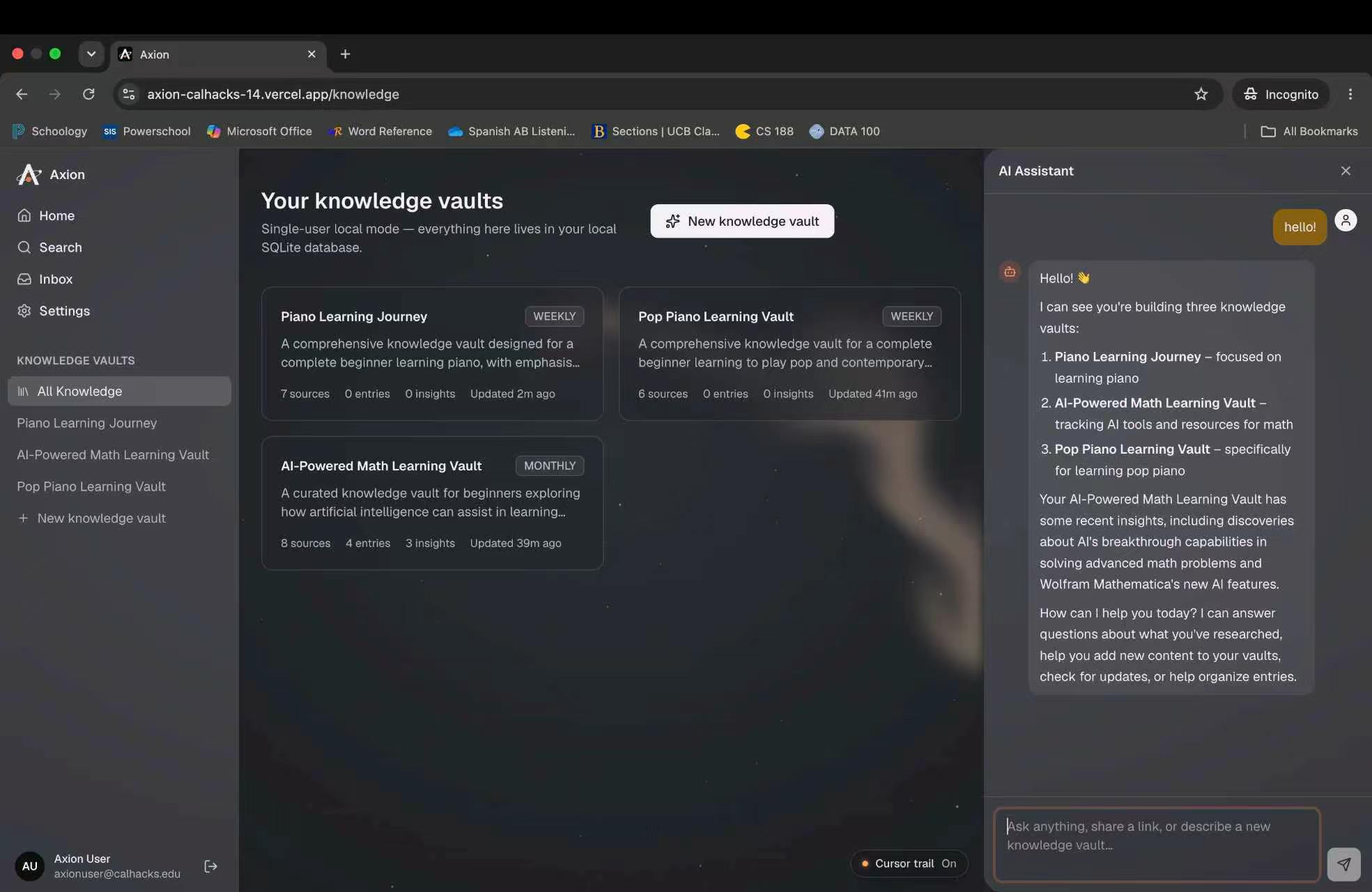
AI Assistant Sidebar
-
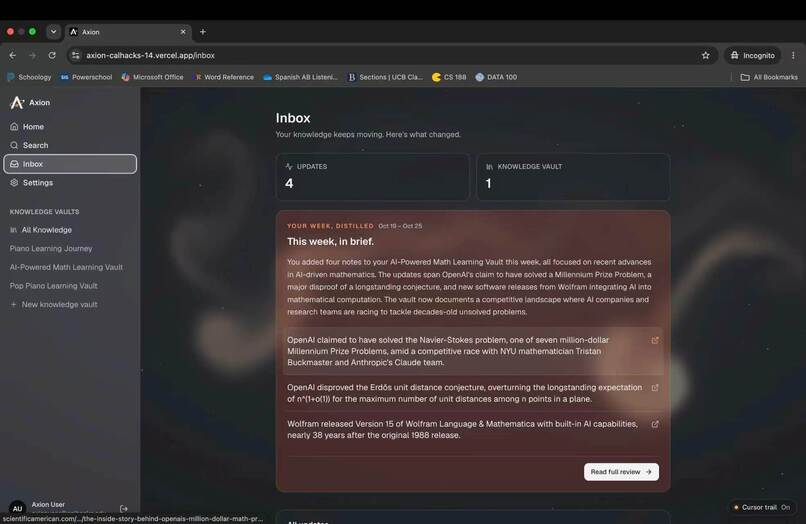
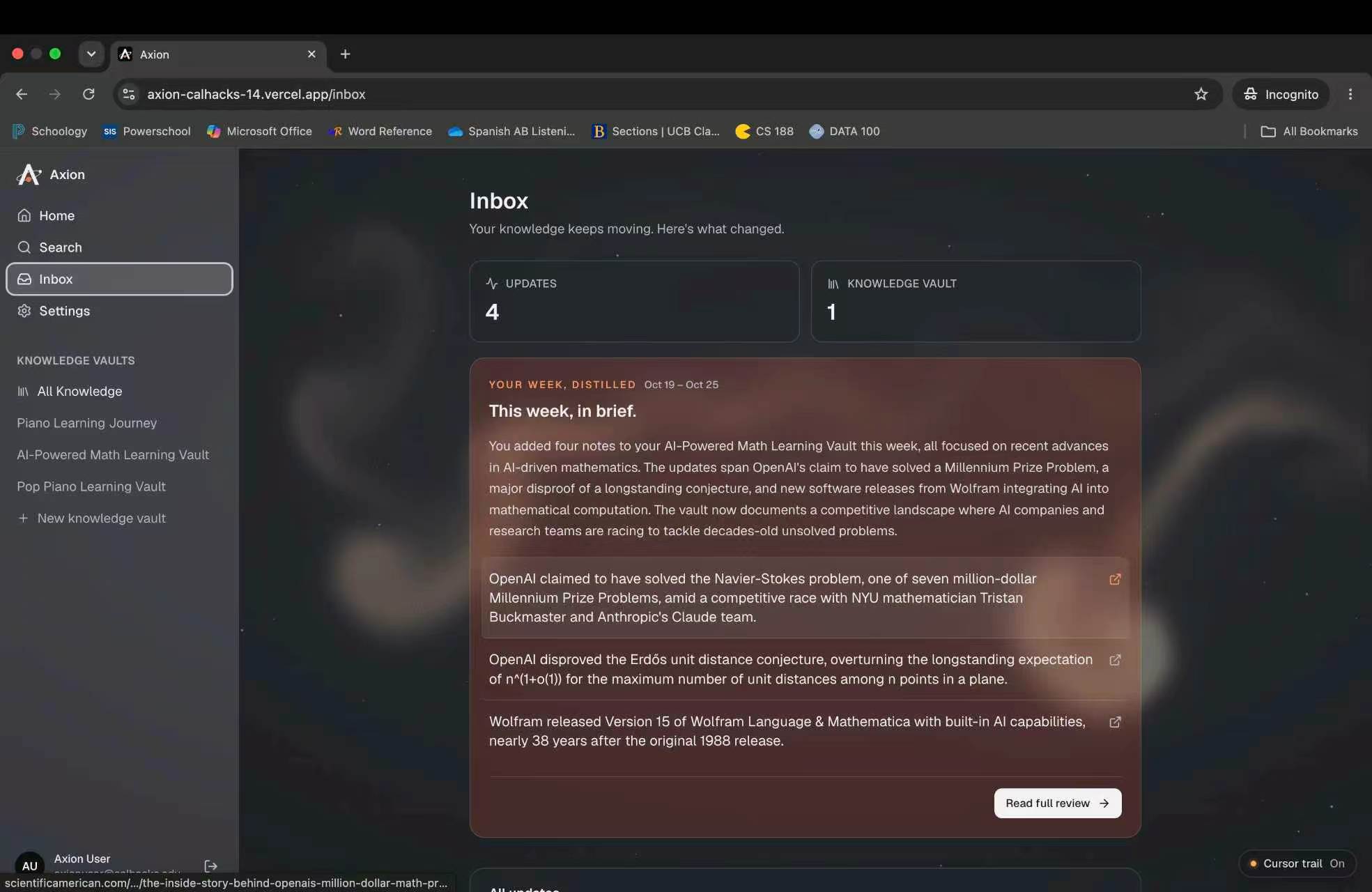
Inbox (Weekly Update)
-
-
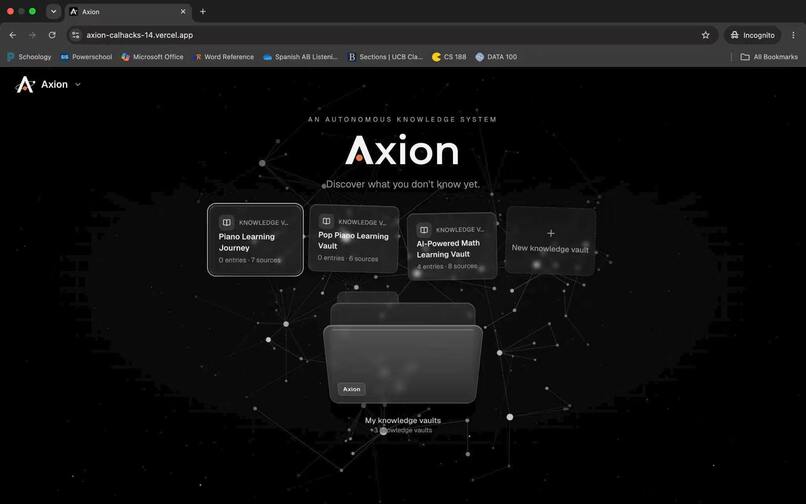
Axion — An AI-Powerd Living Knowledge Base
Discover What You Don't Know Yet.
Inspiration
As AI agents become increasingly integrated into personal and professional workflows, structured personal knowledge bases are emerging as a critical foundation for providing persistent, personalized context. More people are building their own knowledge bases, creating interconnected networks of information to organize what they learn, research, and care about.
However, setting up a truly powerful personal knowledge system takes significant time and technical effort. Users have to design their own knowledge structures, configure external information sources, set up web scraping and automated monitoring, and continuously organize, verify, and update their notes as new information emerges.
Even with powerful tools and plugins, maintaining a knowledge base often becomes a project of its own.
We believe people should spend their time learning and using knowledge, not maintaining the infrastructure behind it.
That's why we built Axion.
We imagined a knowledge base that could handle the tedious work itself: understanding what you want to learn, organizing relevant information, researching new developments, monitoring sources, and evolving alongside your interests.
And as AI agents become an increasingly important part of how we work, we wanted the knowledge accumulated in Axion to be useful beyond Axion itself. By embracing Markdown, we aim to make personal knowledge portable and reusable as context across different AI tools and agents.
Our vision is simple:
What if setting up a living knowledge base were as easy as describing what you want to know?
What It Does
Axion is an AI-powered, self-evolving knowledge management platform built around a Markdown-first philosophy.
Users begin by describing something they want to learn, research, or accomplish. Axion transforms that goal into a structured knowledge vault with relevant categories and research sources.
From there, Axion goes beyond traditional note-taking:
- Autonomous Research: Monitors configured sources and discovers new information relevant to each knowledge vault.
- Intelligent Knowledge Organization: Helps classify and organize information, including content shared through external links.
- Knowledge Evolution: Identifies new discoveries, outdated information, and potential contradictions, proposing updates when existing knowledge needs to change.
- AI Assistant: Lets users interact with their knowledge vaults through natural language, ask questions, conduct research, and manage information.
- Weekly Distillation: Transforms recorded knowledge changes into concise, personalized summaries of what matters and why.
- Markdown-First Knowledge: Axion's knowledge outputs are structured in Markdown, making them human-readable, editable, and reusable across different AI tools and workflows.
Your Knowledge Shouldn't Be Locked Inside One AI
One of Axion's defining principles is that knowledge should belong to the user, not the platform.
Rather than trapping valuable information inside proprietary interfaces or isolated chat histories, Axion uses Markdown as a portable representation of knowledge.
This allows users to build their own evolving context — including research findings, domain knowledge, goals, and accumulated insights — that can be brought into other AI environments.
Whether someone is working with Claude, ChatGPT, Cursor, or another AI agent, their knowledge can serve as reusable context instead of forcing them to start from scratch.
Axion doesn't just help AI understand your questions. It helps you build the context that makes every AI agent more useful.
Our goal is to shift knowledge management from passive storage to active discovery, and from isolated information to portable intelligence.
How We Built It
We built Axion as a full-stack web application using Next.js, React, TypeScript, and Tailwind CSS.
The application combines a structured database with AI-powered research and knowledge-management workflows. We integrated Claude to interpret user goals, process research findings, organize information, and generate contextual summaries.
Our research pipeline retrieves content from configured external sources, processes new documents, and evaluates how discoveries relate to existing knowledge. We also developed an event-based Inbox system that tracks meaningful changes and powers Weekly Distillation, with caching to avoid unnecessary repeated AI calls.
We adopted a Markdown-first approach to knowledge representation, prioritizing readability, portability, and compatibility with AI agents. This helps turn Axion's outputs into reusable context rather than information that can only be consumed inside our application.
On the frontend, we designed two complementary experiences: an immersive dark landing page featuring an interactive knowledge network, and a minimal, light-colored workspace for focused research. Motion and subtle interactive effects help make the knowledge system feel alive.
AI-assisted development tools helped us rapidly prototype, implement, and iterate on the product during the hackathon.
Challenges We Ran Into
One of our biggest challenges was making autonomous research reliable. External websites vary widely in structure, and some sources restrict automated access or provide inconsistent RSS feeds. We had to account for failed requests, malformed content, duplicate information, and partial research results.
Another challenge was deciding when an AI agent should act independently and when it should ask for permission. Automatically adding new information is useful, but silently overwriting existing knowledge can be dangerous. We designed knowledge-change proposals and review workflows to give users greater control over important modifications.
We also had to balance structured knowledge management with portability. Information needs to be organized enough for an autonomous system to reason over it, but flexible enough to remain understandable and reusable outside Axion.
Finally, building a cohesive experience across an experimental landing page and a functional research workspace required careful attention to visual consistency, interaction design, and performance.
Accomplishments We're Proud Of
We're proud that Axion is more than a conversational interface attached to a collection of notes. We built the foundations of a system that connects user goals, external research, structured knowledge, and ongoing updates.
We're particularly proud of combining autonomous research, reviewable knowledge changes, and Weekly Distillation with a Markdown-first knowledge philosophy.
Instead of treating accumulated knowledge as something that only benefits one application, we designed Axion around the idea that it should become a reusable asset for the user and their broader AI ecosystem.
What We Learned
Building Axion taught us that creating an AI agent is not just about connecting a language model to tools. It requires designing the entire system around context, reliability, permissions, and user trust.
We also learned that more information does not necessarily create more value. The most useful AI system is one that can recognize which discoveries are relevant, explain their significance, and help users decide what to do next.
Most importantly, we realized that the future of personal knowledge management is closely connected to the future of AI context management.
As people use more specialized agents, the ability to maintain a consistent, evolving, portable knowledge foundation becomes increasingly important.
What's Next for Axion
We envision Axion evolving into a truly proactive personal research companion and a universal context layer for AI agents.
Future directions include deeper cross-vault knowledge connections, more sophisticated contradiction detection, richer interactive visualizations of knowledge evolution, broader source integrations, and personalized research priorities that adapt to each user's goals.
We also want to expand Markdown-based knowledge portability, making it easier to export, synchronize, and reuse personal knowledge across AI tools and agent workflows.
Ultimately, we want Axion to become a system that doesn't just remember what you know.
It discovers what you don't know yet — and makes what you know useful everywhere.
Built With
- anthropic
- claude
- css3
- framer-motion
- git
- html5
- javascript
- next.js
- node.js
- playwright
- prisma
- react
- sqlite
- tailwindcss
- turso
- typescript
- vercel


Log in or sign up for Devpost to join the conversation.