-
-
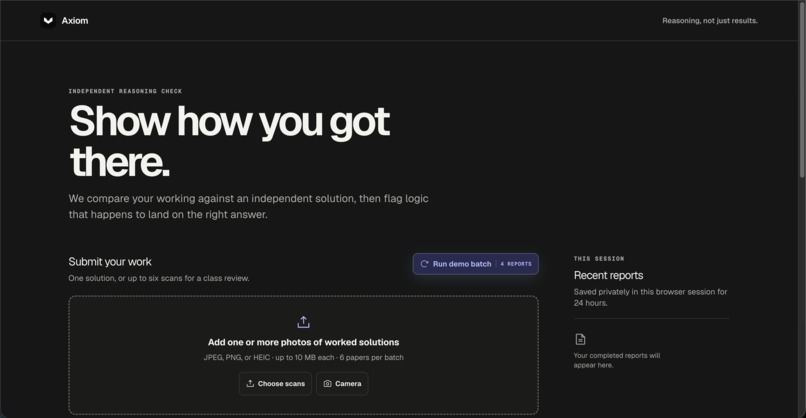
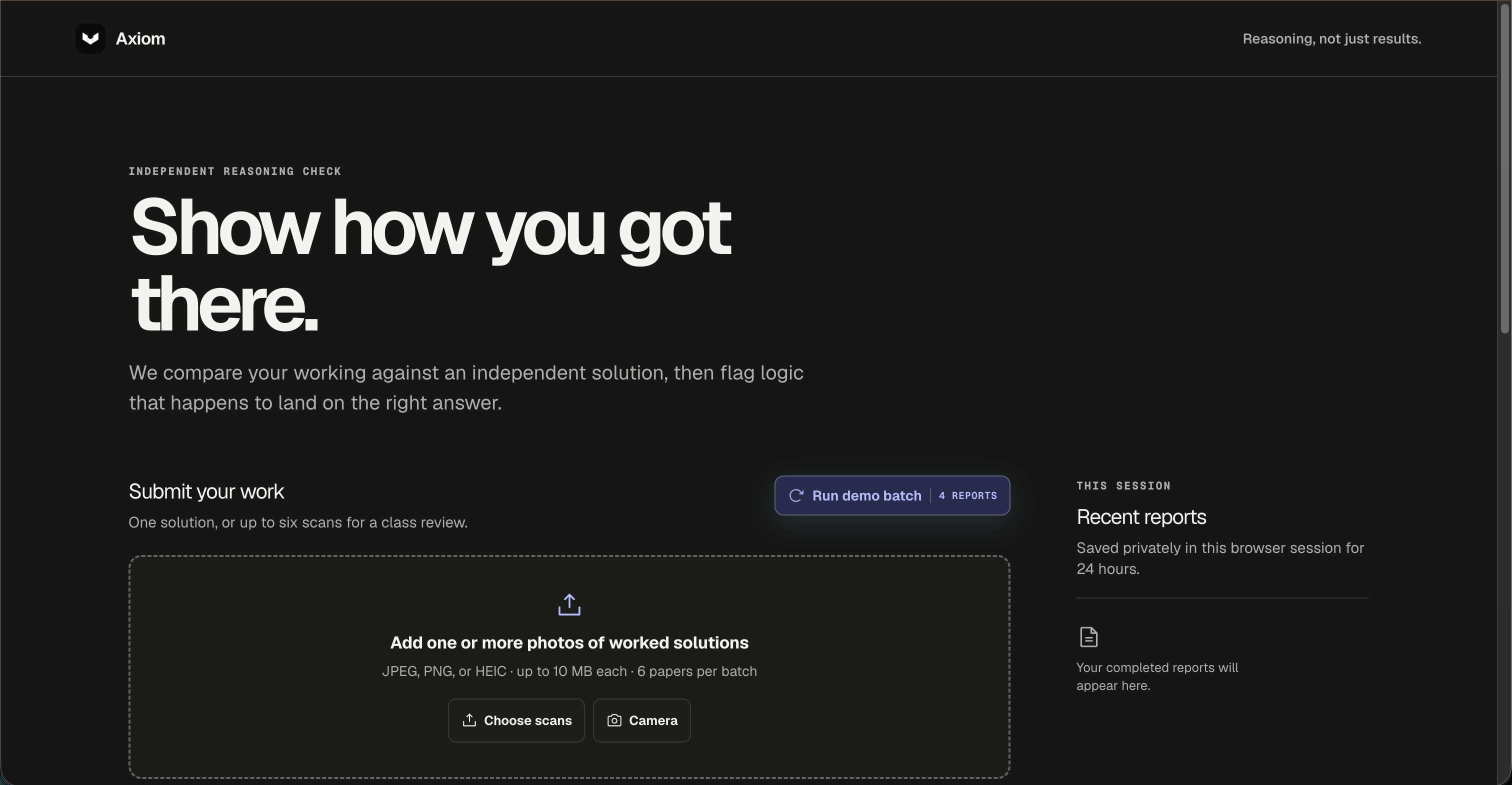
Axiom Dashboard
-
-
Inspiration
Every study app that I've looked into, always answers the question, "Is the answer right?". Being someone who extensively used such apps in high school, I came to a realisation that there is a far more pervasive danger: students who have faulty reasoning that happens to give the right answer, never learn that their reasoning is faulty until they hit a problem where the right-answer heuristic fails. I wanted to build the app that catches that, the "Correct Answer Trap".
What it does
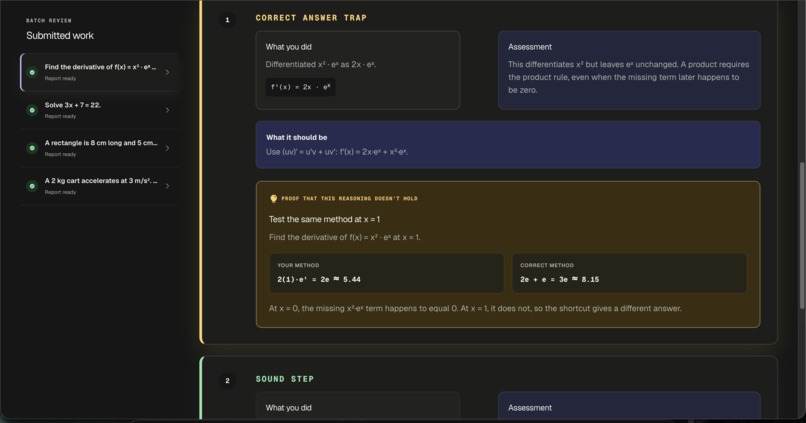
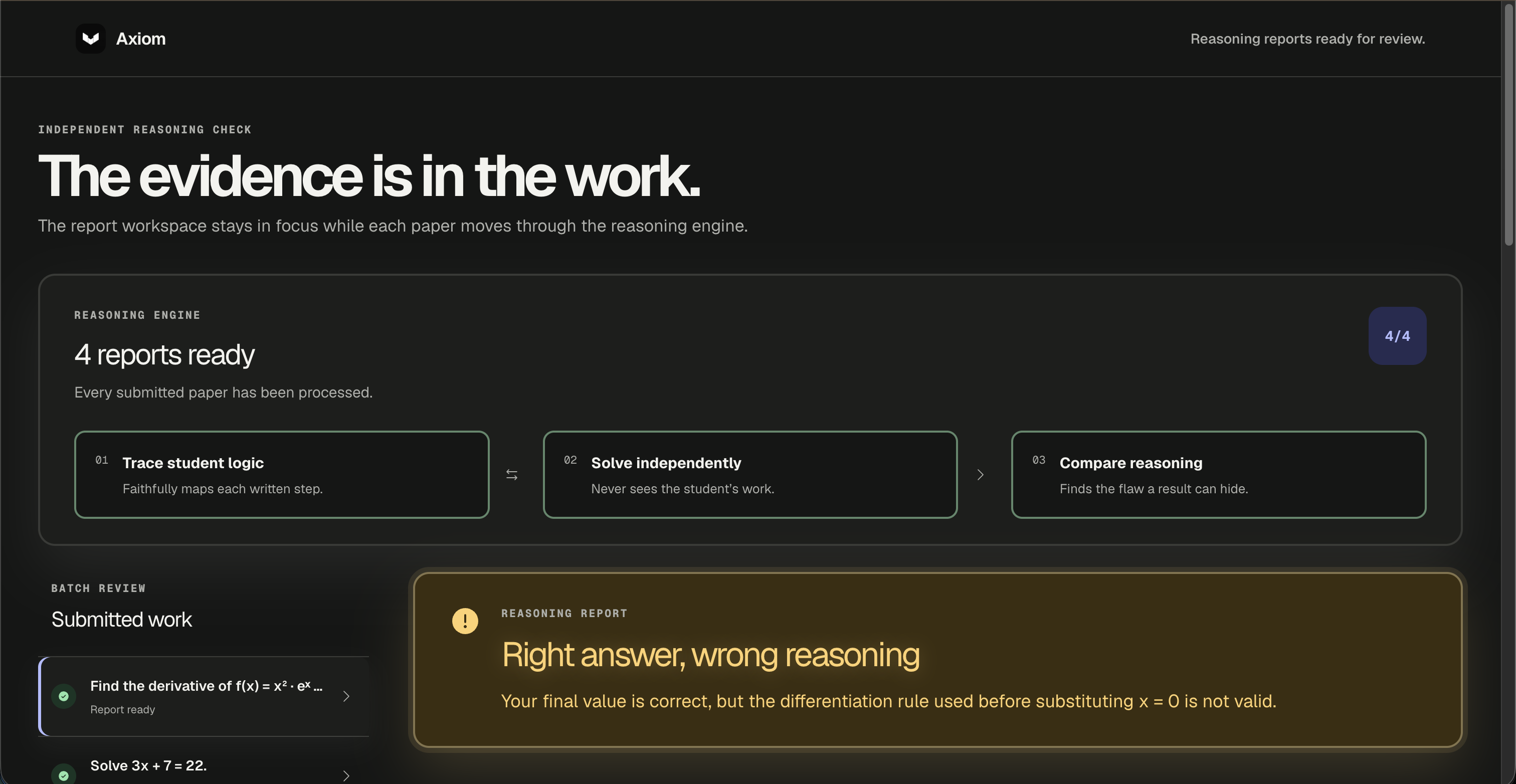
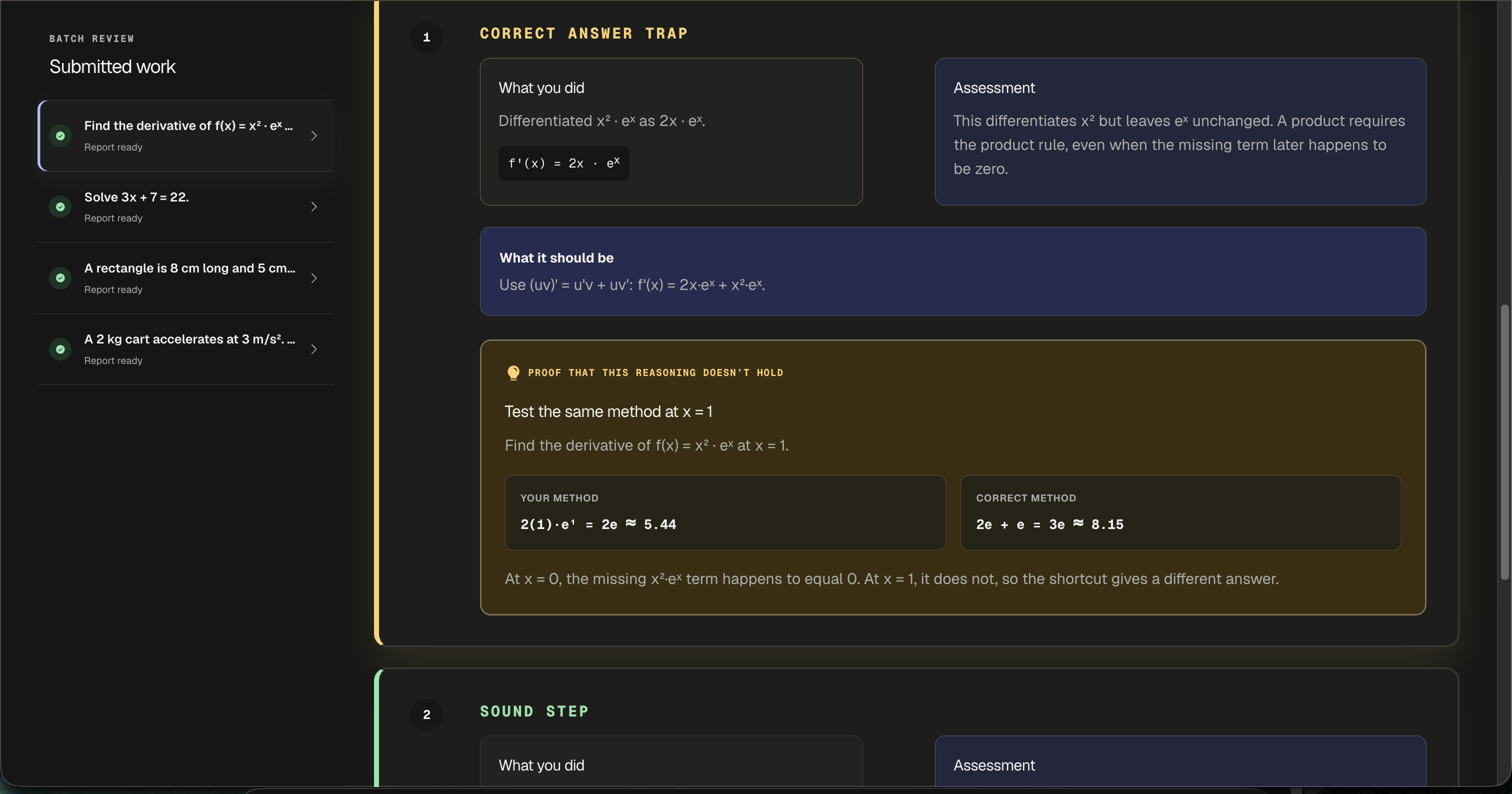
Axiom evaluates a student's worked solution, grading the REASONING process, independent of final "correct answer". The student uploads or types in their solution to a problem, selects their grade and subject, and Axiom reports on whether their logic is consistent. When the app detects reasoning that could lead to a correct answer through invalid logic, it produces a "counter problem": another problem in the same category that the student's reasoning would lead to an incorrect answer, as a demonstration.
How I built it
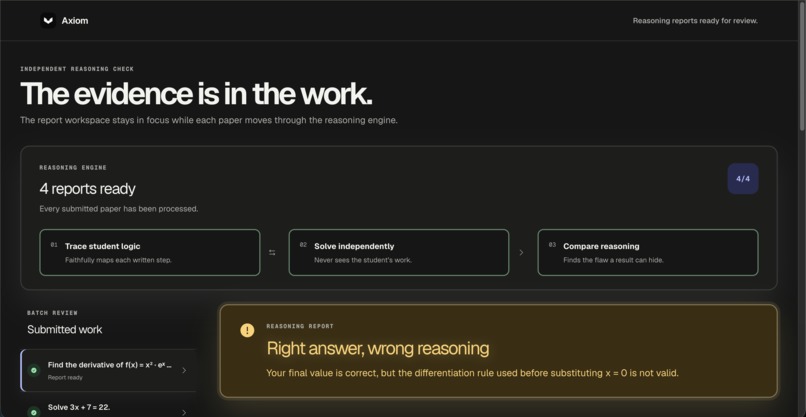
The core of the application is a three-agent reasoning stack implemented in GPT-5.6. A Tracer isolates the student's steps without correcting them, an Independent Solver that never sees the student's work to begin with( to prevent bias ), solves the original problem, and a Comparator assesses each step against what the solver did, classifying them as either valid, correct-answer-trap, error, or grade-level mismatch. Wherever a correct-answer trap gets identified, the counter-problem gets injected into the final output.
I built this application in Codex, by describing the three-agent stack and the isolation of the independent solver as the main design features. It generated the next.js app, the API routes, the structured format of the JSON data exchanged between them, and the report interface. I had to make sure that the solver never saw the student's original work, and that the reports contained a counter example whenever a correct-answer trap was identified; these were the choices that distinguished the application from generic "check your answer" services.
Challenges I ran into
The biggest challenge was ensuring that the Independent Solver never had access to the student's original solution. In Codex, I implemented this by having the route that serves the solver only receive the problem text, not the student's solution or tracer report. Making sure that the counter-problem injection produced consistent results from GPT-5.6 also required some experimentation with the prompt format.
Accomplishments I'm proud of
A working three-agent reasoning engine tht does something useful, built solo, that catches what no existing education tool catches. The demo case — the derivative of x²·eˣ at x=0, where a student forgets the product rule but still gets 0 — produces a clean "right answer, wrong reasoning" verdict and a counter-problem at x=1 that proves it.
What I learned
That the interesting question in automated student assessment isn't whether the final answer is right or wrong, but whether the reasoning process can be generalized. And an isolated multi-agent reasoning supervisor is a good way to catch things a single prompt can't.
What's next for Axiom
A curated set of examples from algebra, calculus, physics, and chemistry, with teacher dashboards for assigning homework at the reasoning level. Adding better handwriting OCR for real classroom photos.
Built With
- codex
- gpt-5.6
- next.js
- openai
- react
- redis
- tailwindcss
- typescript
- upstash
- vercel

Log in or sign up for Devpost to join the conversation.