💡 Inspiration
Forty years of physics-education research — Halloun & Hestenes' Force Concept Inventory — proved something uncomfortable: students don't fail physics because they know nothing. They fail because they arrive with a coherent wrong physics (Aristotle's "heavier objects fall faster," the medieval impetus theory of projectiles), and being told the correct answer demonstrably does not dislodge it. What works is the predict → observe → explain cycle: commit to a prediction, then confront the evidence.
Yet almost every AI education tool ever built does the one thing the research says doesn't work: it corrects the student. So we inverted the pattern. AXIOM doesn't tell you you're wrong — it makes your wrong idea executable, and lets you live in it until it breaks.
⚛️ What it does
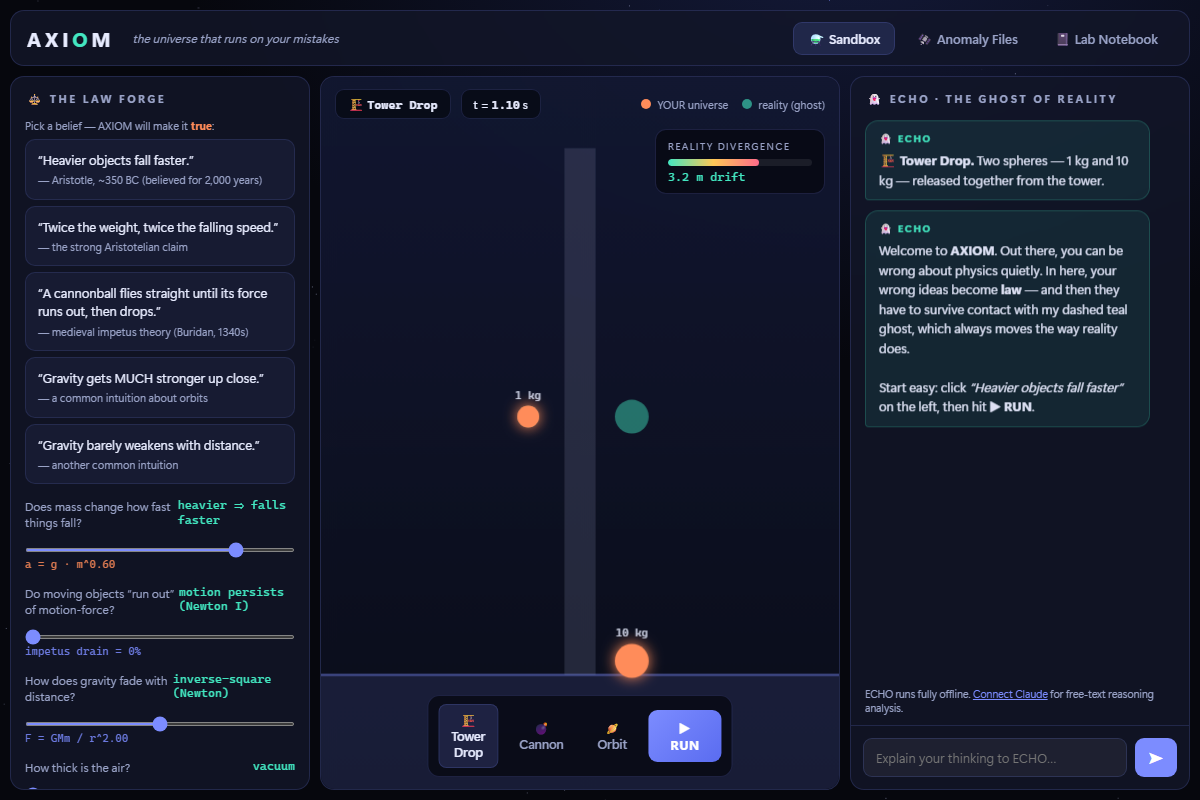
- ⚖️ The Law Forge — Pick a belief card ("a cannonball flies straight until its force runs out") or bend the law sliders directly: mass-dependent gravity \( a = g \cdot m^{\gamma} \), impetus drain, gravity's distance law \( F = GMm/r^{\beta} \), drag. AXIOM compiles your belief into the physics engine. Your misconception is now law.
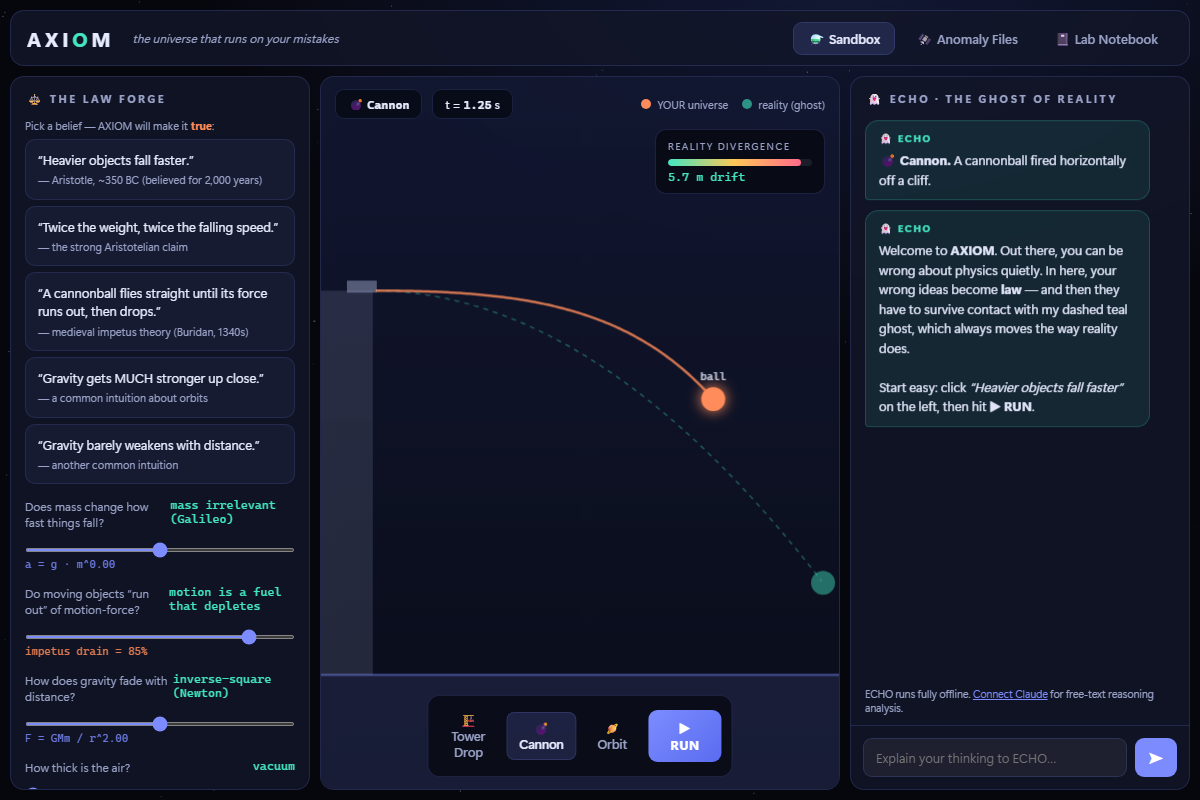
- 👻 The Ghost — Every experiment (tower drop, cannon, planetary orbit) runs in two universes simultaneously: yours (solid orange) and reality (dashed teal ghost) — same initial conditions, one shared integrator, two law-sets. A live Reality Divergence meter quantifies how wrong you are, in metres.
- 🔮 Forced prediction — You cannot press RUN until you commit to a prediction. Predictions are graded against reality — not your universe — and logged forever in an auto-kept Lab Notebook: a measurable record of your intuition improving.
- 🧠 ECHO, the misconception engine — A fully offline AI layer maps your position in "law space" onto documented historical misconceptions (Aristotelian gravity, Buridan's impetus, non-inverse-square gravity ↔ Bertrand's theorem) and responds only Socratically — questions and evidence, never the answer first.
- 🤖 Claude deep mode (optional) — Paste an Anthropic API key and ECHO upgrades: it reads your free-text explanations, diagnoses the physical intuition behind your words, and replies with one pointed Socratic question. The app is 100% functional without it.
- 🛰️ Anomaly Files — The inverse game: five universes where a law is secretly corrupted and the Forge is sealed. You must design experiments, compare against the ghost, and file a diagnosis — i.e., actually do science. This is literally the loop that found Neptune and broke Newton at Mercury.
🛠️ How we built it
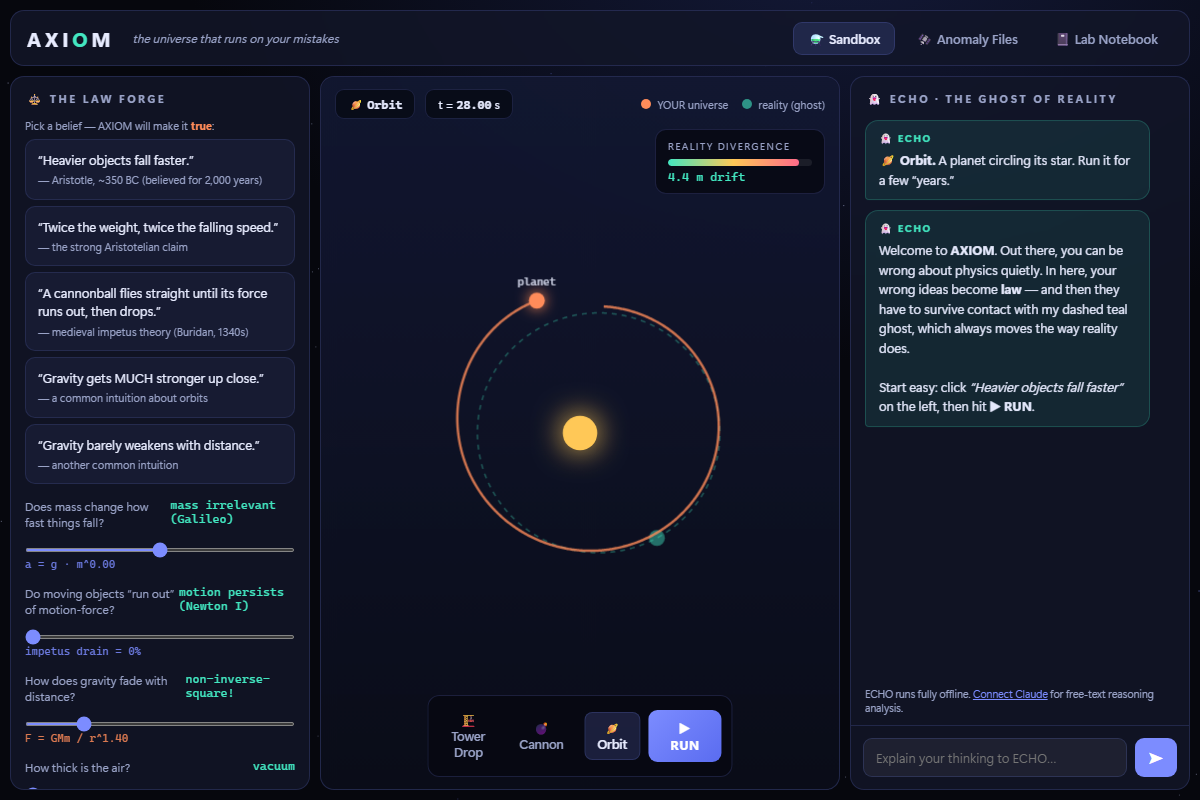
The entire product is one ~46 KB HTML file — HTML5 Canvas, CSS, and vanilla JavaScript, zero dependencies. One numerical integrator advances both universes each frame with different law parameters, so "your" universe is never a canned animation — it's the same solver with your constants. Orbits use a falloff-normalized central force:
$$ a(r) = \frac{GM}{r_0^2}\left(\frac{r_0}{r}\right)^{\beta} $$
so changing \( \beta \) isolates exactly the concept being taught — \( \beta \neq 2 \) produces genuine precessing rosettes (Bertrand's theorem), the same signature that made Mercury famous. The misconception engine is a rule-based diagnostic over law-space backed by a database of misconceptions from the physics-ed literature; the optional Claude integration calls the Anthropic Messages API directly from the browser with a Socratic-only system prompt grounded in the live simulation state.
🧗 Challenges we ran into
- Making wrong physics behave. Naively changing gravity's exponent changes the force constant's units, so planets just plummeted into the star. Normalizing the force at the starting radius fixed it — now the exponent changes only the falloff, which is the actual concept.
- Modeling a belief, not an equation. Impetus theory isn't a formula anyone wrote down rigorously — we had to design a law (gravity suppressed while "motion-fuel" remains, then draining) that reproduces the exact flat-then-drop trajectory ~80% of first-year students draw.
- Keeping the AI Socratic. Both the offline engine and the Claude prompt are hard-constrained to never state the answer first — and in Anomaly mode the diagnosis engine had to be suppressed entirely so it wouldn't leak the case solution.
📚 What we learned
That the most powerful thing an AI can do in education is not be right — it's to make the student's wrongness visible and falsifiable. The simulation is the argument; the AI just asks the question that makes the evidence undeniable.
🚀 What's next
More misconception domains (circuits: "current gets used up"; thermodynamics: "cold flows"), classroom dashboards built on the Lab Notebook data, and shareable "broken universe" challenge links so students can corrupt a universe for their friends to diagnose.
♿ Accessibility
No login, no install, no internet, no data leaves the device. Runs on any school Chromebook or shared phone. Keyboard operable (Space = run, R = reset, 1–3 = scenarios), respects prefers-reduced-motion. The AI core needs no API key — so it reaches exactly the under-resourced classrooms AI ed-tech usually leaves behind.
Built With
- anthropic-api
- canvas
- claude
- css3
- html5
- javascript
- localstorage
- python
- reportlab

Log in or sign up for Devpost to join the conversation.