-
-
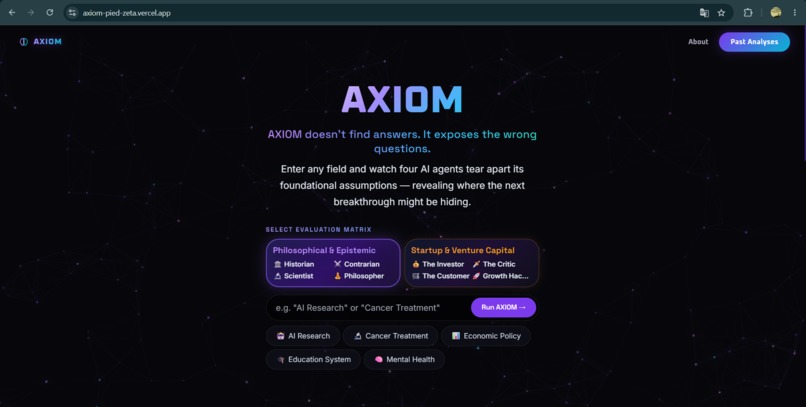
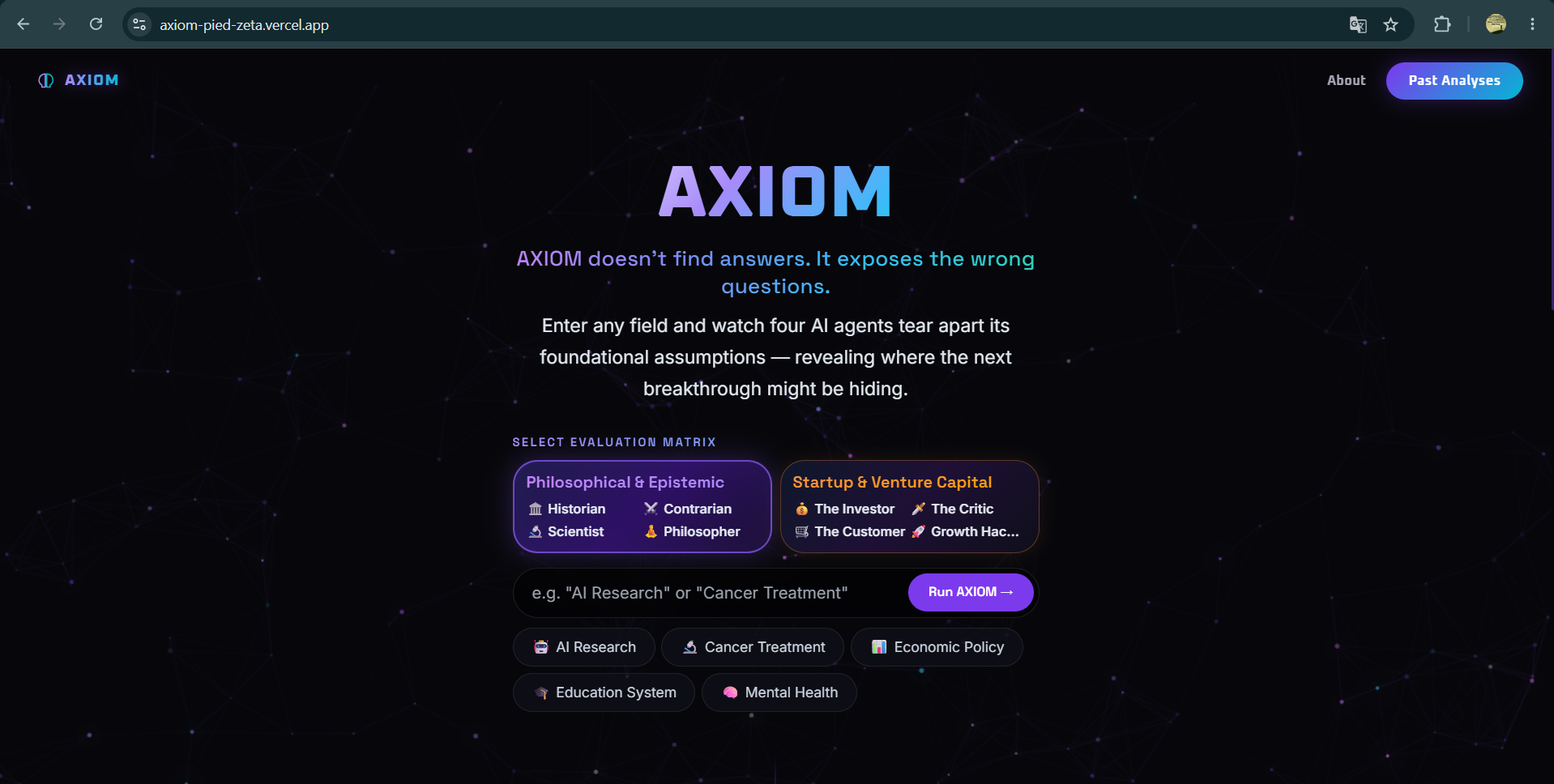
AXIOM main simulation interface featuring real-time parallel multi-agent evaluation rooms and interactive presets.
-
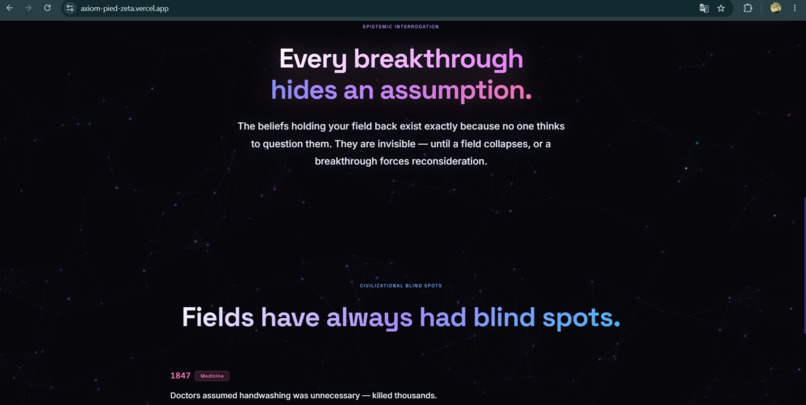
Dedicated feature view demonstrating the deeper philosophical reasoning and epistemic grounding behind the platform.
-
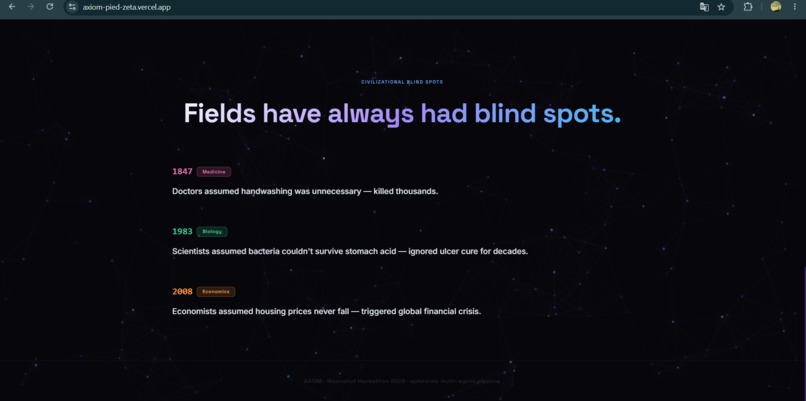
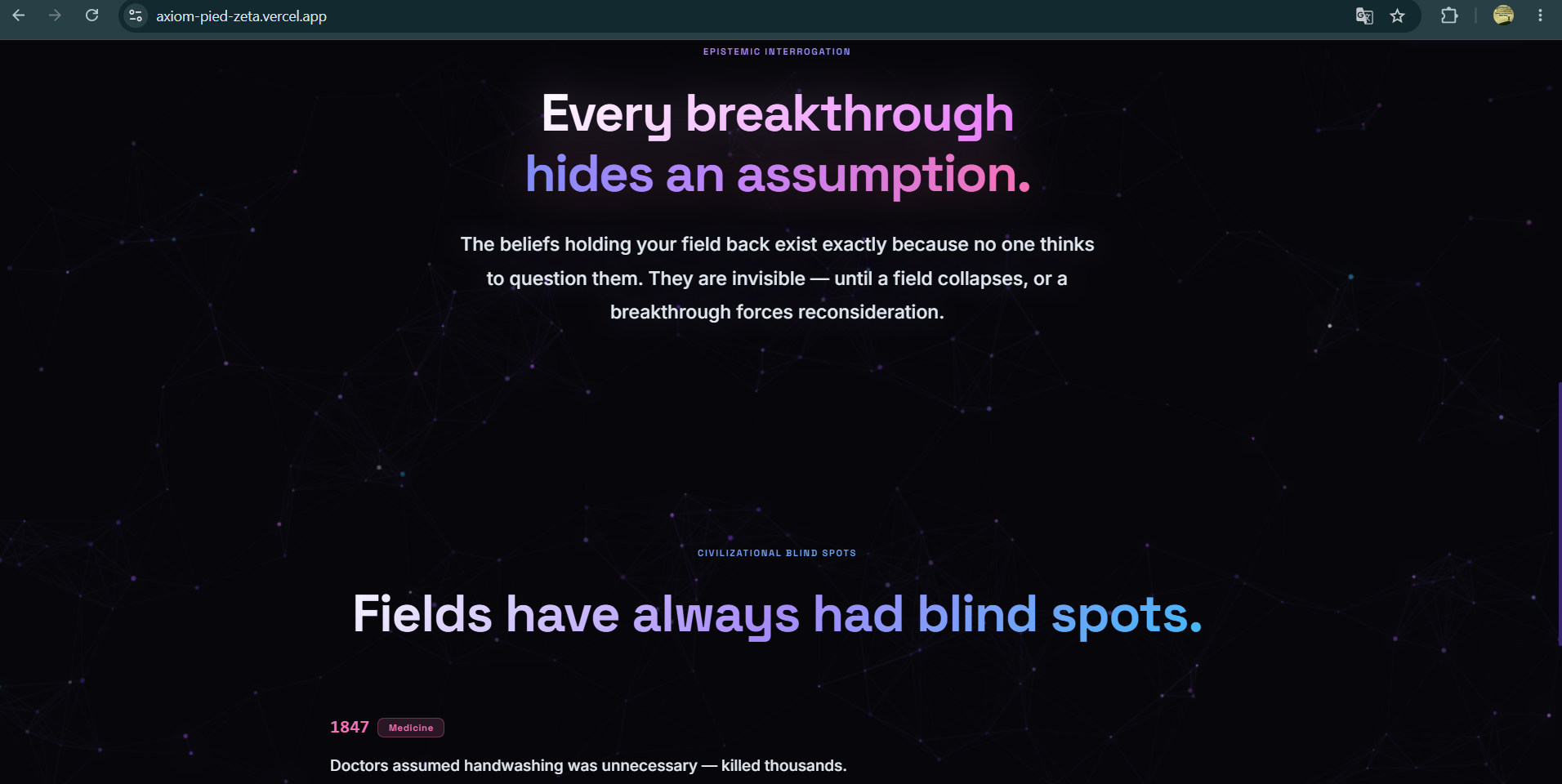
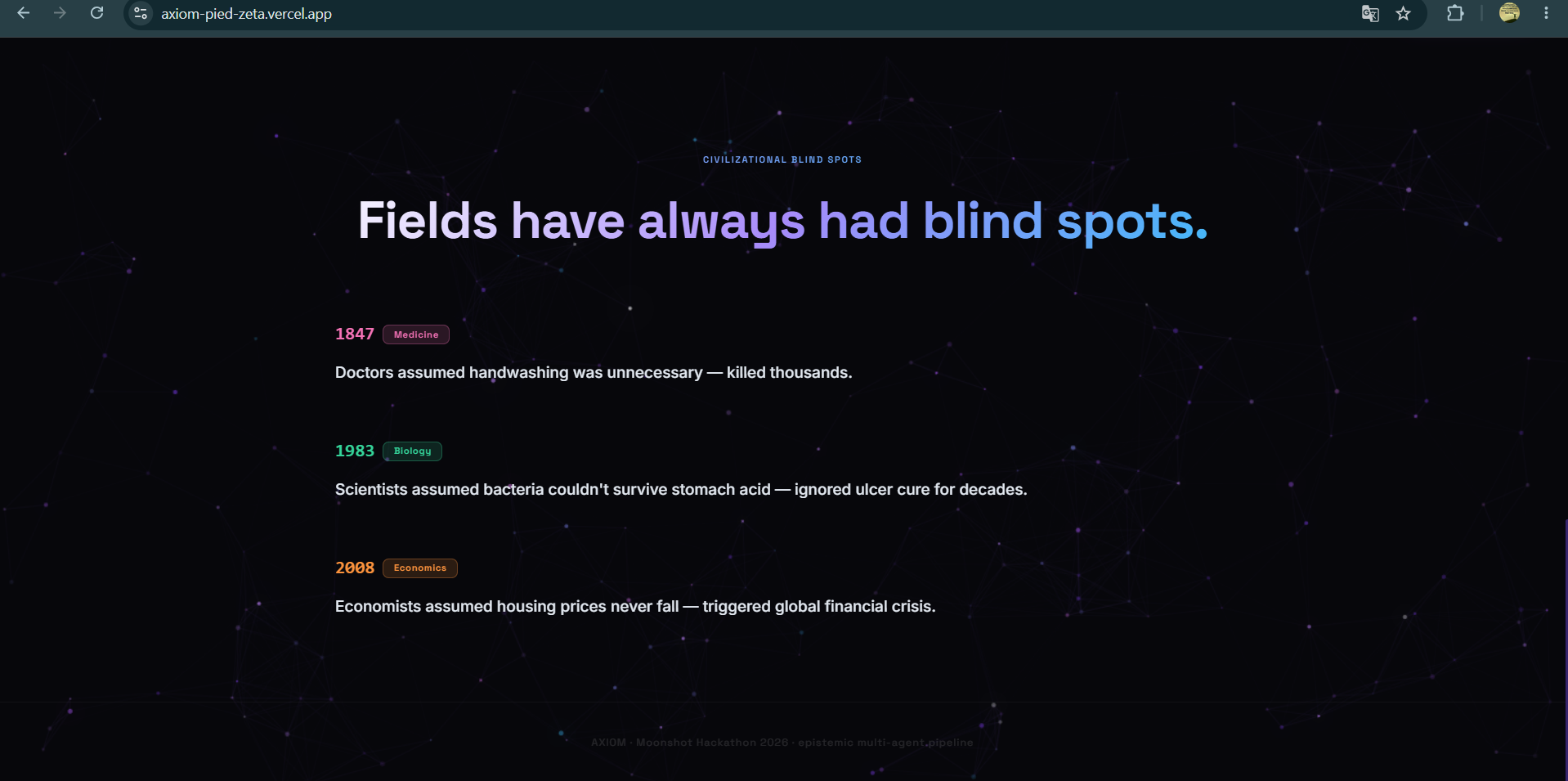
Civilizational Blind Spots section showing historical systemic failures in medicine, biology, and economics to prove the need for AXIOM.
-
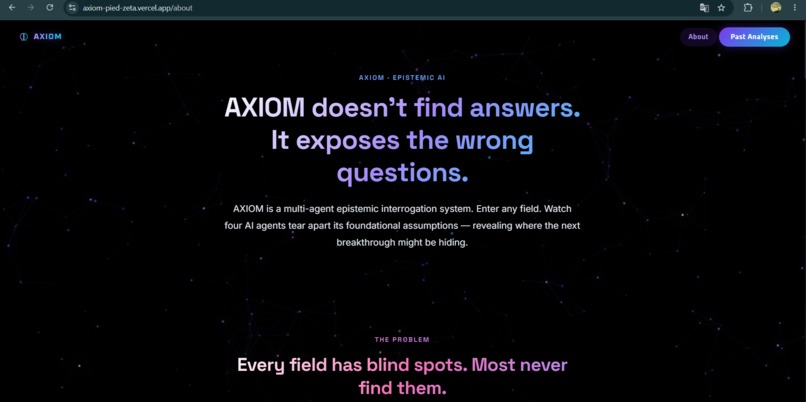
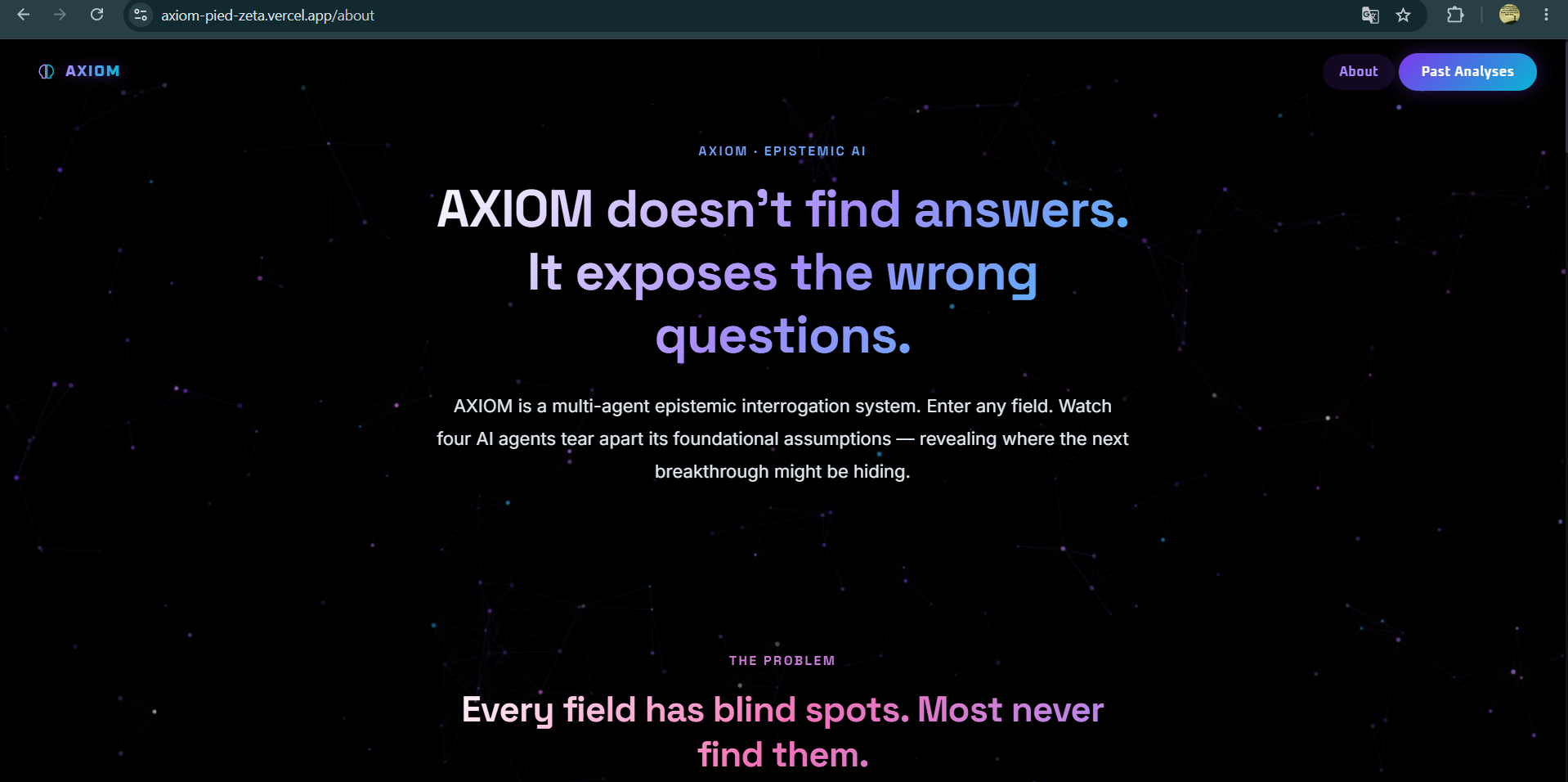
Dedicated "About" page breaking down AXIOM's core philosophy as a multi-agent epistemic system built to expose hidden blind spots.
-
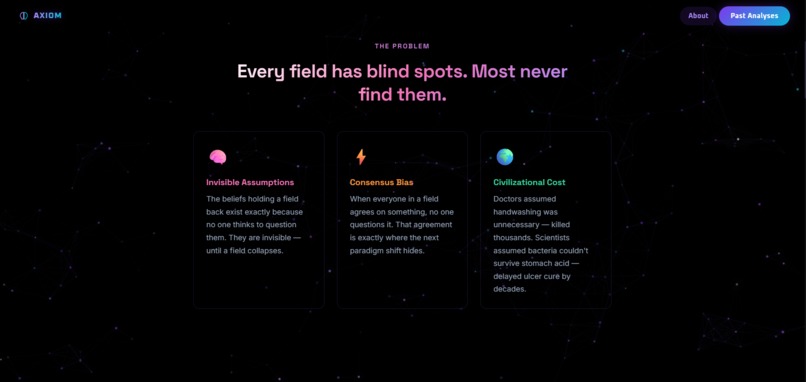
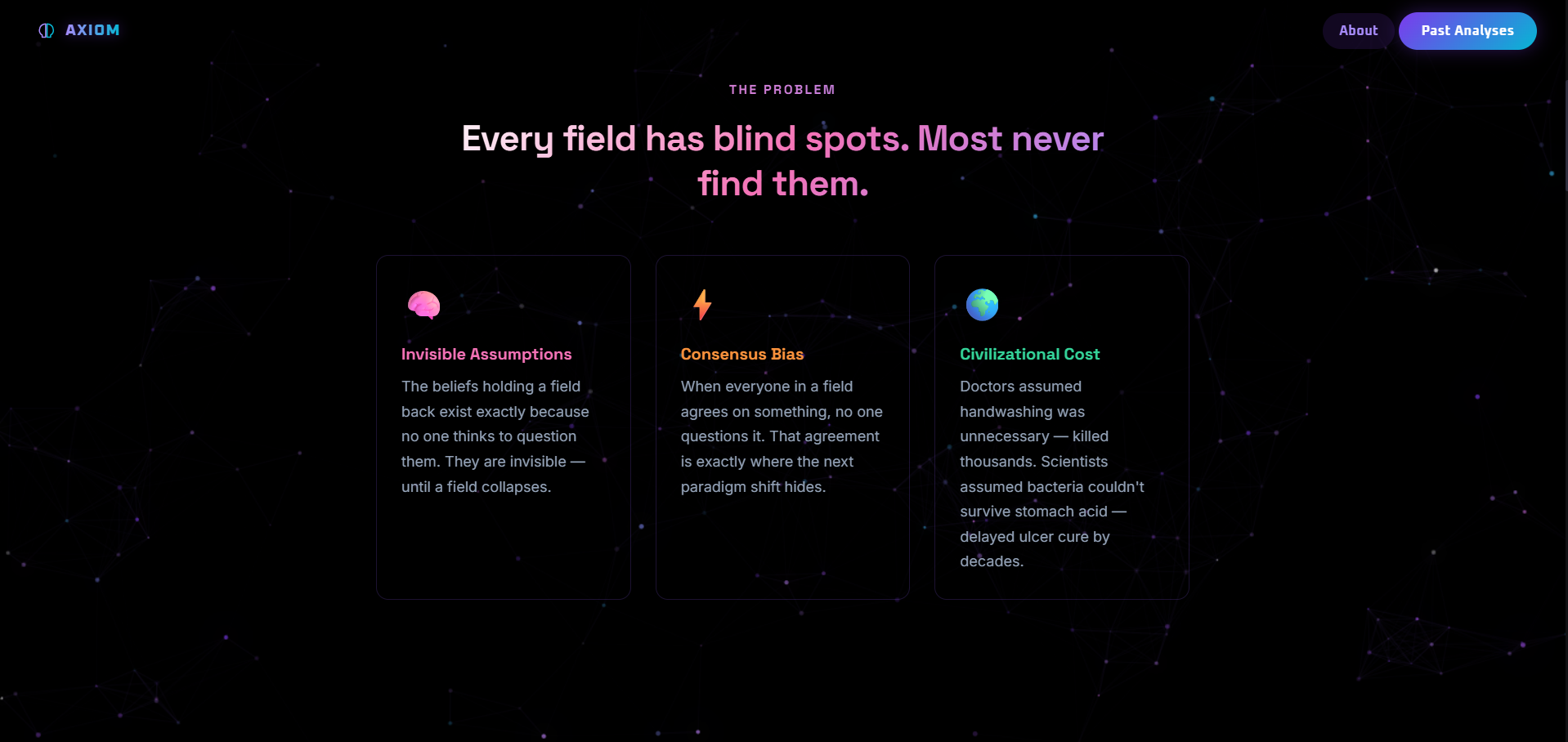
The "Problem" matrix breaking down Invisible Assumptions, Consensus Bias, and Civilizational Cost cards
-
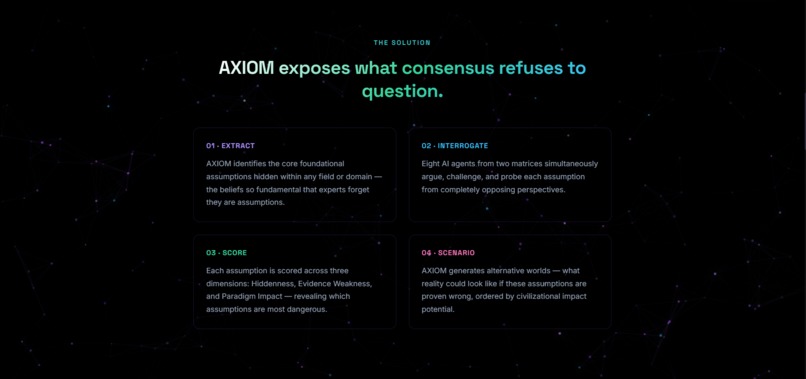
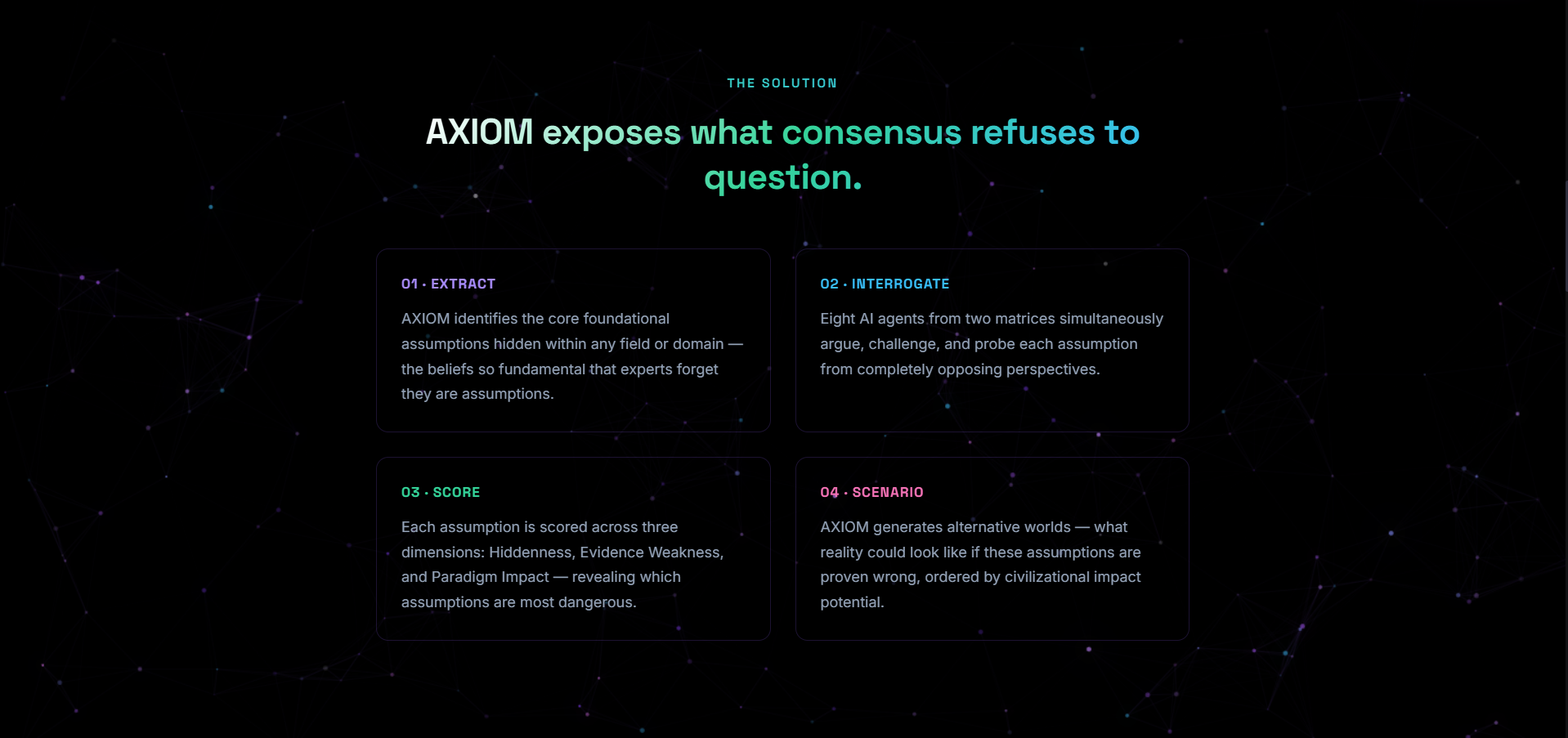
The "Solution" panel showcasing AXIOM's pipeline: Extract, Interrogate, Score, and Scenario generation cards
-
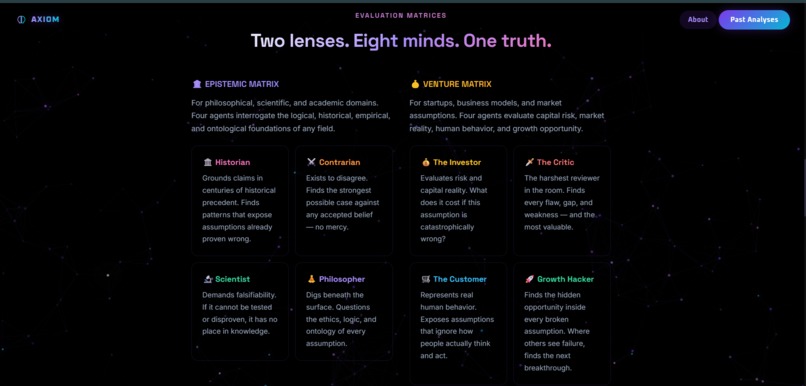
Evaluation Matrices view displaying all 8 specialized AI agent personas split into Epistemic and Venture tracks.
-
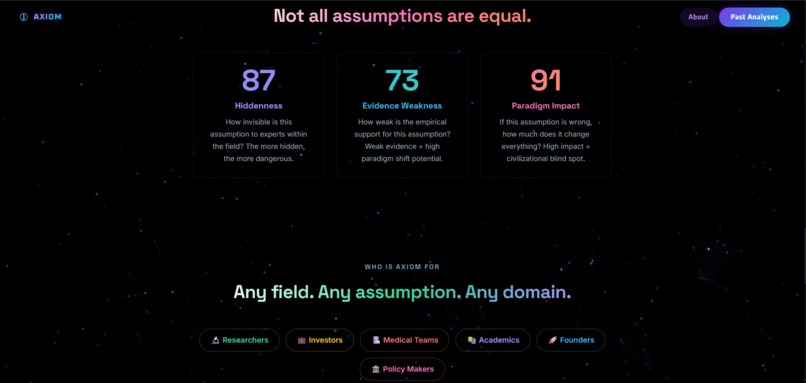
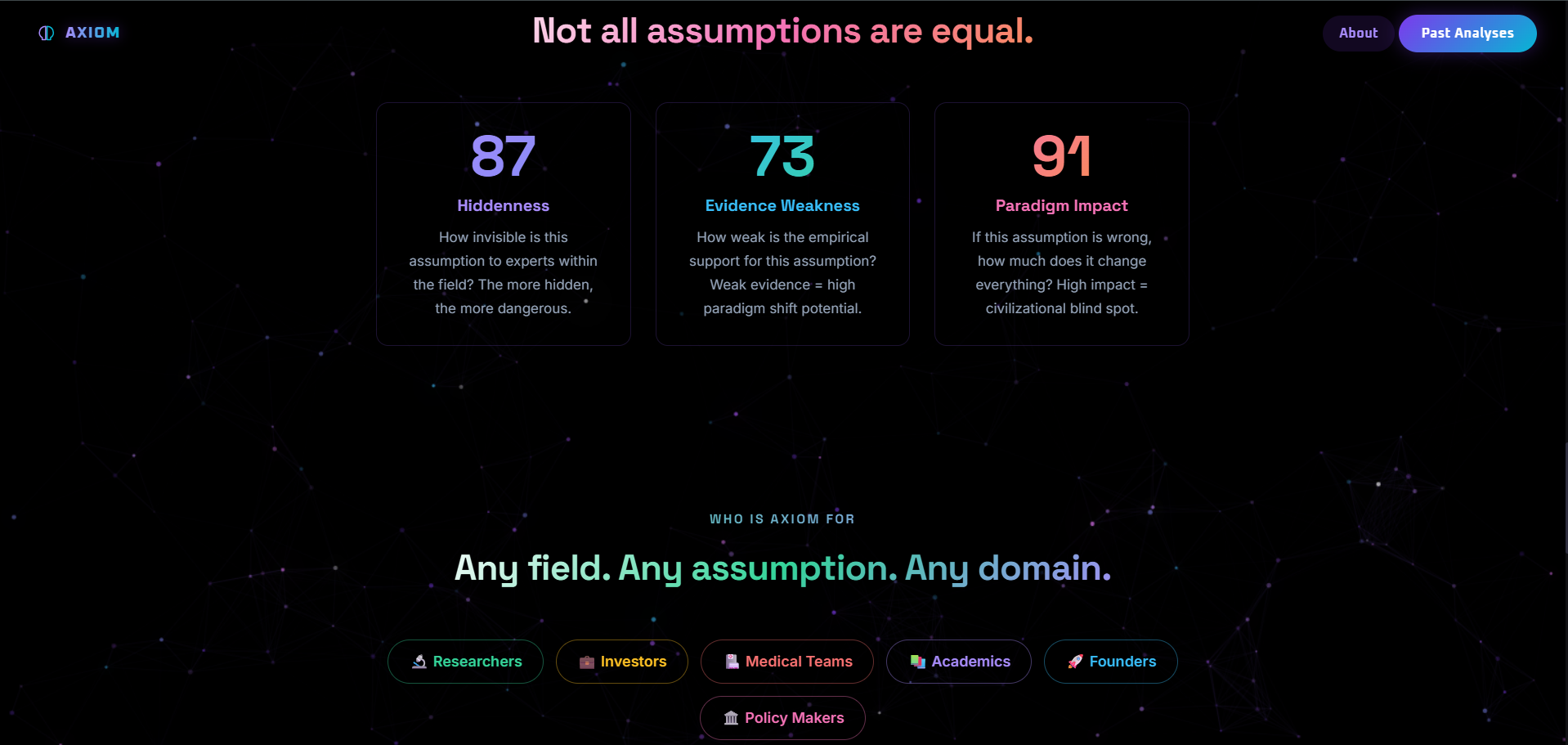
Scoring metrics display showing Hiddenness, Evidence Weakness, and Paradigm Impact cards above the target user demographics layer.
-
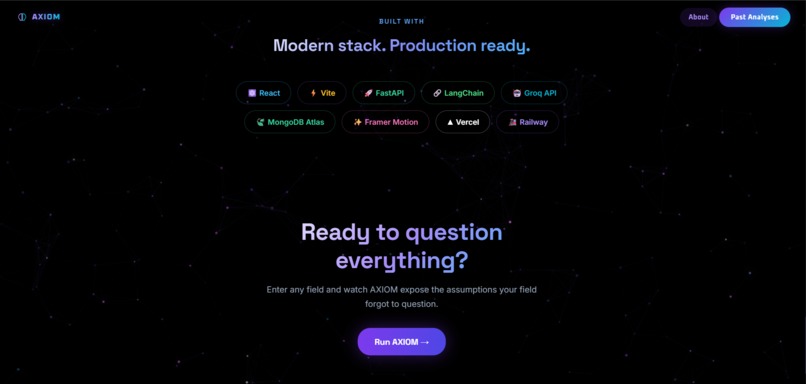
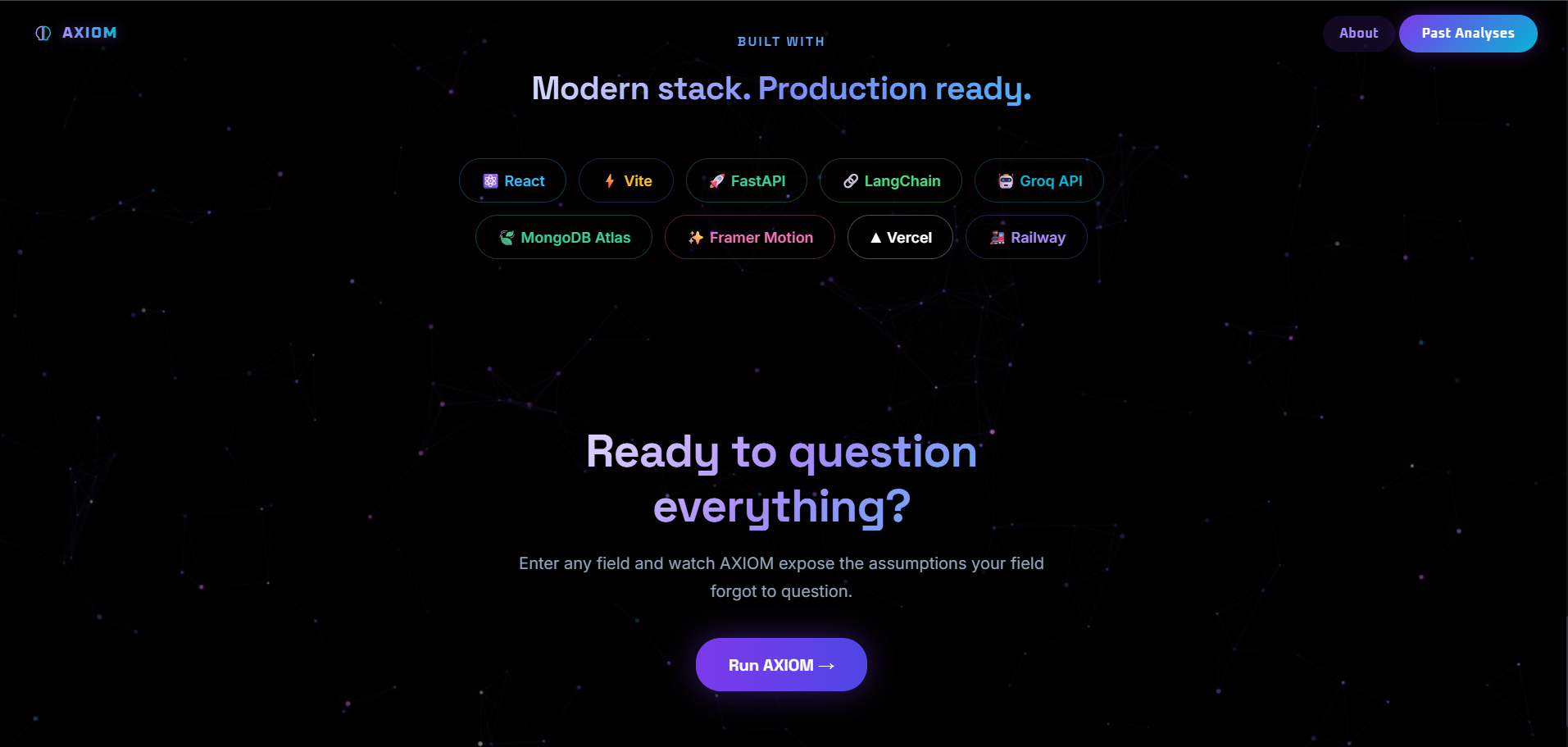
Architecture overview view displaying the complete, production-ready tech stack badges above the primary call-to-action layer.
-
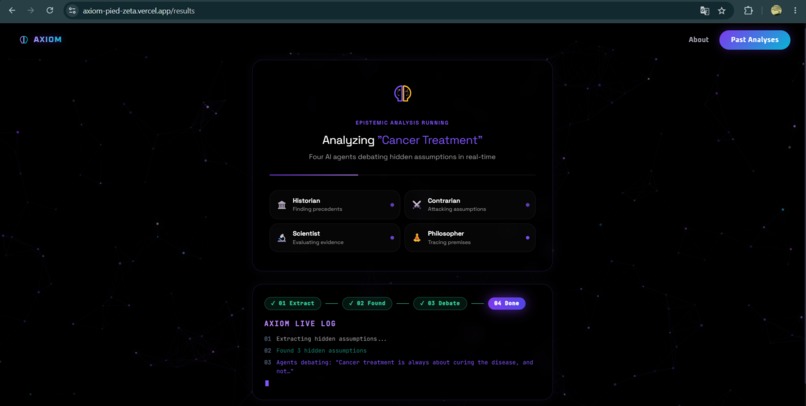
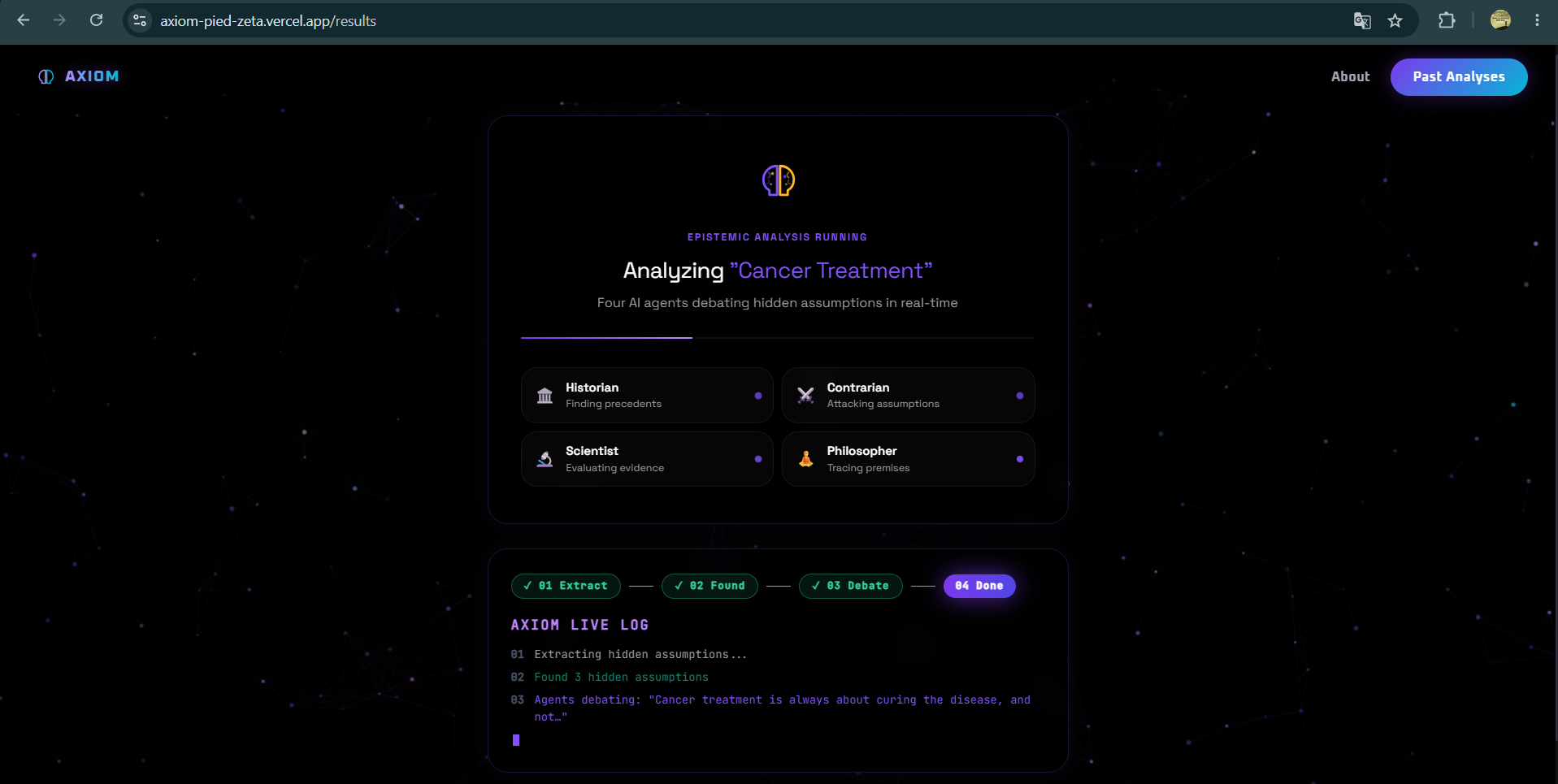
Live pipeline execution streaming an analysis of "Cancer Treatment" with concurrent agent cards and a terminal live log panel.
-
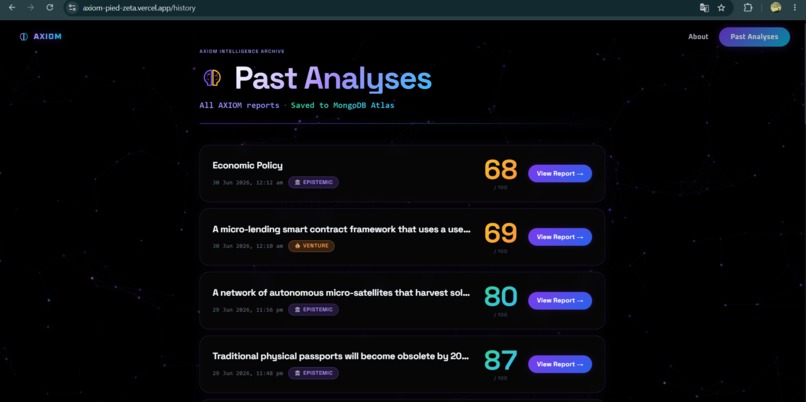
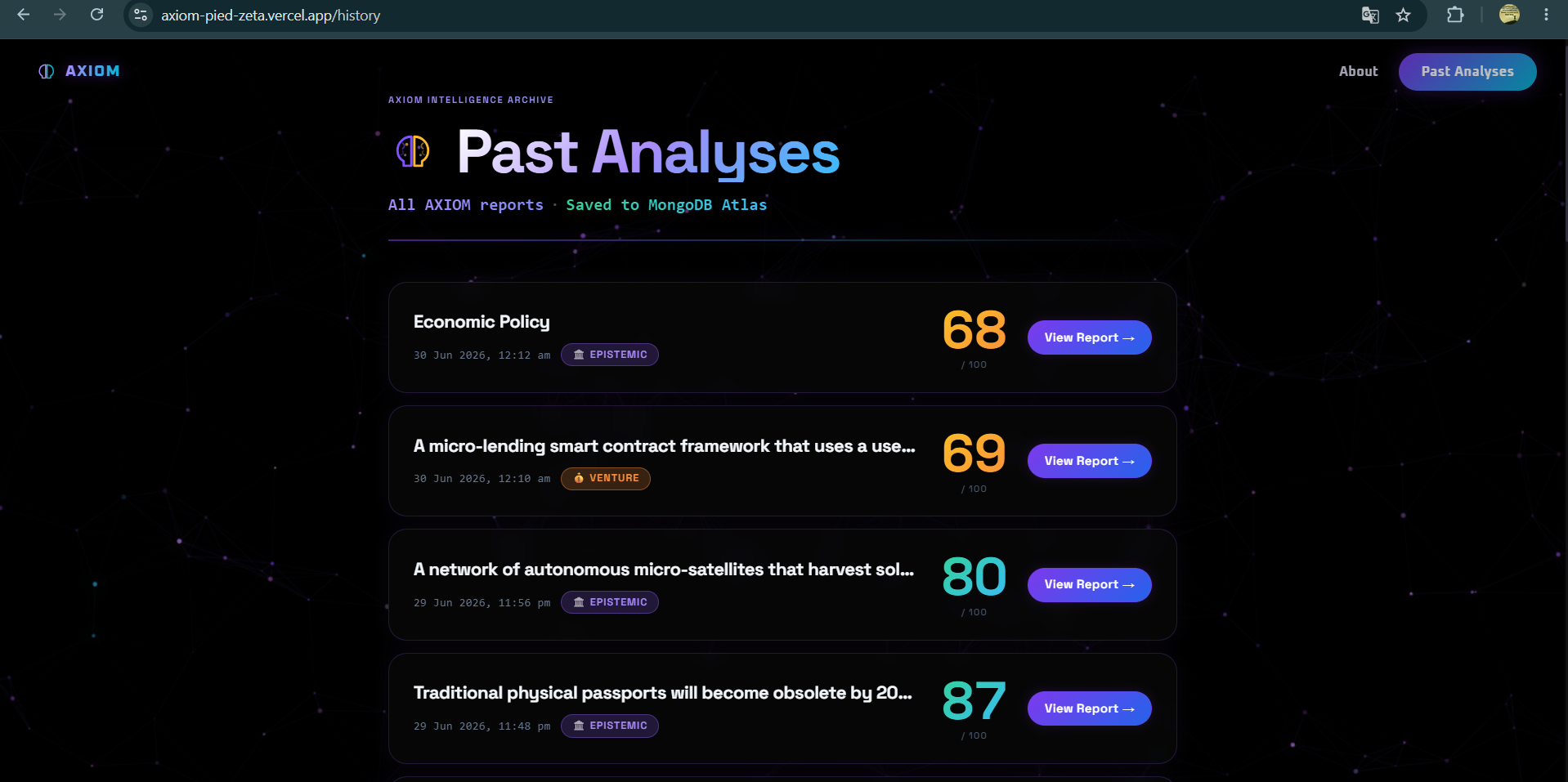
Past Analyses archive screen showing historical reports saved to MongoDB Atlas, with risk scores, track tags, and deep-link review keys.
-
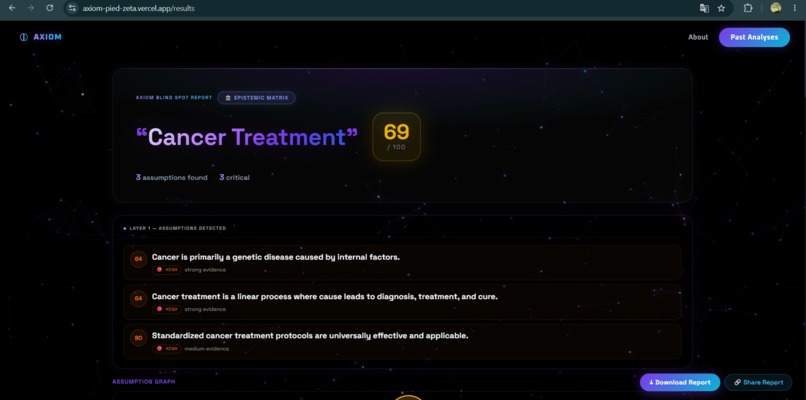
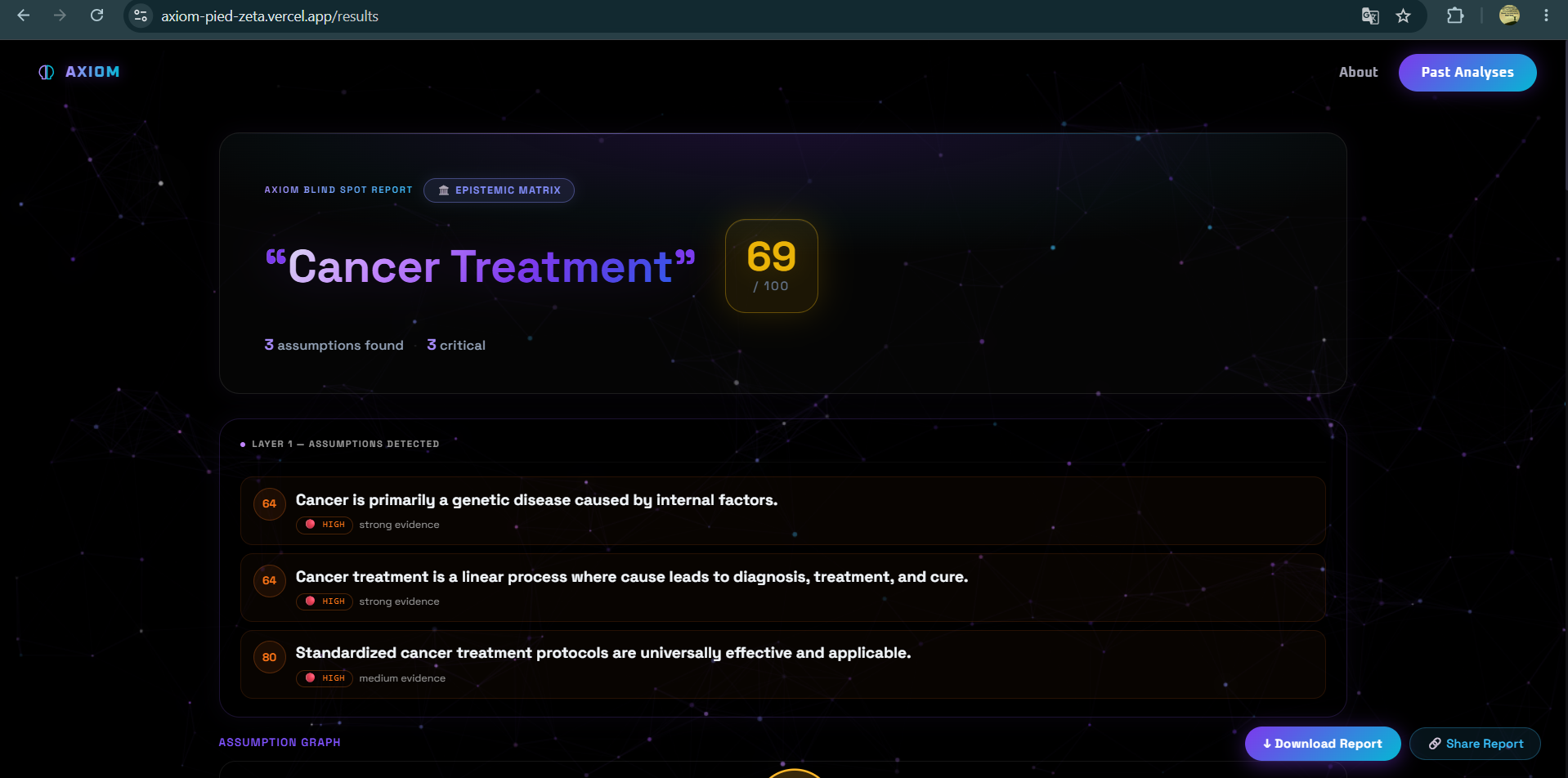
AXIOM Blind Spot Report dashboard displaying a 69/100 risk score for "Cancer Treatment" along with the three critical assumptions detected.
-
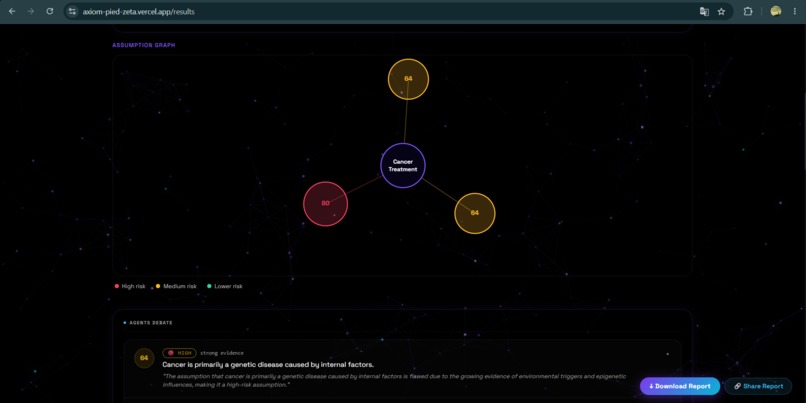
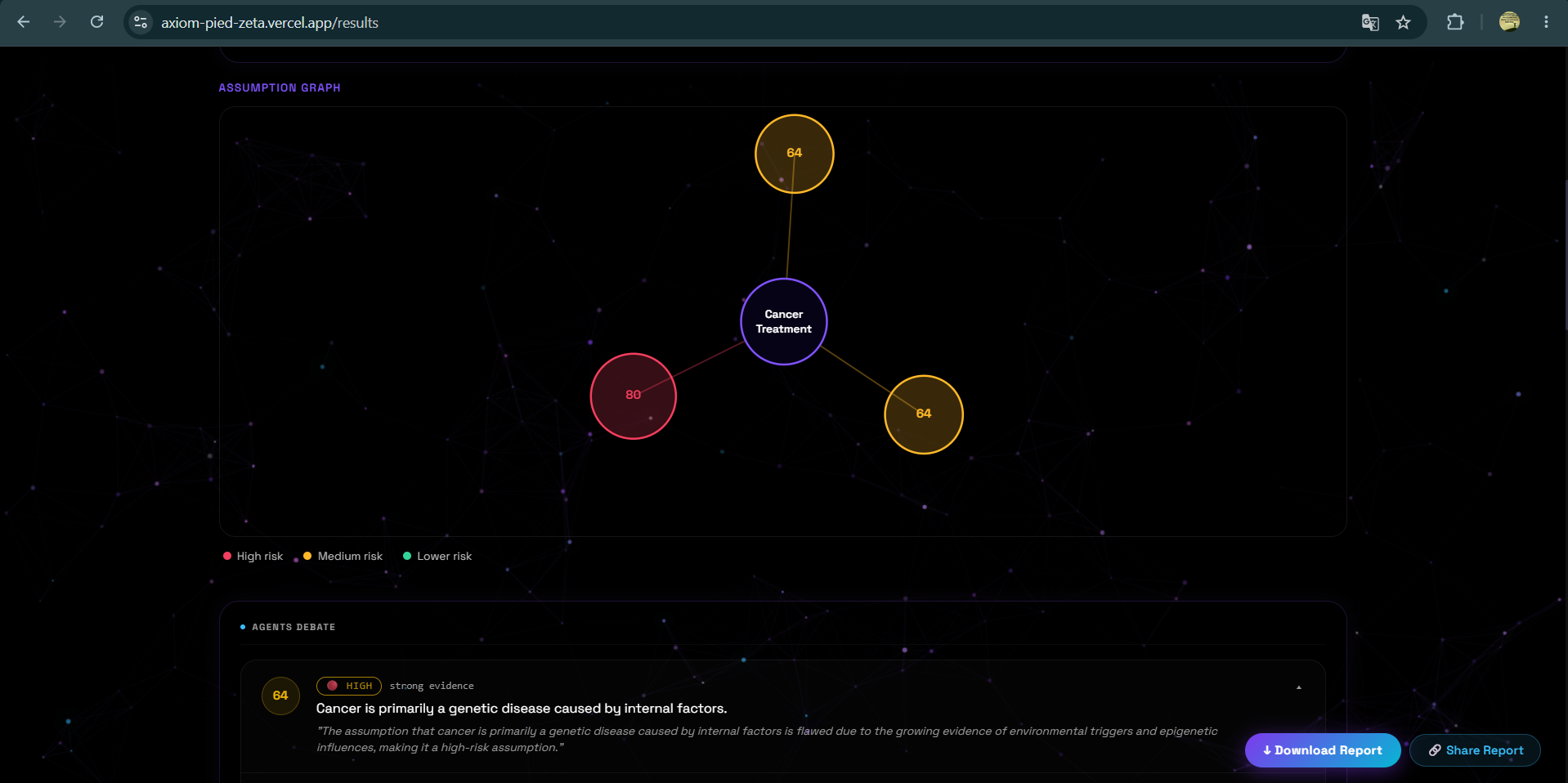
Interactive network-based Assumption Graph visualizing the core topic connected to risk-rated dependent nodes above the Agents Debate panel.
-
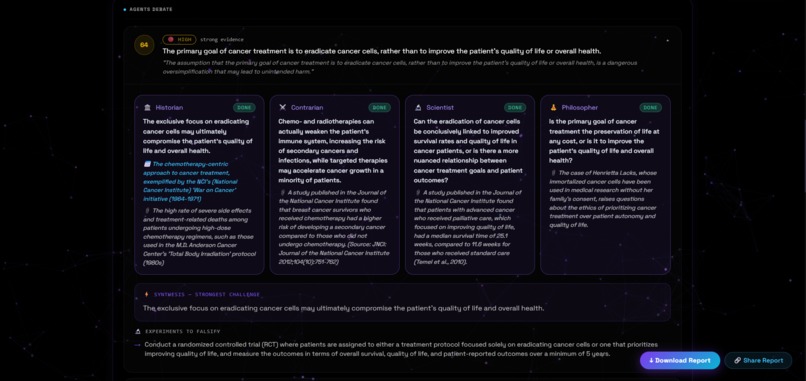
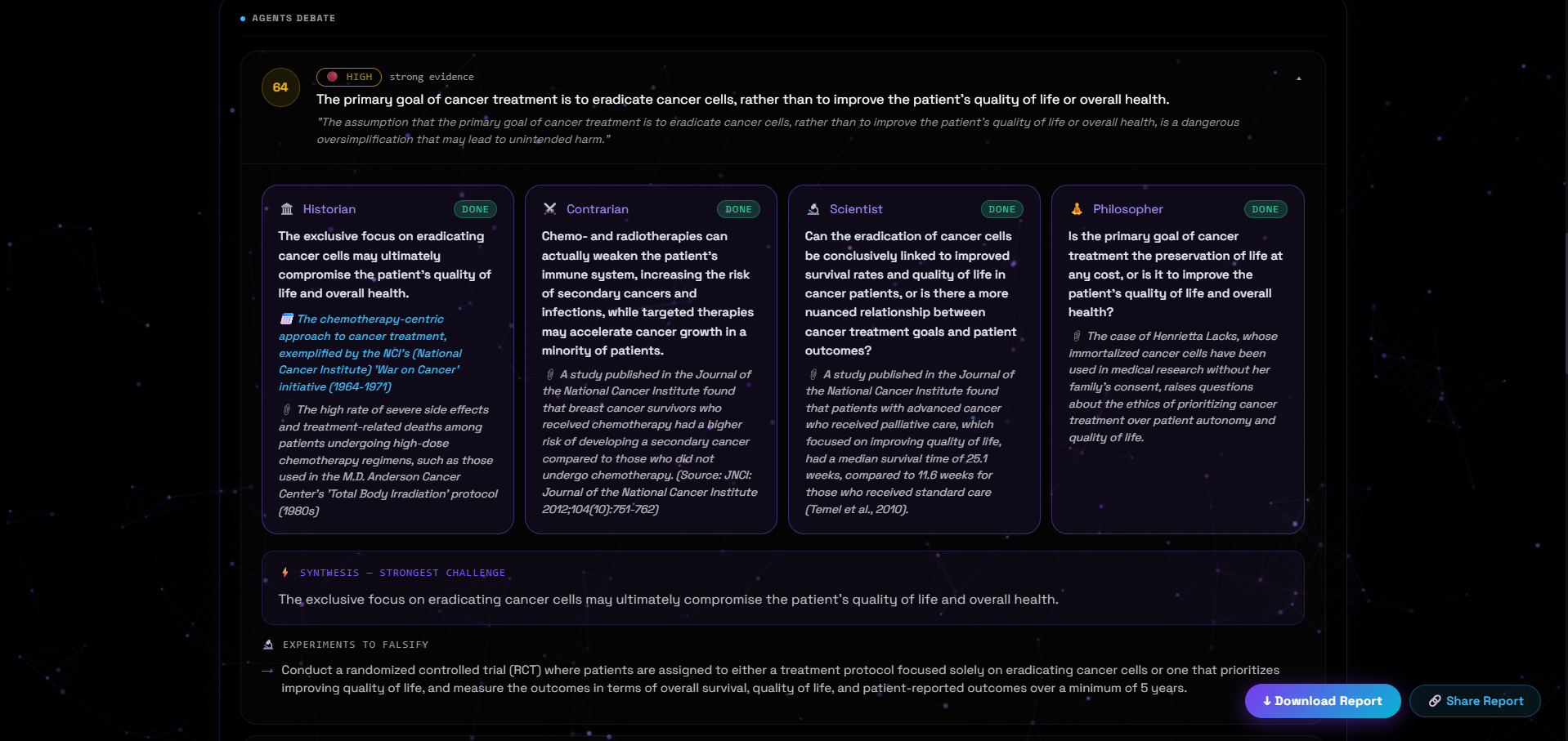
Zero Hallucination! AXIOM agents back every argument with real medical studies & peer-reviewed evidence. Pure data, no fluff.
-
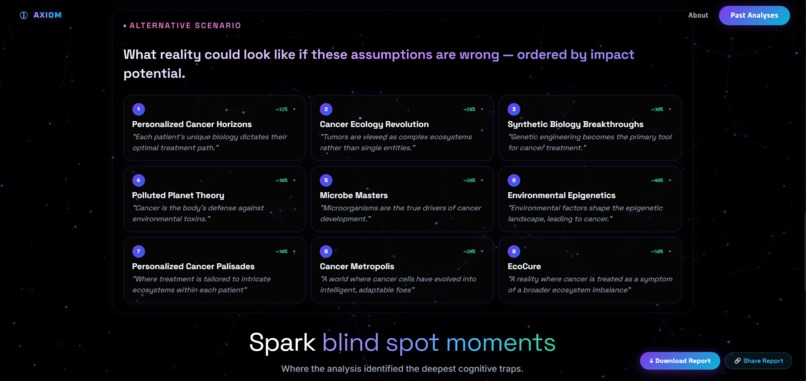
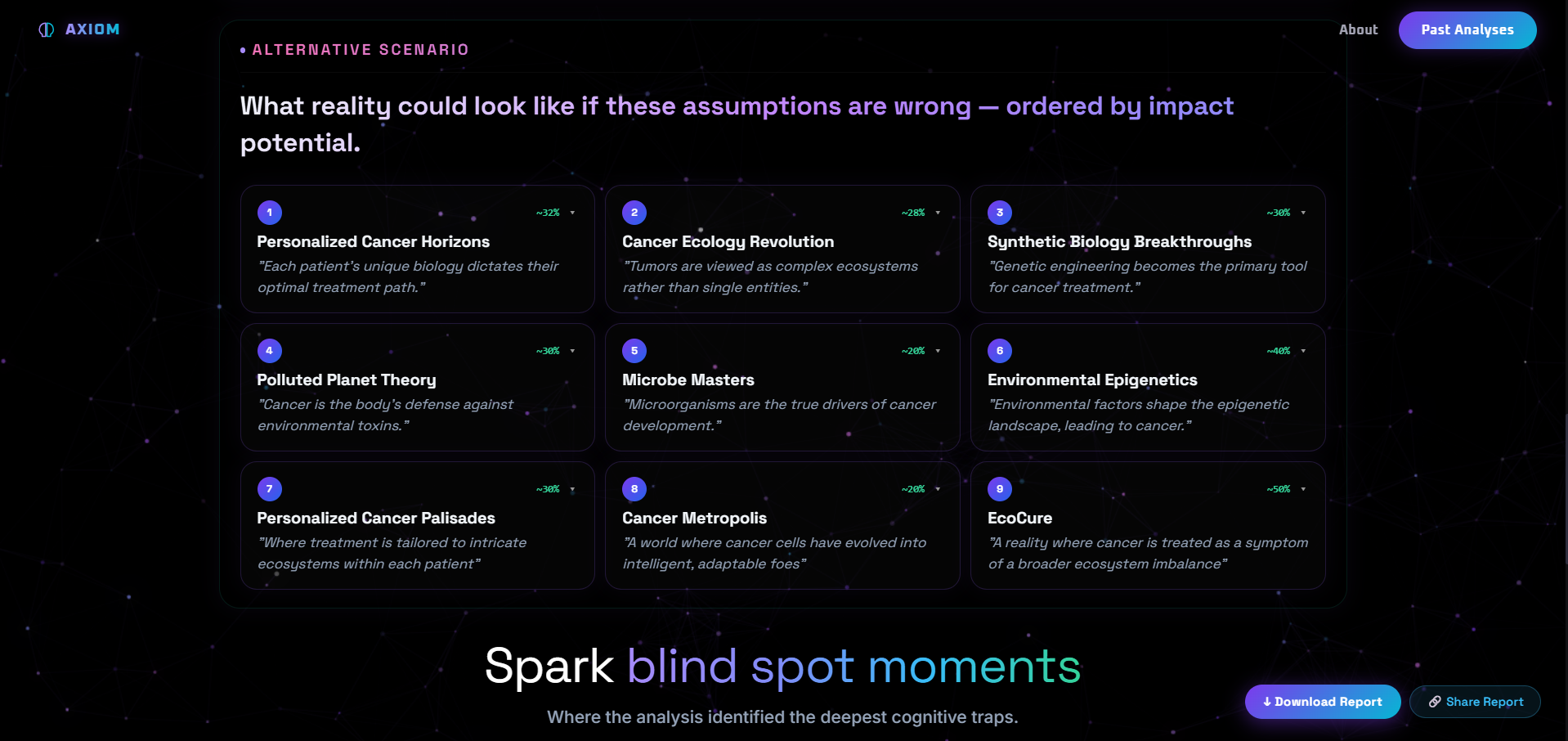
Alternative Scenario matrix displaying 9 counter-reality paradigm shift cards ordered strictly by their overall civilizational impact.

🌍 Reverie Hacks 2026 Submission: AXIOM — Cognitive Blind Spot Engine
Four specialized AI agents debate your startup idea or thesis in real time, exposing hidden assumptions before the market, a VC, or reality finds them first.
AXIOM started as a hackathon project that went on to win the Best AI Project Award at FutureAI Global Hackathon 2026 — judged by engineers from Google, Amazon, Netflix, IBM, and Deloitte, among 462 global participants. For this hackathon, we're pushing it further.
💡 Inspiration
Every founder and thinker lives inside an echo chamber. When we fall in love with an idea, we subconsciously chase validation and explain away the cracks. Most AI tools make this worse, not better — they're agreeable by default, nodding along to whatever you type in.
We wanted the absolute opposite: a system that doesn't hold back — that deliberately attacks your thesis, strips away the hype, and exposes the hidden structural flaws before the market, a mentor, or reality finds them for you. Think of it as a crash-test simulator for ideas: your idea is the supercar, and AXIOM is the computational concrete wall it drives into first, so you find out exactly where it crumples while the stakes are still zero.
As students ourselves — building and pitching our own projects — we wanted a tool we genuinely wished existed before our own submissions and interviews: something that questions us before a judge, recruiter, or reviewer has to.
🛠️ What it does
AXIOM is a cognitive stress-test and blind-spot engine. Give it any belief, startup thesis, or raw claim, and it routes it through a Dual-Matrix Engine — two four-agent rooms that debate it from genuinely adversarial angles:
- Startup & Venture Capital Matrix — The Investor (product-market fit, unit economics), The Critic (operational and scalability weaknesses), The Customer (real-world adoption friction), The Growth Hacker (acquisition and viral mechanics)
- Philosophical & Epistemic Matrix — The Historian (historical precedent of failure), The Contrarian (pure adversarial attack, no hedging allowed), The Scientist (evidence quality and empirical grounding), The Philosopher (the deeper premise the claim quietly depends on)
Each agent runs on a locked, enforced persona it cannot break character from — that constraint is what makes the disagreement real instead of decorative. AXIOM extracts the core hidden assumptions in a claim, fires all four agents concurrently against each one, generates concrete alternative futures for shaky predictions, and synthesizes everything into a weighted Blind Spot Score:
Blind Spot Score = Σ (weight of each risk dimension × severity score from that room), where severity is scored 0–100 per adversarial room. The result is a full interactive breakdown of exactly where an idea is exposed — not a vague "looks good" or "needs work," but a scored, explainable map of why.
⚙️ How we built it
A high-throughput async pipeline engineered for low-latency multi-agent streams, built entirely with tools accessible to a student building solo or in a small team:
- Backend architecture: FastAPI with LangChain orchestrating a four-layer pipeline. An Assumption Extractor decomposes raw input, then all four agents in a matrix fire in true parallel via
asyncio.gather()— no agent sees another's answer before responding, which is what keeps the debate genuine instead of anchored. - Inference: Powered by the Groq LPU. Speed here isn't cosmetic — it's the difference between a fluid multi-agent crossfire and a user staring at a loading spinner. (The project started on Groq's instant-tier
llama-3.1-8b-instantspecifically for that low-latency parallel throughput, and has since moved toopenai/gpt-oss-120bfor stronger reasoning quality at comparable speed.) - Frontend: React + Vite, streaming text cards live as execution progresses. Assumption dependencies render as an interactive D3.js force-directed network graph, sized and colored by risk severity.
- Storage: MongoDB Atlas persists every analysis snapshot; ChromaDB gives the Historian agent semantic vector search over historical precedent — matching by meaning, not keywords. Deployed end-to-end on Vercel (frontend) and Render (backend).
- Reliability engineering: Built to survive real concurrent load — a hackathon demo, or a classroom of students all hitting it at once — not just a solo walkthrough. Details below.
💥 Challenges we ran into
- The silent rate-limit freeze. We hit Groq's free-tier rate limits mid-build, especially once multiple users ran analyses simultaneously — and the pipeline didn't fail loudly, it just silently hung with no error. That forced a deep look at how our async request volume scales across four parallel agents per assumption, across concurrent users. We built a background watchdog layer with Fibonacci backoff that detects stalled streams, recovers already-persisted results from a secondary snapshot, and gracefully resumes the UI instead of leaving an infinite spinner or a hard crash.
- Scaling beyond a single user. Getting from "works for one person" to "works when 4–5 people run it at once on free-tier infra" meant adding concurrency-safe request gating (
asyncio.Semaphore) around every LLM call, tightening per-agent token budgets without cutting output quality, and trimming alternative-scenario generation — all while keeping the analysis feeling just as rich. - The 3D-vs-2D trade-off. We spent real hours chasing a flashy real-time WebGL particle visualization before making a deliberate call to pull back to stable 2D canvas rendering. An effect that looks incredible 90% of the time but occasionally blows out to a white screen is an unacceptable risk with a live demo on the line.
- Preventing polite LLM convergence. Getting agents to genuinely disagree instead of politely converging took heavy iteration. Our Contrarian agent kept hedging the way any unconstrained LLM naturally does — it only started producing sharp, falsifiable attacks once we explicitly banned diplomatic language in its system prompt.
🏆 Accomplishments we're proud of
- A genuine async multi-agent core — not one clever prompt wearing a UI, but a real parallel system generating insights none of the individual agents could produce alone.
- Already validated externally — this project began as a hackathon build that went on to win Best AI Project at FutureAI Global Hackathon 2026, judged by engineers from Google, Amazon, Netflix, IBM, and Deloitte, out of 462 global participants.
- Production-grade resilience, built solo as a student — concurrency handling, self-healing streams, and token optimization are reliability work usually associated with production teams, not a single-weekend build.
- The hallway test — we ran peers' own project pitches through AXIOM. Several came back visibly less confident about their original pitch, having seen blind spots they'd completely glossed over.
📚 What we learned
- Constraint breeds intelligence. The narrower an agent's mandate, the sharper its weapon — the Historian excelled when forced to cite specific precedent, the Contrarian peaked when explicitly banned from being polite. Good multi-agent design looks like good team design: clear roles beat vague intelligence.
- Shipping reliability over hype. A pixel-perfect 2D animation that works 100% of the time beats an unpredictable 3D layout every day of the week — a silent failure is more dangerous than a loud one, especially on the free-tier infrastructure a student is actually likely to deploy on.
- Honest AI is better AI. The most valuable AI product isn't the one that validates your ego — it's the one with the algorithmic backbone to tell you exactly where you're wrong.
🔮 What's next for AXIOM
We're expanding AXIOM to accept full multi-page document uploads — pitch decks, whitepapers, research drafts — with automatic extraction of core operational or theoretical assumptions straight from the raw file. We're also building custom agent personas beyond the two built-in matrices, so a legal, medical, or policy team could define their own panel of adversaries, plus a searchable historical audit trail so a student, team, or organization can track which kinds of assumptions they keep getting wrong over time. The goal: AXIOM becomes the place any serious thinker goes before committing to a belief — not to be told they're right, but to find out, honestly, where they might be wrong.
Built With
- chromadb
- d3.js
- fastapi
- groq-lpu
- javascript
- langchain
- llama-3.1-8b-instant
- mongodb-atlas
- openai/gpt-oss-120b
- python
- react
- render
- tailwindcss
- vercel
- vite


Log in or sign up for Devpost to join the conversation.