Inspiration
The biggest bottleneck in neurotechnology and Brain-Computer Interface (BCI) development is data acquisition. Gathering empirical human EEG data requires expensive medical-grade hardware, navigating institutional review boards (IRBs), and managing strict privacy and HIPAA liabilities.
For everyday developers, students, and independent researchers, even testing a pipeline or training a baseline model becomes inaccessible due to these barriers.
We asked ourselves:
What if we could completely remove hardware friction and cloud latency by shifting the entire synthetic data pipeline directly into the browser?
That question led to the creation of Axiom Neural
What it does
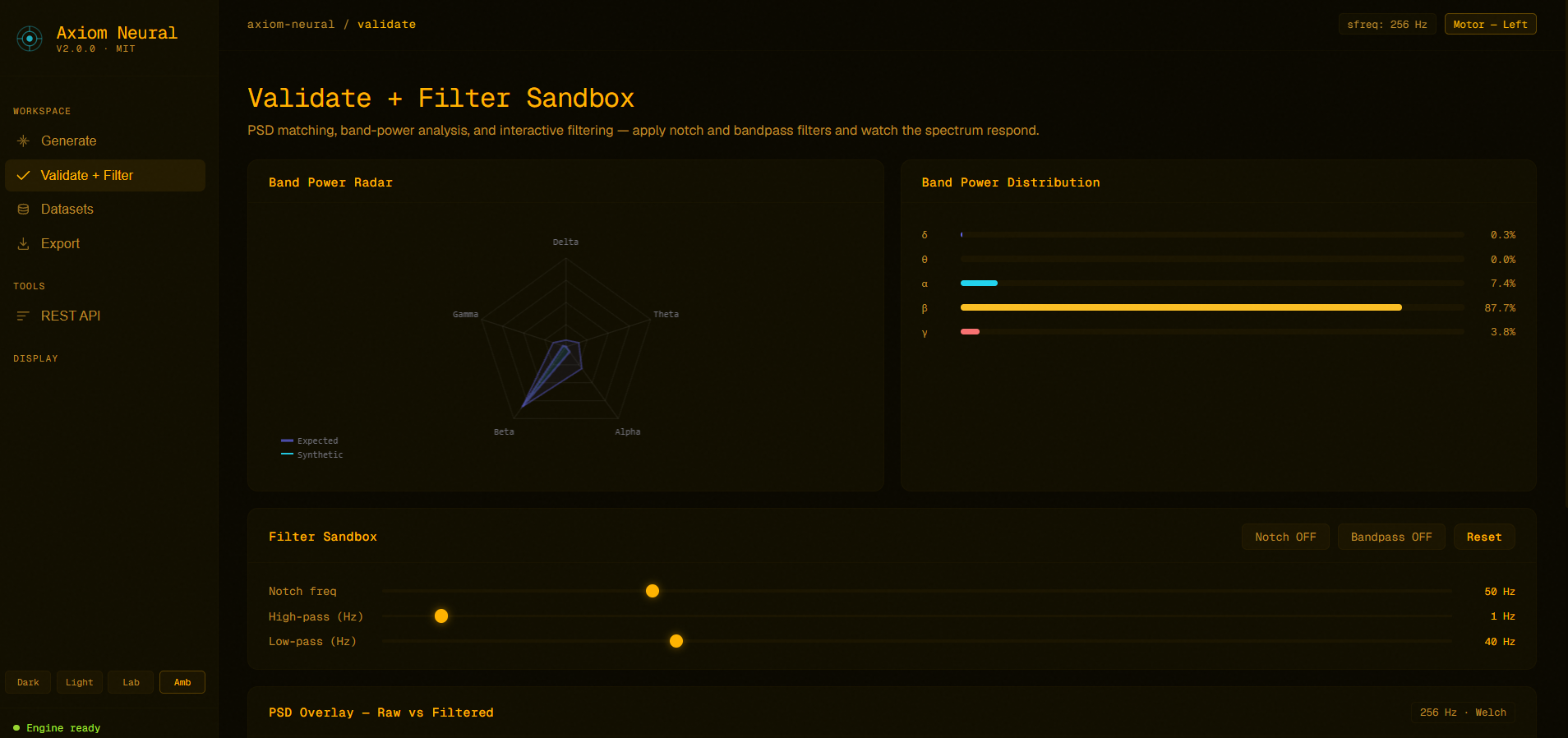
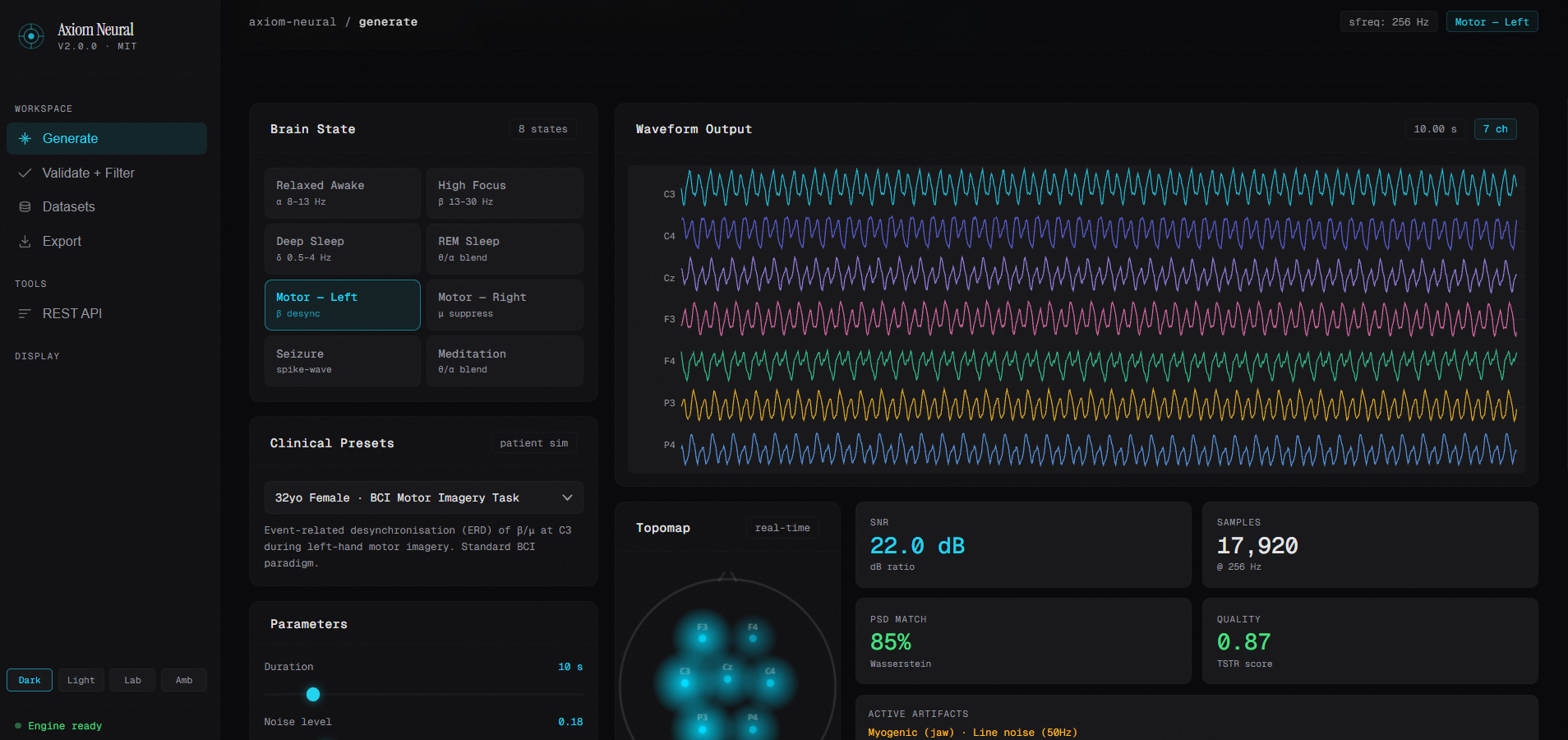
Axiom Neural is a high-performance, browser-native synthetic EEG generator that simulates high-fidelity 16-channel brainwaves in real time with zero backend servers or cloud dependencies.
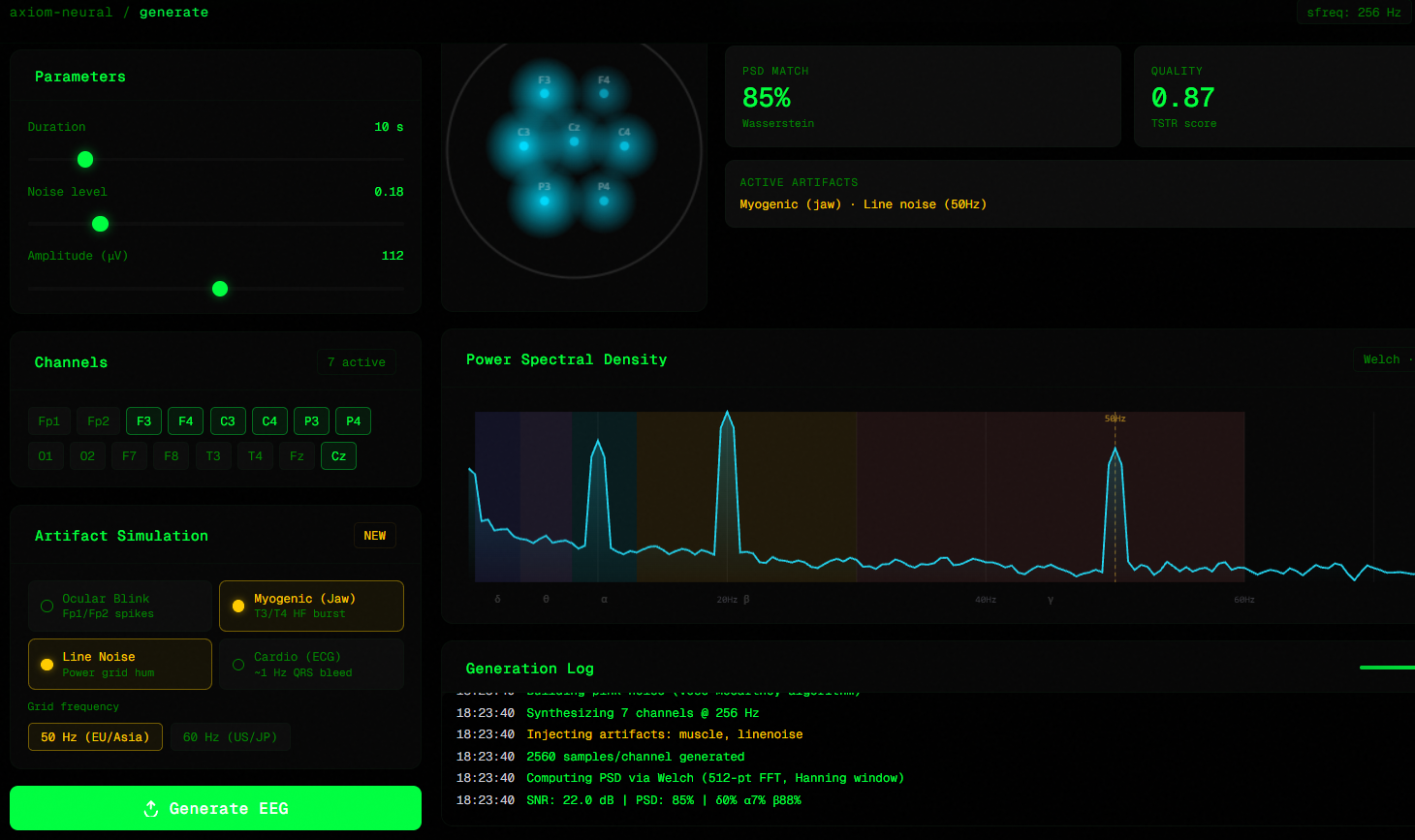
Through a minimalist interface, users can manipulate parametric sliders to control:
- Alpha waves
- Beta waves
- Theta waves
- Delta waves
- Gamma waves
The application injects localized chaotic noise, validates the statistical fidelity of the generated output against baseline datasets, and streams the results instantly.
Researchers can then:
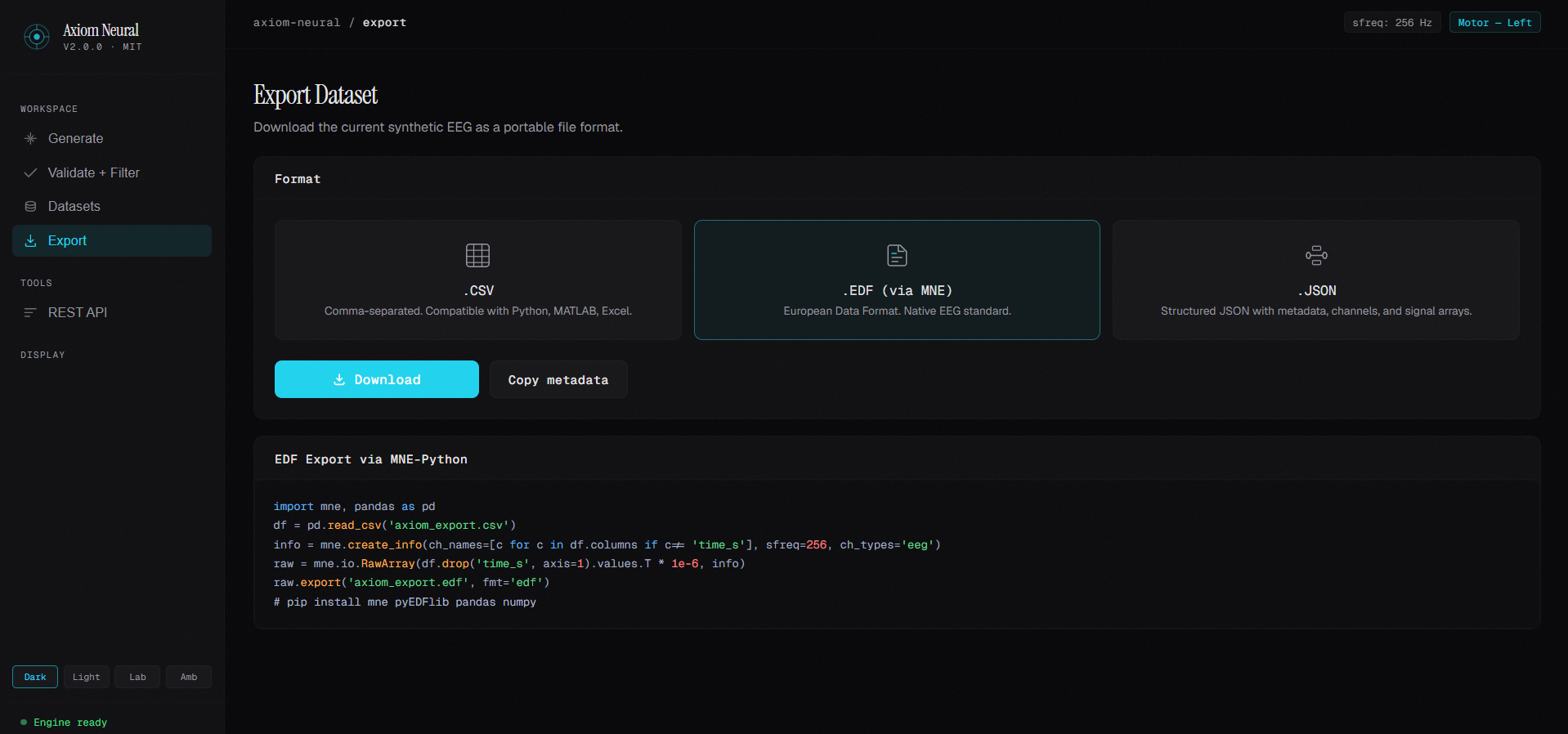
- Download structured EEG data matrices
- Copy dynamically generated code blocks
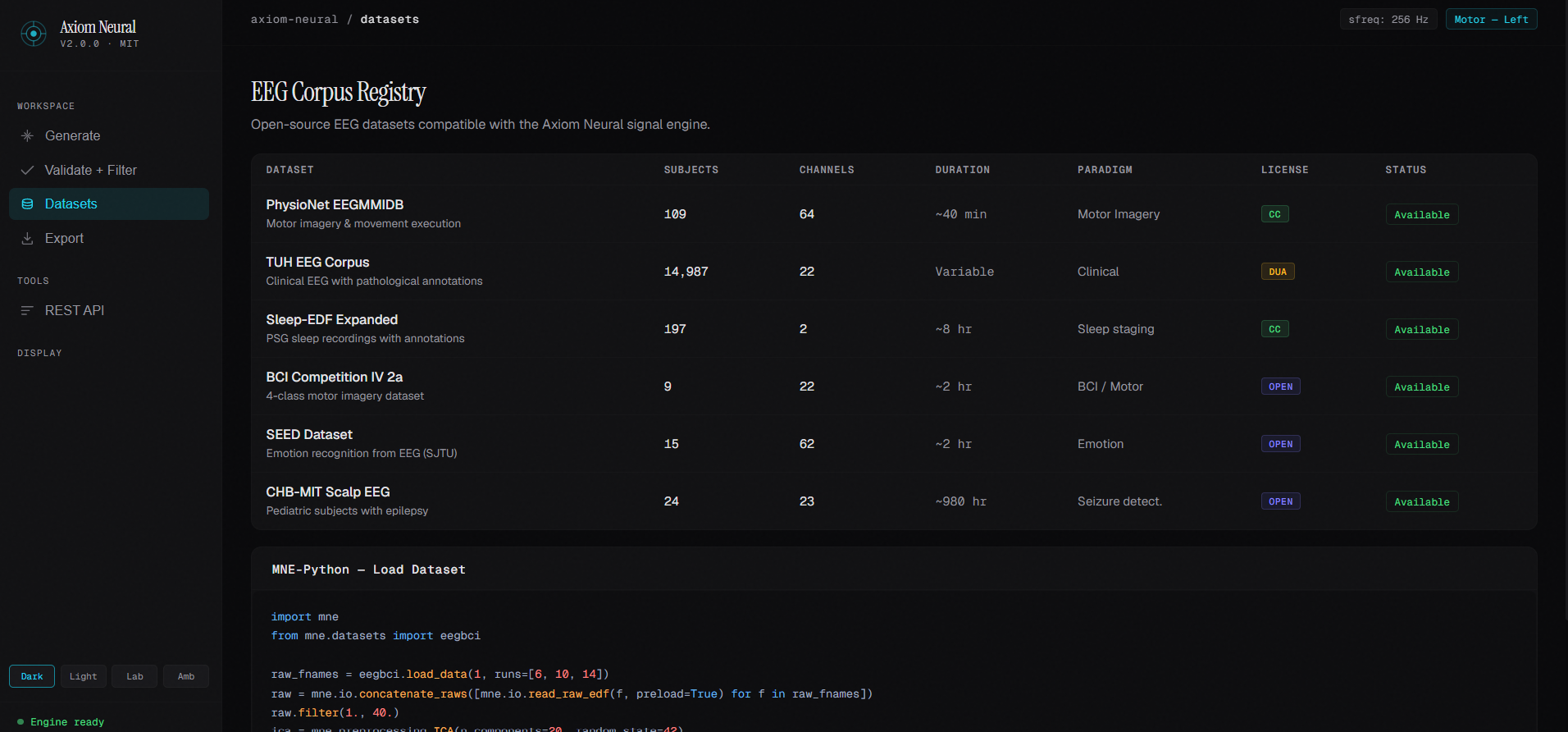
- Export directly into industry-standard MNE-Python pipelines
How we built it
Architecture
We engineered Axiom Neural using a modern, lightweight frontend stack:
- React.js for real-time state management
- Vite for ultra-fast development and builds
- Tailwind CSS for a focused, obsidian-minimalist interface
DSP Engine
The core signal-processing engine was built entirely in Vanilla JavaScript (ES6+).
We implemented high-speed sinusoidal superposition formulas to blend neural frequencies across 16 parallel signal arrays in real time.
Chaos Layer
Perfect mathematical sine waves are unrealistic for ML testing.
To mimic real biological brain activity, we integrated localized fractal 1/f pink noise injection algorithms that simulate natural neural background impedance and chaotic fluctuations.
Rendering Layer
Rendering 16 continuous waveforms at high frequency required bypassing React’s rendering cycle entirely.
Instead of relying on the virtual DOM, we streamed raw coordinate arrays directly into the HTML5 Canvas API memory buffer, enabling hardware-accelerated rendering at a stable 60 FPS.
Challenges we ran into
The DOM Bottleneck
Initially, updating 16 parallel state arrays thousands of times per second inside React caused severe UI thread blocking and frame drops.
We solved this by separating mathematical computation from UI state management and streaming raw waveform coordinates directly to Canvas memory buffers.
Simulating Imperfection
Clean sine waves are ineffective for machine learning validation because real EEG data is inherently noisy.
Fine-tuning the coefficients of our fractal noise generator so the output felt both mathematically chaotic and biologically believable — while still passing local statistical validation metrics like Wasserstein distance calculations — required extensive experimentation.
Accomplishments that we're proud of
Zero Infrastructure, Infinite Scale
We successfully shifted heavy digital signal processing entirely into the client-side browser environment.
Because the platform operates without backend servers or cloud processing, it becomes globally scalable at virtually zero infrastructure cost.
Smooth 60 FPS Rendering
Streaming 16 independent high-frequency neural channels simultaneously with zero noticeable lag or frame drops was a major milestone for us.
Seamless Research Pipeline Integration
We designed a workflow that bridges modern web applications with scientific research tooling, allowing users to move from browser-generated EEG signals directly into MNE-Python environments in a single click.
What we learned
This project gave us a deep appreciation for the raw rendering power of vanilla JavaScript and browser-native graphics pipelines when detached from heavy framework overhead.
We also learned:
- The mathematical behavior of neural frequency bands
- How biological brains naturally generate electrical noise
- The importance of balancing computational performance with clean, human-centered UI/UX design
What's next for Axiom Neural
Web Audio API Sonification
We plan to introduce spatial audio sonification, allowing researchers to hear synthetic neural frequency fluctuations in real time alongside visual waveform rendering.
Extended Pipeline Templates
We aim to expand export compatibility with specialized machine learning ecosystems such as:
- PyTorch Geometric
- Graph Neural Network (GNN) pipelines
- Advanced neuroscience research frameworks
On-the-Fly Model Ingestion
Using ONNX Runtime Web, we want to enable localized in-browser ML inference so users can test live classification pipelines directly inside the application window.

Log in or sign up for Devpost to join the conversation.