-
-
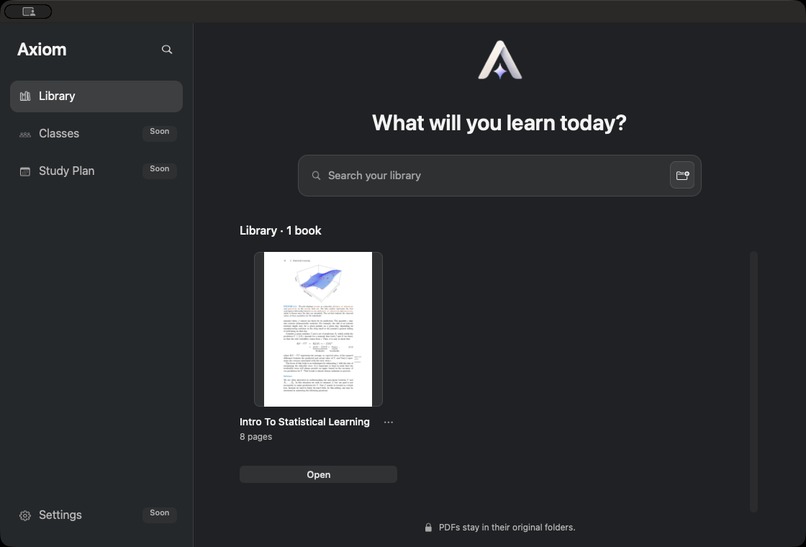
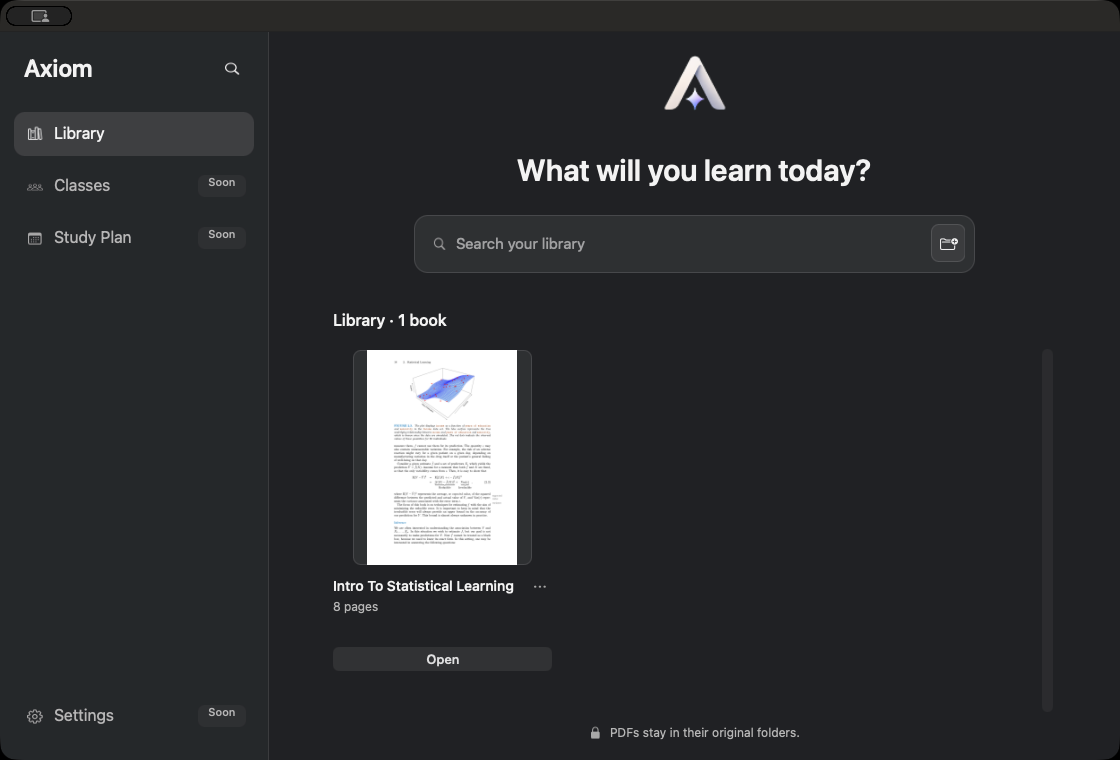
Axiom main screen
-
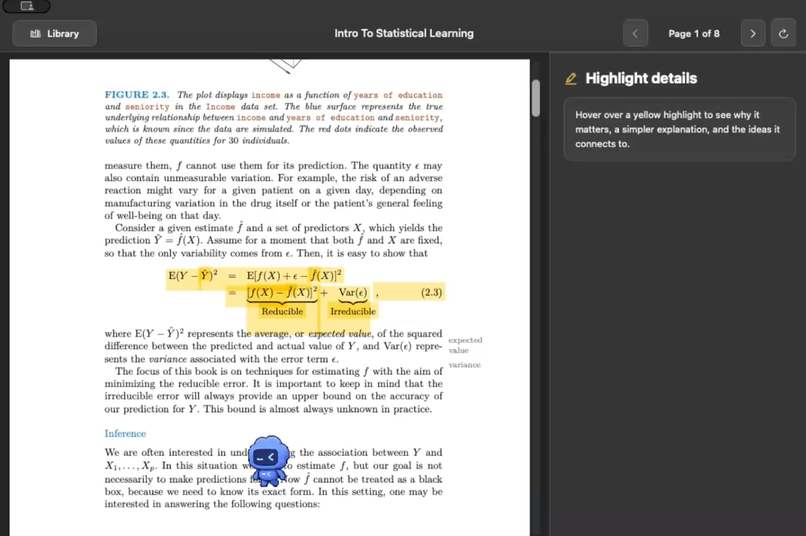
Codex pet highlighting behavior
-
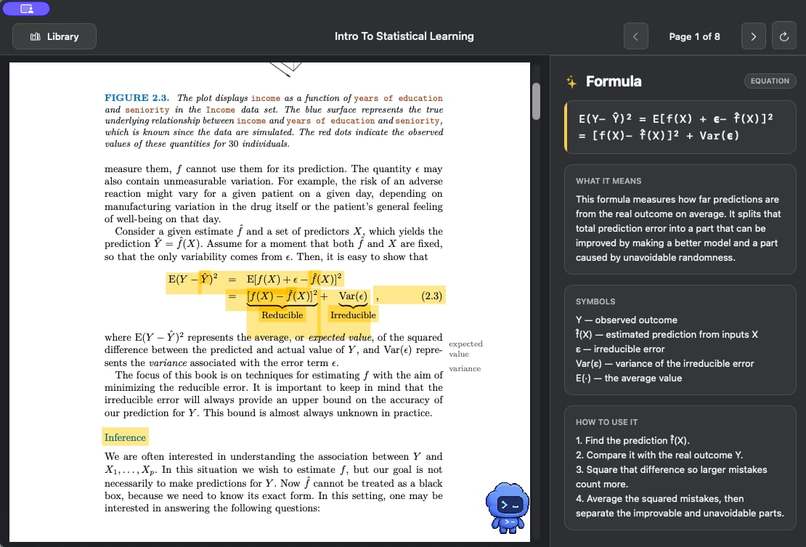
Highlight explanation
Inspiration
Throughout our years in school, textbooks and research papers have been some of the most valuable learning resources, but also some of the hardest to engage with. Dense explanations, unfamiliar notation, and long pages often make it difficult to know what deserves attention.
AI has made it easier to summarize a document or generate an answer, but that convenience can also encourage students to skip the reading and learning process entirely.
We built Axiom around a different question: What if AI could help students read more effectively without replacing reading itself?
What it does
Axiom is an AI-powered reading companion for textbooks and research papers.
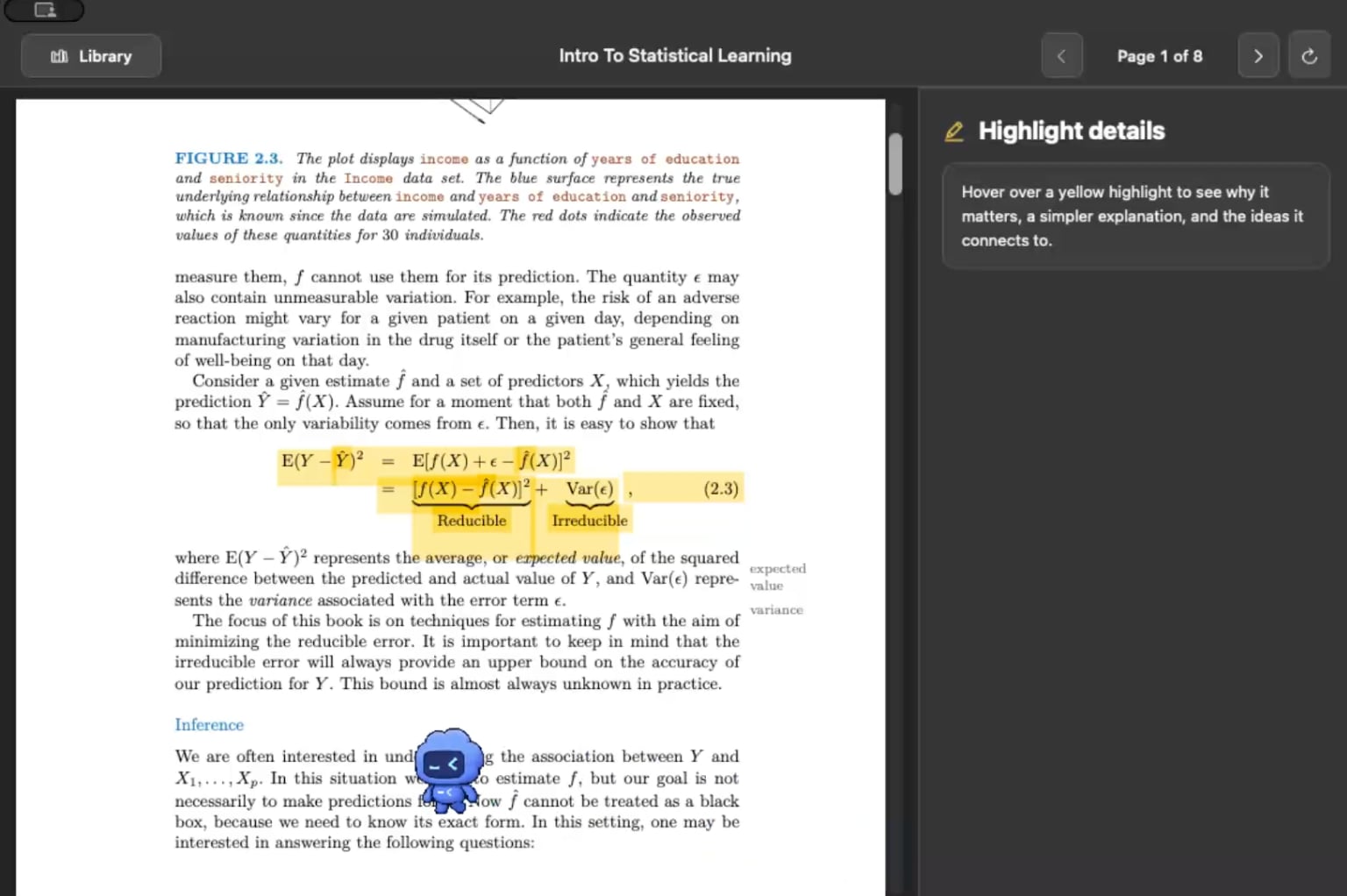
Students import a folder of PDF documents and read them inside the application. As they move through a document, an animated AI pet proactively highlights important or difficult sentences directly on the page.
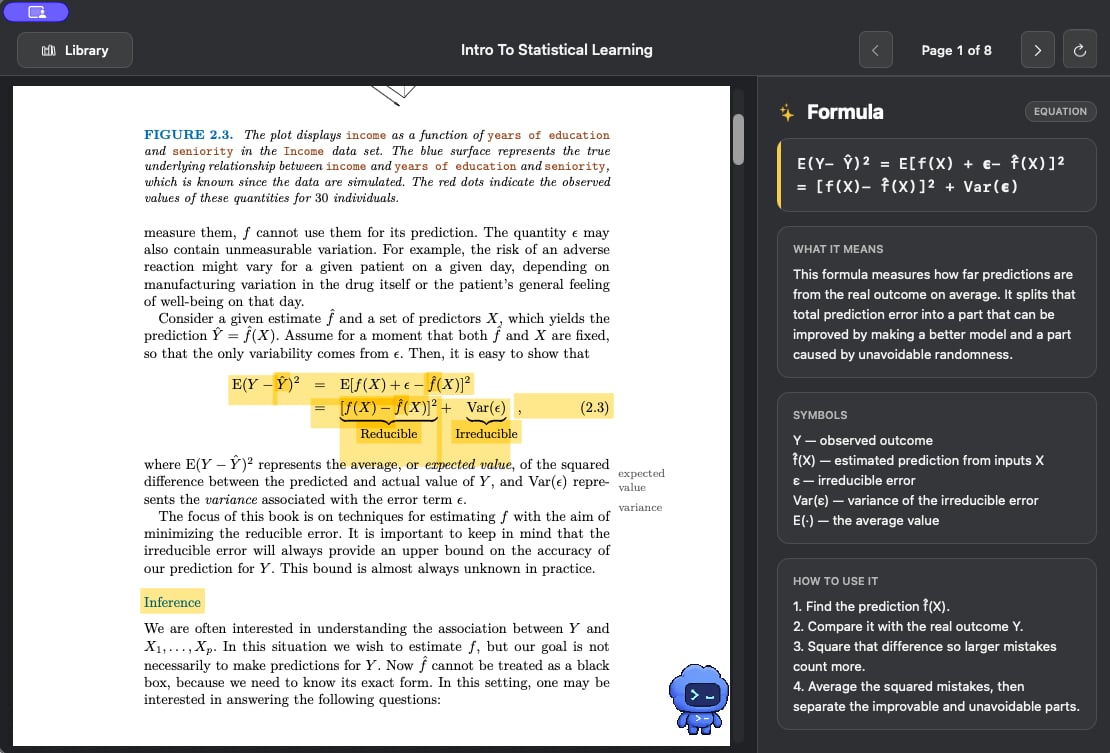
Students can hover over a highlight to see a concise explanation of why the passage matters, clarify an unfamiliar concept, or understand mathematical notation in more intuitive language.
Rather than moving the learning experience into a chatbot, Axiom keeps the original material at the center. The AI acts as a guide, helping students focus their attention while allowing them to develop their own understanding.
How we built it
We built Axiom as a native macOS application with an integrated PDF reading experience.
The application processes PDF text and page geometry so that AI-generated highlights can be mapped back to their exact locations in the document. We added safeguards to prevent duplicate or overlapping highlights and cached the results as document metadata.
The reading companion uses AI to identify meaningful sentences and generate short contextual explanations. We then connected those results to an animated pet that moves across the page and visually performs each highlight.
We used Codex throughout the development process to prototype interfaces, explore interaction designs, implement features, debug the PDF rendering pipeline, and refine the application through rapid iterations.
Challenges we ran into
One of our biggest challenges was connecting the AI output to the visual PDF interface. The model could identify an important sentence, but we still needed to reliably locate that sentence inside the rendered document and place the highlight over the correct text.
PDFs also vary significantly in structure. Text may be split across multiple lines, encoded in an unexpected reading order, or positioned differently from how it appears visually.
Another challenge was making the AI proactive without making it distracting. Too many highlights could overwhelm the student, while too few would make the companion feel inactive. We had to balance usefulness, consistency, animation timing, and visual simplicity.
Integrating the animated pet introduced additional complexity because its movement needed to feel connected to the highlighting action rather than appearing as a decorative animation layered on top of the document.
Accomplishments that we're proud of
We are proud that we created a working interaction in which an animated AI companion moves through a real PDF and highlights meaningful passages directly on the page.
Instead of building another chatbot or summarization interface, we developed an AI experience that works within an existing learning behavior: reading.
We are also proud of the connection between the visual design and the underlying intelligence. The pet is not only a decorative character. Its movement communicates what the AI is doing and makes the reading guidance feel more approachable and intuitive.
Most importantly, we built and presented the application as a functional prototype within one week during OpenAI Build Week.
What we learned
We learned that adding AI to education is not only about improving model intelligence. The way the intelligence is presented can have an equally important effect on the learning experience.
A small contextual explanation delivered at the right moment can be more useful than a complete summary delivered before the student has engaged with the material.
We also learned that building AI directly into a document interface requires careful coordination between language models, text extraction, document geometry, animation, and interaction design.
Finally, we learned how valuable Codex can be as a development partner. It helped us move quickly from ideas and interface mockups to working implementation, while still allowing us to control the product direction and make the final design decisions.
What's next for Axiom - Intelligence for Learning
Our long-term vision is for Axiom to become an intelligence layer connecting students, teachers, and learning materials.
For students, Axiom could adapt its guidance to individual learning needs, explain mathematical notation, connect concepts across multiple documents, ask comprehension questions, and help students revisit ideas they may have misunderstood.
For teachers, Axiom could provide aggregated insights into where students slow down, which concepts receive the most attention, and where a class may need additional support. Teachers could also guide how the reading companion behaves by specifying important concepts, learning objectives, or connections to lectures.
The pet would become a bridge between the teacher's learning objectives and the student's reading experience.
Axiom is built around one simple principle: AI should not replace learning. It should make learning more active, personal, and connected.
Built With
- chatgpt
- codex
- sol5.6


Log in or sign up for Devpost to join the conversation.