Inspiration
We're two student videographers with a passion for making creative content, but not the budget. We saw how commercial Hollywood robotic camera sliders cost thousands of dollars and that was preventing us from making the content we've always wanted to make. That's why we came together to make the AXI6 Camera Slider for a tenth of the budget, while still maintaining the smooth and precise motion of those you'd find on a professional film set.
What it does
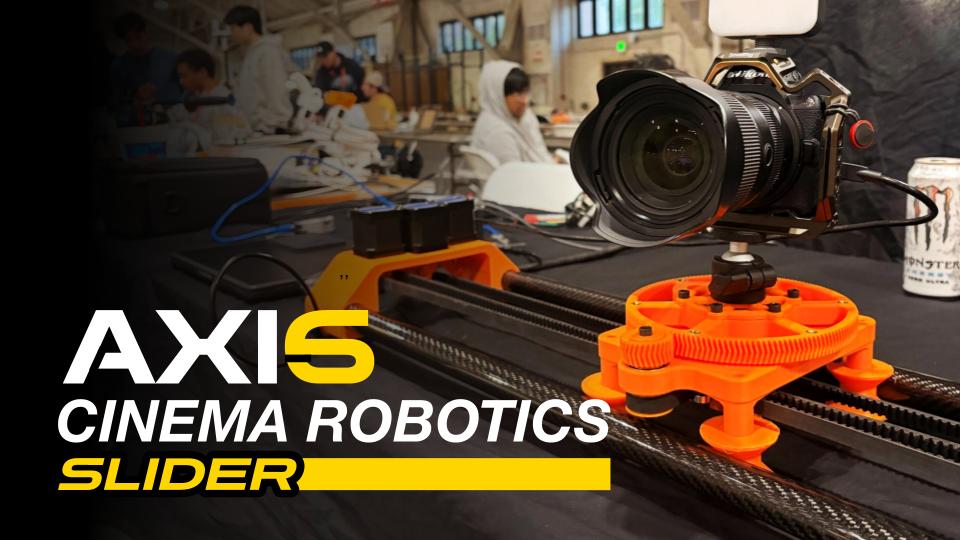
Our camera slider uses a Raspberry Pi and NEMA 17 stepper motors to drive two belts across the bottom of the slider. One controls the slide axis, and one controls the pan axis. Through our custom web app, we can set waypoints for each axis, and send a pre-animated path to the slider which it will execute in a given time. The web app also allows for remote control of the slider for more precise adjustment.
How we built it
The frame is built upon two sleek, carbon fiber tubes with fully 3D printed gears, pulleys, and shafts. The electronics consist of a Raspberry Pi for the brains, TMC2209 stepper drivers to control the motors, and a 12V DC power supply with a buck converter for power.
Challenges we ran into
The main challenges we ran into mechanically were tensioning the long belt runs underneath the slider. Without proper tension, the belts would skip and ride off of the pulleys, resulting in the slider losing track of its position. We solved this by adding slots so we could move the pulleys in and out to tension the belts. Another challenge we had on the software side was with syncing our slide and pan axes. Since the two axes are mechanically linked, when the slide moves, the pan axis wants to move a certain amount as well. To counteract this in software, we counter-rotate the pan a specific number of steps to ensure that when one axis moves, the other stays put.
Accomplishments that we're proud of
One accomplishment we’re proud of is making such a tight budget. Initially, our goal was to make the slider for less than $500, and we ended up making the full slider for less than $200. We think we’ll be able to get that even lower with more standardized hardware and more streamlined electronics.
What we learned
We learned a lot about the challenges of integrating hardware and software for smooth, precise motion. By design, the digital world works with discrete binary ones and zeroes, but in the real world we want smooth, organic motion. In order to achieve such synchronization requires precise timing between camera frames, electrical pulses, and software clock ticks. The hardware was designed to be as controllable as possible to mitigate a lot of these issues. For example, our gears and pulleys were designed to eliminate backlash to ensure there’s no play in any of our joints.
What's next for AXI6 Cinema Robotics Camera Slider
Next, we plan on adding the third axis to the slider which would be a tilt head on top of the pan axis to allow the camera to tilt up and down as well as side to side to give users more creative freedom. We also want to make the electronics more polished so that the whole slider can be its own isolated package with minimal cords coming in and out of it. We’d also like to continue to bring the cost down to make our product more accessible for all creators.
Built With
- fastapi
- html5
- opencv
- python
- raspberry-pi
- react
- tailwind
- uvicorn
- viam
- vite
- websockets


Log in or sign up for Devpost to join the conversation.