Inspiration
One of our customers at beSharp is a food distributor serving hotels, restaurants and cafés. Most of its orders don't come from a portal. They arrive at the end of service as a photo of a handwritten list, a voice note or a quick WhatsApp message to a sales rep, and someone in the back office retypes each one into the ERP.
That means minutes of data entry per order, misread abbreviations, "the usual" taken to mean the wrong thing, out-of-stock products found only after the order was promised, and nobody noticing when a regular customer quietly stops reordering.
We asked restaurant owners what would help. They didn't want a new app or a B2B portal: they wanted to keep ordering on WhatsApp. So we built an agent that meets them where they already are.
What it does
SuppliAgent is an agentic AI that turns the way restaurants already order into verified, confirmed orders for their distributor. It serves three kinds of users.
Restaurant owners (on WhatsApp or by email)
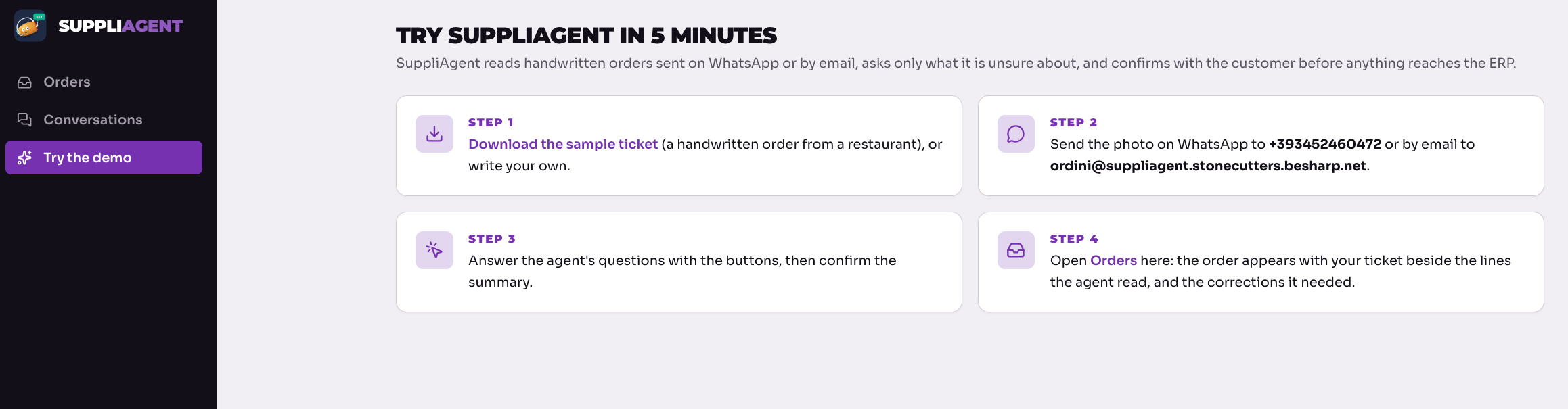
- Send a photo of a handwritten list, a voice note or a text. The agent reads the handwriting with a vision model, transcribes the voice note and matches every line to the catalog using the customer's price list and purchase history.
- It asks only when it has to: when a line has several plausible matches, the customer gets a WhatsApp question with interactive buttons (at most three options plus "Other").
- It checks the business rules before promising anything: stock, price list, pack multiples, delivery days and cut-off. It proposes substitutes for missing products and makes at most one relevant suggestion per order.
- It asks for explicit confirmation with one tap. Nothing reaches the ERP before that, and confirmation is idempotent, so a double tap never creates two orders.
- Then the paperwork: the order goes to the ERP, a confirmation email with the order PDF and an SMS/RCS confirmation go out, followed by delivery notifications with suggested replies (Received / Report a problem).
- Proactive reorders: when a regular reorder is overdue, the agent offers to repeat it with one tap. It only does this with the customer's consent, never at night, and at most once every 7 days.
Sales reps (copilot on WhatsApp or in the web chat)
- "What should I pitch to this restaurant?": recommendations based on the customer's history, products they stopped buying, similar customers and current promotions.
- Catalog search and technical sheet Q&A (allergens, storage, formats) with citations, plus visit briefings and orders placed on behalf of a customer. Reps only ever see their own portfolio.
Back office (web console)
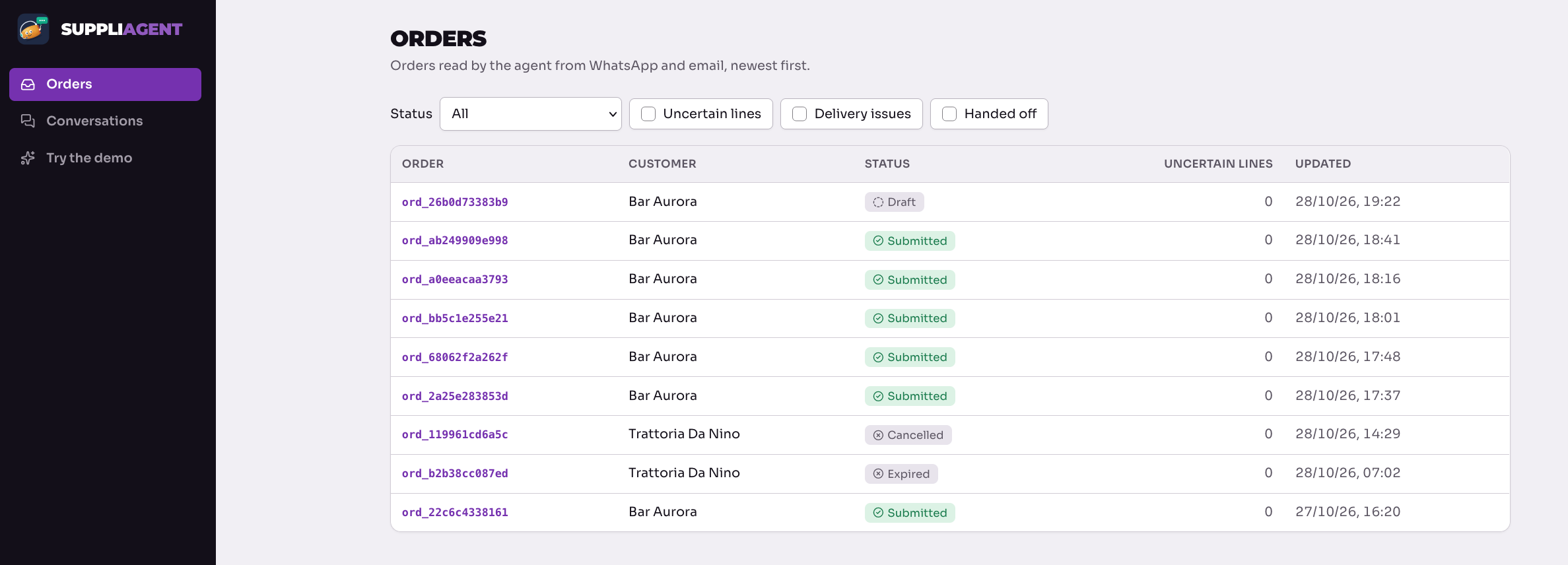
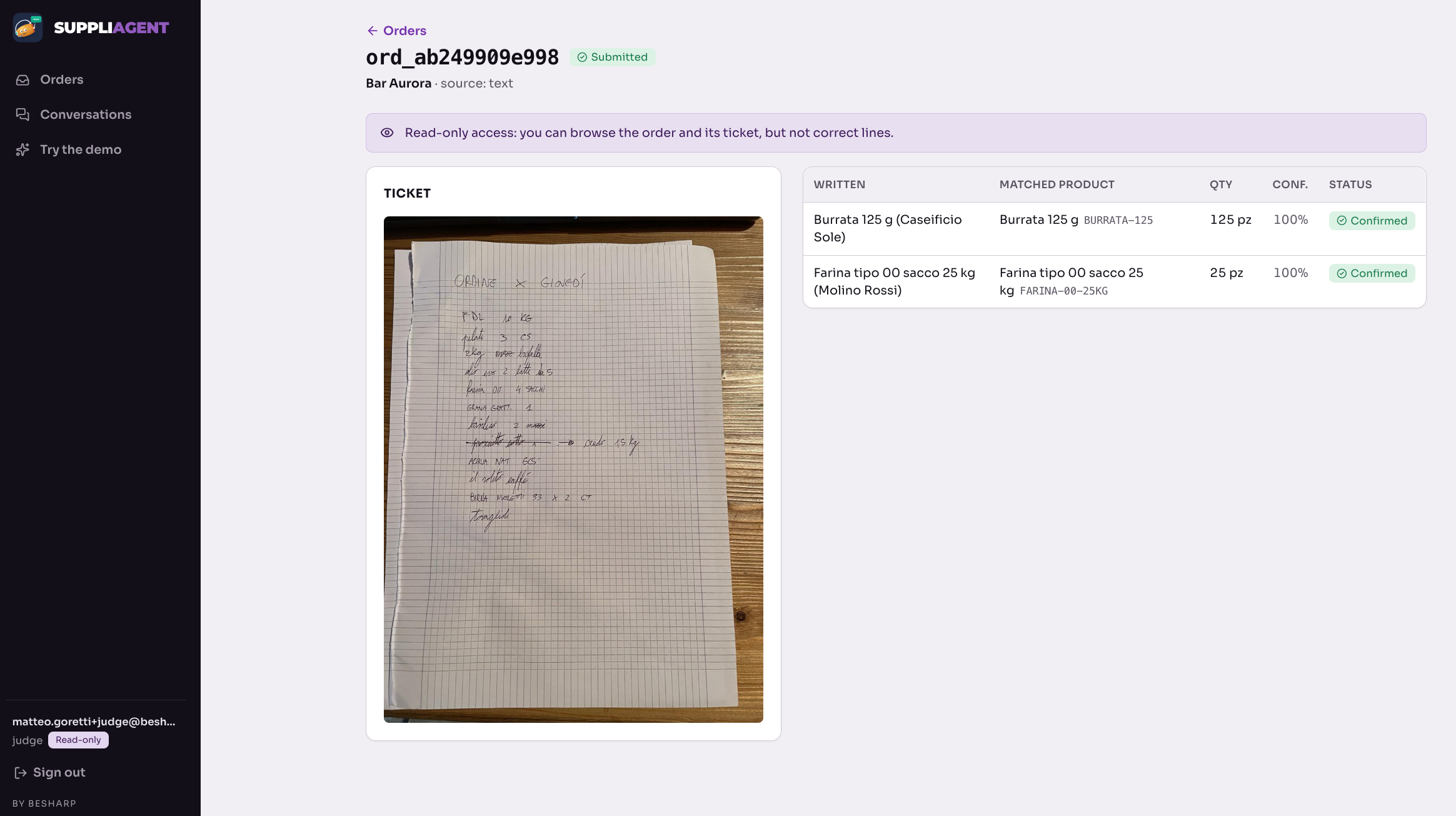
- Orders in real time, with the original photo of the handwritten list next to the order lines. Low-confidence lines are highlighted and can be corrected by picking another candidate.
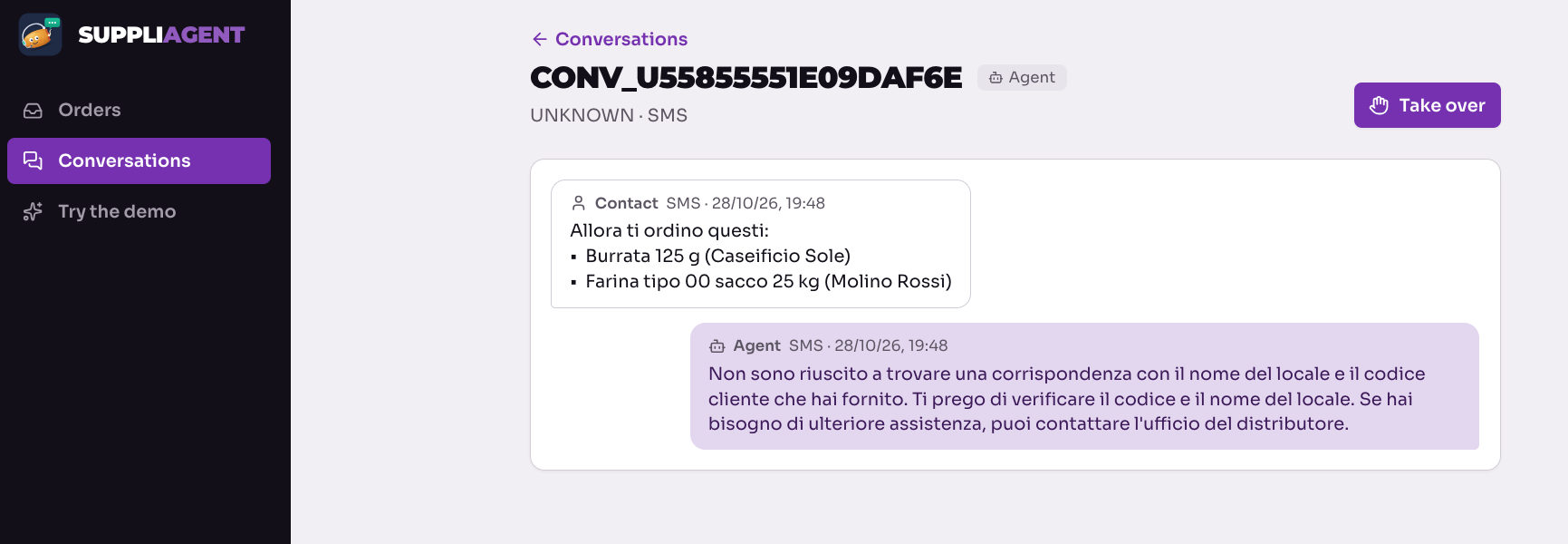
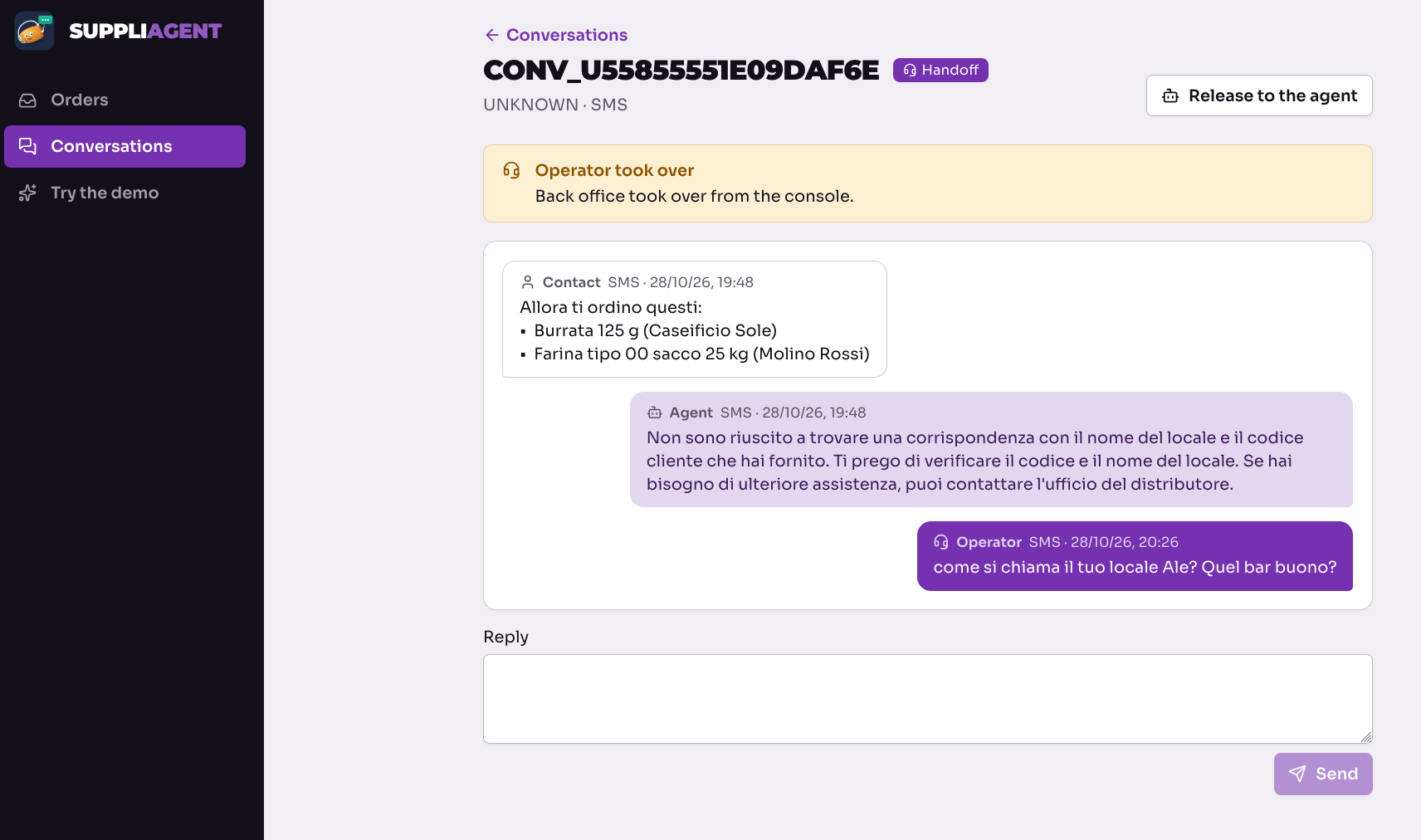
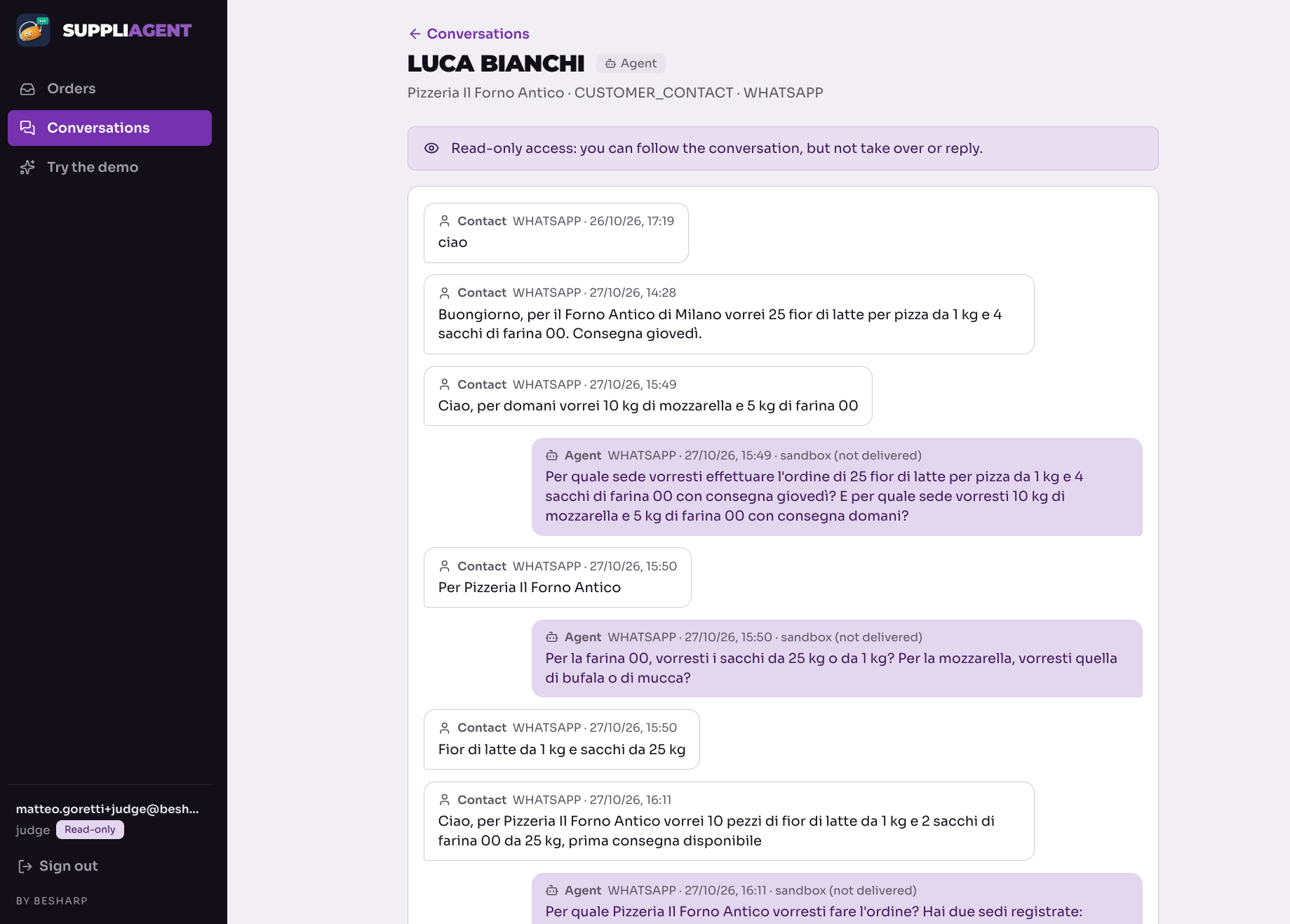
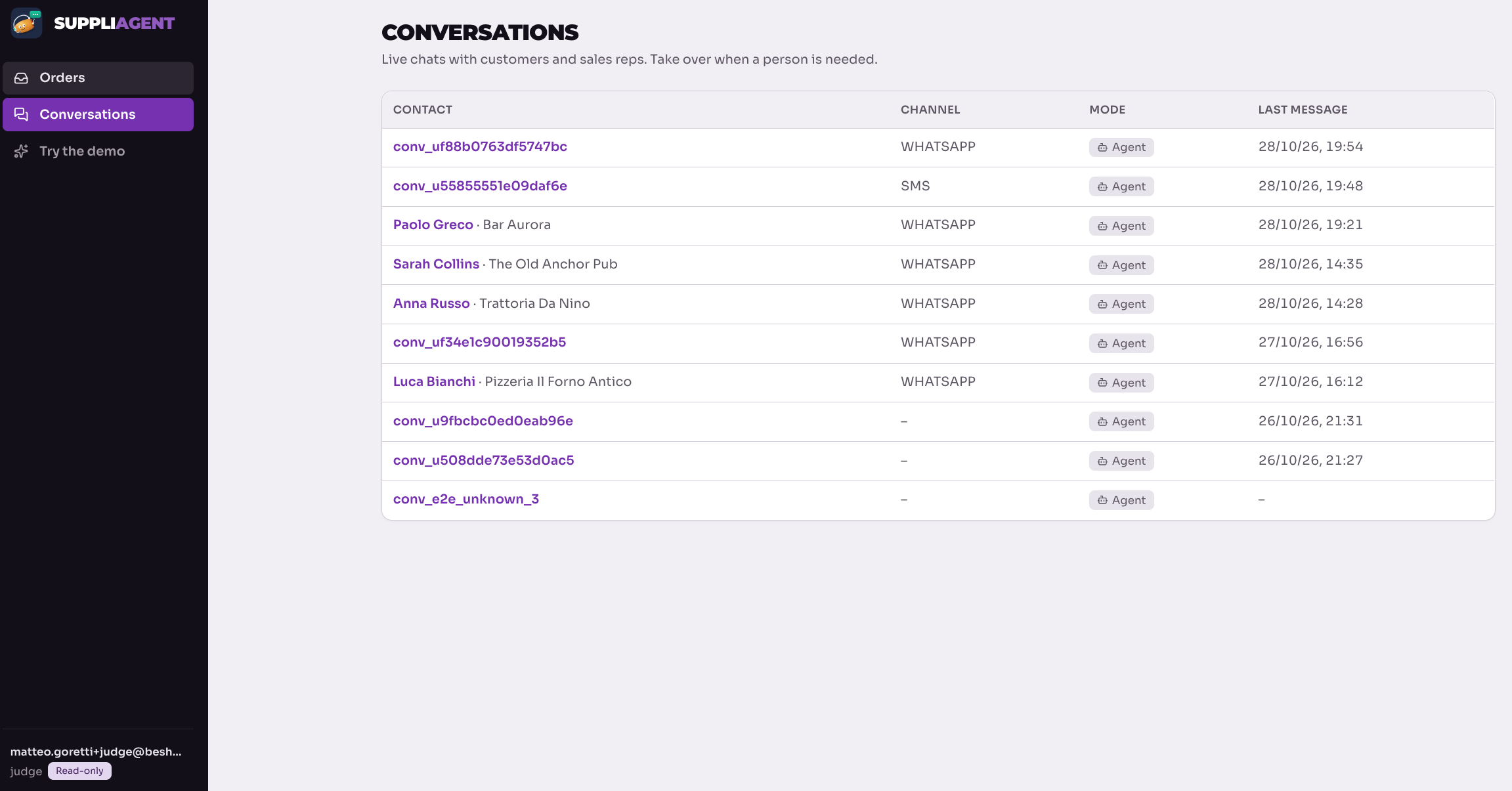
- Live conversations with take over / release (human handoff), delivery issues and impact KPIs. A read-only
judgerole is available for the hackathon.
How we built it
Everything is serverless in eu-west-1 and deployed with AWS CDK (TypeScript): nine stacks, cdk-nag clean, one AWS KMS key for all data at rest.
| Layer | What we used |
|---|---|
| Messaging (AWS CDS) | AWS End User Messaging Social (WhatsApp, SendWhatsAppMessage), Amazon SES v2 (SendEmail plus inbound email), AWS End User Messaging SMS/RCS (SendRcsMessage, SendTextMessage) |
| Ingestion | SNS → SQS (standard + DLQ) → Inbound Router (identity, role, idempotency, media to encrypted S3) → per-conversation turn buffer in DynamoDB → Turn Dispatcher (debounce + lock) |
| Agent | Strands Agents on Amazon Bedrock AgentCore: Runtime, Memory, Gateway (MCP tools on Lambda, IAM SigV4), Identity, Observability, plus Bedrock Guardrails |
| Models | Amazon Nova Pro (reasoning and handwriting vision) and Nova Lite (fast classification) through the eu. inference profile, so data and inference stay in the EU |
| Knowledge | Amazon S3 Vectors catalog index (Titan Text Embeddings V2), Bedrock Knowledge Bases for technical sheets, Amazon Transcribe for voice notes |
| Orders | DynamoDB, EventBridge order.confirmed → ERP adapter (mock) and order PDF, scheduled sweep for draft reminders and expiry |
| Proactivity | Nightly EventBridge Scheduler → Insights & Reorder Analyzer → Proactive Trigger |
| Console | React on CloudFront, Amazon Cognito (backoffice, sales_rep, judge), API Gateway REST + WebSocket |
| Analytics | Firehose → S3 Parquet → Glue → Athena for the KPIs, CloudWatch for operations |
A few design choices shaped the whole system:
- One writer for all channels. Only the Notifier is allowed to call the CDS send APIs. Channel policy (the WhatsApp 24-hour window, approved templates outside it, fallback to SMS or email) lives in one place.
- One answer per burst. People send three photos and two messages in ten seconds. The Turn Dispatcher waits for the burst to end (3 s for text, 6 s for media, 15 s at most) and holds a per-conversation lock, so the customer gets one coherent reply instead of five.
- The model proposes, the code decides. The model reads the list and proposes SKUs and quantities with a confidence score \(c\). Prices, totals, pack sizes, order status and permissions are decided in code. Each line is handled like this:
$$ \text{line} \;\rightarrow\; \begin{cases} \text{accepted automatically} & c \ge 0.85 \ \text{clarification question (max 3 options + Other)} & 0.5 \le c < 0.85 \ \text{flagged as unmatched, never guessed} & c < 0.5 \end{cases} $$
- Authorization inside the tools, not in the prompt. The Dispatcher passes the caller's role and customer ids to the tools, and the model can't change them. A restaurant can only see its own data and a sales rep only their own portfolio, and every tool has negative authorization tests.
- Proactive, but polite. A reorder is due when the time since the last order exceeds 1.5 times the customer's average interval: \(t_{\text{since last}} > 1.5\,\bar{\Delta t}\). Even then, the agent only proposes it with consent, outside quiet hours and at most once every 7 days.
- Synthetic data only. The catalog, price lists, customers and order history are anonymized or synthetic.
Challenges we ran into
- Handwriting is hard. Cursive, strikethroughs, arrows, quantities written as "2 cs" or "the usual" and notes that aren't order lines at all. The hard part isn't reading, it's knowing when you've read badly. Our first prototype read 62% of the lines right, and too many wrong lines came back looking valid. That pushed us towards the confidence thresholds above, clarification questions and a mandatory confirmation step instead of trusting the read.
- Real messaging is messy. Duplicate deliveries, bursts of messages, media that arrives after the text, the 24-hour window and templates that need Meta approval. We also learned that SNS standard topics can't deliver to FIFO queues, so we used standard SQS with idempotency on the provider message id and ordered messages by AWS receive time, and let the debounce do the rest.
- Trusting a button. On WhatsApp, an interactive reply id can be forged. A tap on "Confirm" only counts if it answers the summary of that order, and the order tool checks the quoted message id.
- New services, tight deadline. AgentCore and S3 Vectors are very new. We deployed them entirely with CDK and kept the agent as a zip code deployment (no container) to keep the deploy loop short.
- Model availability. We planned for Claude but it wasn't enabled on our account, so we moved to Amazon Nova through the EU inference profile. The model id is configuration, not code.
Accomplishments that we're proud of
- A restaurant owner can go from a photo of a handwritten list to a confirmed order in 60 seconds without installing anything, while the back office retypes nothing.
- 95% of handwritten lines read correctly on our anonymized evaluation set of 30 real-style notes, and lines the agent isn't sure about are asked or flagged, never silently guessed.
- All three AWS CDS channels working together: WhatsApp for the conversation, email with the PDF for the paperwork, SMS/RCS for confirmations and delivery notices, with automatic fallback between them.
- A real use case for a real distributor, designed around how restaurants actually work and not around a demo script.
- Fully reproducible: one
cdk deploy, cdk-nag clean, least-privilege IAM, encrypted everywhere, synthetic data only.
What we learned
- Put authorization in the tools. Enforcing role and customer scope inside every tool made the agent simpler to trust and much simpler to test than prompt rules ever could.
- Let the model propose and the code decide. That split is what makes ordering, an action with money attached, safe to automate.
- Conversation design matters as much as the model. Debounce, short questions with buttons and one clear summary to confirm did more for the experience than any prompt tweak.
- Measure before you claim. A small, honest evaluation set of handwritten notes told us more than any demo did, and changed the design.
What's next for SuppliAgent
- Pilot with the distributor: real catalog and ERP integration replacing the mock, and a measured baseline (orders per day, entry time, error rate) to compare against.
- Better handwriting confidence: calibration on a larger set of notes and learning from back-office corrections.
- More channels and languages: RCS rich cards for reorder proposals and more languages beyond Italian and English.
- Smarter proactivity: seasonal patterns, menu-aware suggestions and promotions targeted per segment.
Built With
- amazon-api-gateway
- amazon-athena
- amazon-bedrock
- amazon-bedrock-agentcore
- amazon-bedrock-knowledge-bases
- amazon-cloudfront
- amazon-cognito
- amazon-dynamodb
- amazon-eventbridge
- amazon-nova
- amazon-s3-vectors
- amazon-ses
- amazon-sns
- amazon-sqs
- amazon-transcribe
- aws-cdk
- aws-end-user-messaging-sms
- aws-end-user-messaging-social
- aws-lambda
- python
- rcs
- react
- strands-agents
- typescript

Log in or sign up for Devpost to join the conversation.