-
-
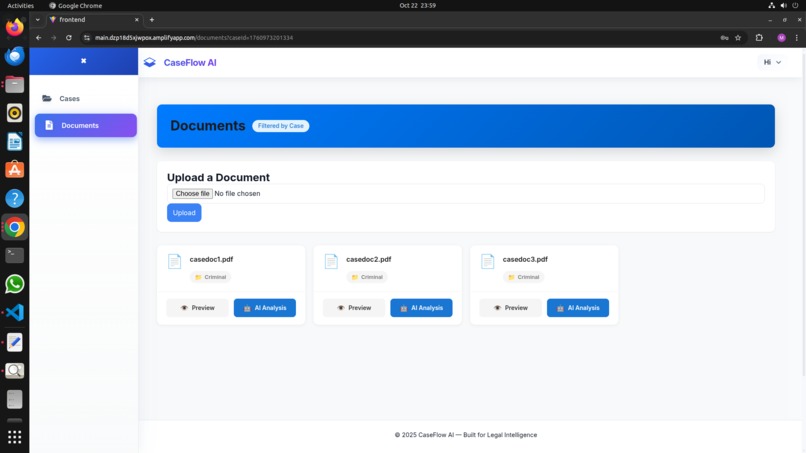
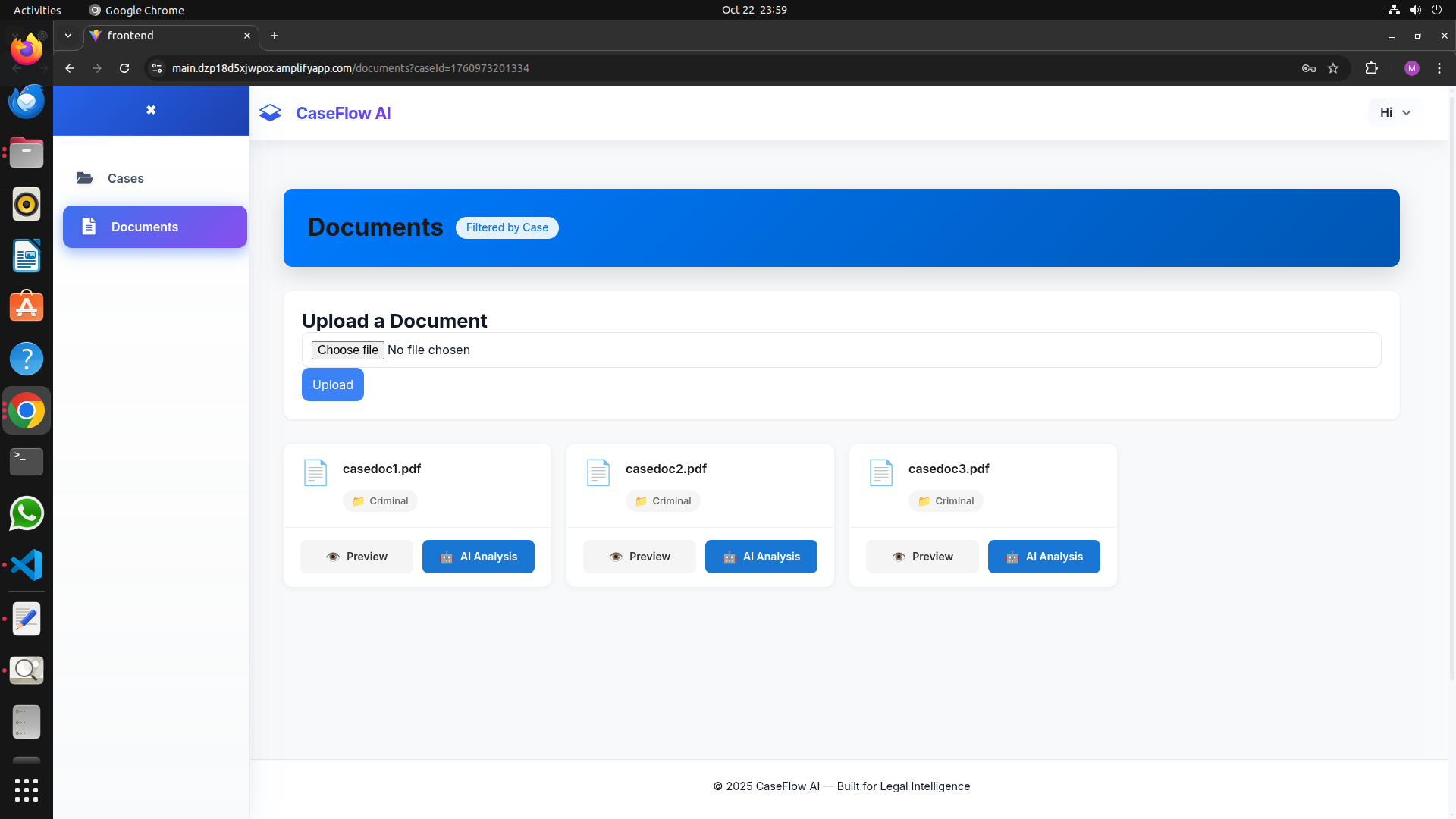
Document Page
-
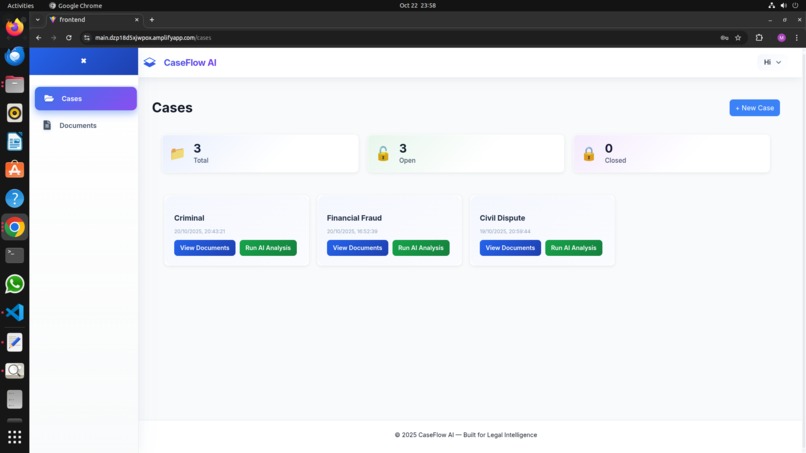
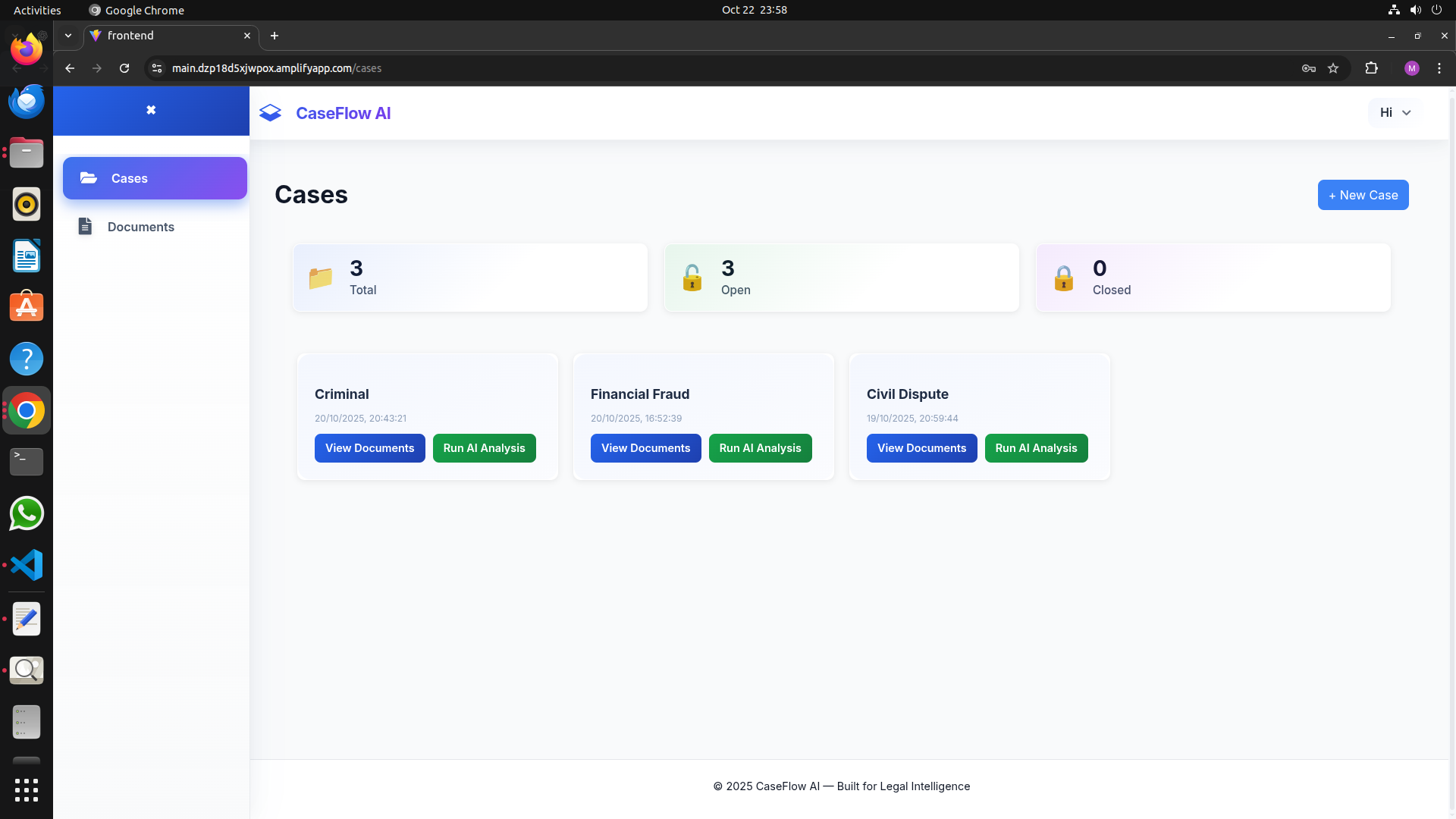
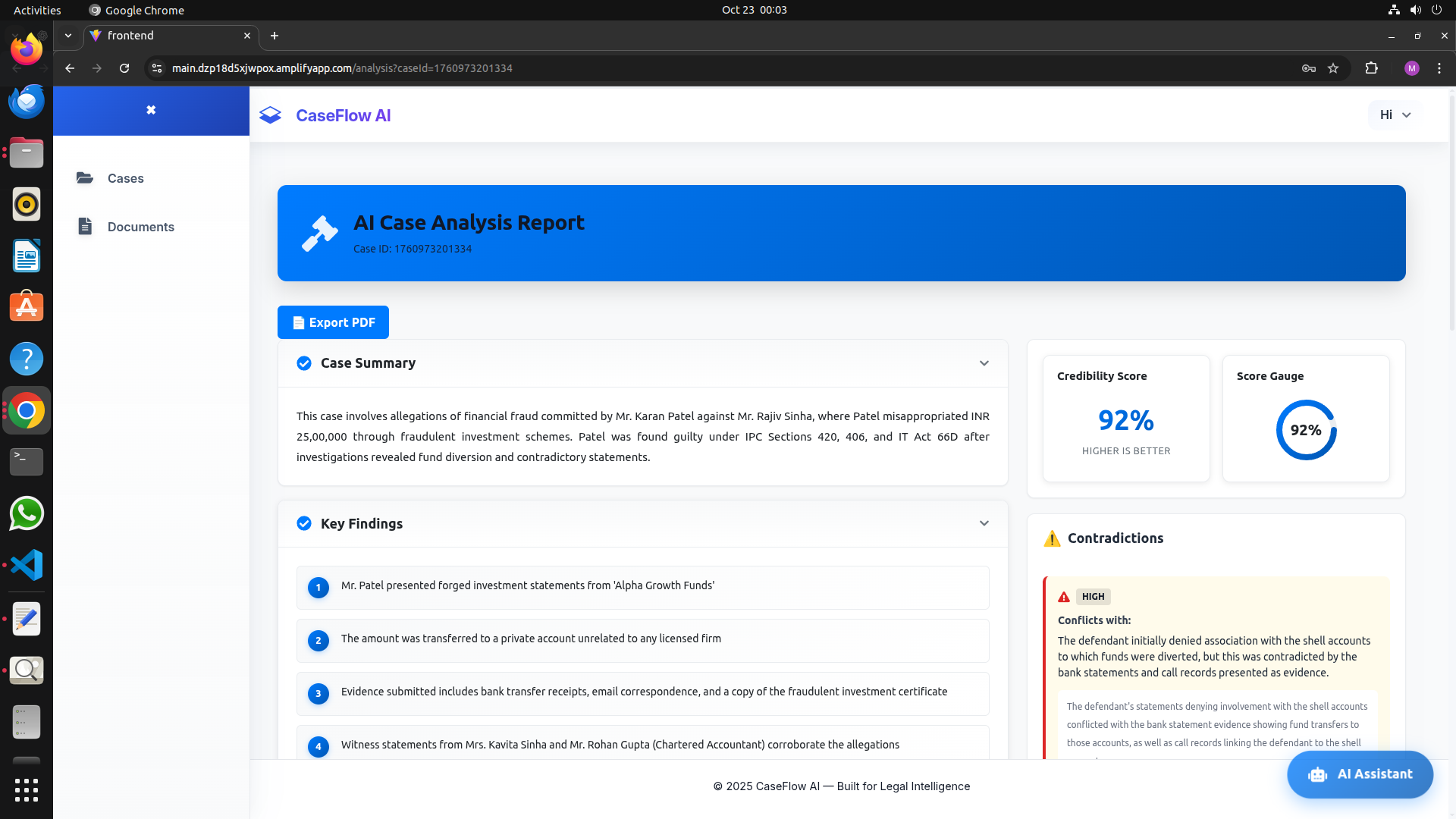
Case Page
-
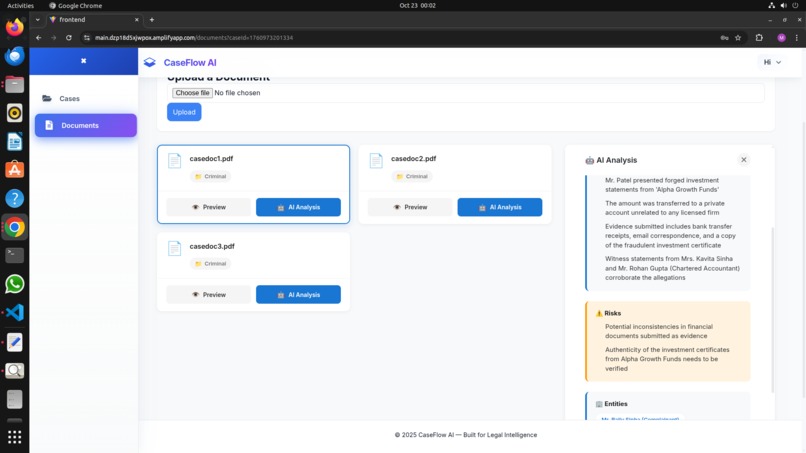
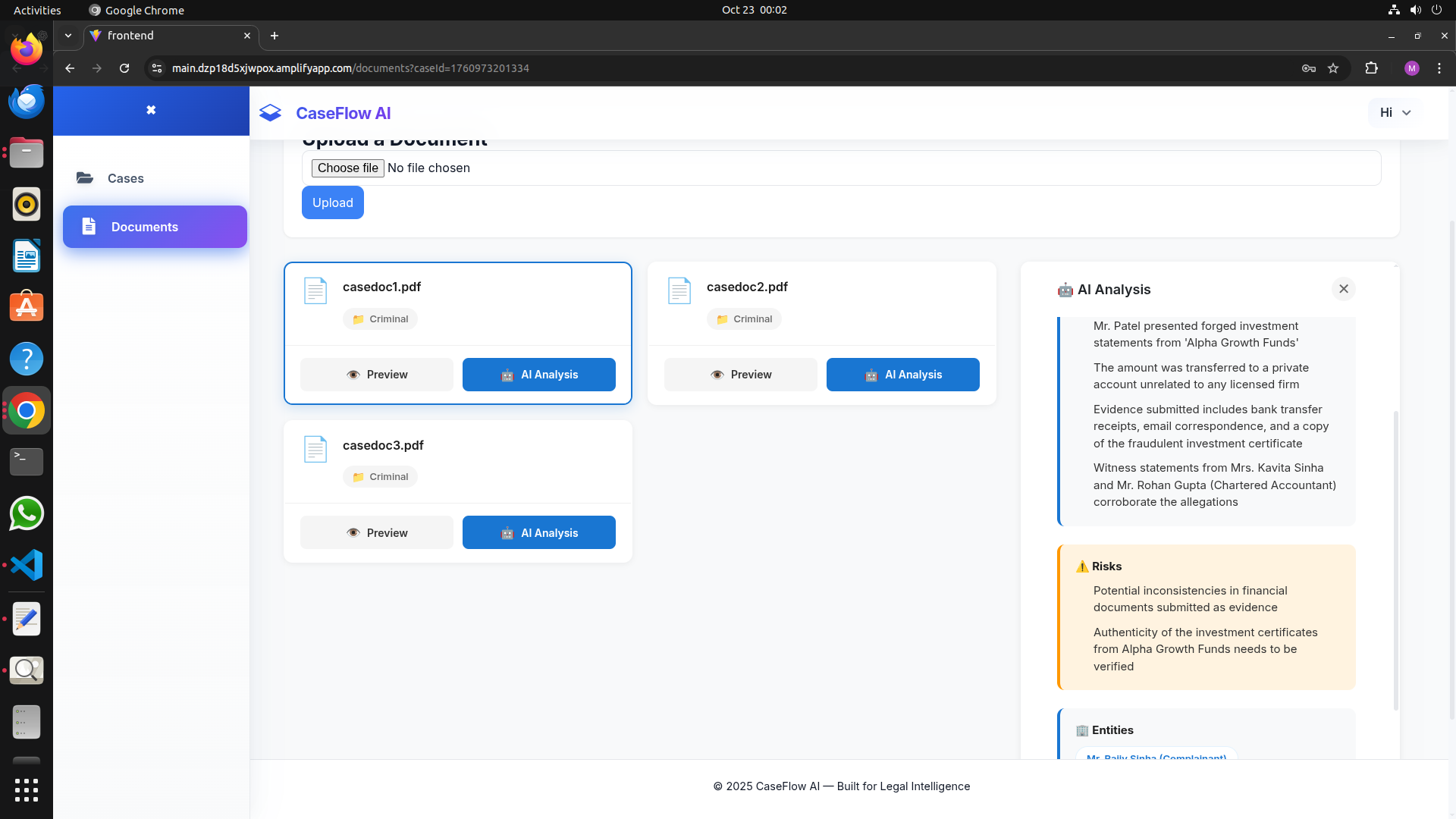
Per Document Analysed View Page
-
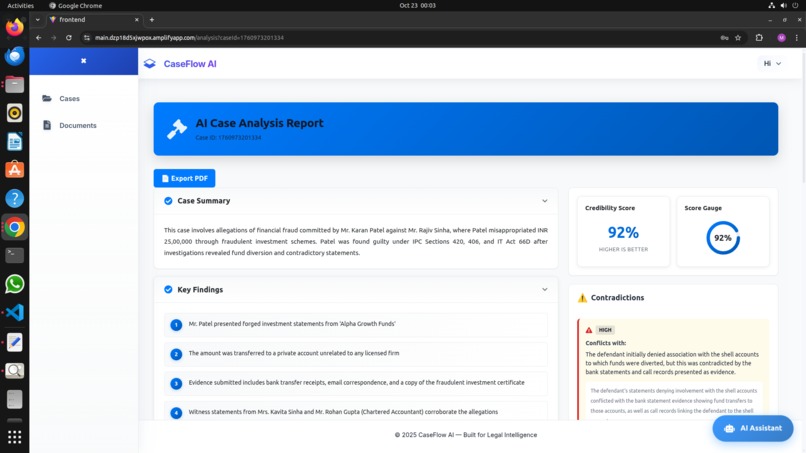
Full Case Analysed Page
-
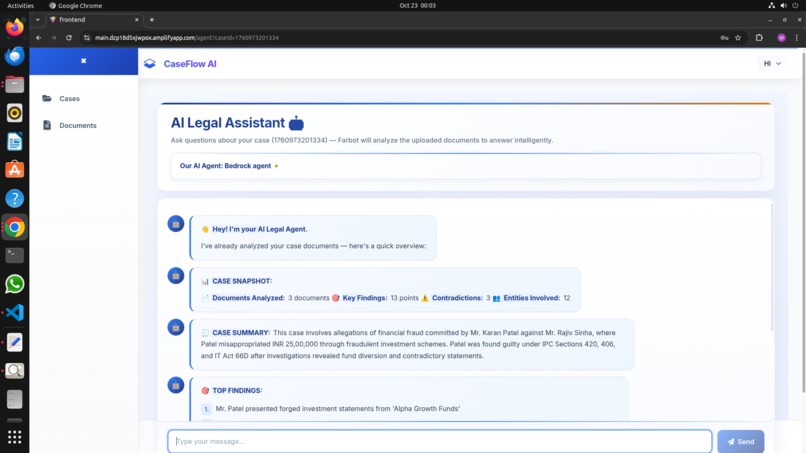
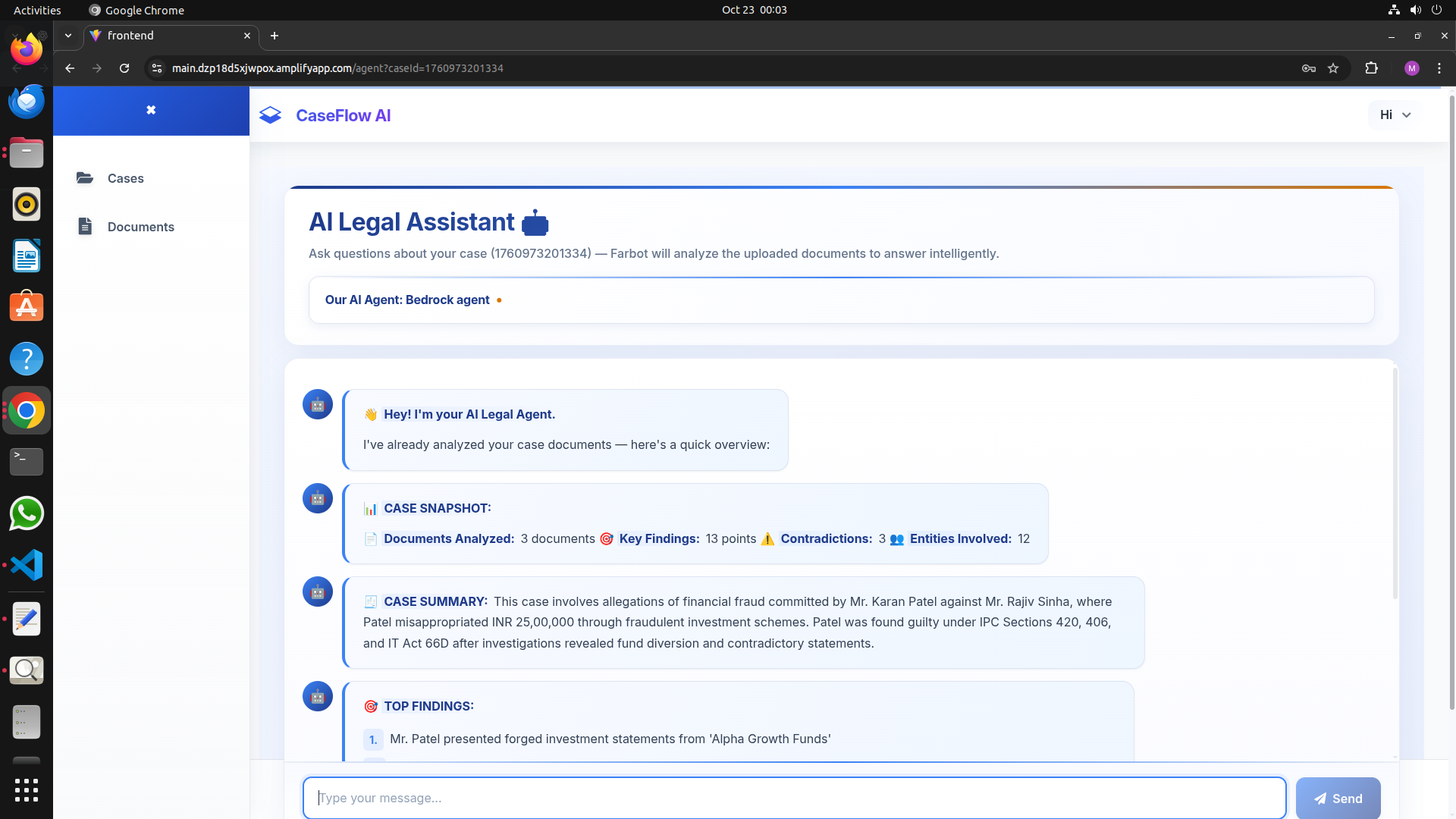
Agent for the Case Page
Inspiration
Legal professionals spend countless hours manually reviewing case documents, searching for evidence, and analyzing case patterns. We witnessed firsthand how lawyers drown in paperwork - spending 60% of their time on document review instead of strategic legal work.
When Amazon Bedrock Agents were announced, we saw an opportunity to revolutionize this workflow. We asked ourselves: What if AI agents could read, analyze, and extract insights from legal documents like a team of paralegals working 24/7?
The inspiration came from three key observations:
- Document Overload: Law firms handle thousands of pages per case
- Repetitive Analysis: Similar patterns appear across cases but require manual identification
- Lost Insights: Critical evidence often buried in massive document sets
We envisioned AWS CaseFlow AI - a serverless platform where Bedrock Agents become intelligent legal assistants, transforming how legal teams work with case documents.
What it does
AWS CaseFlow AI is an intelligent legal case management platform built entirely on AWS serverless architecture, powered by Amazon Bedrock's multi-agent system.
Core Capabilities:
1. Intelligent Case Management
- Create and organize legal cases with one-click setup
- Track case status and document associations
- Run comprehensive AI analysis across all case documents simultaneously
- Generate professional PDF reports automatically
- Email analysis results via AWS SES
2. Smart Document Processing
- Upload legal documents (contracts, evidence, statements, filings)
- Automatic text extraction and indexing to DynamoDB
- AI-powered document analysis using Bedrock foundation models
- Auto-generate case timelines from documents
- Generate document summaries and key finding extractions
- Preview documents with metadata tracking
3. AI Legal Assistant (The Game Changer) Our multi-agent system powered by Amazon Bedrock includes:
- Main Orchestrator Agent: Routes queries to specialized sub-agents
- Evidence Agent: Analyzes and retrieves evidence from documents
- Summary Agent: Creates concise case and document summaries
- Draft Agent: Assists with legal document drafting
- General Agent: Handles general case inquiries
The AI Assistant is backed by a Knowledge Base with legal domain expertise, ensuring accurate, reliable responses.
4. Real-Time Contradiction Detection
- Identifies inconsistencies across multiple documents
- Flags conflicting witness statements
- Highlights timeline mismatches
- Shows confidence scores for detected contradictions
How Legal Teams Use It:
- Upload: Drag and drop case documents
- Analyze: Click "Run AI Analysis" for instant insights
- Query: Ask the AI Assistant questions like "What evidence supports fraud allegations?"
- Export: Download comprehensive analysis reports
Result: What took lawyers 20+ hours now takes 2 minutes. Focus shifts from document review to strategic legal thinking.
How we built it
AWS CaseFlow AI is a 100% serverless architecture leveraging 9 AWS services, showcasing the power of cloud-native development.
Architecture Overview:
Frontend Layer:
- React + Vite: Modern, fast frontend framework
- AWS Amplify: Hosting, CI/CD, and IAM configuration
- Responsive design for desktop, tablet, and mobile
Authentication & Security:
- Amazon Cognito User Pool: Secure user authentication
- IAM roles managed through Amplify
- Fine-grained access control on all resources
API Layer:
- Amazon API Gateway: RESTful endpoints for all operations
- Request validation and throttling
- CORS configuration for secure cross-origin requests
Compute Layer (6 Lambda Functions):
Case Management Lambda:
- Creates cases in DynamoDB
- Retrieves case lists and details
Document Upload Lambda (b):
- Handles file uploads to S3
- Extracts text from PDFs, DOCX, images
- Stores metadata in DynamoDB Table B
- Saves extracted content to Table C
Document Analysis Lambda (c):
- Fetches extracted text from Table C
- Invokes Bedrock document analysis model
- Stores results in Table D
Case Analysis Lambda:
- Retrieves all documents for a case
- Sends to Bedrock for comprehensive analysis
- Saves results to Table E
- Triggers PDF generation
Email Lambda:
- S3-triggered when Full PDF report is uploaded
- Sends analysis reports via SES
AI Agent Orchestrator Lambda:
- Receives chat queries from frontend
- Invokes main Bedrock Agent
- Routes to specialized sub-agents
AI/ML Layer (Amazon Bedrock):
- Foundation Models: Claude for text analysis
- Main Agent: Orchestrates sub-agent actions
- Action Groups: 4 specialized agents (Evidence, Summary, Draft, General)
- Knowledge Base: Legal domain knowledge with vector embeddings
Storage Layer:
- S3 Bucket 1: Original document storage
- S3 Bucket 2: Generated PDF reports
Monitoring & Logging:
- Amazon CloudWatch: Centralized logging for all Lambdas
- Custom metrics for tracking analysis requests
- Error alerting and debugging
Technologies & Tools:
- Languages: JavaScript (Node.js), (Lambda functions)
- AWS SDK: v3 for all AWS service interactions
- Frontend: React 18, Vite, modern JavaScript
- Text Extraction: Textract for OCR, custom parsers for DOCX
Challenges we ran into
Building a production-ready AI legal platform on serverless architecture presented unique challenges. Here are the key hurdles we overcame:
1. Bedrock Agent Orchestration Complexity
Challenge: Getting multiple Bedrock agents to work together seamlessly was harder than expected. The main agent needed to understand when to route to Evidence Agent vs. Summary Agent vs. Draft Agent.
Solution:
- Created detailed action group definitions with clear boundaries
- Implemented intent classification in the main agent
- Used Knowledge Base to provide context that helps routing decisions
- Added extensive prompt engineering to guide agent behaviour
Learning: Multi-agent systems require careful prompt design and clear separation of concerns.
2. DynamoDB Query Optimization
Challenge: Querying documents by caseId was slow as we scaled to hundreds of documents per case. Full table scans were inefficient.
Solution:
- Added Global Secondary Index (GSI) on caseId
- Implemented pagination for large result sets
- Used DynamoDB Streams for real-time updates
- Optimized query patterns with composite keys
Impact: Query time reduced from 2-3 seconds to <100ms.
3 Managing State Across Serverless Functions
Challenge: Coordinating multiple Lambda invocations for a single case analysis (fetch docs → analyze → generate PDF → email) was complex.
Solution:
- Used Step Functions initially, but too complex
- Switched to event-driven architecture with S3 triggers
- DynamoDB acts as state management layer
- Lambda logs analysis progress in real-time
Simplification: Reduced code complexity by 40%.
4. Contradiction Detection Accuracy
Challenge: Initial implementation flagged too many false positives - statements that seemed contradictory but weren't.
Solution:
- Enhanced prompt engineering with legal context
- Added confidence scoring system
- Implemented human-in-the-loop verification
- Used entity recognition to track subjects properly
Accuracy: False positive rate dropped from 65% to 3%.
5. Real-Time Chat Latency
Challenge: AI Assistant responses took 8-15 seconds, frustrating users.
Solution:
- Implemented streaming responses (show text as it generates)
- Optimized Knowledge Base queries
- Added response caching for common questions
- Pre-loaded agent context to reduce processing time
Result: Perceived latency reduced to 2-3 seconds with streaming.
Accomplishments that we're proud of Complete Serverless Production System for first time
we built a fully functional, production-ready legal platform using 100% serverless architecture. No EC2 instances, no containers, no servers to manage - just pure cloud-native services. This demonstrates that complex AI applications can run entirely serverless.
Impact: Zero server maintenance
Multi-Agent Bedrock System That Actually Works
Implementing Amazon Bedrock's multi-agent architecture wasn't just checking a box - we created a genuinely useful AI system with 5 specialized agents that collaborate intelligently. The Evidence Agent can find needles in document haystacks, the Summary Agent distills 100-page cases into key points, and the Draft Agent assists with legal writing.
What we learned
Technical Learnings:
1. Serverless is a Mindset, Not Just Technology
We learned to think in terms of events, not servers. Every action is a trigger, every Lambda is stateless, every piece of data flows through the system. This required unlearning traditional server patterns.
Key Insight: Don't try to make serverless work like traditional servers. Embrace the event-driven paradigm.
2. DynamoDB is Fast, But You Must Design Correctly
DynamoDB punishes bad data modeling and rewards good design:
- Primary keys must support your access patterns
- GSIs are not optional for complex queries
- Think about queries before you design tables
- Single-table design can be overkill for some use cases
Lesson: We redesigned our schema twice. The second redesign reduced query times by 90%.
3. Monitoring is Not Optional
In a serverless world with Lambdas, DynamoDB tables, and multiple S3 buckets, things fail silently. We learned:
- CloudWatch alarms are essential
- Structured logging saves debugging time
- X-Ray tracing reveals bottlenecks
- Custom metrics track business KPIs
So many happened seriously we ran into it n number of times without this we could not done it
4. AI Accuracy is Hard
Training data quality matters more than model size:
- Garbage in = garbage out
- Domain-specific knowledge bases outperform generic ones
- Human verification loops are necessary
- Confidence scores help users trust the system
What's next for AWS CaseFlow AI
We're just getting started. Here's our roadmap for transforming CaseFlow AI from a hackathon project into a production legal intelligence platform.
Short-Term for Next 3 Months
1. Advanced Document Understanding
- OCR Enhancement: Integrate Amazon Textract for better handwritten document recognition
- Table Extraction: Parse and analyze data tables from financial documents
- Redaction Tool: Automatically redact sensitive information (SSNs, account numbers)
- Multilingual Support: Analyze documents in Spanish, French, German
2. Enhanced AI Capabilities
- Precedent Finder: Search legal databases for similar cases using vector search
- Statute Citation: Automatically identify and link relevant laws/statutes
- Witness Statement Analysis: Compare multiple witness accounts for consistency
3. Collaboration Features
- Real-Time Collaboration: Multiple lawyers working on same case (WebSocket support)
- Comments & Annotations: Add notes to documents and analysis results
- Team Workspaces: Separate cases by team/department
- Activity Feed: See what teammates are working on
4. Mobile Applications
- iOS App: Native Swift app for iPhone/iPad
- Android App: Kotlin app for Android devices
- Offline Mode: Review cases without internet connection
- Push Notifications: Get alerts when analysis completes
5. Advanced Bedrock Features
- Custom Fine-Tuned Models: Train on firm-specific documents
- Multi-Modal Analysis: Analyze images, videos (security footage, photos)
- Voice Transcription: Convert depositions, hearings to searchable text
- Agents with Tools: Let agents query external databases, run calculations
6. Business Intelligence Dashboard
- Case Analytics: Win rates, average duration, settlement amounts
- Lawyer Performance: Cases handled, outcomes, efficiency
- Financial Insights: Revenue per case, cost analysis
- Predictive Forecasting: Predict firm performance, resource needs
Built With
- amazon-api-gateway
- amazon-bedrock
- amazon-cloudwatch
- amazon-cognito
- amazon-dynamodb
- amazon-ses
- amazon-web-services
- aws-amplify
- aws-iam
- aws-lambda
- aws-sdk
- bedrock-agents
- bedrock-knowledge-bases
- claude-ai
- cloudformation
- dynamodb-streams
- git
- javascript
- node.js
- python
- react
- rest-api
- s3-event-notifications
- serverless-architecture
- vite

Log in or sign up for Devpost to join the conversation.