-
-
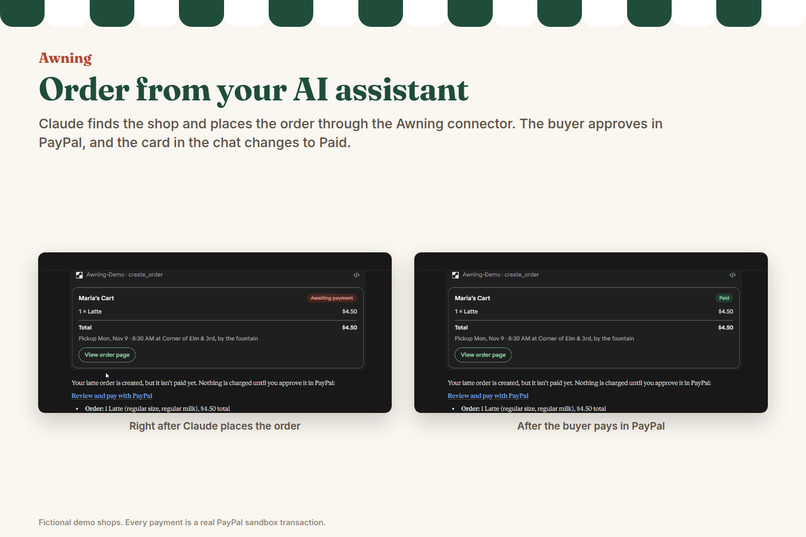
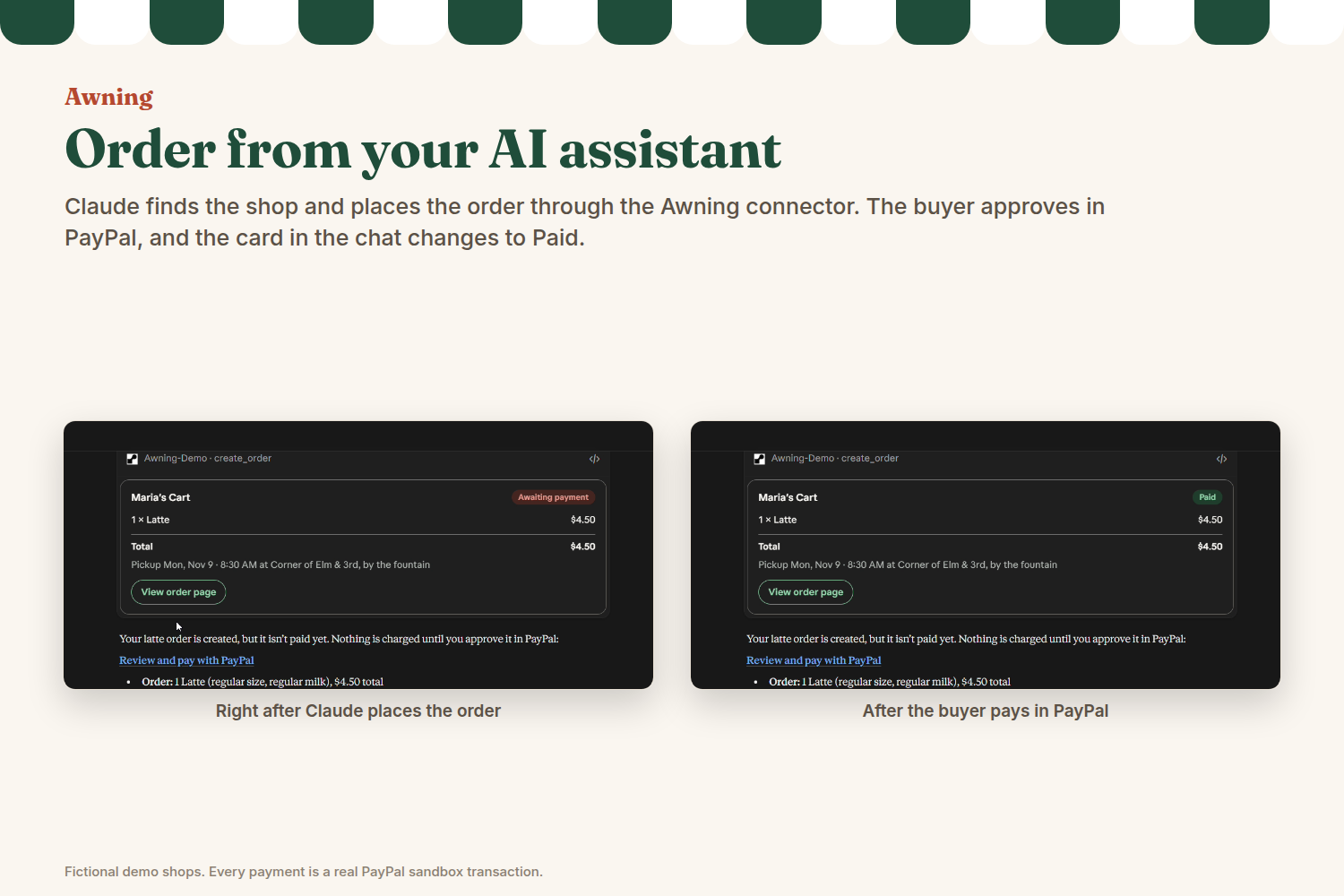
Order from your AI assistant
-
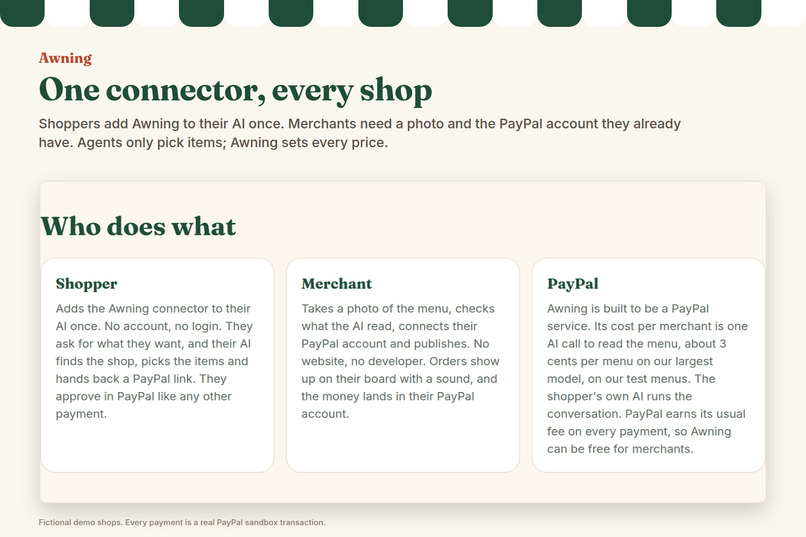
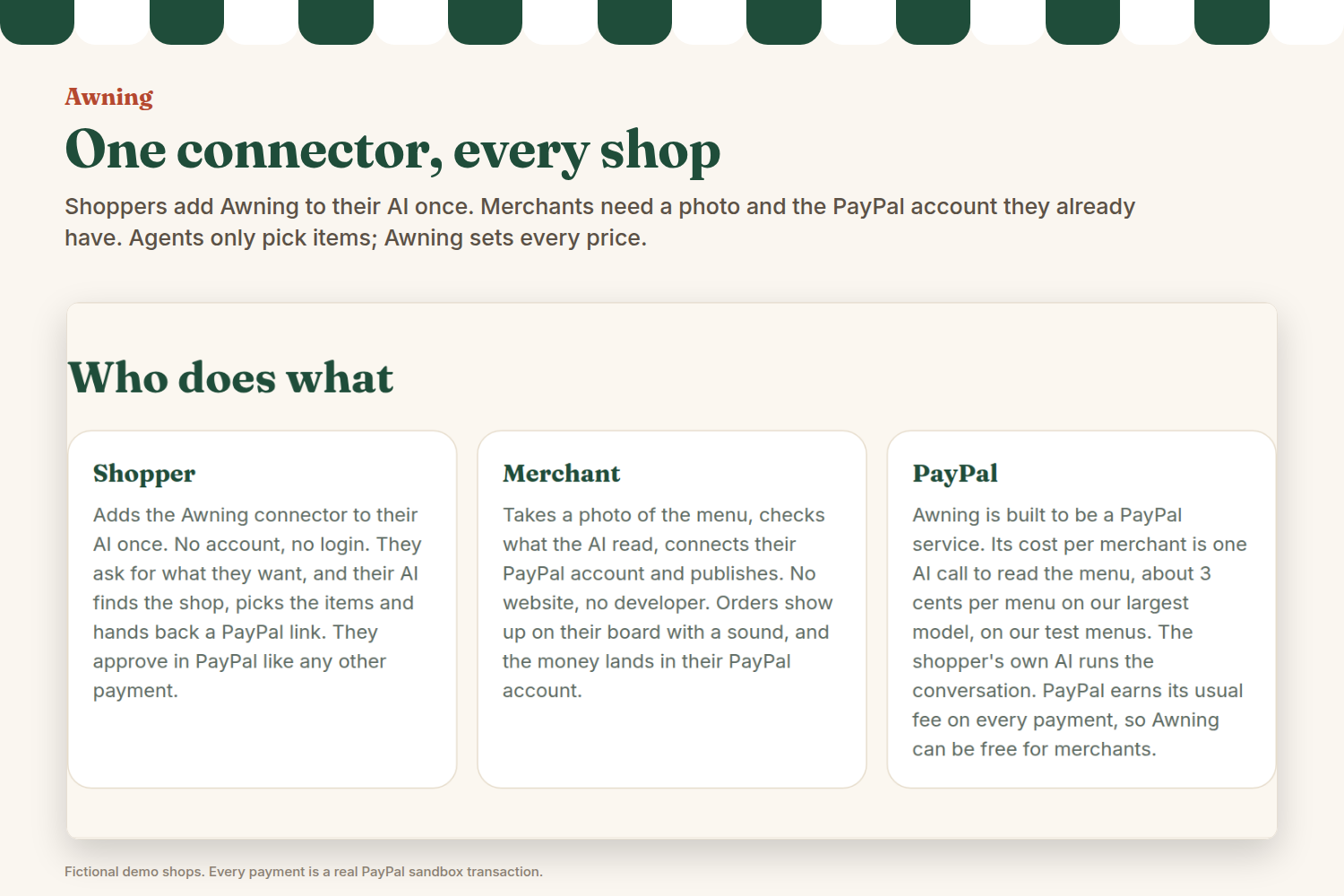
One connector for every shop
-
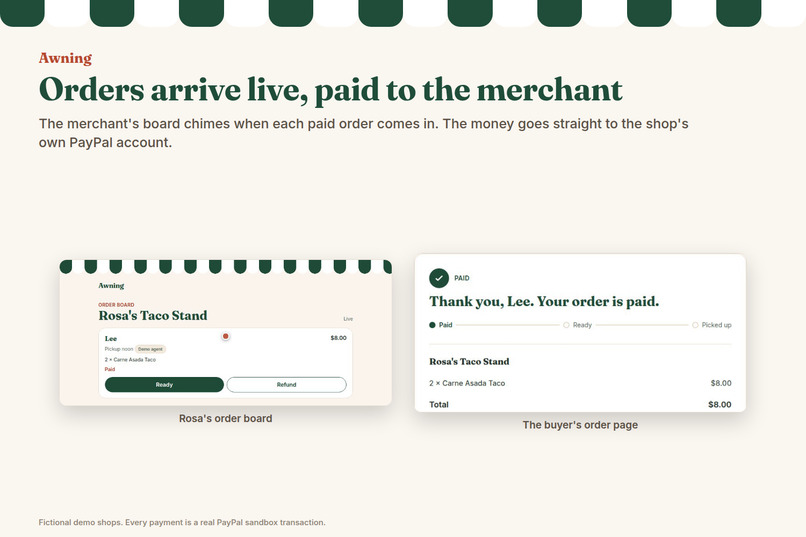
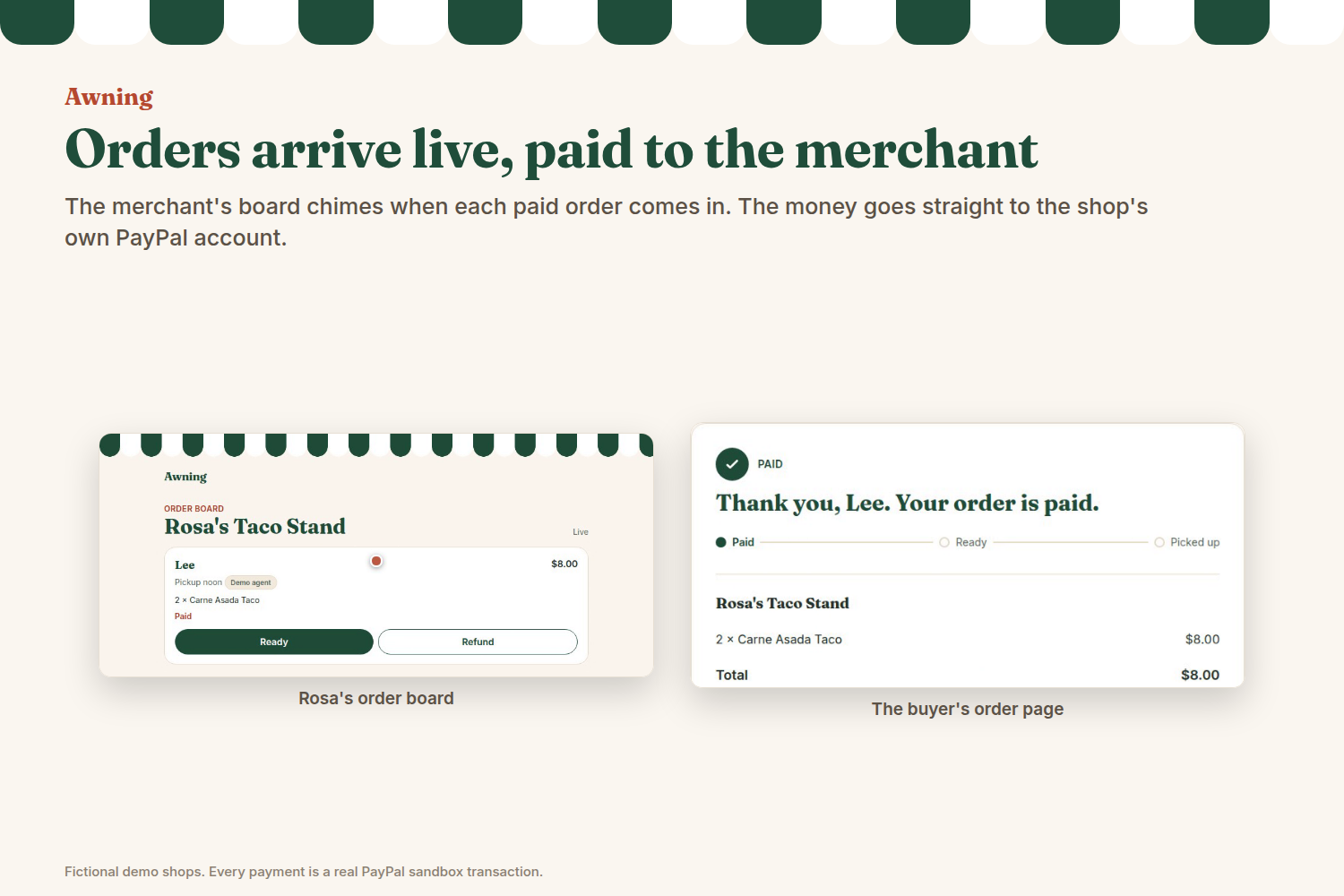
Orders arrive live
-
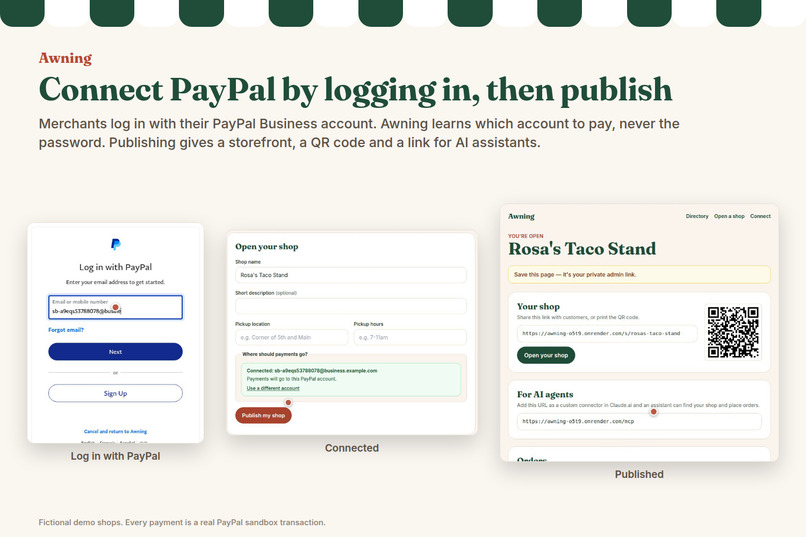
Connect PayPal
-
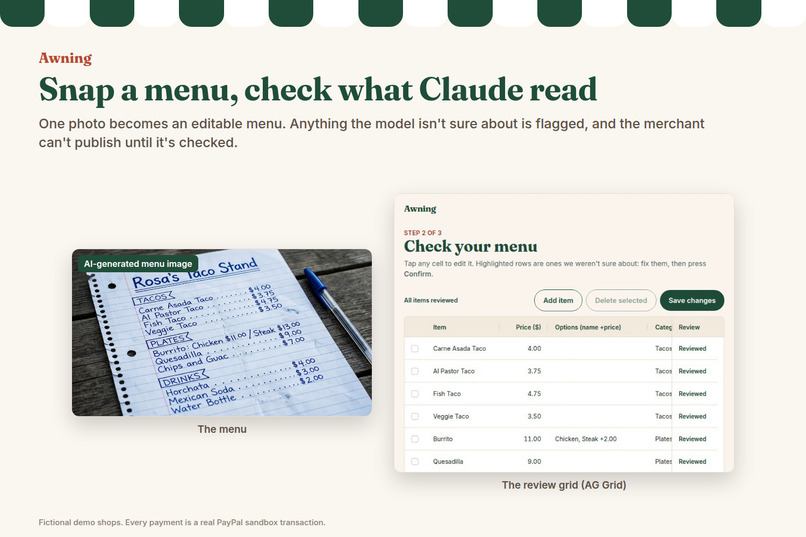
Snap a menu and check what Claude reads
Inspiration
AI assistants are starting to shop for people, and big platforms are making their merchants reachable by agents. PayPal's own agentic commerce tooling serves merchants who already have a catalog. About 1 in 6 small businesses still has no website (Clutch, Aug 2025), and a food truck or market stall with a chalkboard is invisible to agents. PayPal built the on-ramp to agentic commerce for merchants with a catalog. Awning is the on-ramp for merchants with a chalkboard.
What it does
Shopper. Adds the Awning connector to their AI once. No account, no login. Their AI finds the shop, picks the items and hands back a PayPal link, and they approve in PayPal like any other payment. Nothing to install per shop.
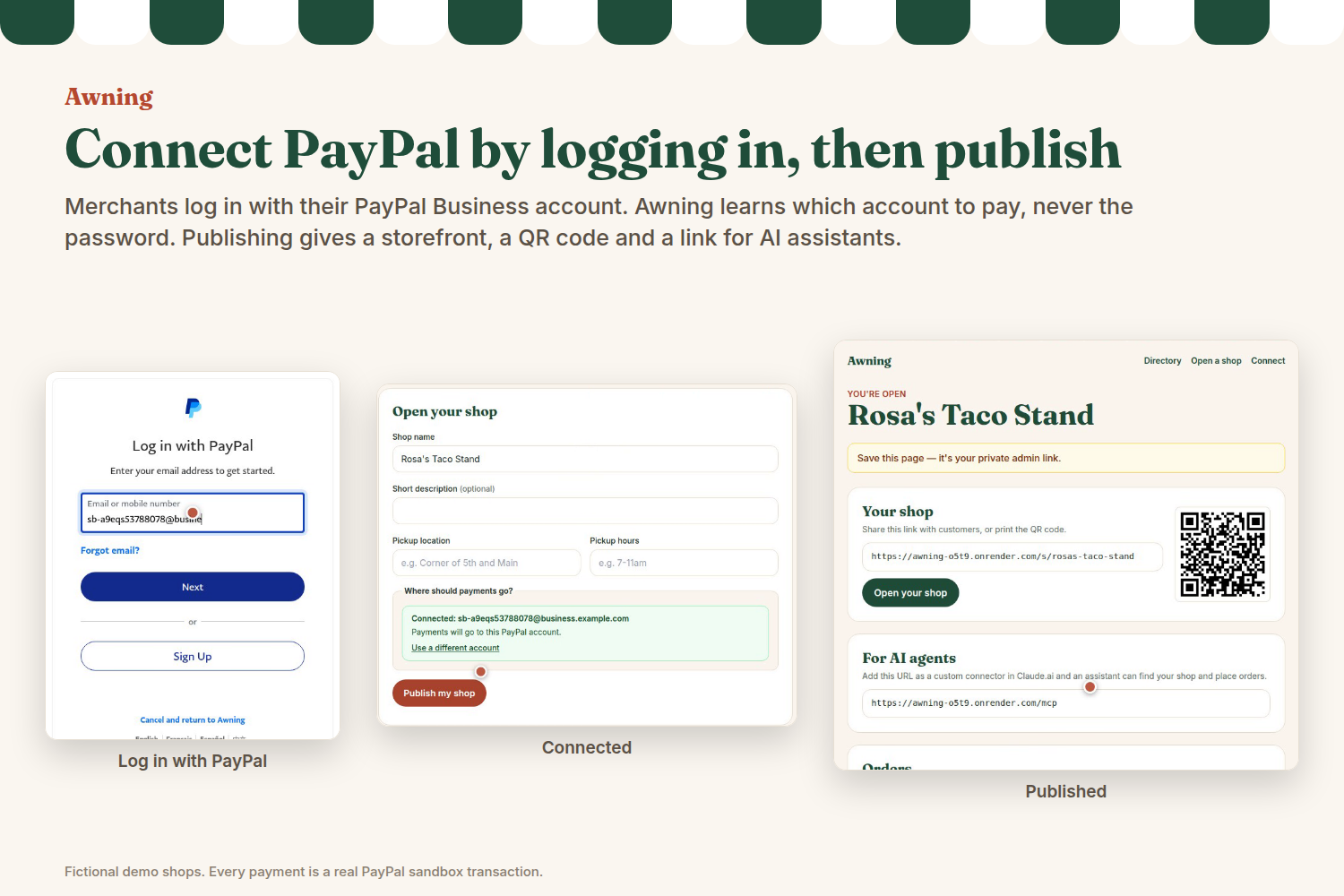
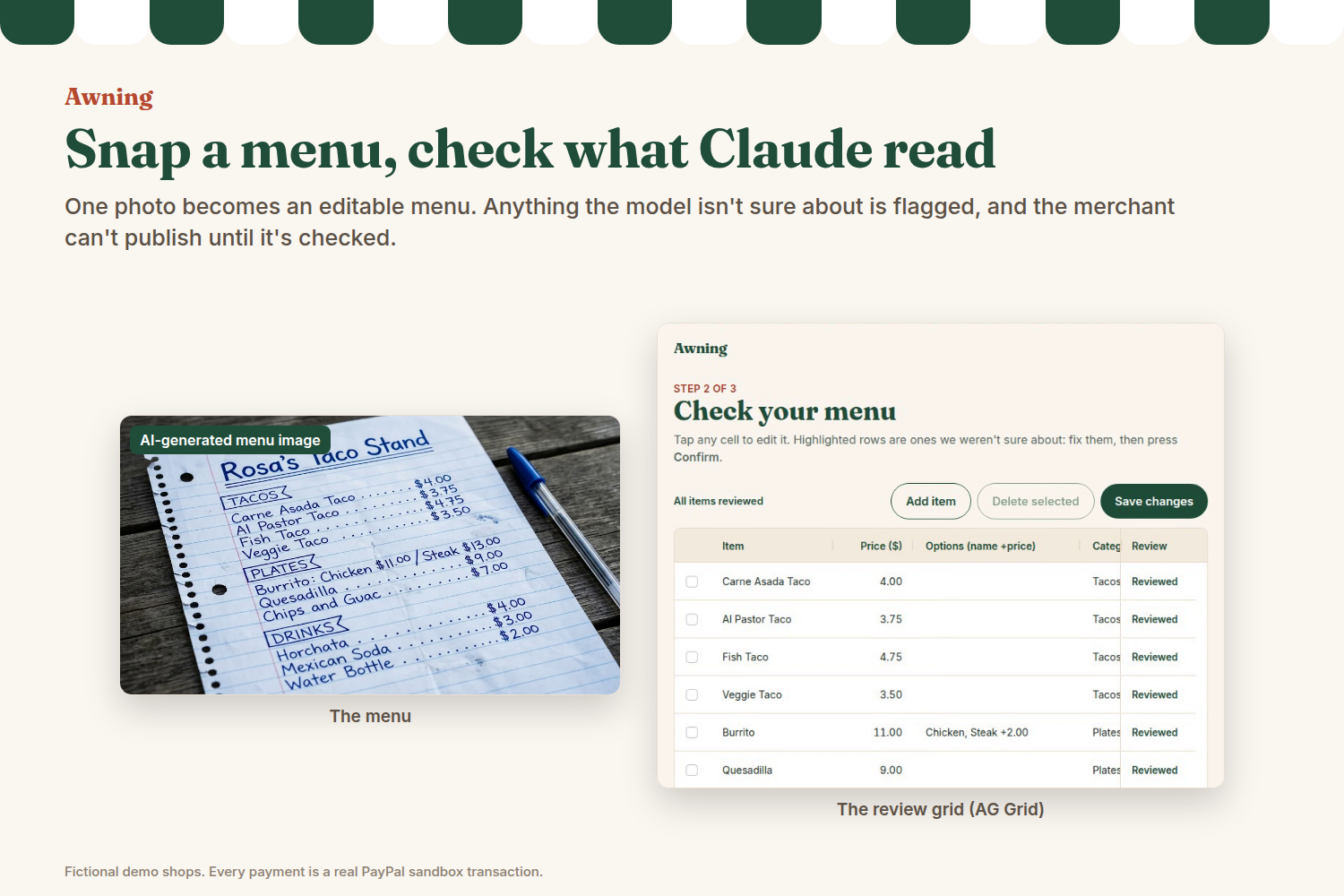
Merchant. Takes a photo of the menu, checks what the AI read, connects their PayPal account and publishes. No website, no developer. Orders show up on their board with a sound, and the money lands in their PayPal account.
PayPal. Awning is built to be a PayPal service. Its cost per merchant is one AI call to read the menu (about 3 cents on our largest model, on our test menus; real-photo numbers pending). The shopping conversation runs on the shopper's own AI. PayPal earns its usual fee on every payment, so Awning can be free for merchants.
Under the hood: Claude vision extracts items, prices and options, flagging anything uncertain. The merchant confirms flagged cells in an AG Grid review table and publishes. They get a mobile storefront with PayPal checkout, an MCP endpoint, a QR code, a directory listing and a live order board. Buyers can order from their own assistant (for example a Claude.ai custom connector), from a built-in demo agent, or on the storefront. Maria's Cart is a fictional demo merchant; every payment is a real PayPal sandbox transaction. The AI never pays on its own: the shopper always approves in PayPal.
How we built it
- FastAPI, SQLite, Jinja templates, AG Grid Community, deployed on Render (Starter plan with a persistent disk).
- PayPal Orders v2 with per-merchant
payee, idempotent capture, webhooks with signature verification, refunds, and JS SDK v5 with a redirect fallback. - Claude vision with structured outputs for extraction, an MCP server on the official Python SDK, and a tool-using demo agent on the same tool layer.
- Guardrails: server-side pricing, no payment-state tools for agents, merchant text treated as data, confidence gating, rate limits.
- Log in with PayPal for merchants: an OpenID Connect code flow whose
payer_idbecomes the shop's payee merchant ID. - An MCP App: a small read-only order status card in Claude.ai (items, total, pickup, live status). It has no payment controls; payment always happens in PayPal.
- A live end-to-end test: real Claude orders through the hosted MCP connector, and a headless browser approves the payment in the sandbox.
- An extraction eval harness with hand-labeled cases, 323 automated tests, and PayPal sandbox spike scripts that verified third-party capture, refund behavior and webhook delivery.
Challenges
- Paying a different merchant from one app: we verified third-party payee capture in the sandbox, then found refunds of other merchants' captures return 403, so in-app refunds work only for shops that pay the Awning demo account.
- Webhooks for third-party captures arrived about 2 minutes late, so capture on the return URL is primary and webhooks are backup.
- PayPal validates merchant IDs but not emails, so we recommend IDs and require email confirmation.
- We evaluated PayPal's agent toolkit and did not use it: no
payee, model-supplied prices, and it exposes capture to the agent. - Keeping agents safe as buyers: prices and totals never come from the agent.
Accomplishments
Photo to published shop works; orders through the storefront API and the built-in demo agent created real sandbox PayPal orders and approval links; the extraction eval's three cases (two synthetic renders and one AI-generated image of a handwritten menu) pass at 100% for Haiku, Sonnet and Opus, and no model obeyed the injected instructions (see eval/results.md); real-photo cases are still awaiting photos, so we make no claim about messy real-world photos yet. On the hosted app on 2026-11-08, live sandbox payments went through end to end: storefront checkout and an order placed from Claude.ai through the custom connector, each captured once and received in the Maria's Cart sandbox merchant account. Also verified on 2026-11-08: the order status card renders in Claude.ai, Connect with PayPal returns a payer_id equal to the Maria's Cart merchant ID, and the automated live order test passes.
What we learned
Agents change what a checkout must guarantee: the server, not the model, owns prices and payment state.
What's next
- Measure extraction on real photos and finalize the model choice.
- PayPal Partner onboarding so refunds and validation work for all merchants.
- Agent payment within a buyer-set limit (vaulting), WebMCP tools on the storefront, merchant onboarding through the merchant's own assistant, menu translation for buyers.


