-
-
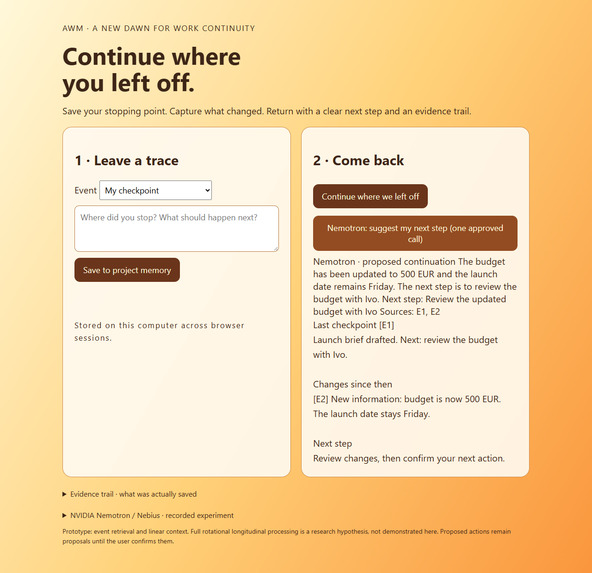
Actual Nemotron continuation after returning to a saved checkpoint: updated 500 EUR budget, Friday deadline, sources E1/E2.
Inspiration
Returning to a project often means rebuilding context before doing useful work. AWM asks a simple question: can we preserve the stopping point, include what changed during an interruption, and produce a traceable next step?
What it does
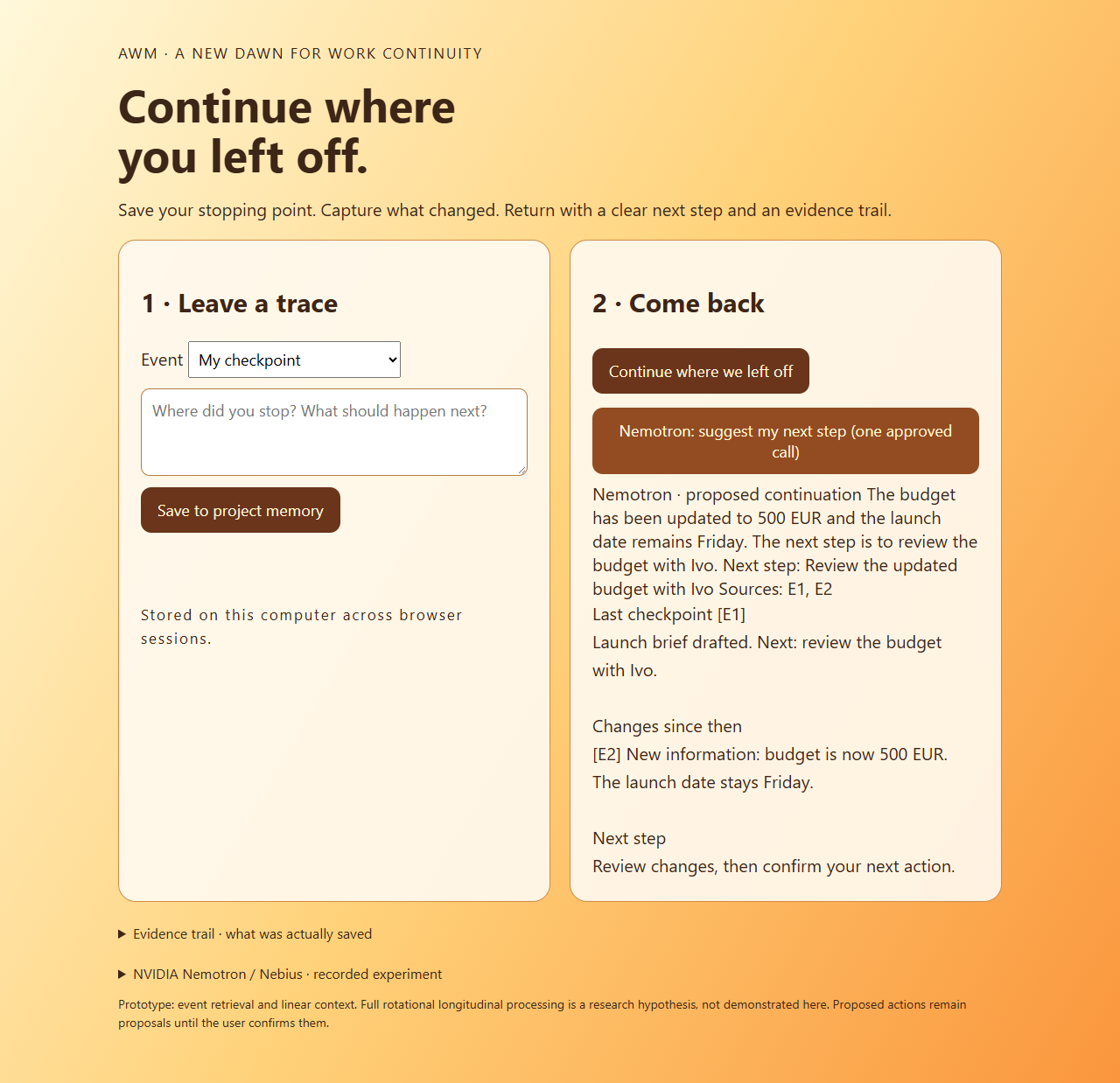
AWM — Continue Where You Left Off saves a project checkpoint and later updates. On return, it retrieves the latest checkpoint and subsequent changes with event IDs. In the recorded real test, NVIDIA Nemotron on Nebius turned that recovered state into a useful proposed continuation: review the updated 500 EUR budget with Ivo while preserving the Friday launch date.
The public browser demo offers persistent local memory and an explicitly labelled replay of the actual provider response. It makes no new inference calls and does not send visitors' notes to a model.
How we built it
Python's standard library and SQLite preserve user events across sessions. A compact evidence payload is sent to nvidia/NVIDIA-Nemotron-3-Nano-30B-A3B through the Nebius Token Factory chat-completions API. The response is checked for JSON structure, proposal status and citation coverage before display. The user remains responsible for confirming actions.
The approved live run was made through the actual browser UI: checkpoint → interruption → update → interruption → return → one Nemotron request → displayed continuation. Its raw request, response, provider receipt, usage and browser readback are published with the code.
What changed during the hackathon
AWM research existed before the submission period. During the period we built the CPU reference implementation, synthetic A/B/C retrieval experiments, durable project-memory interface, bounded model adapter, citation/status validation, real Nebius/Nemotron integration, end-to-end capture and distributable test build. This submission is the working continuity prototype, not a claim that the wider research architecture has been completed.
Evidence and testing
32 automated tests pass. The single real continuation returned HTTP 200 in 1192.4 ms and consumed 179 input + 72 output tokens. The calculated token charge at the published catalog rates was $0.00002802; this is usage-based calculation, not an invoice settlement. Citations E1 and E2 match the saved checkpoint and budget update.
To test locally: install Python 3.10+, clone the repository, run python -m unittest discover -s tests -v, then python src/continue_demo.py and open http://127.0.0.1:8765. Normal mode makes no inference calls. The one approved live-call claim is preserved; no further paid calls are enabled by the public demo.
Nebius and NVIDIA feedback
Token Factory enabled a real Nemotron test without provisioning GPU infrastructure. Nano was adequate for this small grounded continuation and produced concise source-linked JSON. Helpful improvements would be clearer model-specific structured-output/reasoning examples, per-request dollar ceilings and invoice-level usage receipts. We did not use AI Cloud instances, fine-tuning or Tavily.
Challenges and limits
A saved note is not independently verified truth. Valid citation IDs do not prove semantic correctness. Suggestions remain proposals; the app performs no external actions. The evidence covers one synthetic continuity scenario. Earlier A/B/C runs compare retrieval plus linear prompting; they do not establish general superiority, GPU acceleration or full rotational longitudinal processing.
AI assistance
ChatGPT/Codex helped implement, test, document and package the prototype. NVIDIA Nemotron supplied the actual recorded continuation through Nebius. No model weights, third-party music, external artwork or private project books are bundled.
What's next
Evaluate more changed-condition scenarios and independently assess semantic correctness before expanding automation. Preserve the user's authority and the distinction between proposal, execution and verification.
Built With
- codex
- css
- html
- javascript
- nebius-token-factory
- nvidia-nemotron
- python
- sqlite

Log in or sign up for Devpost to join the conversation.