Inspiration
After a trip or even one night out, a home camera system leaves you with hundreds of motion events. Finding the three that matter means scrolling timelines, and generic AI summaries can invent or misread events. That is a bad trade for something as personal as home security. I build camera AI and LLM evaluation tools, so I wanted a NAS Skill that summarises like an assistant but is held to evidence like an audit.
What it does
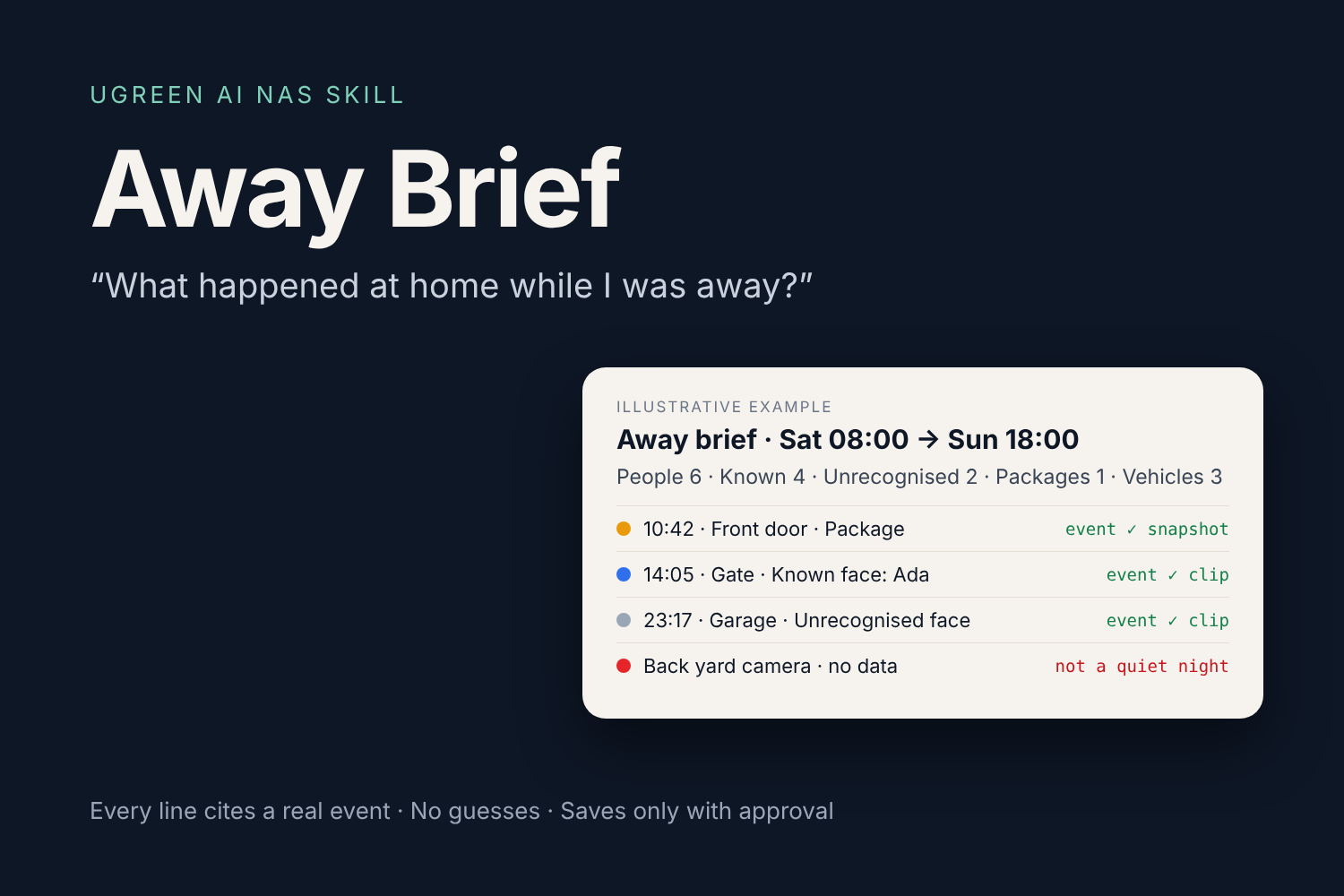
Ask your UGREEN AI NAS "what happened at home while I was away?" and Away Brief returns a short incident brief:
- At a glance: counts of people, known faces, unrecognised faces, packages, pets and vehicles for your time window (zeros shown explicitly).
- Notable events: one line per event with its real event ID and a snapshot, clip or playback position.
- Coverage notes: which cameras were covered and which returned no data.
It describes what was recorded and never why. There are no "intruder" or "safe" labels, and "unrecognised" only means a face is not enrolled. It separates "no events" from "no data", so an offline camera is never reported as a quiet night. It saves the brief as Markdown on the NAS only after platform approval.
How I built it
Away Brief is an orchestration Skill built with UGREEN's official Skill Developer Package (uliya-skill-kit 0.7.7). The parent Skill only delegates self-contained instructions to registered experts and passes only verified results forward:
- Coverage check:
ug-surveillancecameras - Category counts:
event-group-counts(human, known, stranger, package, pet, vehicle) - Notable timeline:
event-timeline(strangers, packages, vehicles, night activity) - Identity:
identity-resolveagainst the NAS face library - Evidence:
event-evidence(snapshot, clip or playback position) - Verification gate: drops any sentence not backed by a returned fact
- Optional save:
ug-knowledgesave-text, workflow-approved
Steps 1 to 5 run through security-monitor-agent and step 7 through knowledge-agent. Every state (completed, failed, cancelled, waiting_user, waiting_approval) has explicit handling, and partial results are reported step by step. Faces and footage stay on the NAS.
Challenges
- Designing for honesty, not fluency: the hardest part was the rules for what the brief must not say. That means no inferred intent, no merged events, and no treating missing data as zero.
- Working without hardware in Round 1: the Skill is written and checked against the kit's static rules, but real response fields, evidence references and the approval flow still need testing on a NAS.
What I learned
UGREEN's expert-delegation model makes "grounded by construction" practical. Because the parent can only pass forward verified results from a completed delegation, an evidence-first workflow becomes a structural property, not just a prompt instruction.
What's next (Round 2)
Validate on a real iDX6011 Pro with three tests:
- Overnight with known and unrecognised faces: counts match the NAS UI, and every line has evidence.
- Package at the front door: the event appears with a snapshot, and the approved save is verified.
- Edge case: an offline camera or a zero-event window. The brief must say "incomplete" or "no events" and never invent anything.
Built With
- ai-agents
- claude
- markdown
- ug-knowledge
- ug-surveillance
- ugos
- ugreen-ai-nas
- uliya-skill-kit
