Inspiration
AWARE began with a hundred notifications from home after an earthquake struck Panama. Before this hackathon, Paula spoke with her father, an engineer volunteering with the Coast Guard. He described communities still waiting for assistance and responders struggling to track where help had already gone.
That conversation raised a question: How can someone request help, and know their request has been heard? We built AWARE to connect that person with the teams working to reach them.
What it does
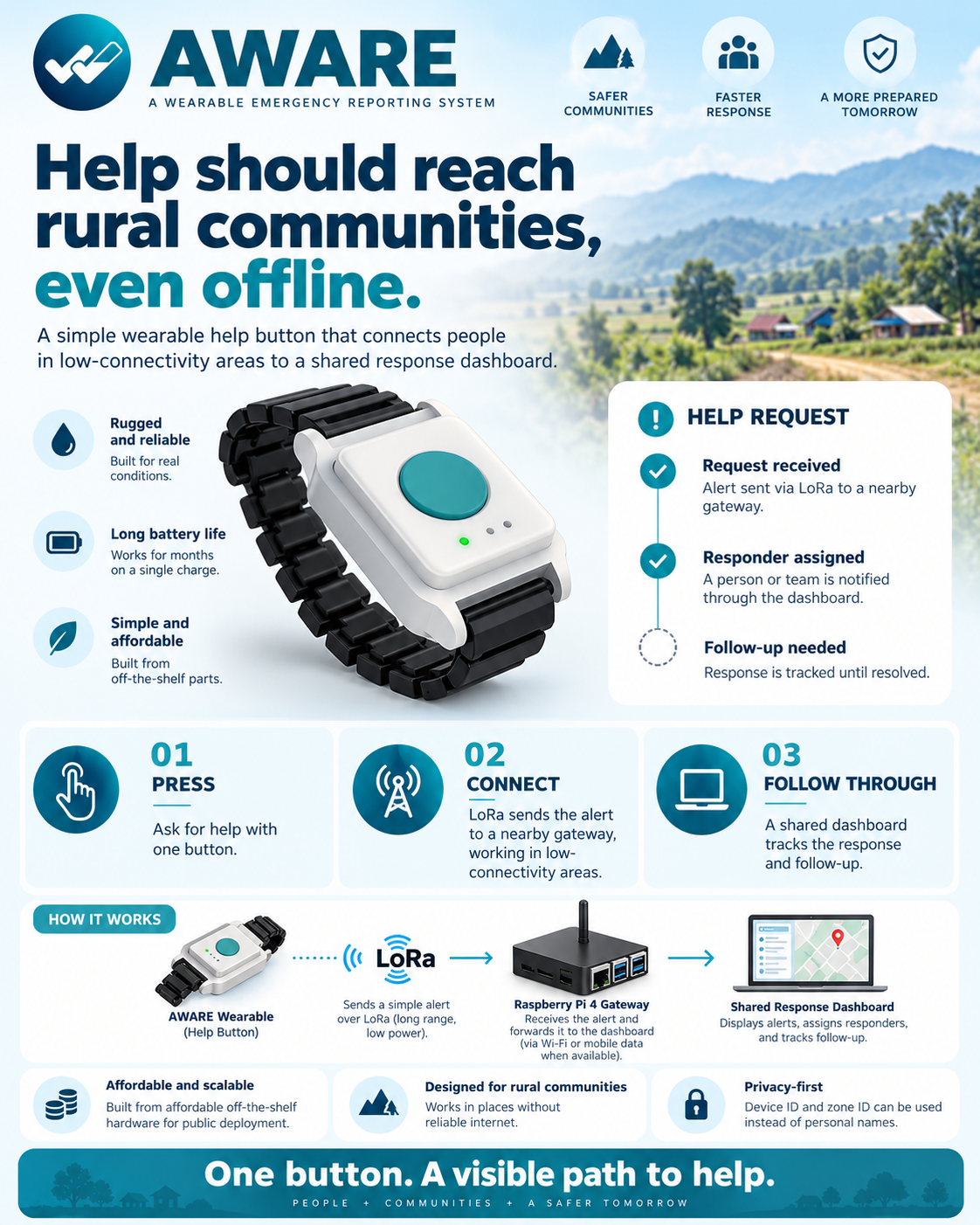
AWARE connects an emergency wearable to a responder dashboard, tracking requests from submission through verified assistance.
Users select one of four emergency categories and press once to request help. Responders can view the request’s location, category, and status, assign a team, and acknowledge it. A green device indicator confirms acknowledgment.
Unresolved requests trigger an overdue alert. When assistance arrives, the survivor presses three times to report arrival; a responder separately verifies assistance before closing the case.
Our demo uses a simulated USC campus location and a shortened, 30-second overdue threshold.
How we built it
We combined an Arduino hardware prototype with a button-based interface, LED status indicators, and an interactive HTML dashboard developed using IBM tools.
The software connects hardware interactions with request tracking, acknowledgment, overdue alerts, and assistance updates. We also created a CAD design for a proposed wearable enclosure.
Together, these components demonstrate how a simple physical interaction can support a shared response workflow.
Challenges we ran into
Our central challenge was keeping the survivor’s interface simple while giving responders enough information to coordinate assistance.
We also needed to distinguish between a request being received, acknowledged, and resolved. A green light must communicate acknowledgment clearly, while unresolved requests remain visible.
Coordinating hardware behavior, dashboard updates, and the timed overdue alert was another key integration challenge.
Accomplishments that we're proud of
We brought together a hardware prototype, responder dashboard, and CAD enclosure concept in one weekend.
Our demonstration follows a request through acknowledgment, overdue escalation, reported arrival, and responder verification. We are especially proud of keeping the survivor’s interaction simple while preserving a detailed request history for responders.
Most importantly, we turned a personal experience into a concrete prototype addressing a real coordination problem.
What we learned
Emergency communication requires follow-through. Sending a request is only the first step; survivors need understandable feedback, and responders need visibility into unfinished cases.
We learned how hardware and software can work together to communicate status, and why acknowledgment and confirmed assistance must remain separate stages.
Designing for stressful situations also reinforced the value of simple controls and clear indicators.
What's next for AWARE
We plan to refine the wearable enclosure, improve power efficiency, and test usability with potential users and emergency-response professionals.
We also want to develop offline field updates and evaluate communication options for areas with unreliable cellular service. These capabilities require further engineering and field testing.
Our proposed business model combines wearable-device sales with a coordination-software subscription for emergency agencies and campuses. We aim to validate that model through pilot partnerships.
Our goal: keep every request visible until assistance is confirmed.

Log in or sign up for Devpost to join the conversation.