Inspiration
Hyderabad's civic complaint channels expect citizens to type, usually in English, and to know which department owns their problem. Most residents think in Telugu, Hindi/Dakhni or Urdu, many can't type, and when one drain overflows, 30 people complain and officers see 30 separate tickets. A fallen live wire waits in the same queue as a flickering streetlight.
What it does
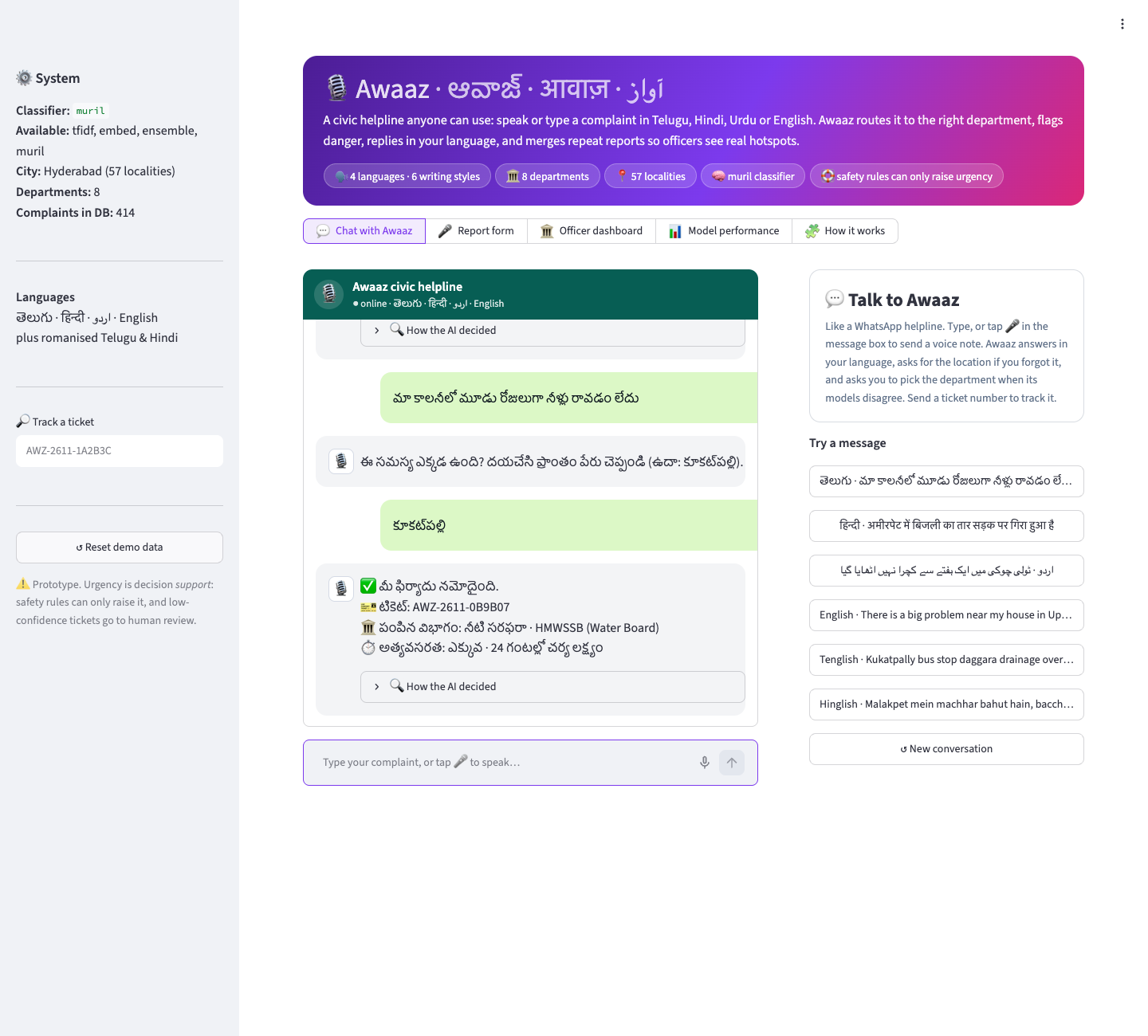
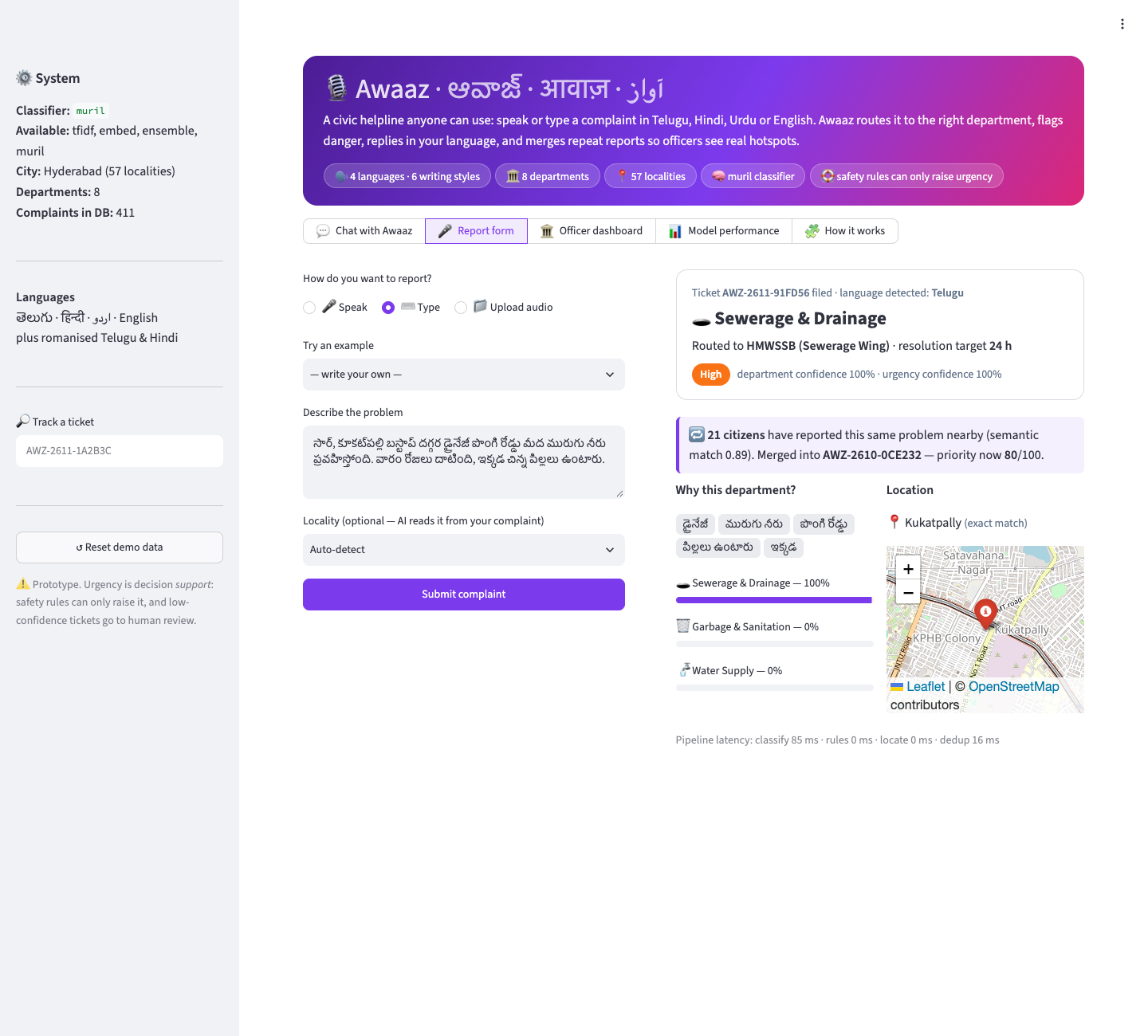
Awaaz is a WhatsApp-style chatbot for civic grievances (HI-02). A citizen types or sends a voice note in Telugu, Hindi, Urdu or English, including romanised "Tenglish"/"Hinglish". Awaaz:
- replies in the citizen's own language, and asks for the location if it's missing
- routes the complaint to the right department (8 departments: GHMC, HMWSSB, TGSPDCL) and sets urgency
- asks instead of guessing: when its models disagree, it offers the top two departments as one-tap replies
- flags danger: safety rules (live wire, open manhole, fire, injury, oxygen/dialysis) can only raise urgency, with safety advice and helpline numbers (1912, 108, 101) in the citizen's language
- merges duplicates across languages: a Telugu and a Hindi report of the same drain become one incident
- gives a ticket number the citizen can track (open → in progress → resolved)
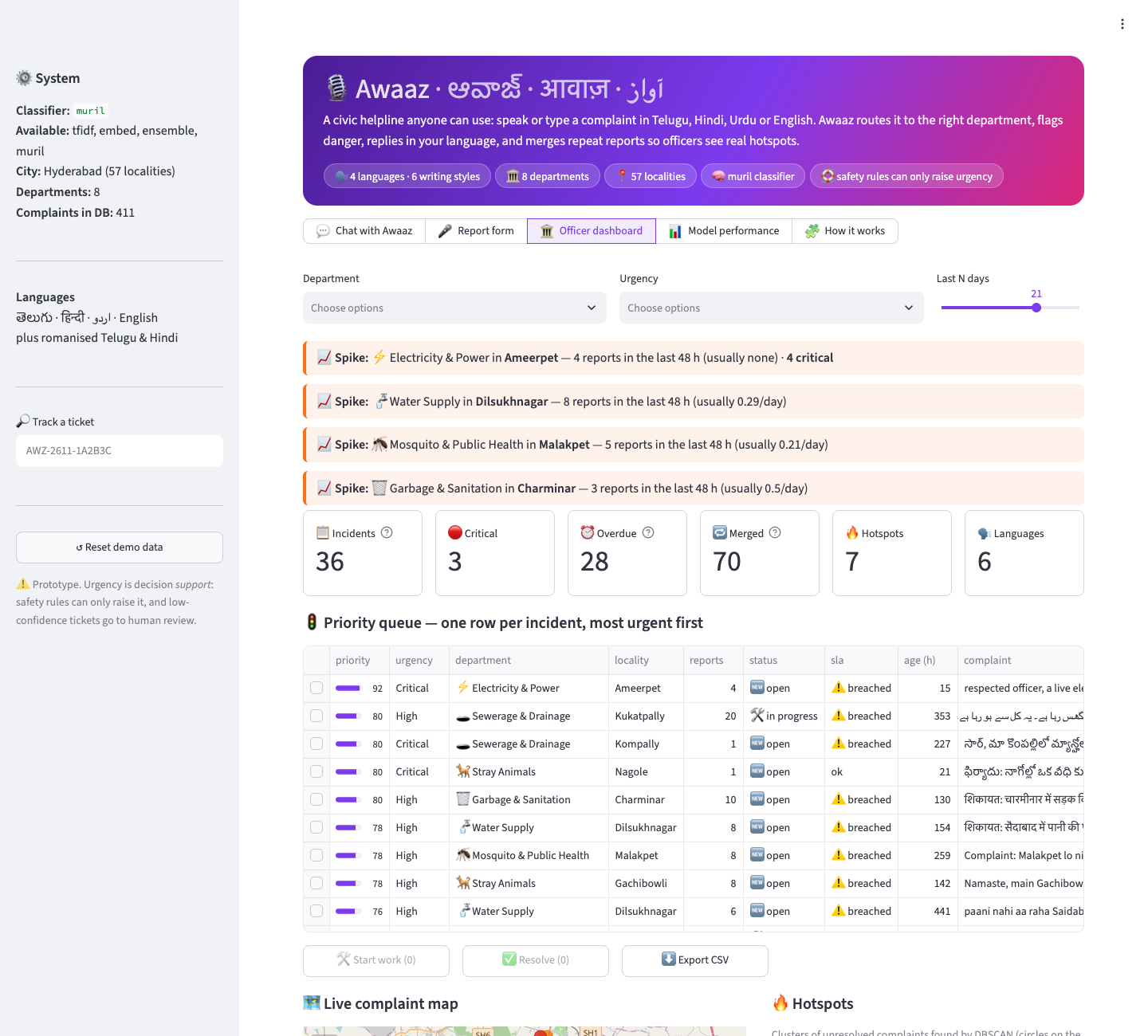
Officers get a dashboard with spike early-warnings, a live map, a priority queue (one row per incident, SLA/overdue flags), DBSCAN hotspots and CSV export.
How we built it
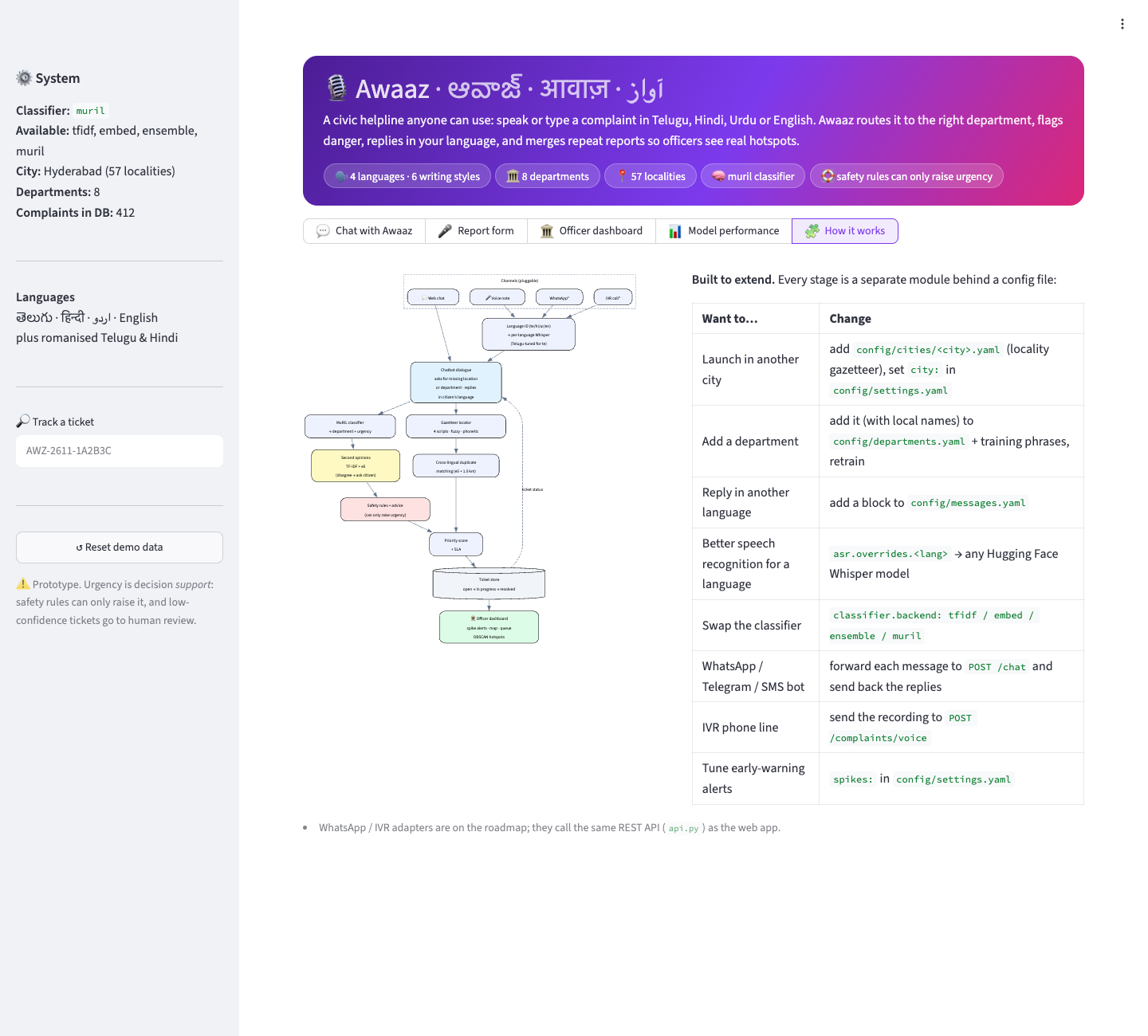
- MuRIL (Indian-language BERT) fine-tuned with two heads (department + urgency), calibrated with temperature scaling
- Second-opinion models (TF-IDF and multilingual-e5) – when they disagree, the bot asks the citizen
- Whisper speech recognition with language ID restricted to te/hi/ur/en, and a Telugu-tuned Whisper for Telugu
- Locality finder over 57 Hyderabad localities in 4 scripts with fuzzy + phonetic matching (survives speech errors)
- Duplicate detection: multilingual-e5 similarity + 1.5 km radius; DBSCAN hotspots
- Streamlit web app, FastAPI REST API (
/chatfor WhatsApp/IVR adapters), SQLite - Everything city/department/language-specific is YAML config, so it extends to new cities and languages without code changes
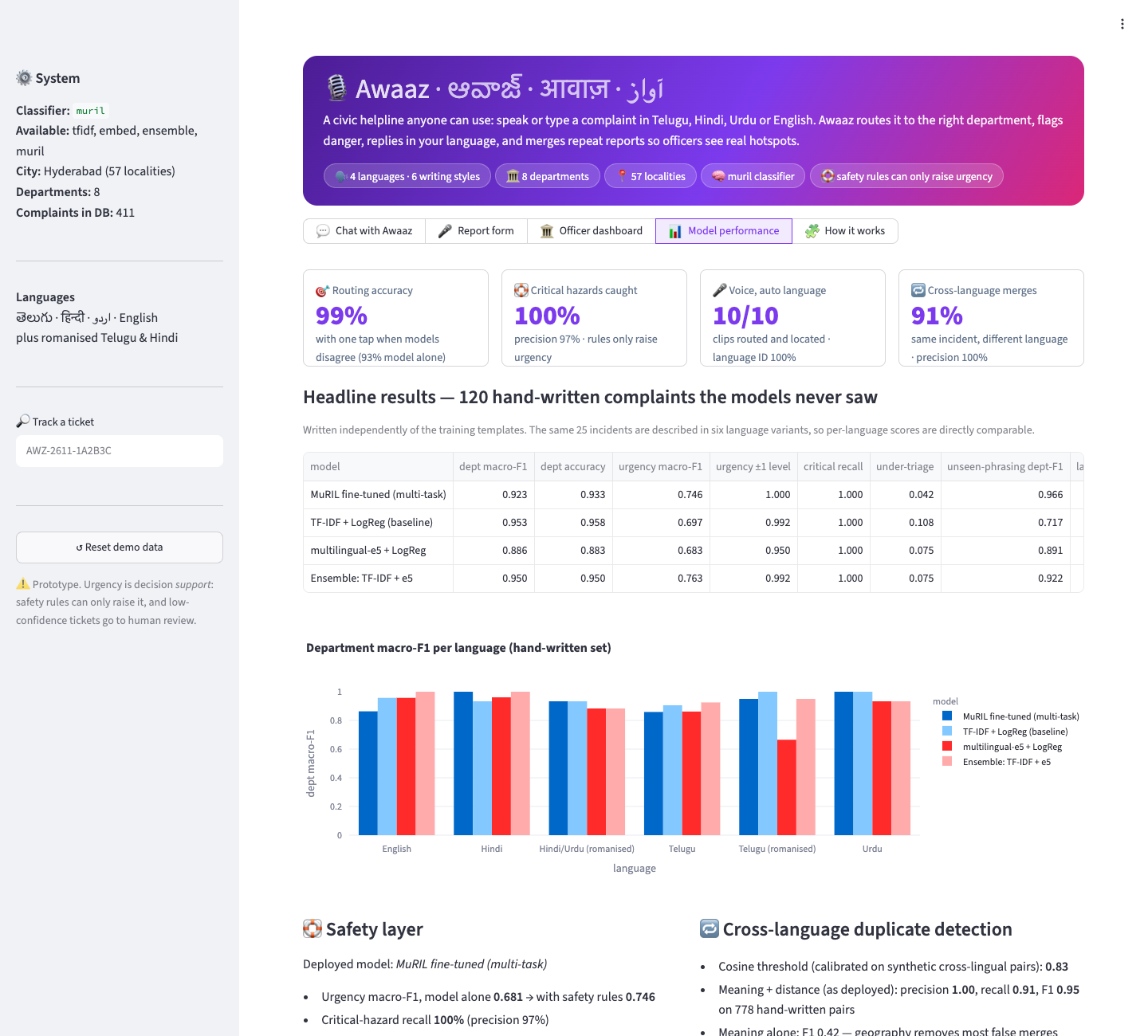
Results (120 hand-written complaints the models never saw)
- Routing accuracy 99.2% with one citizen tap (93.3% model alone; 100% when all models agree)
- 100% of life-threatening hazards caught (28/28, precision 97%)
- Voice: 10/10 clips (Telugu, Hindi, English) routed and located with auto language detection
- 91% of same-incident reports in different languages merged, with no false merges
Challenges we ran into
- No public labelled dataset of civic complaints in Telugu/Urdu/Hindi, so we built a synthetic generator with held-out phrasings and a separate hand-written test set
- Base Whisper wrote Telugu speech in Devanagari script; a Telugu-tuned model and restricted language ID fixed it
- The fine-tuned model was confidently wrong on vague complaints ("big problem near my house"), which led to the "ask when models disagree" design
What we learned
Asking the citizen one simple question beats a confident wrong guess, and safety rules should only ever raise urgency.
What's next
WhatsApp and IVR adapters on the existing API, photo complaints, real (noisy) voice recordings, a pilot with anonymised GHMC data, and native-speaker review of replies.
Built With
- fastapi
- folium
- hugging-face-transformers
- muril
- plotly
- python
- pytorch
- rapidfuzz
- scikit-learn
- sentence-transformers
- sqlite
- streamlit
- whisper
