-
-
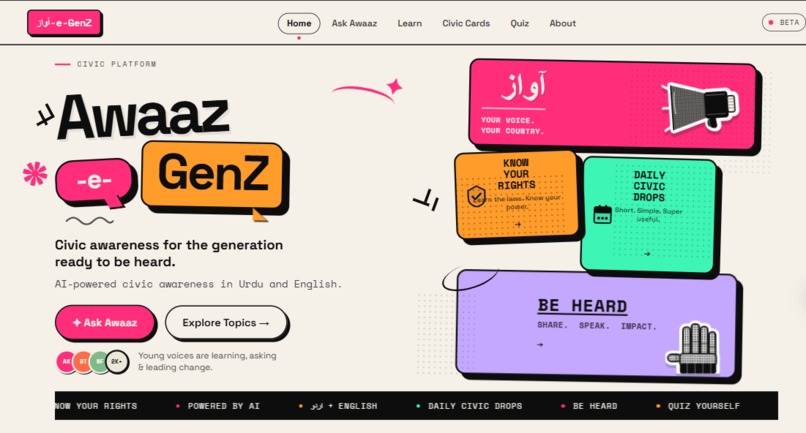
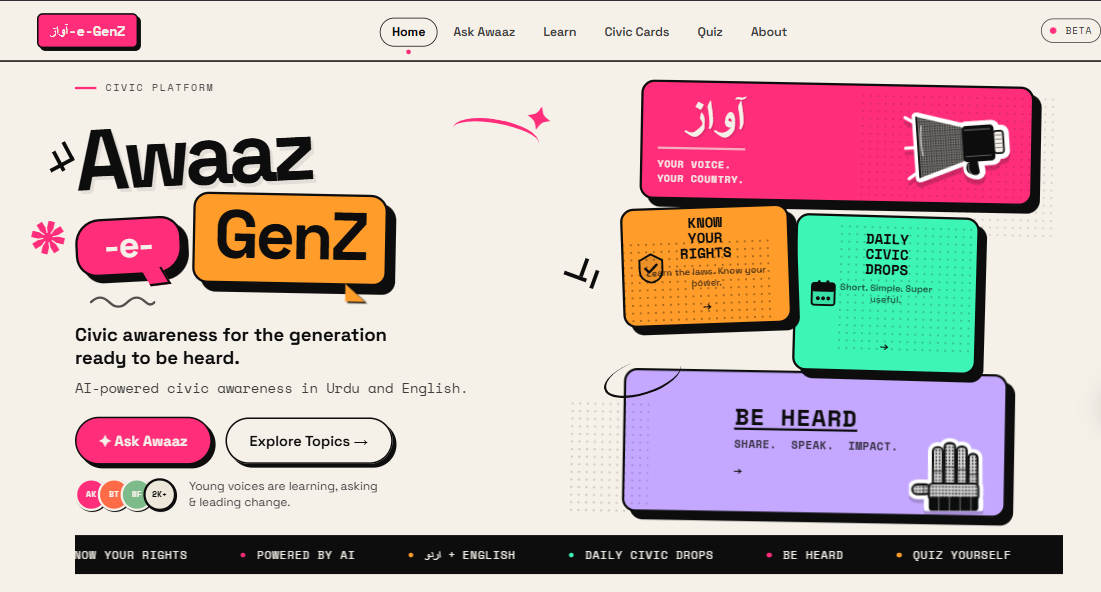
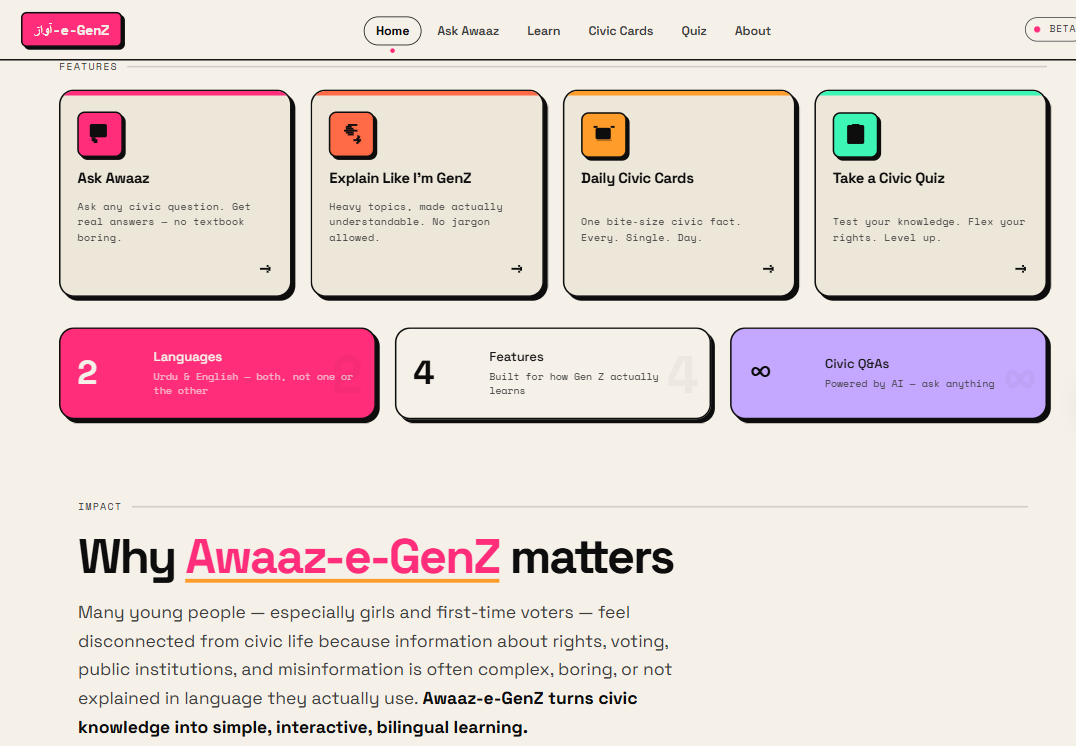
Homepage showing the Awaaz-e-GenZ product journey: Ask, Learn, Quiz, and Share.
-
-
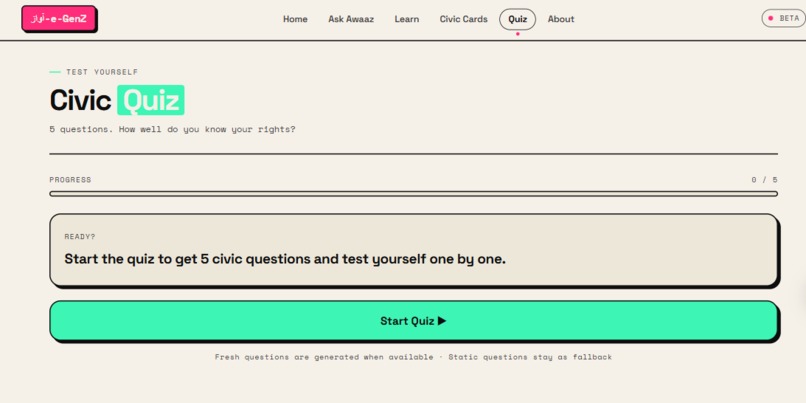
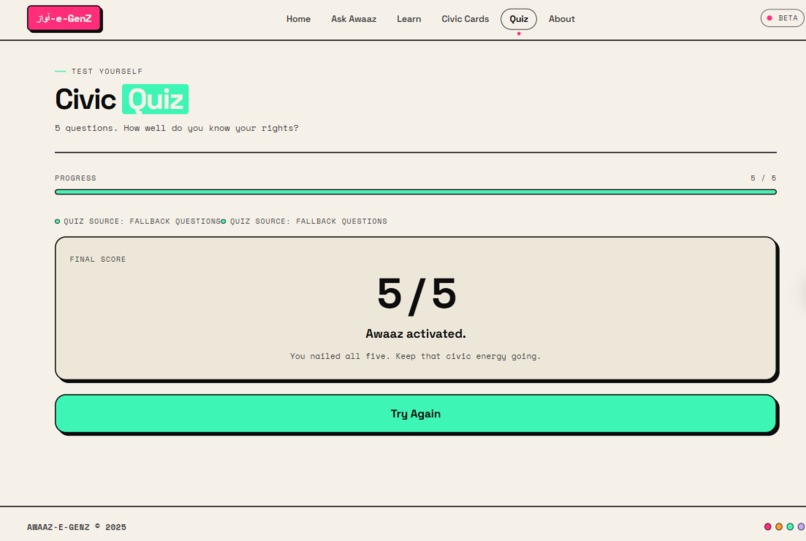
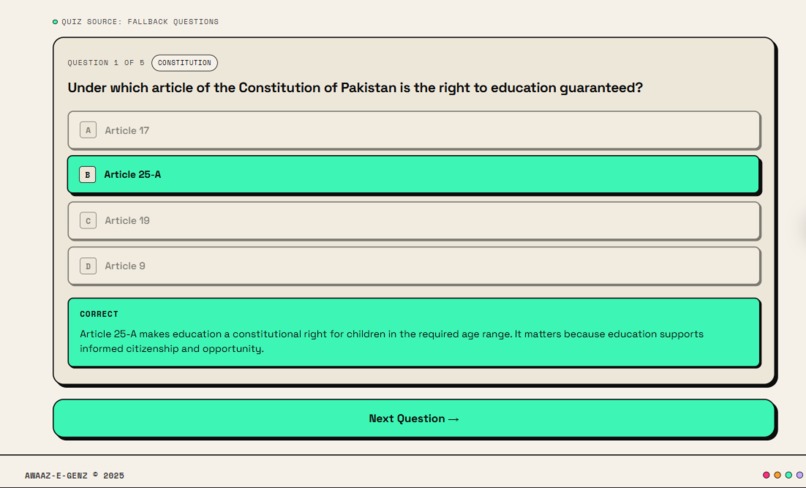
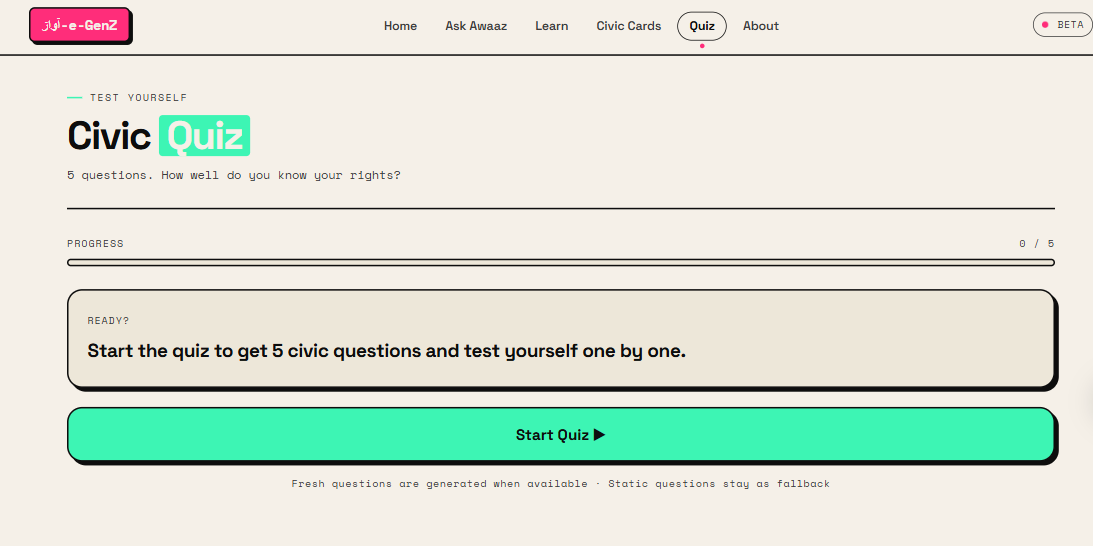
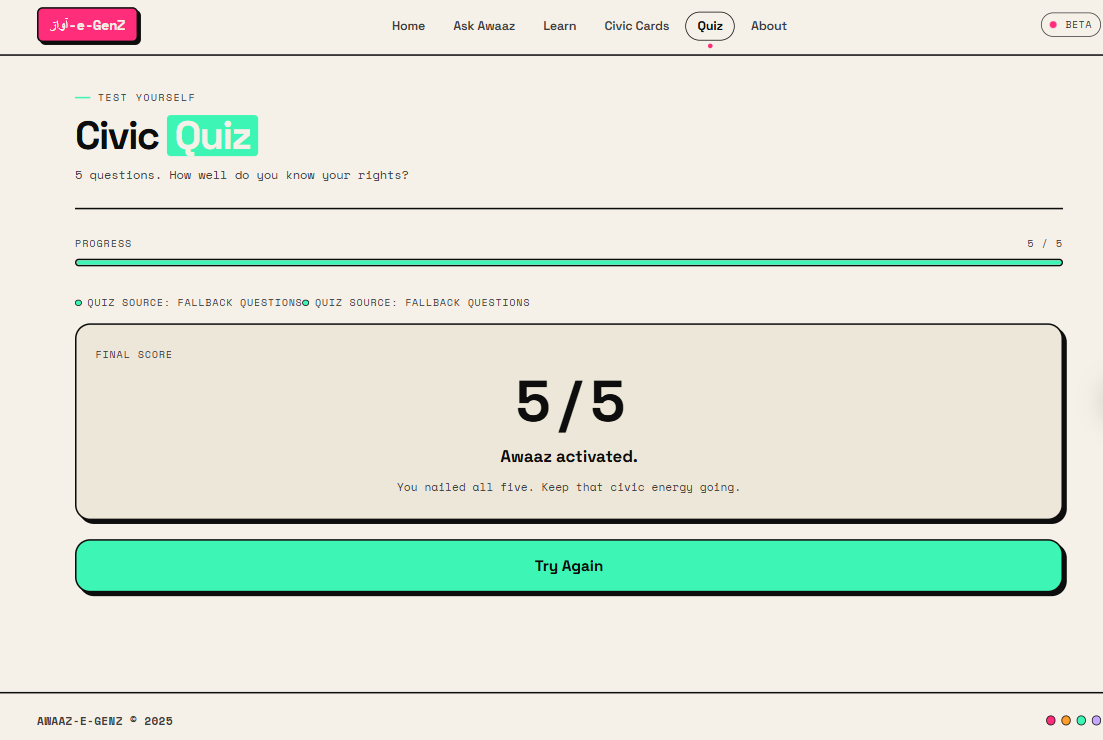
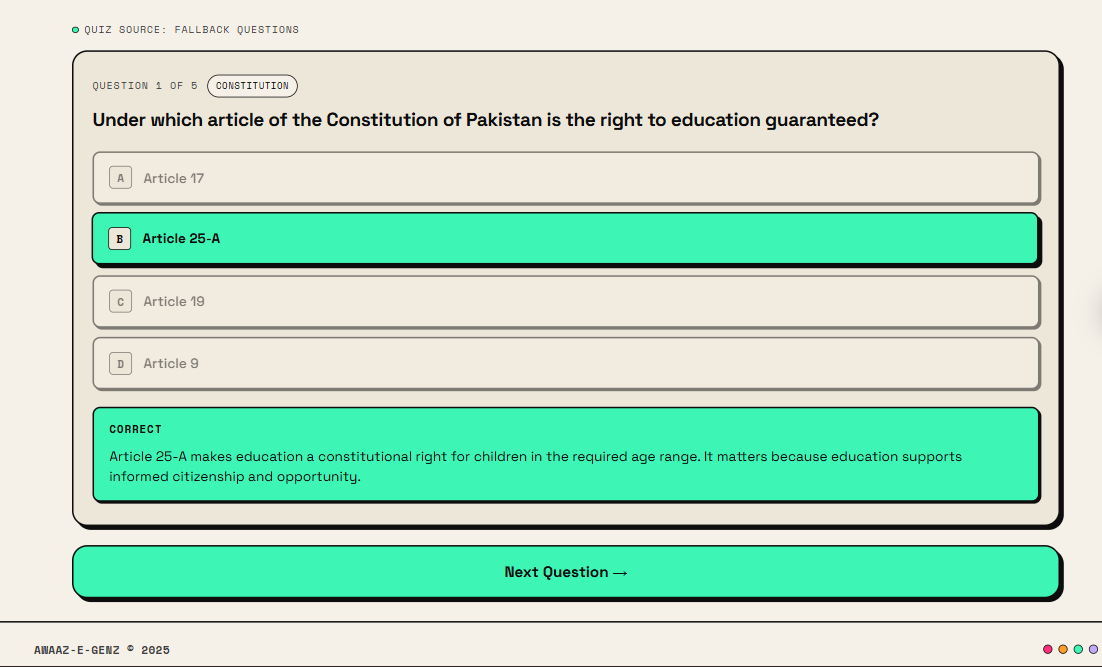
AI-generated civic quiz with instant feedback and explanations.
-
-
-
-
-
-
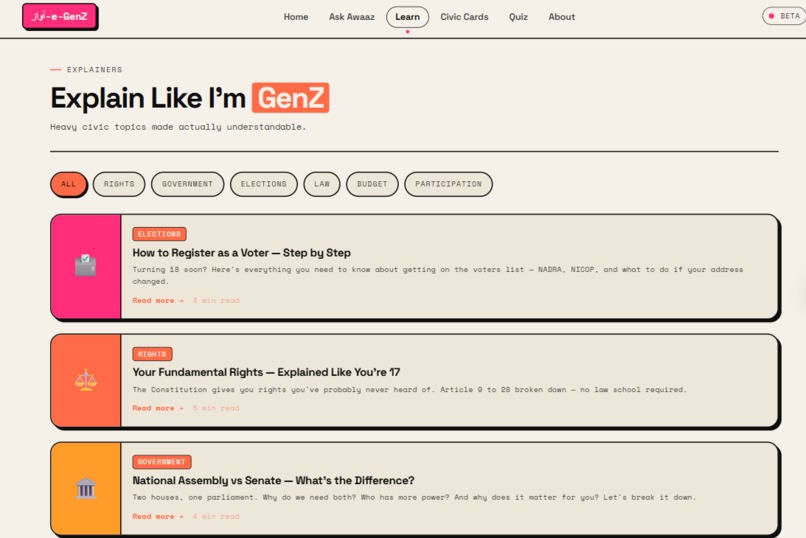
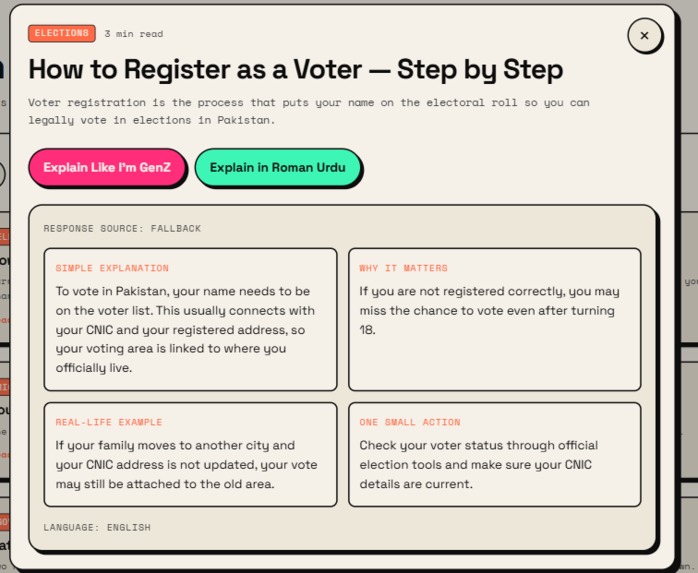
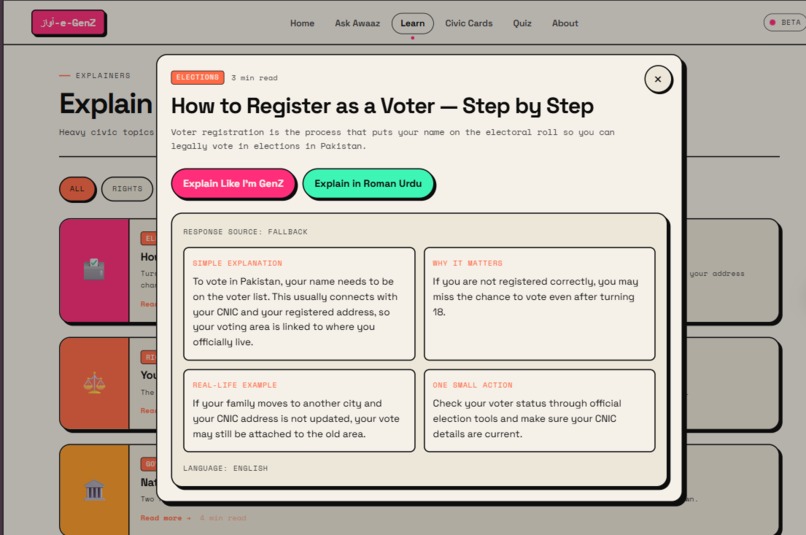
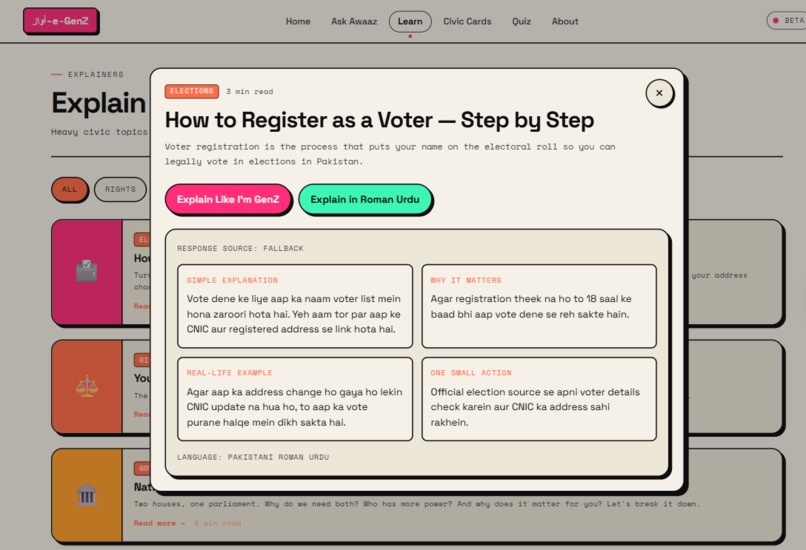
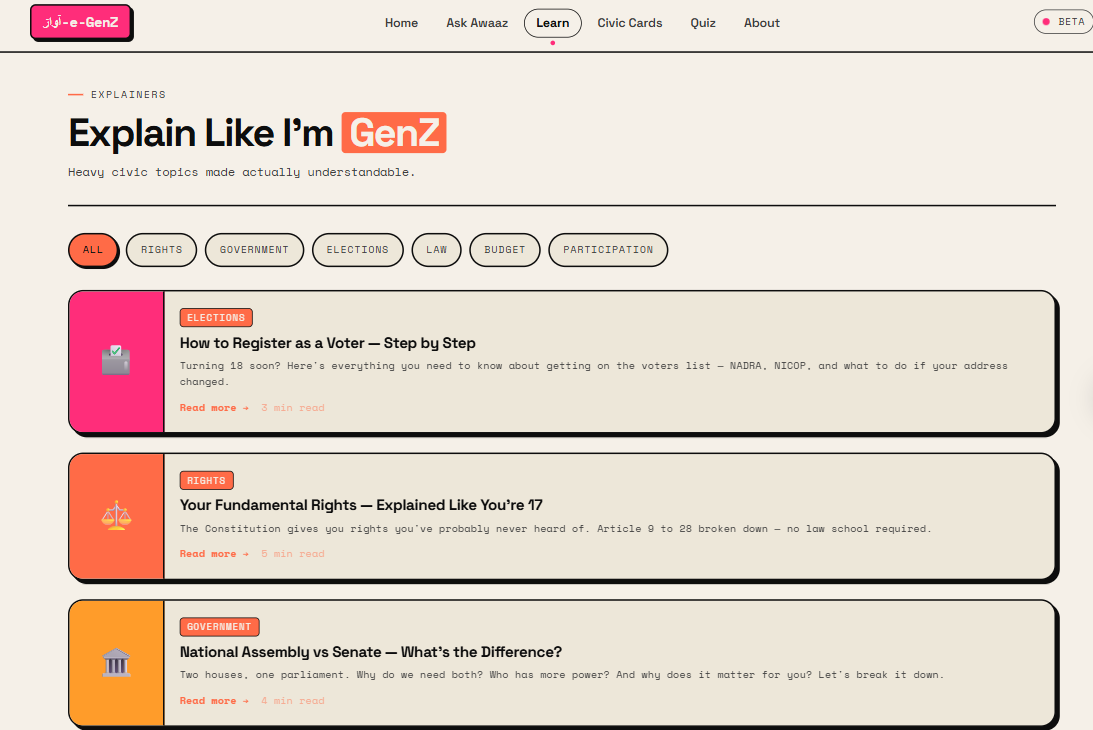
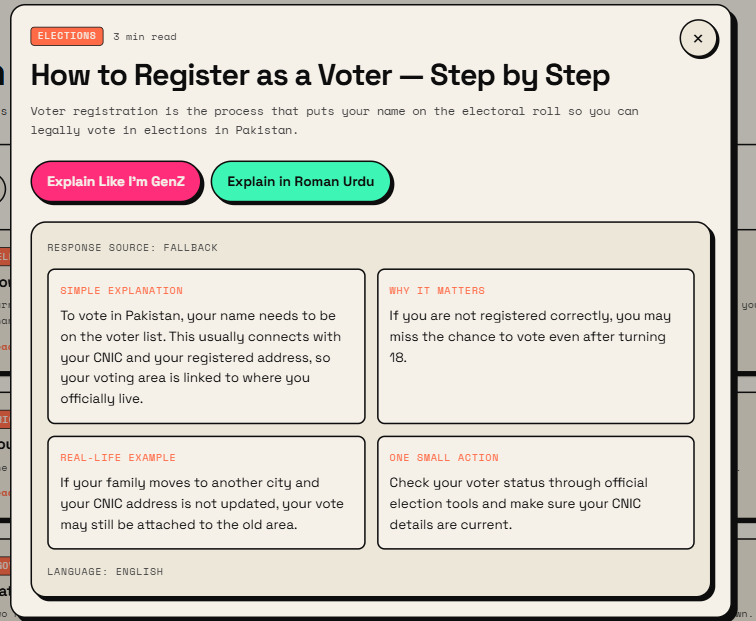
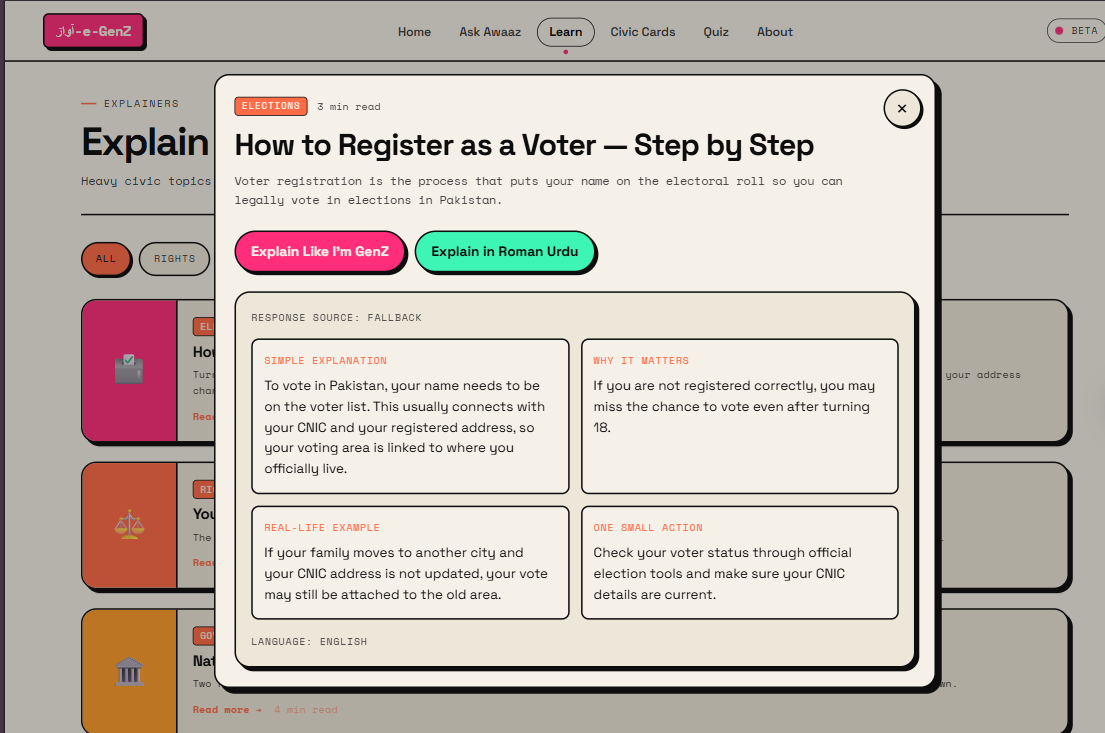
AI-powered “Explain Like I’m GenZ” feature simplifying civic topics.
-
-
-
-
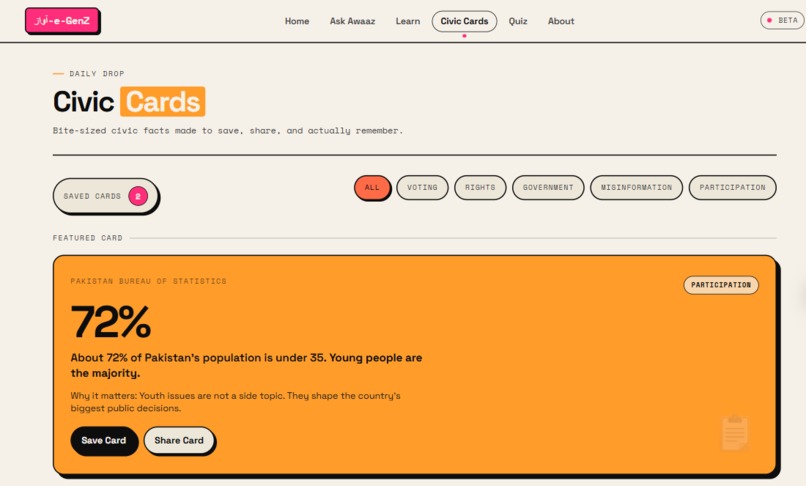
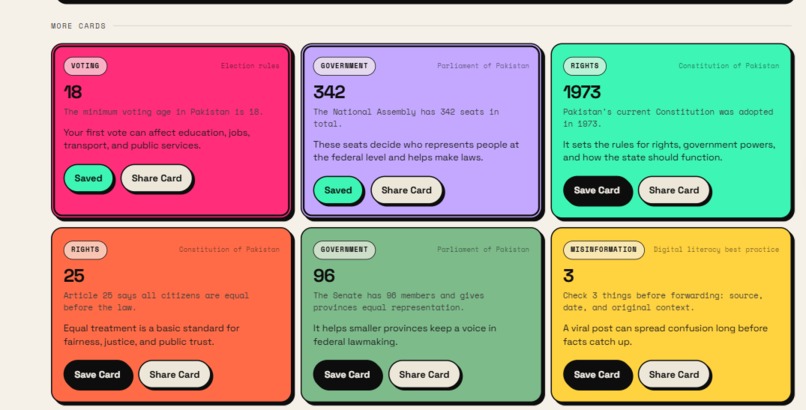
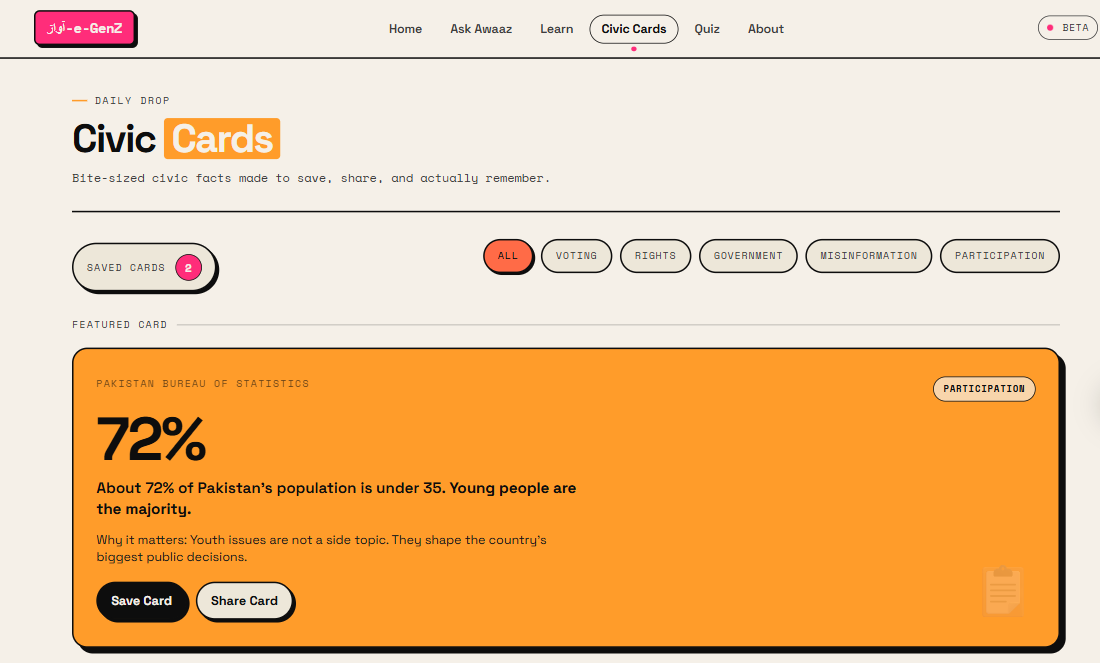
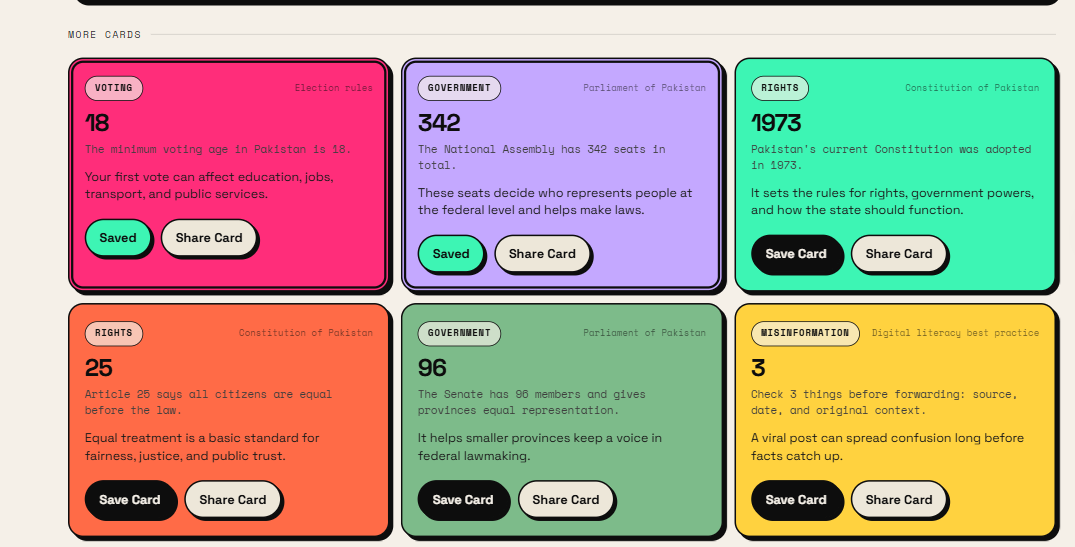
Shareable civic cards with bite-sized facts about rights, voting, and misinformation.
-
-
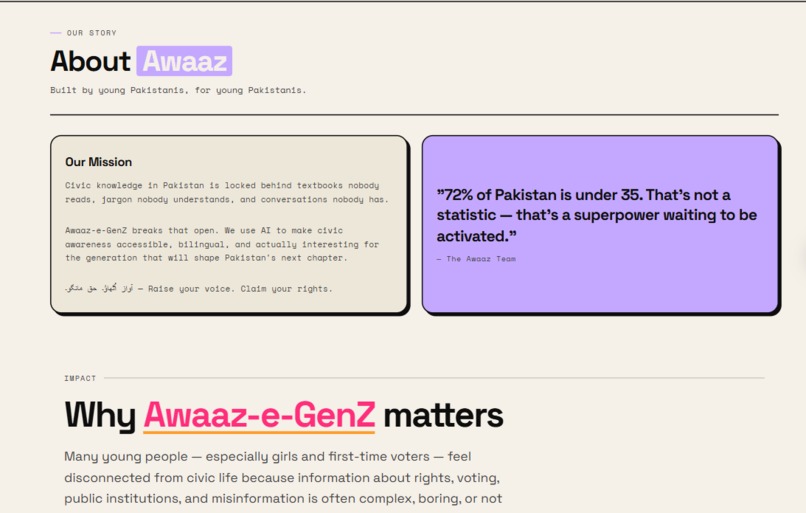
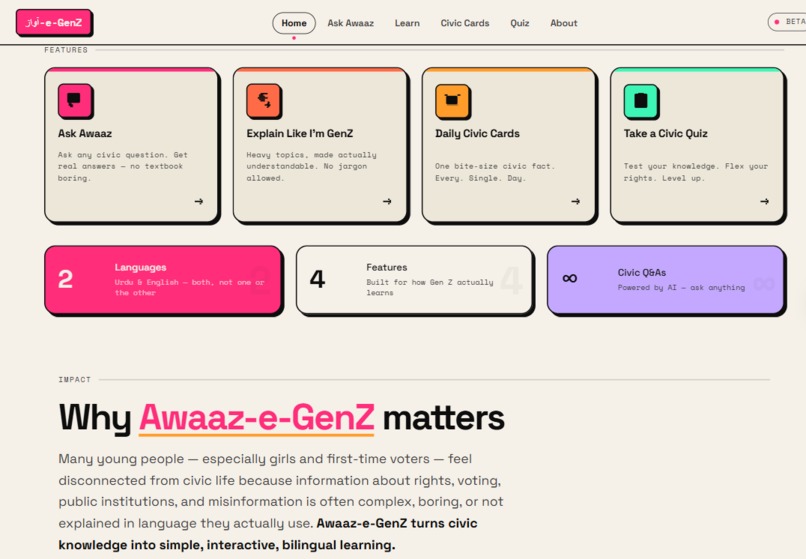
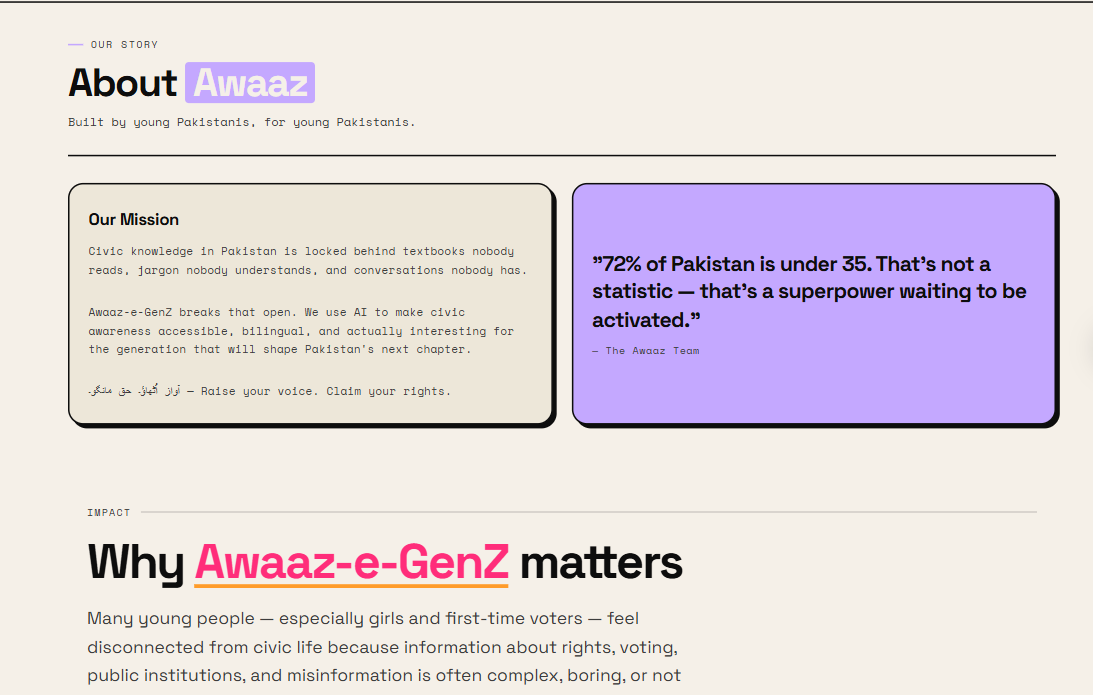
Impact section explaining how Awaaz-e-GenZ builds civic confidence for young people.
Inspiration
Awaaz-e-GenZ was inspired by a simple problem: many young people in Pakistan are not disconnected from civic life because they do not care, they are disconnected because civic information often feels complex, boring, scattered, or written in language they do not actually use.
For Gen Z users, especially girls, students, first-time voters, and young people who feel apolitical, topics like rights, voting, public institutions, misinformation, and civic participation can feel intimidating. We wanted to build something that makes civic learning feel simple, local, interactive, and accessible.
That is why we created Awaaz-e-GenZ, an AI-powered civic awareness platform for Pakistan’s Gen Z.
What it does
Awaaz-e-GenZ helps young people build civic confidence through an interactive learning journey:
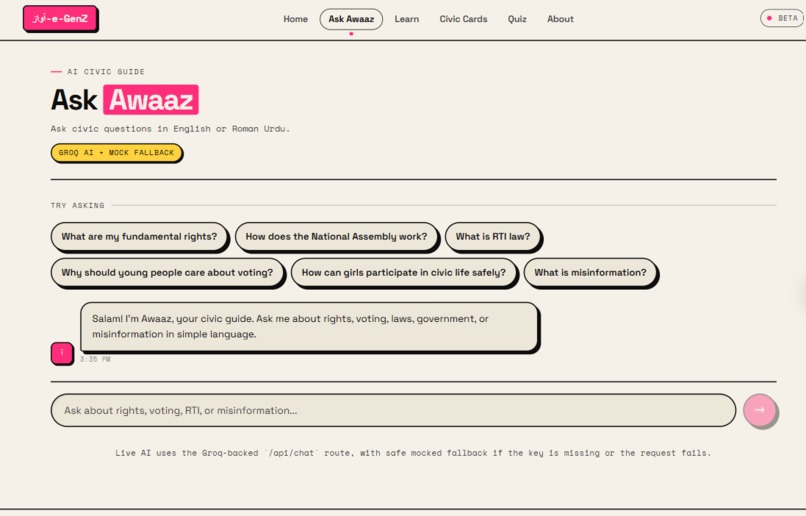
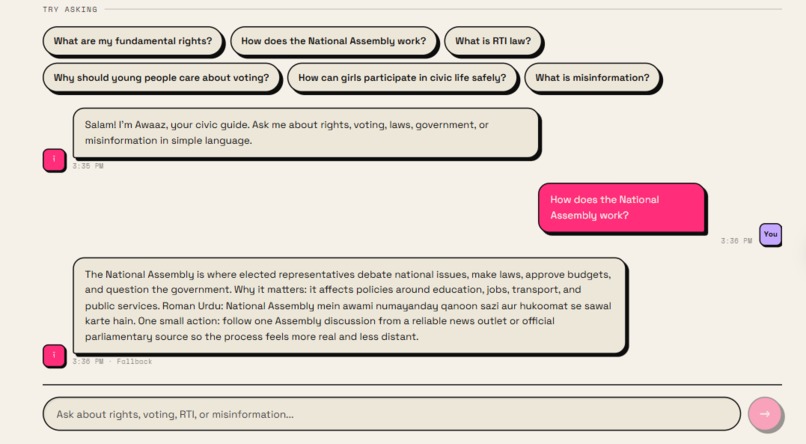
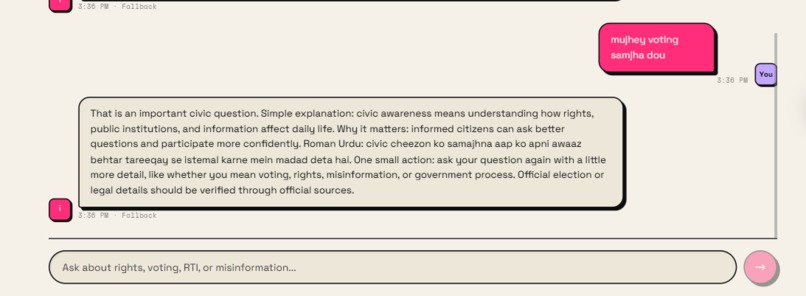
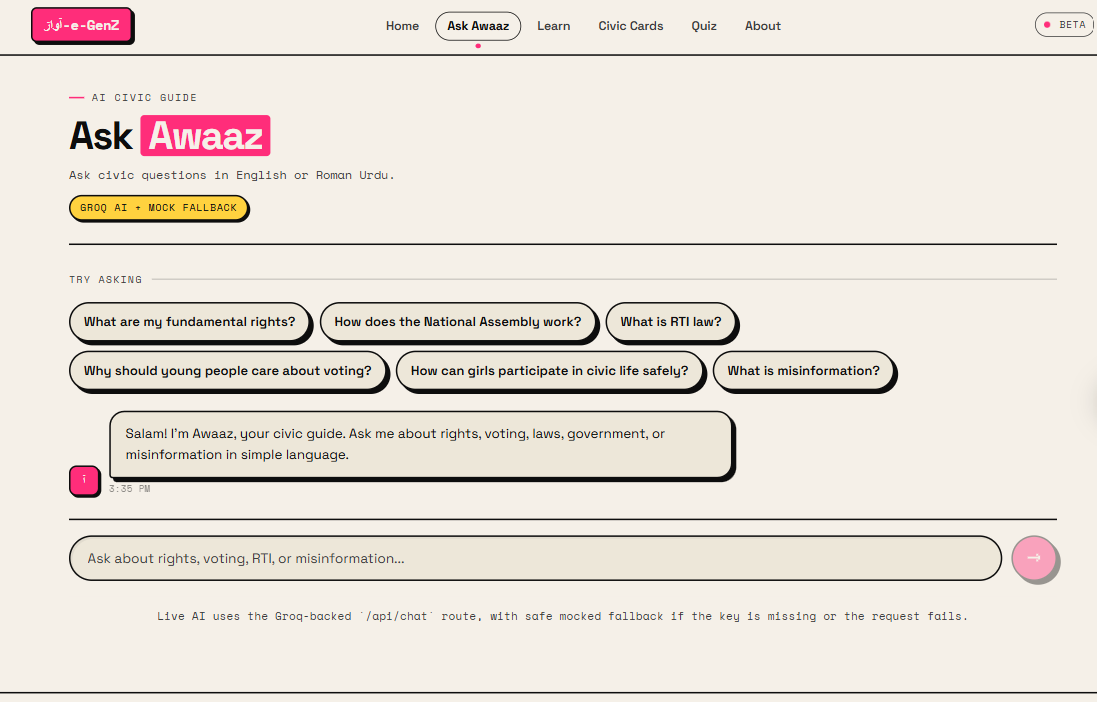
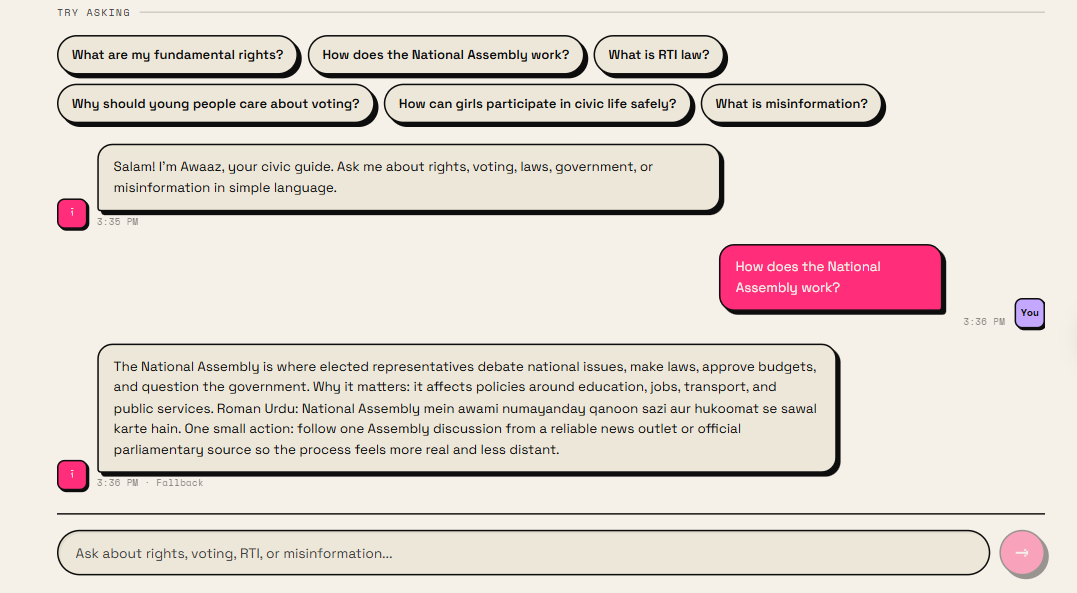
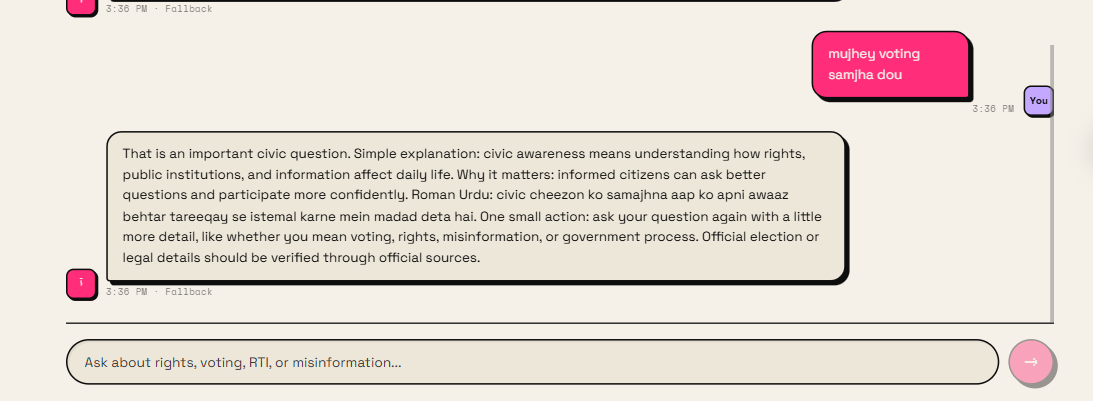
- Ask Awaaz: an AI civic assistant where users can ask questions about rights, voting, misinformation, public institutions, and civic participation.
- Explain Like I’m GenZ: AI-powered topic explanations that simplify civic concepts into clear, relatable language.
- AI-generated Civic Quiz: fresh quiz questions generated with AI so users can test their knowledge and learn through feedback.
- Civic Cards: bite-sized civic facts that users can save or share.
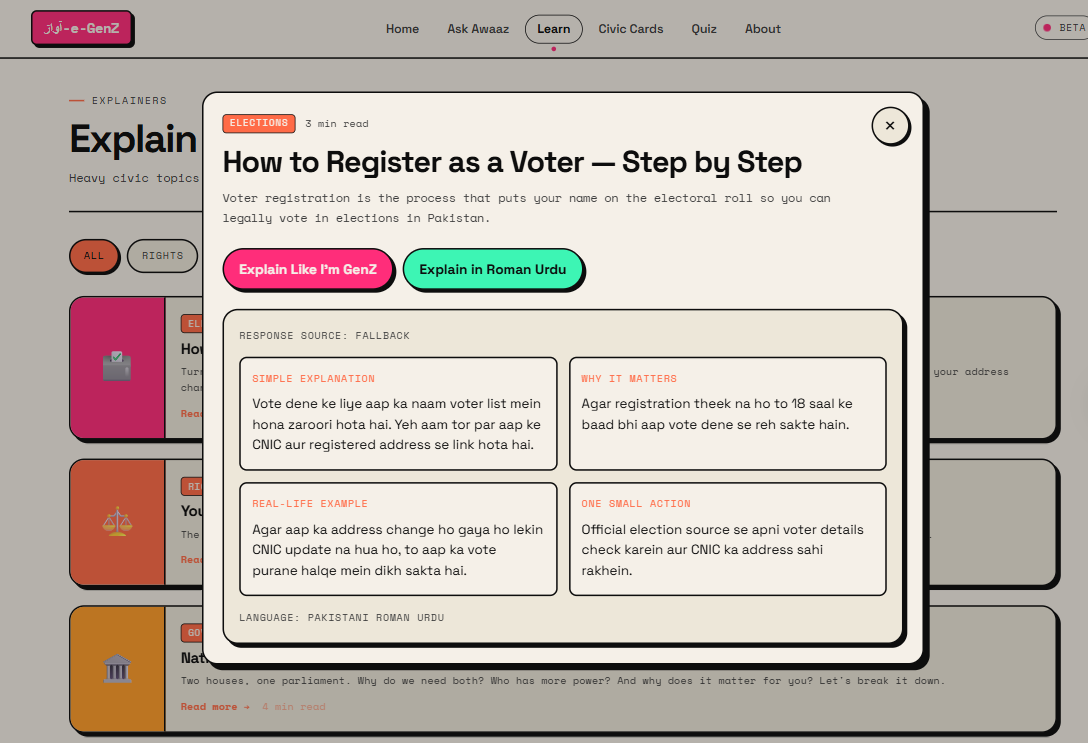
- English + Pakistani Roman Urdu support: so civic learning feels more local and accessible.
The goal is not to influence political choices. Awaaz-e-GenZ is designed for neutral civic learning. It does not recommend parties, politicians, or candidates. Instead, it helps users understand civic concepts clearly enough to participate with confidence.
How we built it
We built the project as a web application using React and Vite for the frontend. The design uses a bold Gen Z-inspired visual identity with cream backgrounds, black outlines, colorful cards, and playful civic elements.
For the AI features, we integrated the Groq API. Groq powers:
- the Ask Awaaz civic assistant,
- AI explanations on the Learn page,
- and AI-generated quiz questions.
We also added fallback content to make the prototype more reliable if an AI request fails. This was important because we wanted the demo to remain usable even if the API has an issue.
Challenges we faced
One challenge was making the AI feel useful without becoming politically biased. Since the project deals with civic topics, we had to be careful with prompt design. We added rules so the assistant stays neutral, avoids recommending parties or politicians, and focuses on education instead of influence.
Another challenge was language quality. Our target users include Pakistani youth, so Roman Urdu needed to sound natural and local, not Hindi-style or overly formal. We refined the assistant so it responds in English when the user asks in English, and Pakistani Roman Urdu when the user asks in Roman Urdu.
We also had to make the project feel like more than just a chatbot. To do that, we added multiple learning formats: AI chat, topic explanations, quizzes, and shareable civic cards.
What we learned
We learned that AI can be powerful in civic education when it is used carefully. It is not enough to generate answers — the system must be neutral, accessible, understandable, and locally relevant.
We also learned that civic technology needs strong user experience. If the interface feels boring or government-like, young users may not engage. Awaaz-e-GenZ uses a Gen Z-centered design to make civic learning feel less intimidating and more approachable.
Impact
Awaaz-e-GenZ aims to help young people move from confusion to civic confidence.
Potential impact can be measured through:
- questions asked in Ask Awaaz,
- Learn topics opened,
- quiz completion rate,
- civic cards saved or shared,
- Roman Urdu usage,
- and users reporting increased civic confidence.
The long-term vision is to make civic education more accessible for students, girls, first-time voters, and youth communities across Pakistan.
What’s next
Future plans include:
- verified civic data partnerships,
- an Election Mode for official voter information guidance,
- support for more Pakistani languages,
- campus and youth-group pilots,
- improved shareable civic content,
- and partnerships with NGOs, universities, and civic education organizations.
Awaaz-e-GenZ is not just a chatbot. It is a civic confidence platform that helps young people ask, learn, test themselves, and share civic knowledge in a way that feels simple, local, and relevant.


Log in or sign up for Devpost to join the conversation.