Inspiration
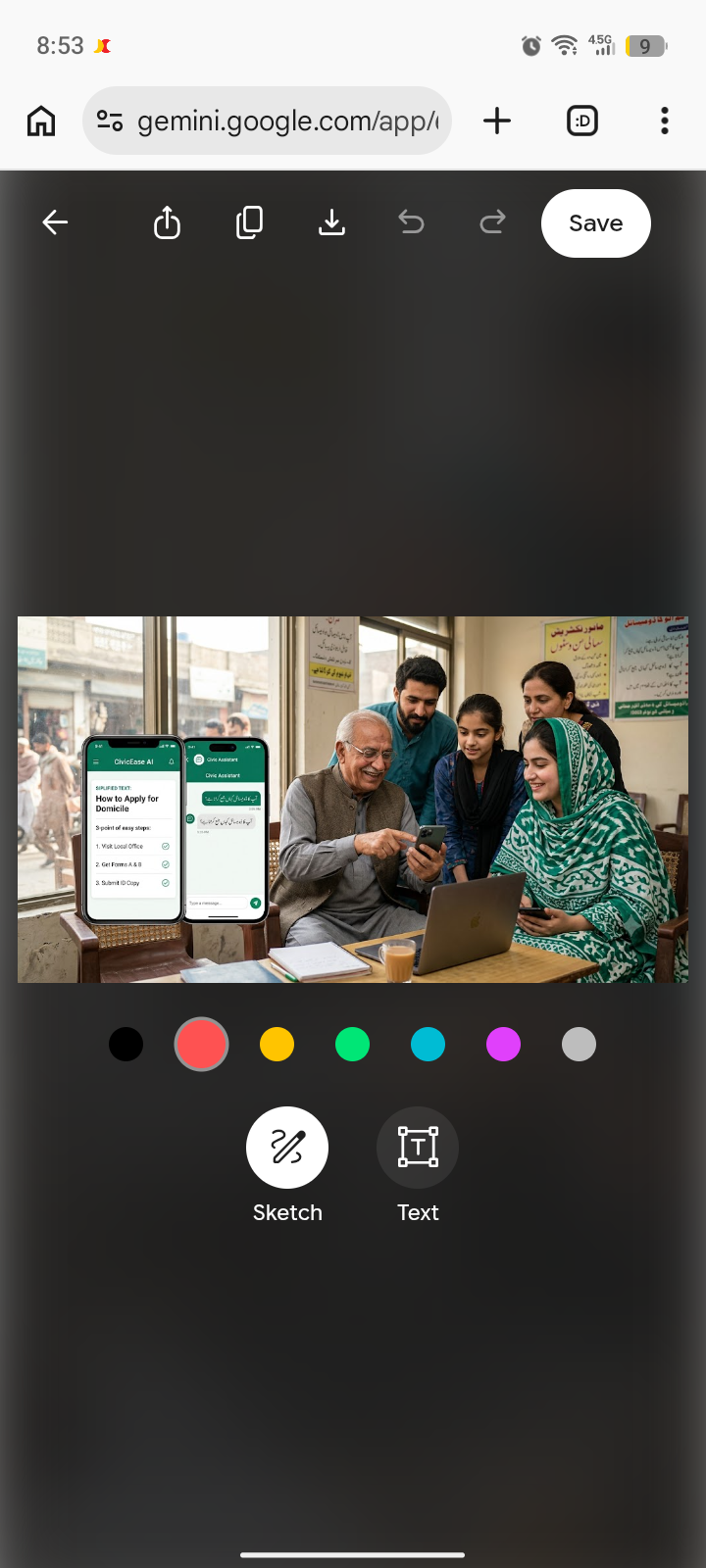
Access to clear public information is a fundamental right, yet dense bureaucratic jargon creates a massive barrier between citizens and government resources. We witnessed an elderly community member try to apply for a local government social welfare program online. Despite having internet access, the convoluted multi-page guidelines left them completely excluded from the system without outside technical help. This highlighted how systemic information barriers actively disenfranchise vulnerable groups, lower transparency, and erode public trust. We built this project to bridge that gap.
What it does
Our project is an AI-driven civic accessibility platform that acts as a bridge between complex state documentation and ordinary citizens.
Jargon Translation: Users can copy-paste or upload dense policy documents, service guidelines, or regulatory forms, and the AI instantly refines them into plain, easy-to-read text.
Multilingual Conversational Interface: Features an intuitive chatbot capable of processing localized queries and breaking down public service application steps.
Voice Integration: Supports voice-to-text inputs to bypass literacy barriers, ensuring that civic resources are accessible to everyone, regardless of technical or educational background.
How we built it
The prototype's ecosystem is built with scalability and modularity in mind:
Frontend/Interface: Developed using modern Web technologies to ensure a fast, responsive user interface accessible across mobile and desktop devices.
AI Core: Leveraged Large Language Models (LLMs) integrated via secure APIs to handle the heavy semantic parsing, text summarization, and tone translation.
Development Flow: Built using GitHub Copilot / VS Code AI for clean, rapid prototyping during the hackathon sprint.
Challenges we ran into
One of the core challenges was ensuring the AI didn't hallucinate or alter critical legal/procedural rules when simplifying dense legal text. We managed this by implementing tight prompt structures and exploring retrieval-augmented constraints, ensuring the output strictly anchors to verified public databases without losing crucial contextual accuracy.
Accomplishments that we're proud of
We successfully designed a working, conversational pipeline that can take a highly complex government policy text and reduce it to a simple, localized bulleted checklist in seconds. We are incredibly proud of creating a solution that moves beyond pure tech and directly targets social equity and civic inclusivity.
What we learned
We gained deep insights into how critical user experience (UX) design is when building tools for public use. When creating civic tech, simplicity isn't just a design choice—it's an absolute necessity for accessibility.
What's next for Awaamconnect
Moving forward, we want to scale this solution by adopting an open-source development model and collaborating directly with civic organizations like Code for Pakistan to expand localized database access. We plan to integrate optimized API caching to minimize operational costs and implement voice-synthesis models to natively read simplified guidelines back to visually impaired or low-literacy users


Log in or sign up for Devpost to join the conversation.