-
-
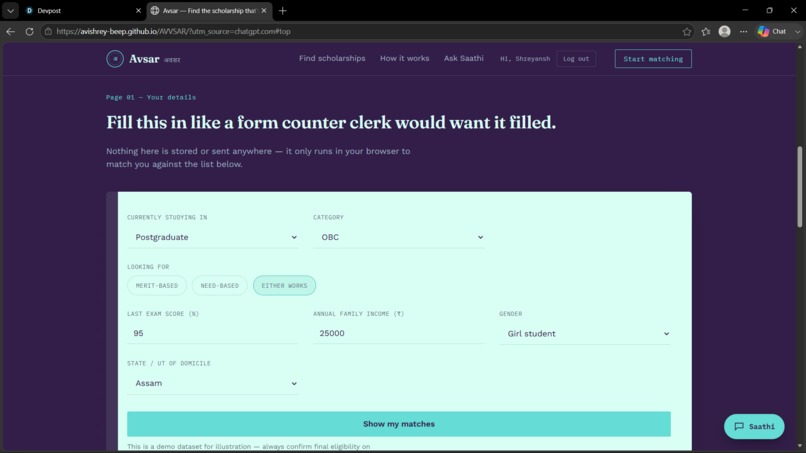
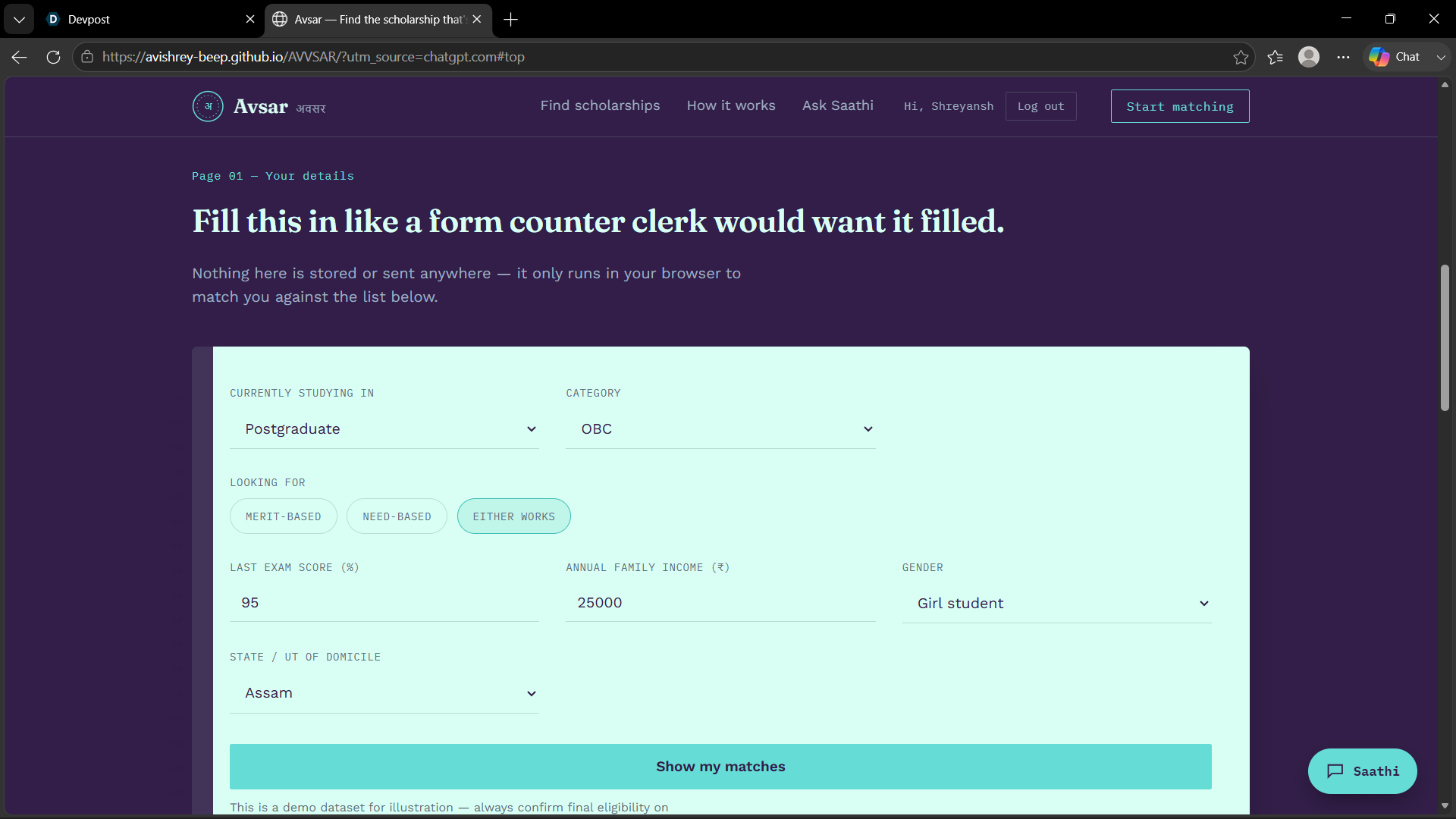
Details form filled again: Postgraduate, OBC, 95% marks, ₹25,000 income, Girl student, Assam.
-
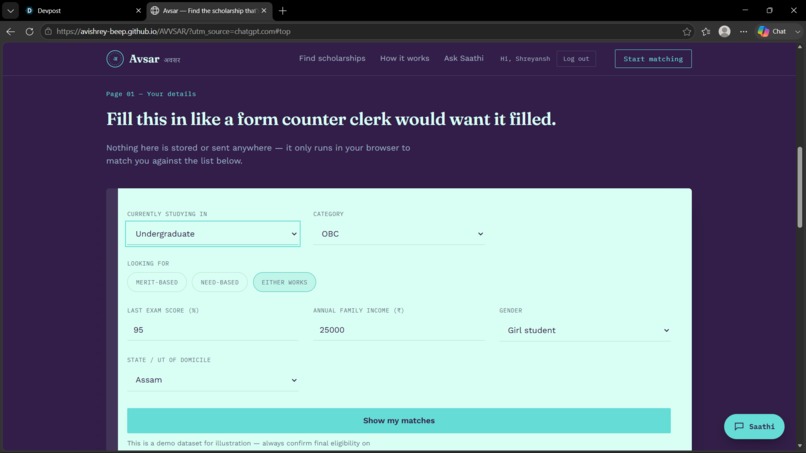
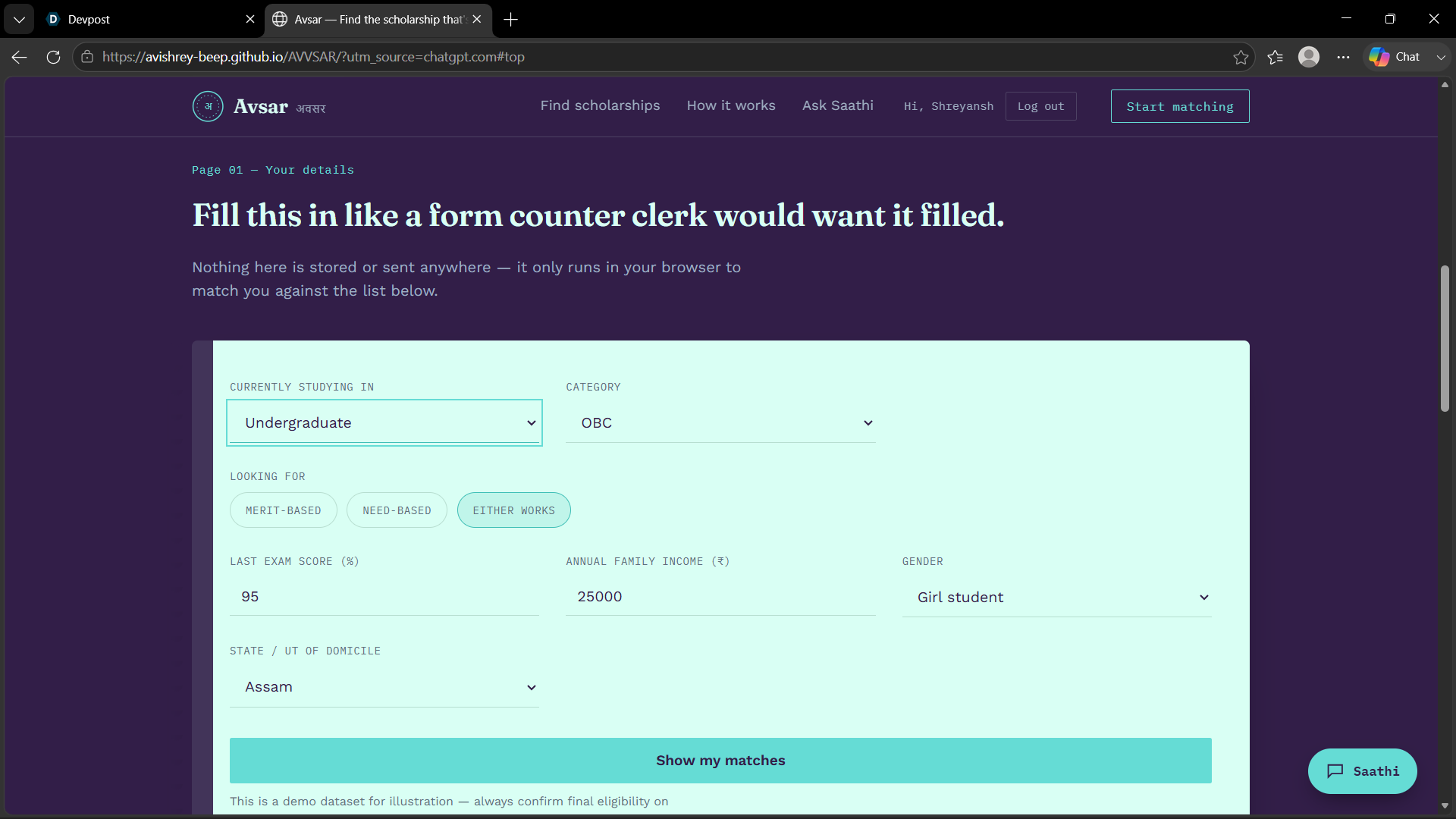
Details form filled: Undergraduate, OBC, 95% marks, ₹25,000 income, Girl student, Assam — ready to match.
-
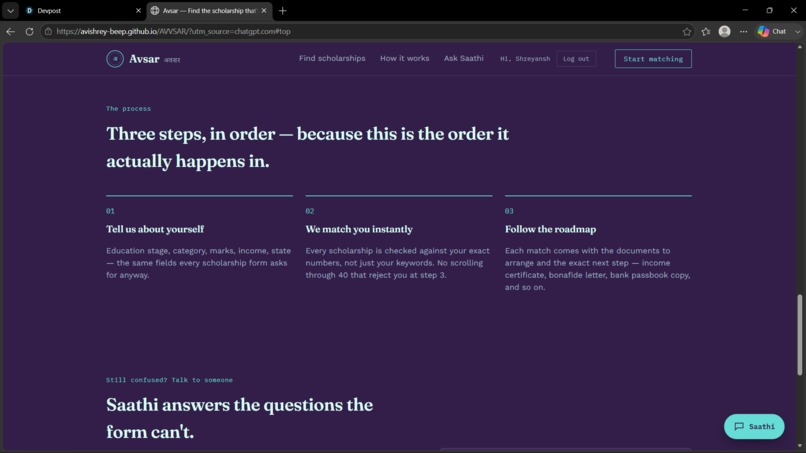
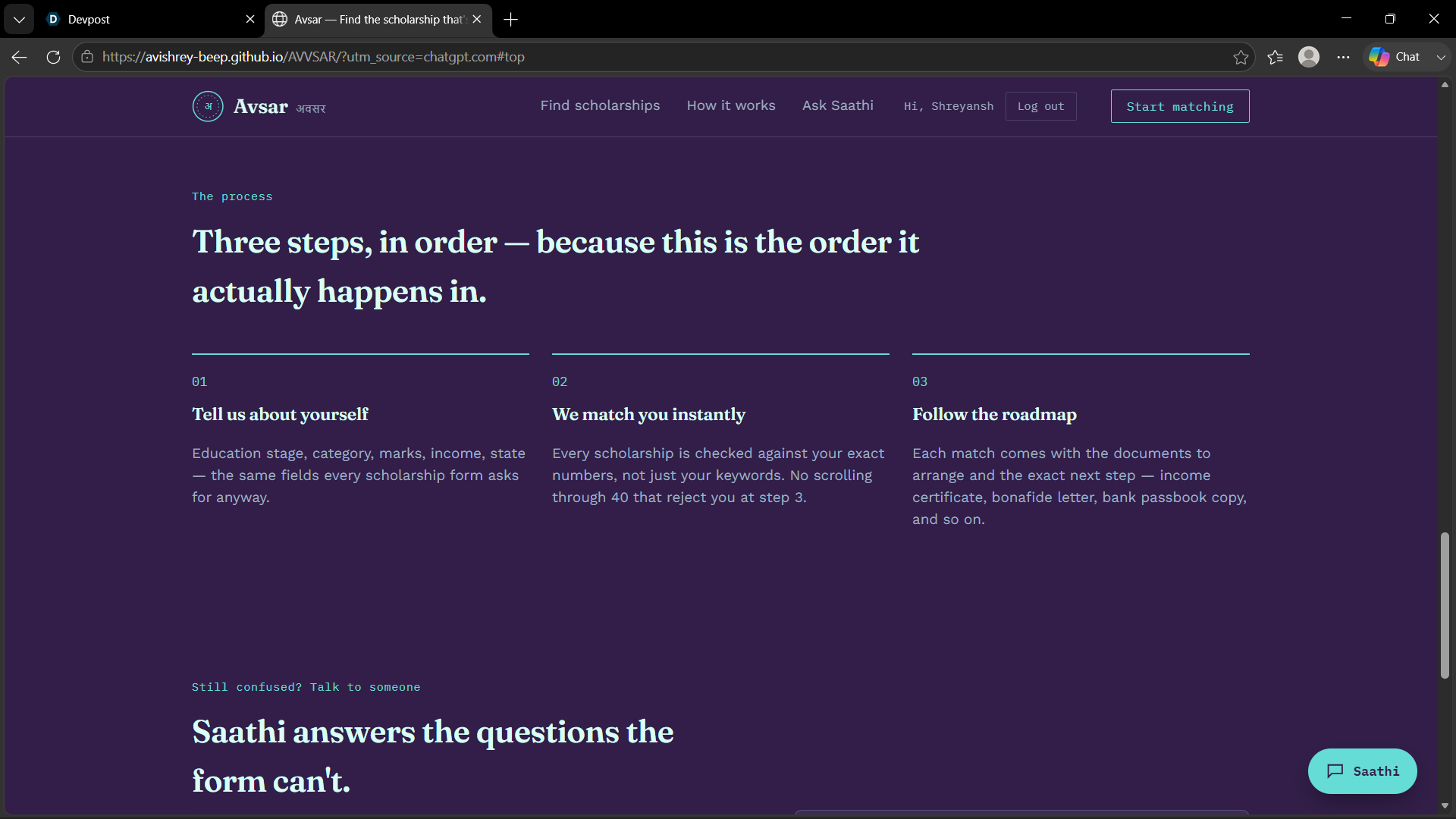
"How it works" section explaining the three-step process: tell us, get matched, follow the roadmap.
-
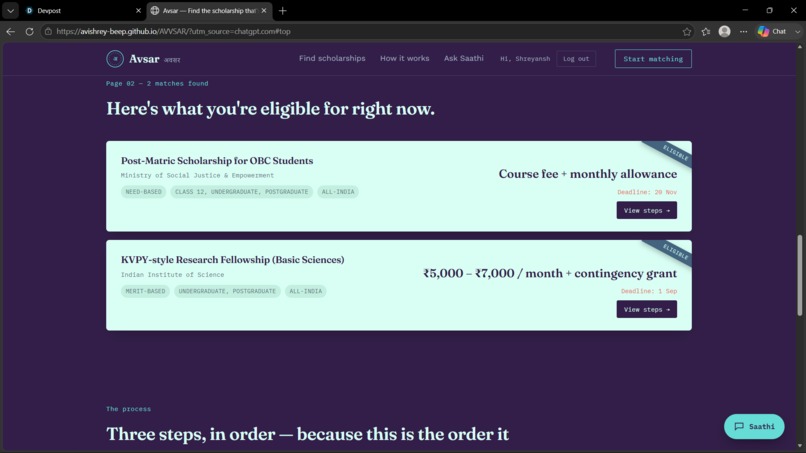
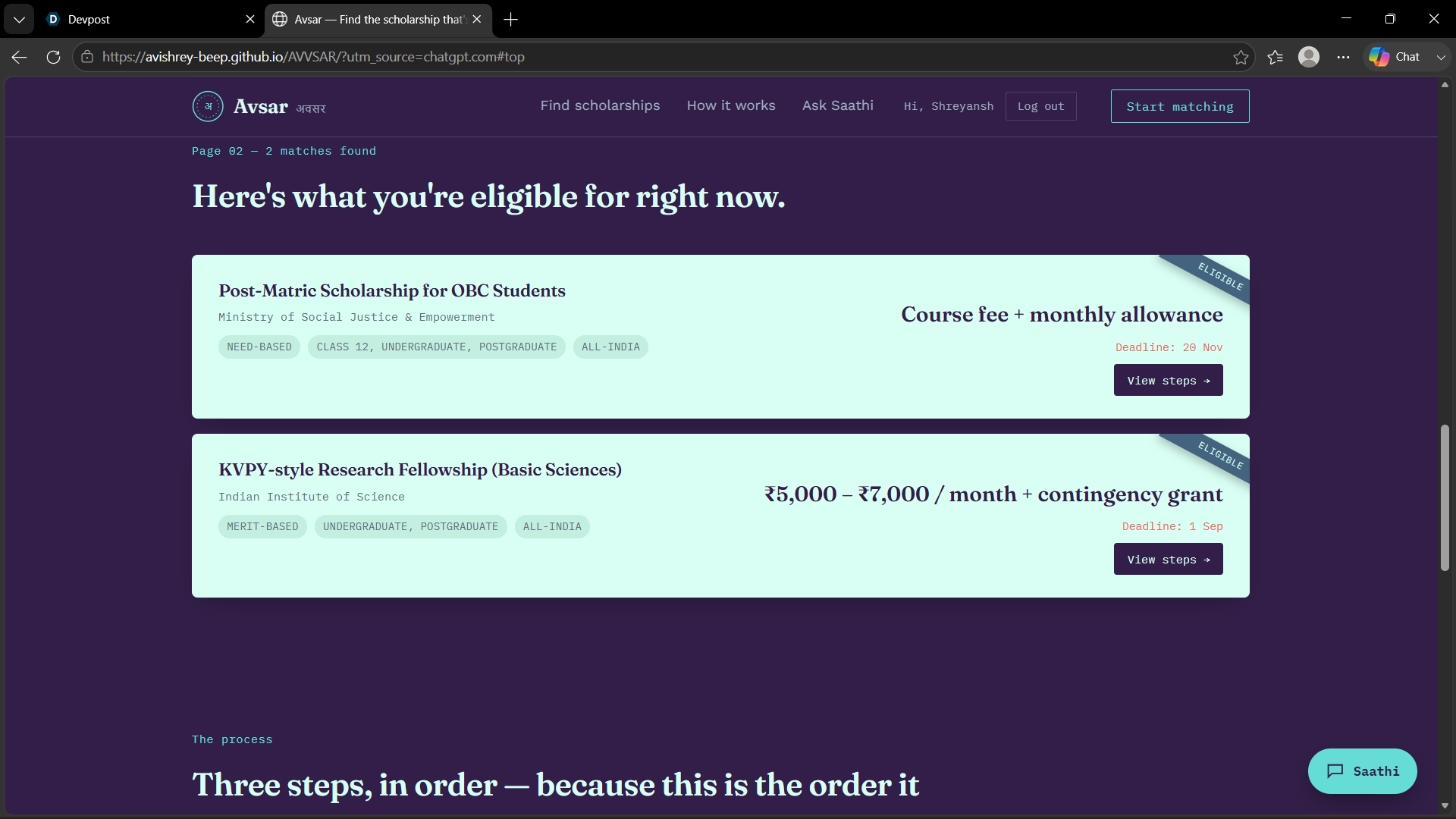
Second matches page — "2 matches found" showing Post-Matric OBC and KVPY-style Fellowship as eligible
-
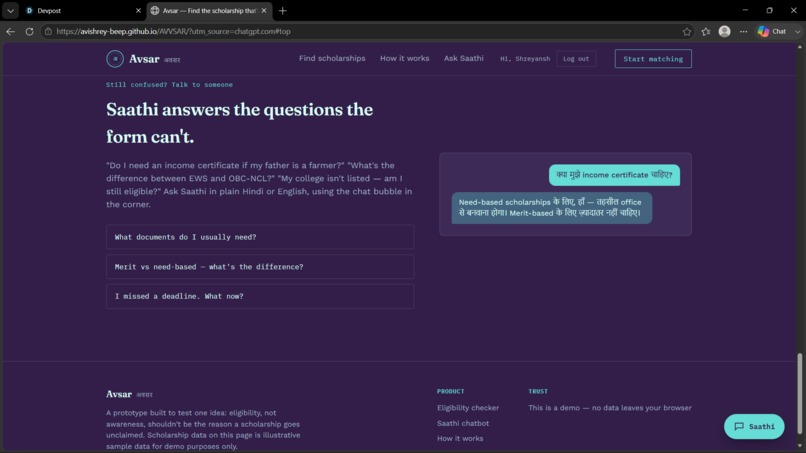
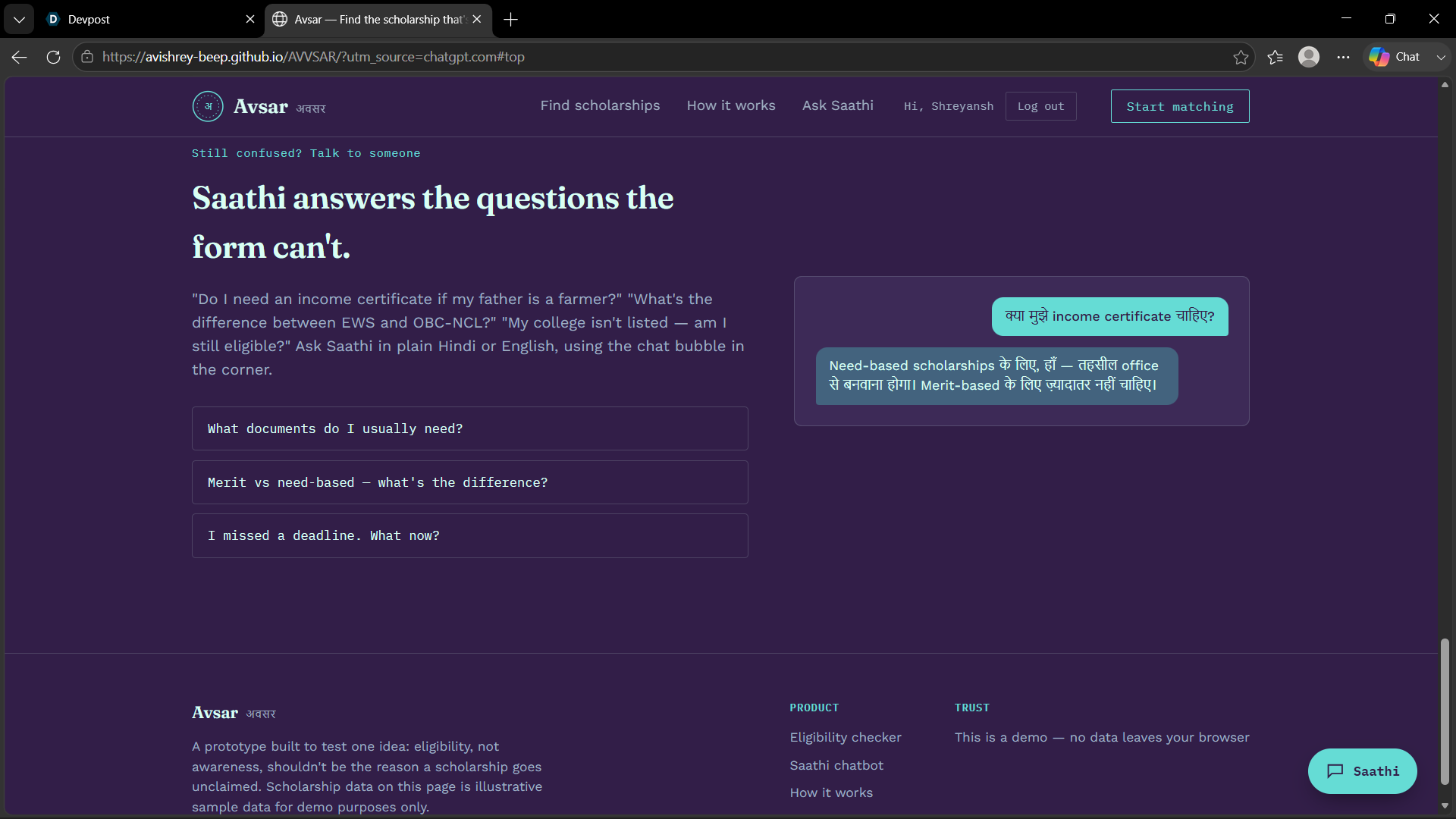
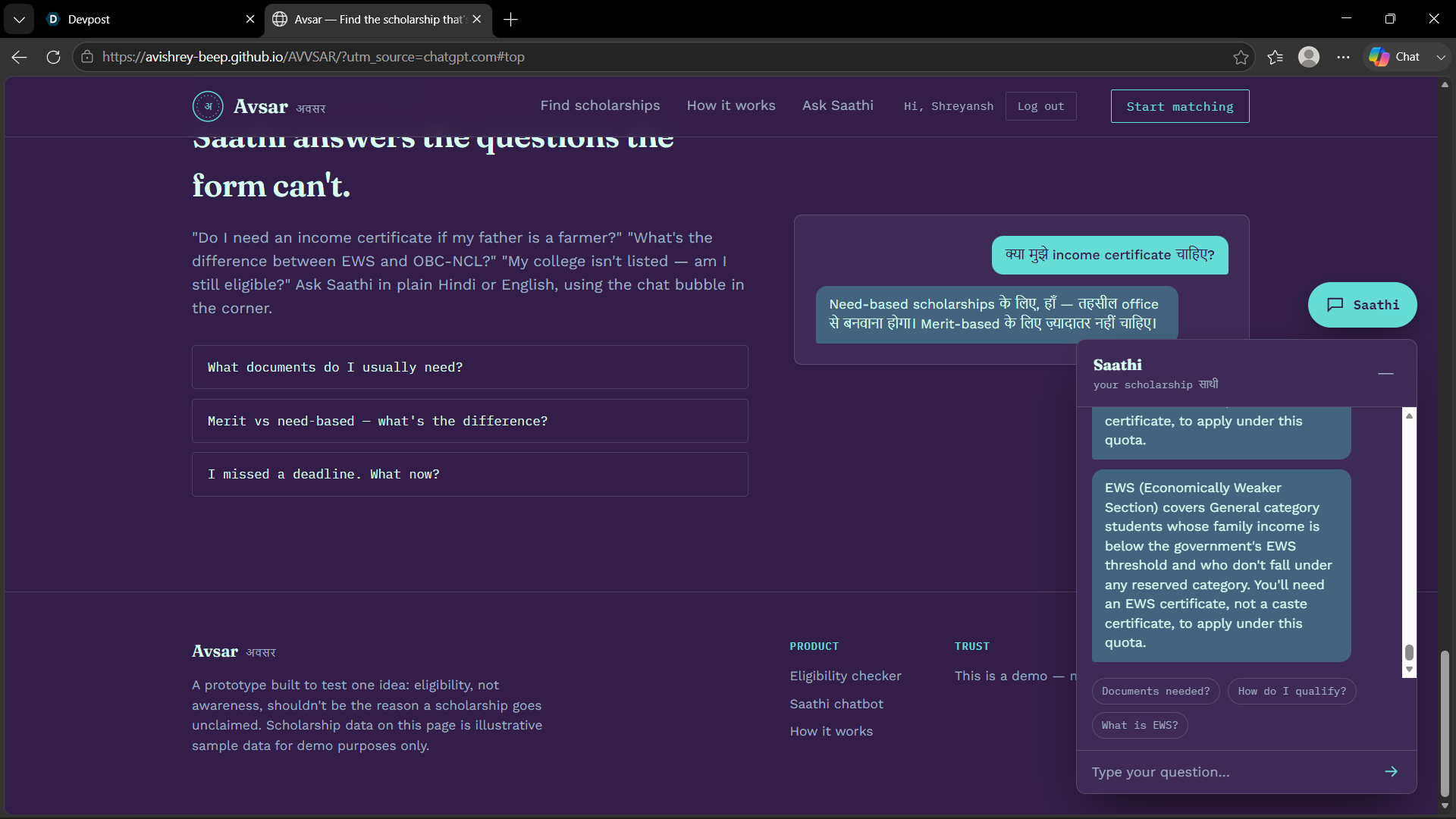
"Ask Saathi" section with sample prompts and a preview of the Hindi income-certificate conversation.
-
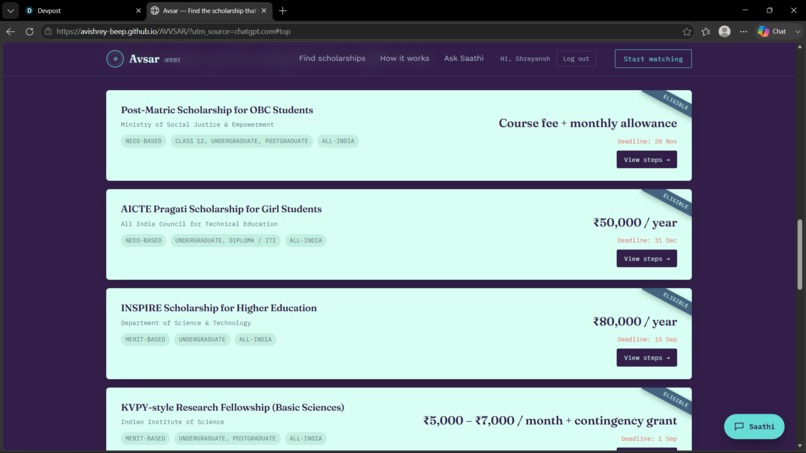
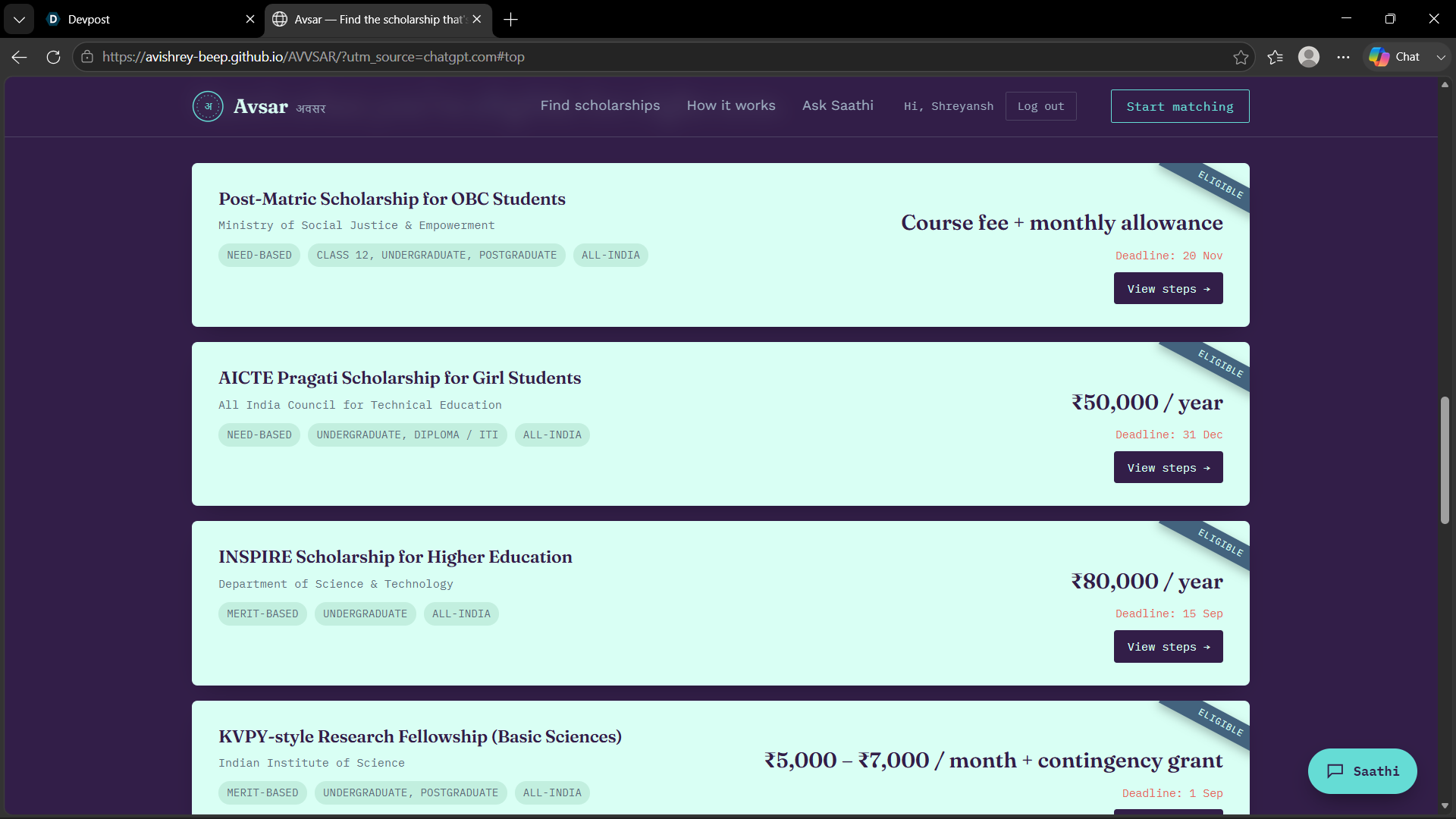
Matches page showing all four eligible scholarships as cards with amount, deadline, and "View steps."
-
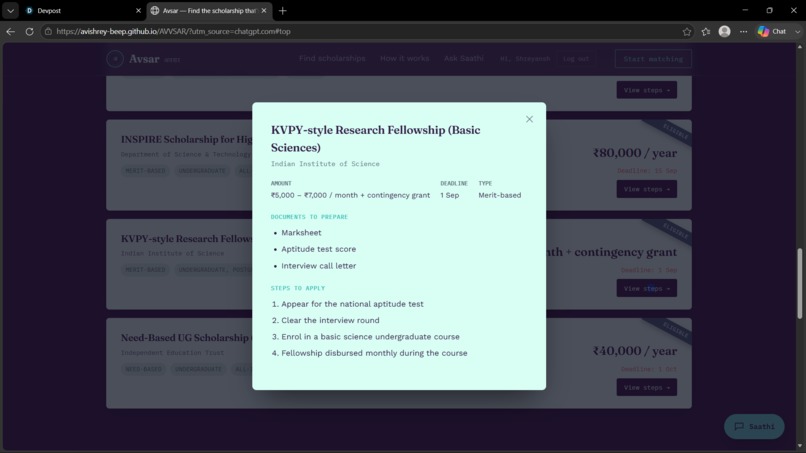
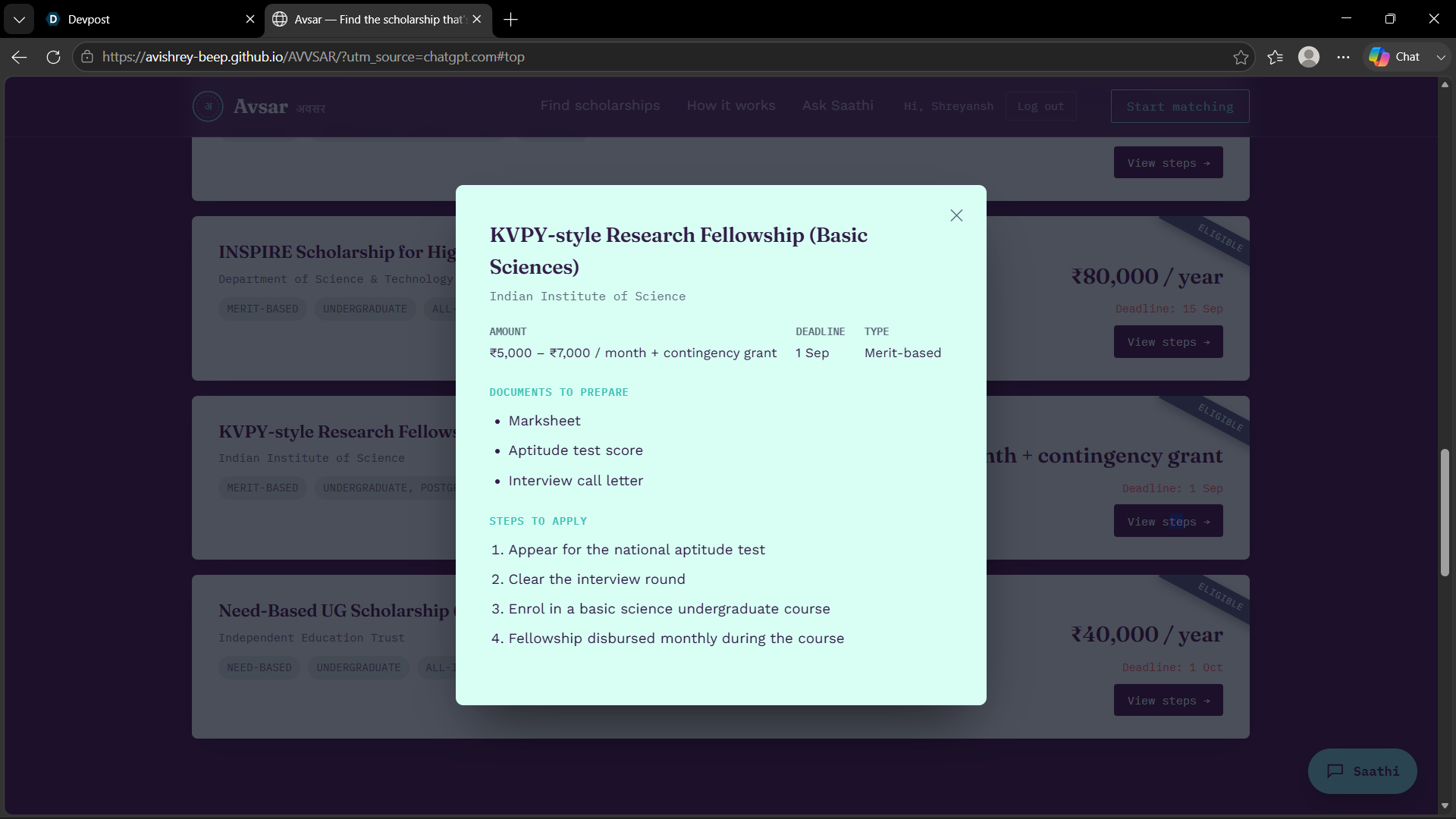
KVPY-style Research Fellowship modal — amount, deadline, docs needed, and 4-step application process.
-
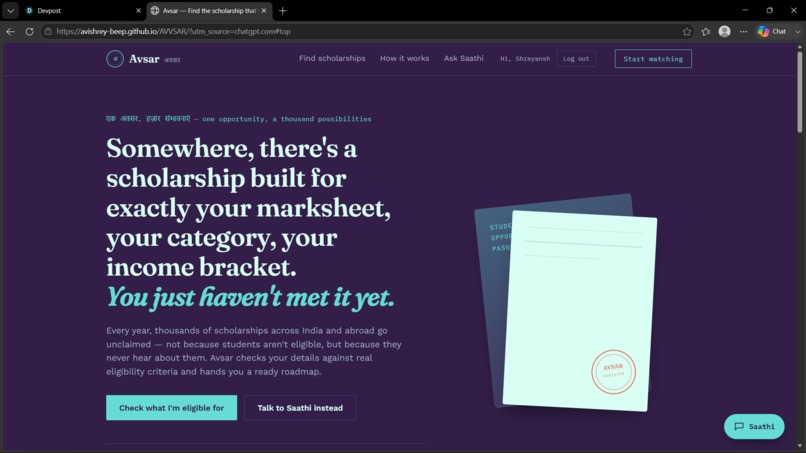
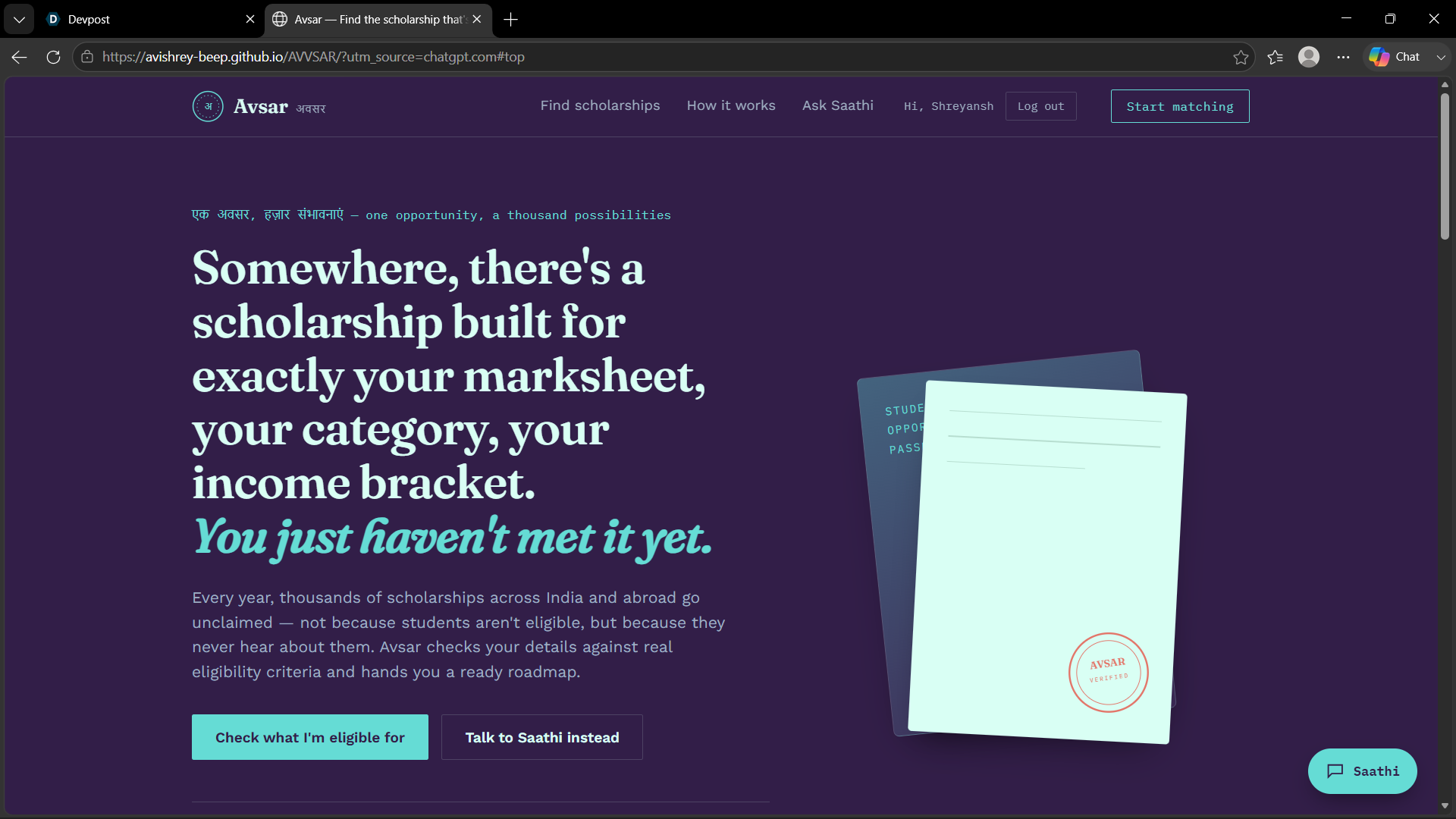
Landing page hero: "Somewhere, there's a scholarship built for exactly your marksheet... you just haven't met it yet.
-
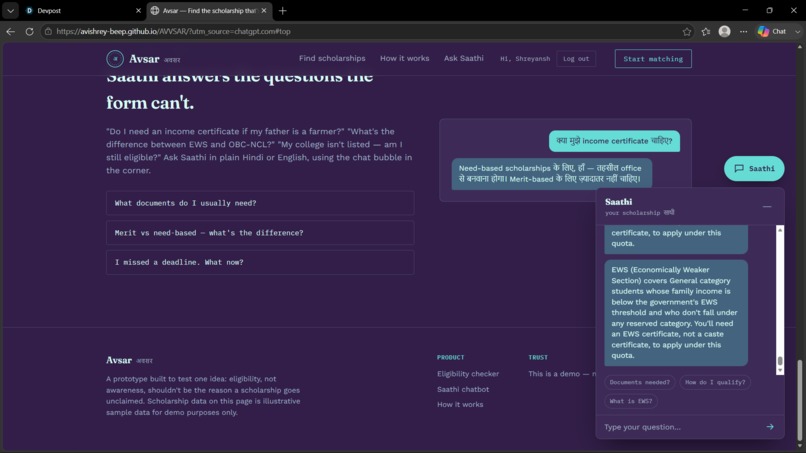
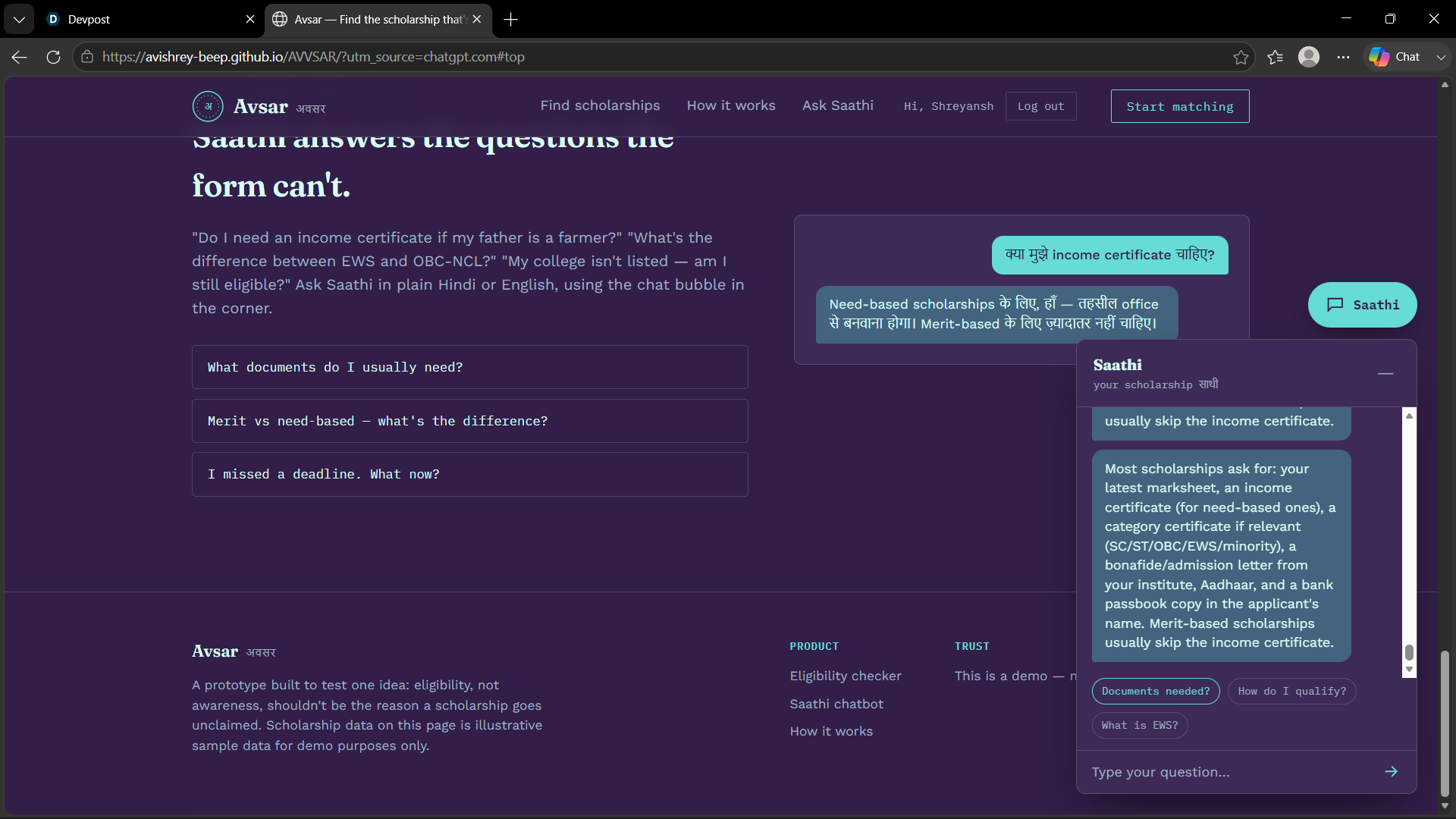
Saathi chatbot answering a Hindi question about income certificates and EWS eligibility.
-
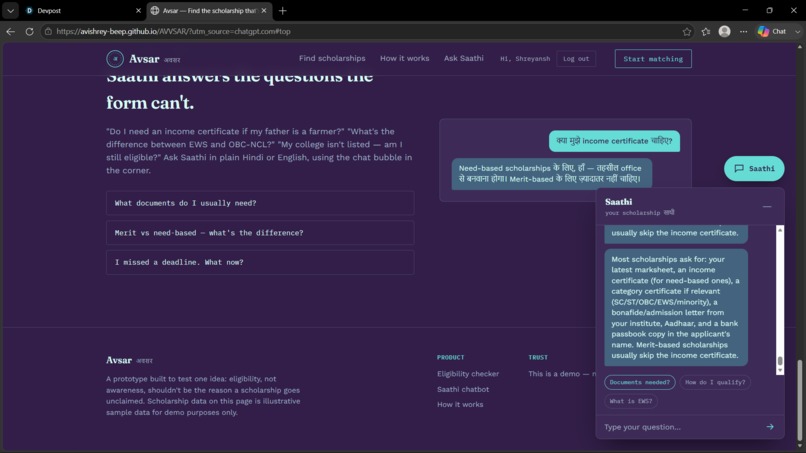
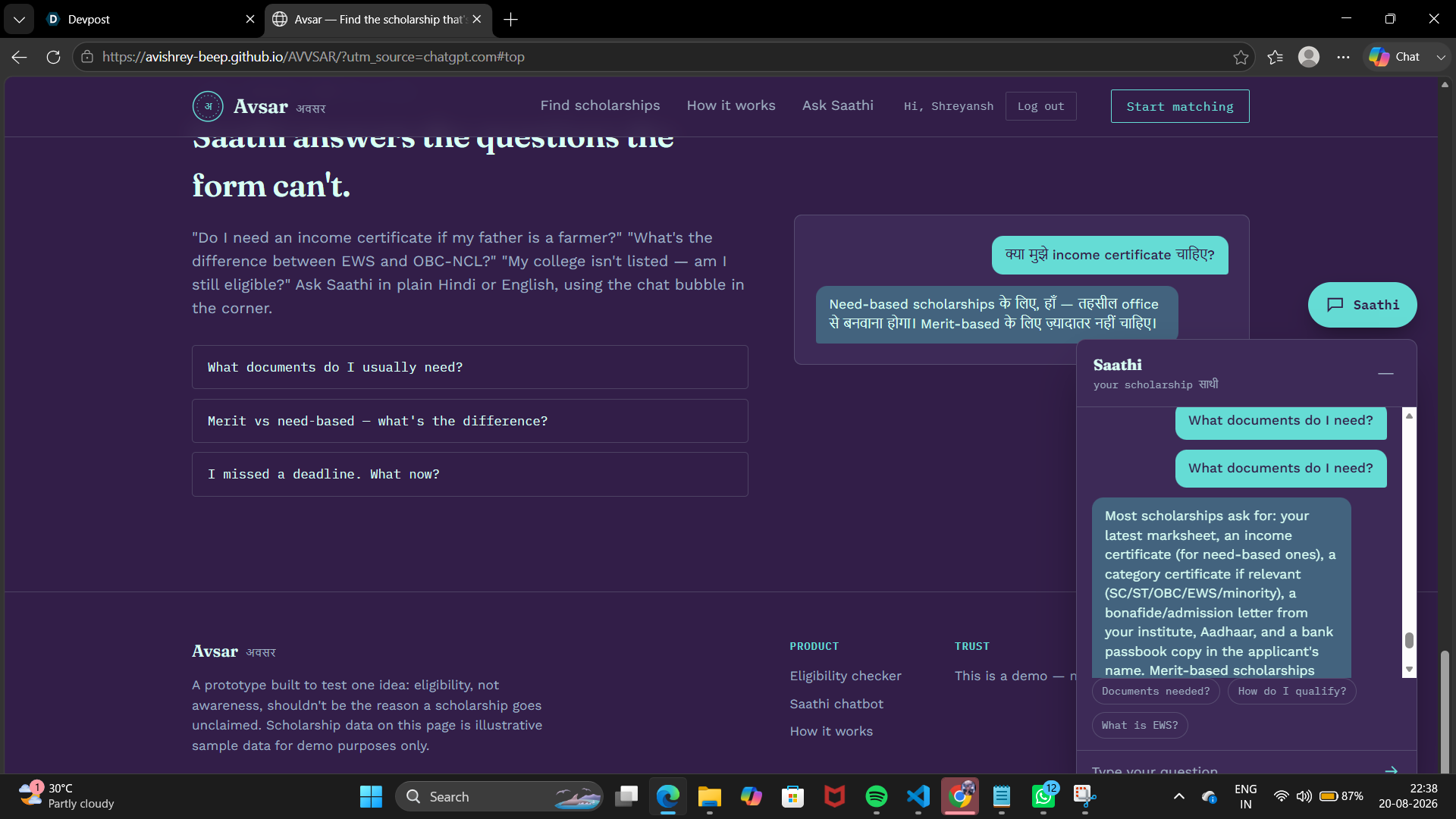
Saathi chatbot scrolled further, showing the documents-needed answer with quick-reply chips below.
-
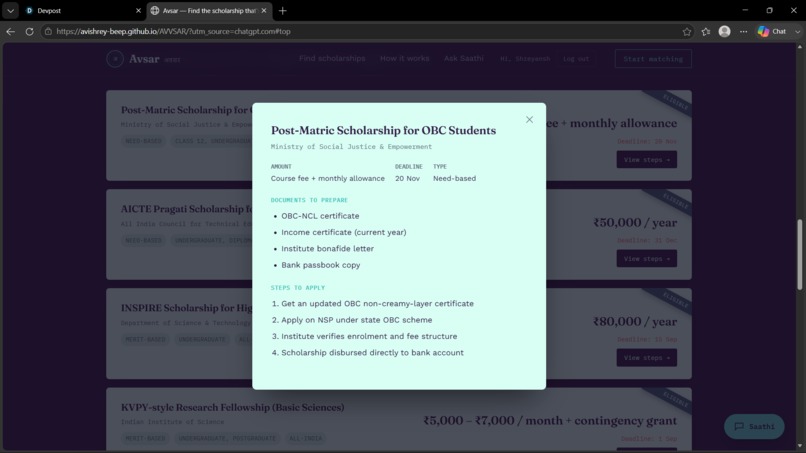
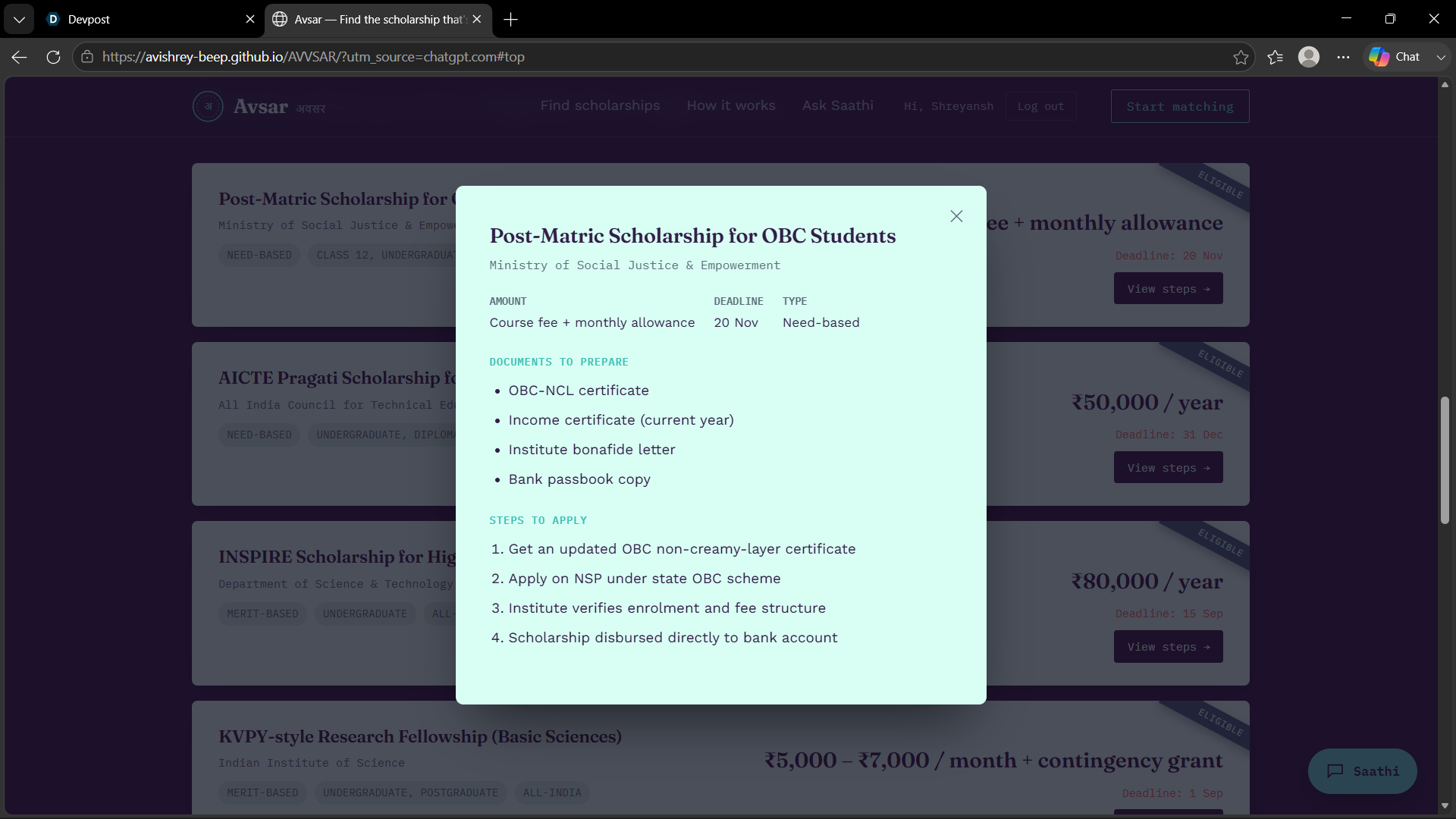
Post-Matric OBC Scholarship modal — course fee + allowance, required docs, and NSP application steps.
-
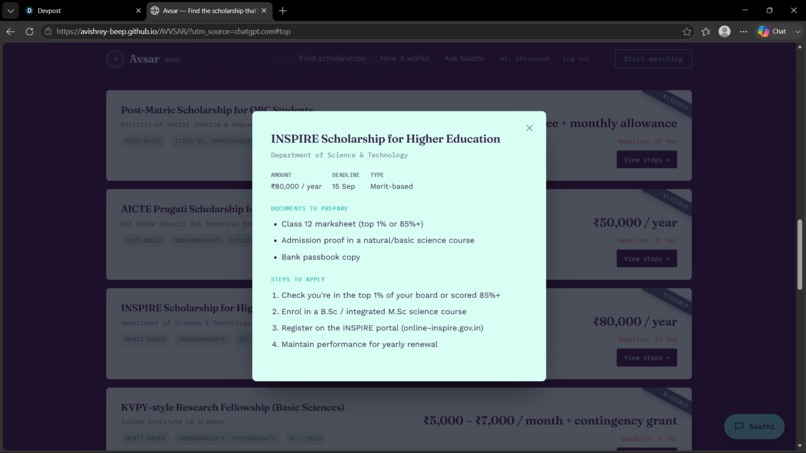
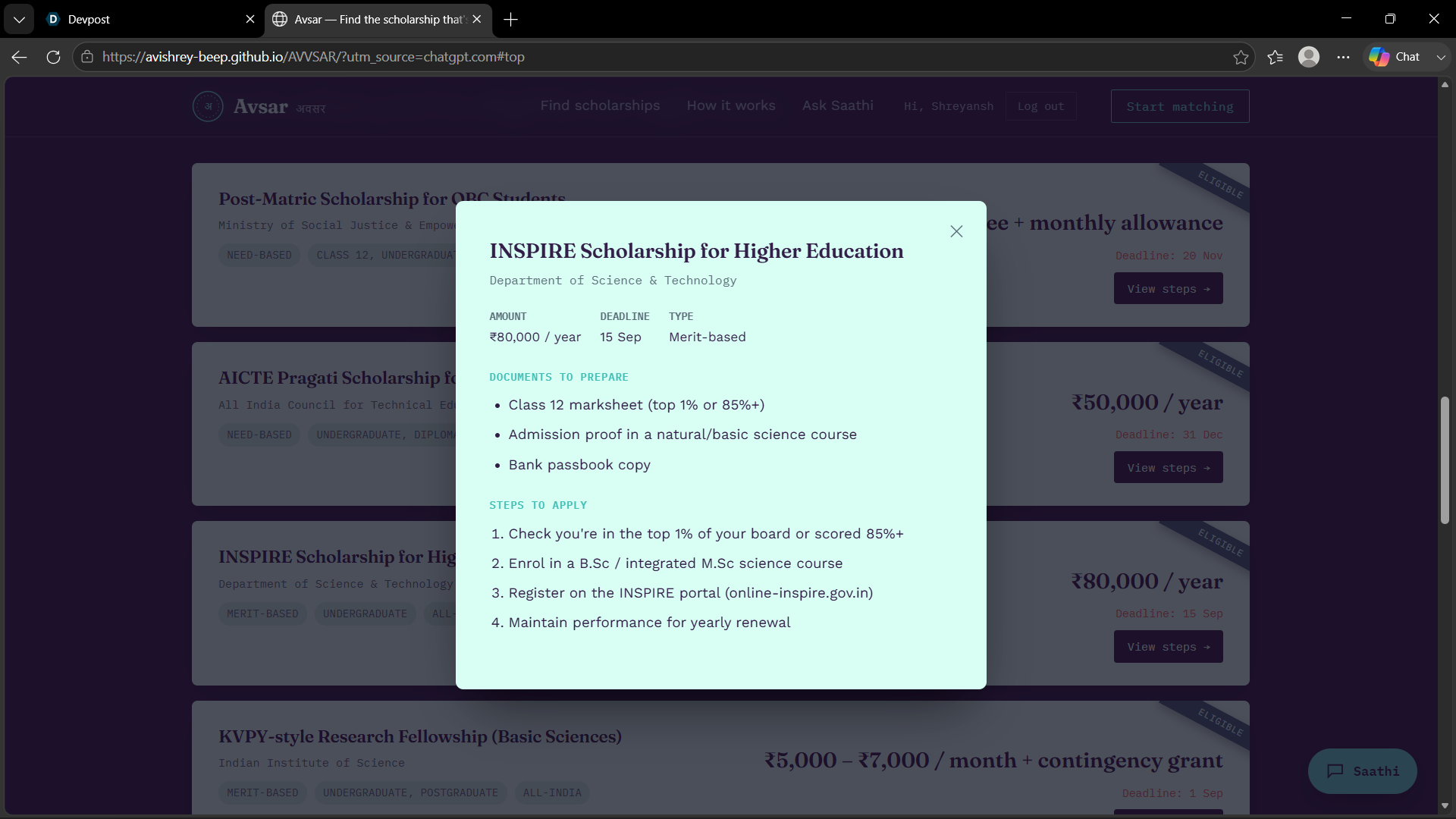
INSPIRE Scholarship modal — ₹80,000/year, merit-based, required docs, and steps to apply via the portal.
-
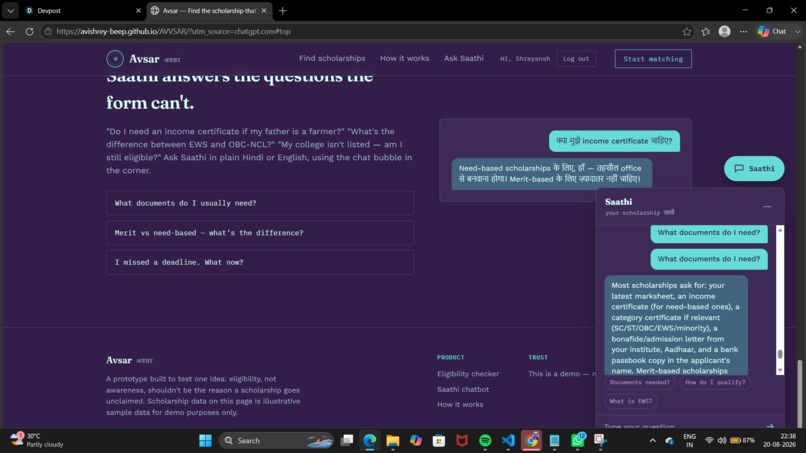
Saathi chatbot answering "What documents do I need?" with a full checklist of common requirements.
-
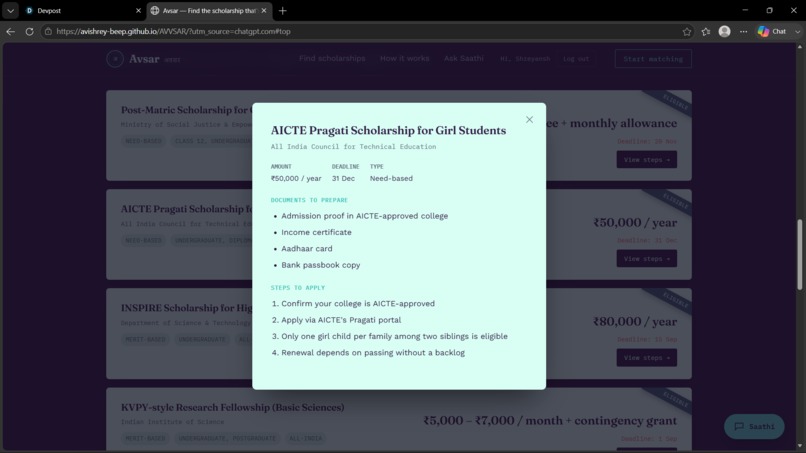
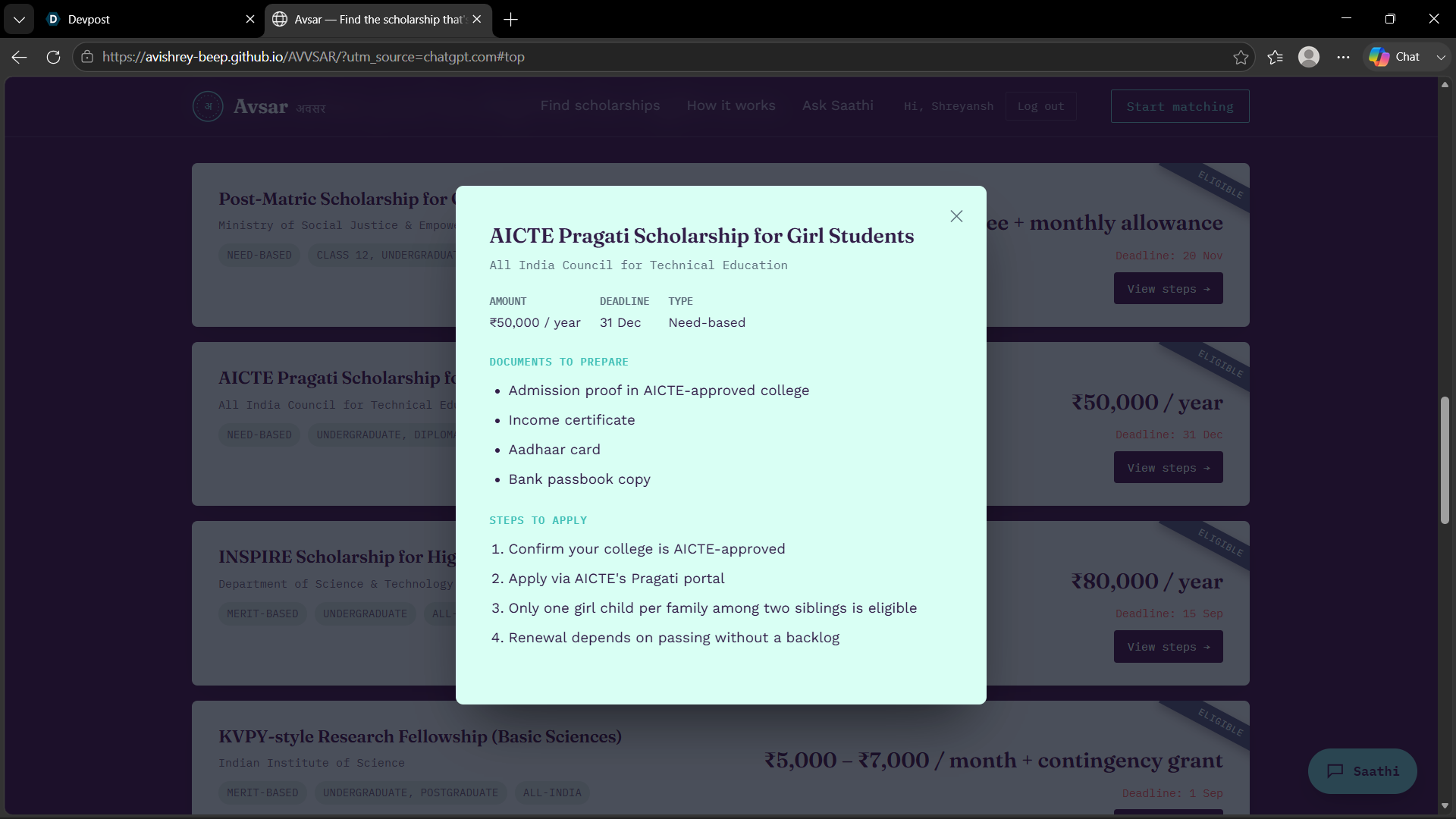
AICTE Pragati Scholarship modal — ₹50,000/year for girl students, docs list, and 4 application steps.
-
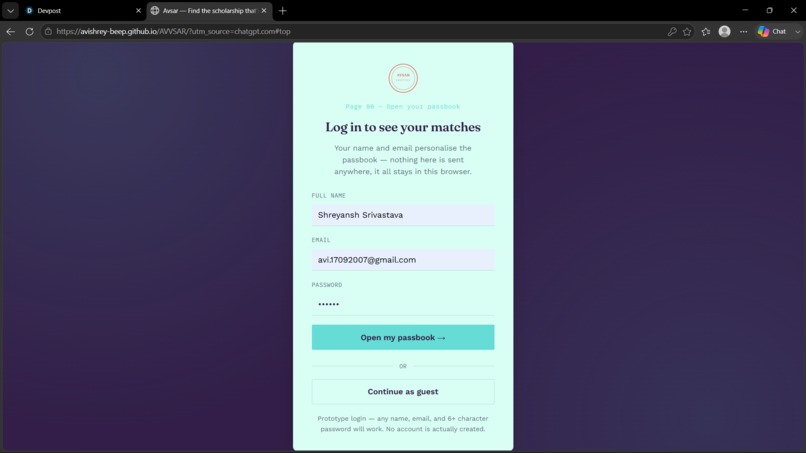
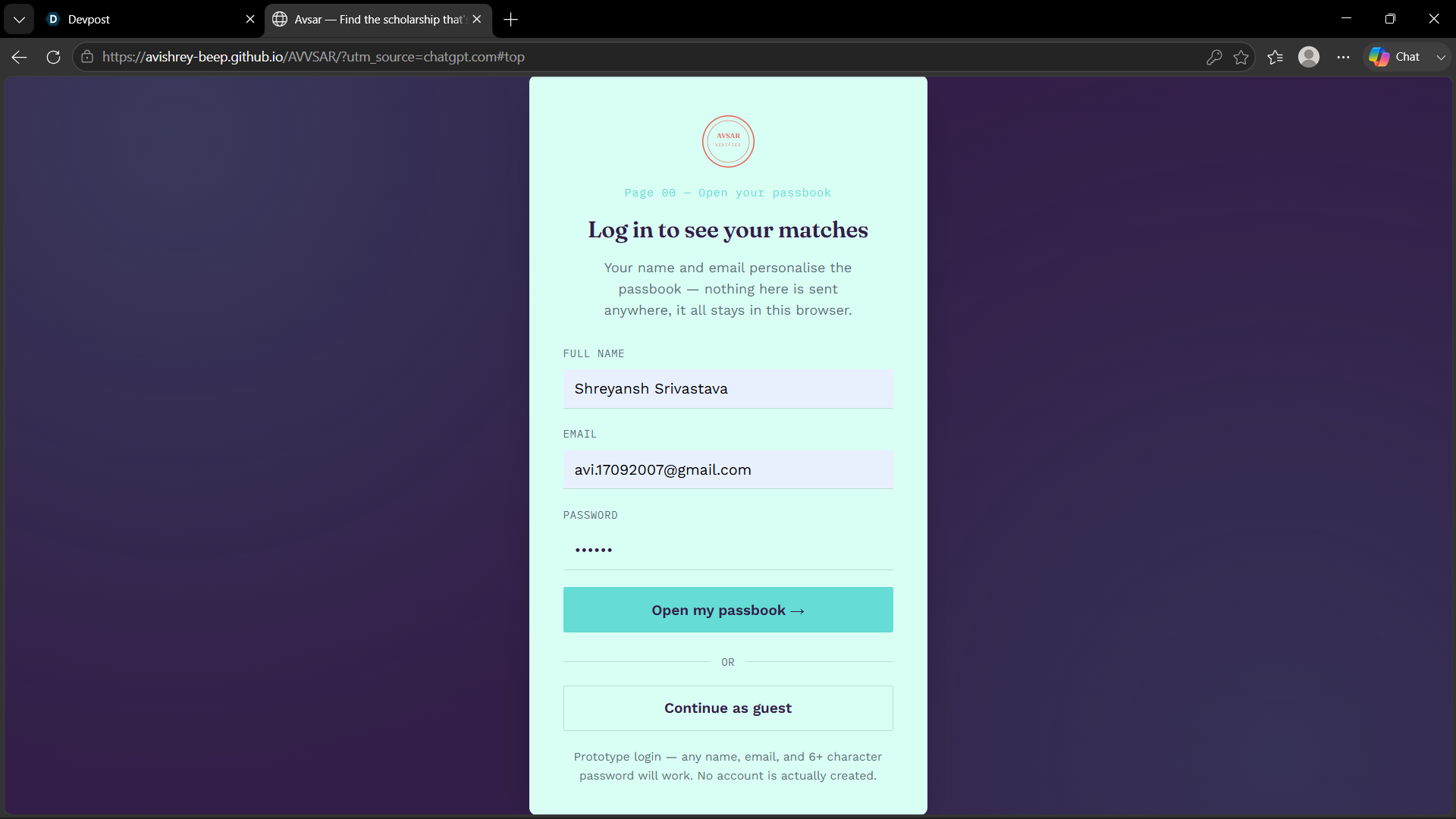
Login modal "Open your passbook" — prototype sign-in with name, email, password, or continue as guest.
Inspiration
Every year, thousands of scholarships across India go unclaimed — not because students aren't eligible, but because they never hear about them. The forms are scattered, the eligibility criteria are buried in PDFs, and no one tells a Class 12 student from Assam whether they qualify for a fellowship run by IISc. We built Avsar (अवसर) — "opportunity" — around one belief: eligibility, not awareness, shouldn't be the reason a scholarship goes unclaimed.
What it does
Avsar matches students to scholarships they actually qualify for, based on real details instead of guesswork.
- Quick, judgment-free intake — Students fill in their education stage (Class 10 through PhD), category, annual family income, gender, and state of domicile, styled deliberately like "a form counter clerk would want it filled."
- Instant, explainable matches — Based on those details, Avsar surfaces scholarships (AICTE Pragati, INSPIRE, KVPY-style fellowships, private trust scholarships, and more) tagged as Eligible, along with amount, deadline, and whether they're merit- or need-based.
- Step-by-step roadmap — Each match expands into the documents to prepare (marksheet, income certificate, category certificate, Aadhaar, bank passbook, etc.) and the exact steps to apply — turning "you're eligible" into "here's what to do next."
- Saathi, the scholarship chatbot — For the questions a form can't answer — "Do I need an income certificate if my father is a farmer?", "What's the difference between EWS and OBC-NCL?", "My college isn't listed — am I still eligible?" — Saathi answers in plain Hindi or English, right from a chat bubble on every page.
- Privacy by design — Everything a student enters runs only in the browser to compute matches; nothing is stored or sent anywhere, and login is optional (guest mode works too).
How we built it
Avsar is a front-end prototype: a details form drives a rules-based matching engine that checks a curated scholarship dataset (stage, category, income ceiling, domicile, gender) and returns ranked, eligibility-tagged results client-side. Saathi is a lightweight conversational layer trained on common scholarship FAQs — documents required, merit vs. need-based distinctions, category definitions like EWS — so students get answers without waiting on a helpline. The whole flow, from landing page to matches to chat, was designed to feel less like a government form and more like a guided conversation, bilingual by default (Hindi/English) to meet students where they are.
Challenges we ran into
- Translating dense, inconsistent real-world eligibility criteria (that usually live in scattered circulars and PDFs) into a single, clean rules engine that still reads as accurate.
- Deciding what belongs in the structured form versus what should be left to Saathi — some eligibility nuances (like caste-certificate exceptions or missed deadlines) are genuinely conversational, not checkbox-able.
- Keeping the experience trustworthy without a backend: making it clear to students that "nothing here is stored or sent anywhere" while still delivering personalized, accurate matches.
- Balancing bilingual support so Hindi and English users get equally natural answers from Saathi, not a translated afterthought.
What we learned
Most students don't fail to get scholarships because they're ineligible — they fail because no one ever tells them, clearly, that they qualify and what to do next. A huge amount of the "product" turned out to be language and trust: plain wording, a visible privacy promise, and a chatbot that talks like a helpful senior rather than a support ticket.
What's next for Avsar
- Expanding the scholarship dataset beyond the current curated list to cover state-specific and private-trust scholarships at scale.
- Adding deadline reminders and application tracking so students don't just discover a scholarship — they finish applying for it.
- Making Saathi smarter about document exceptions and edge cases (e.g., farmers without formal income certificates).
- Exploring official data partnerships (AICTE, NSP) to keep eligibility criteria continuously accurate.
Built With
- c++
- css3
- html5
- javascript
- node.js
- server
- vscode
