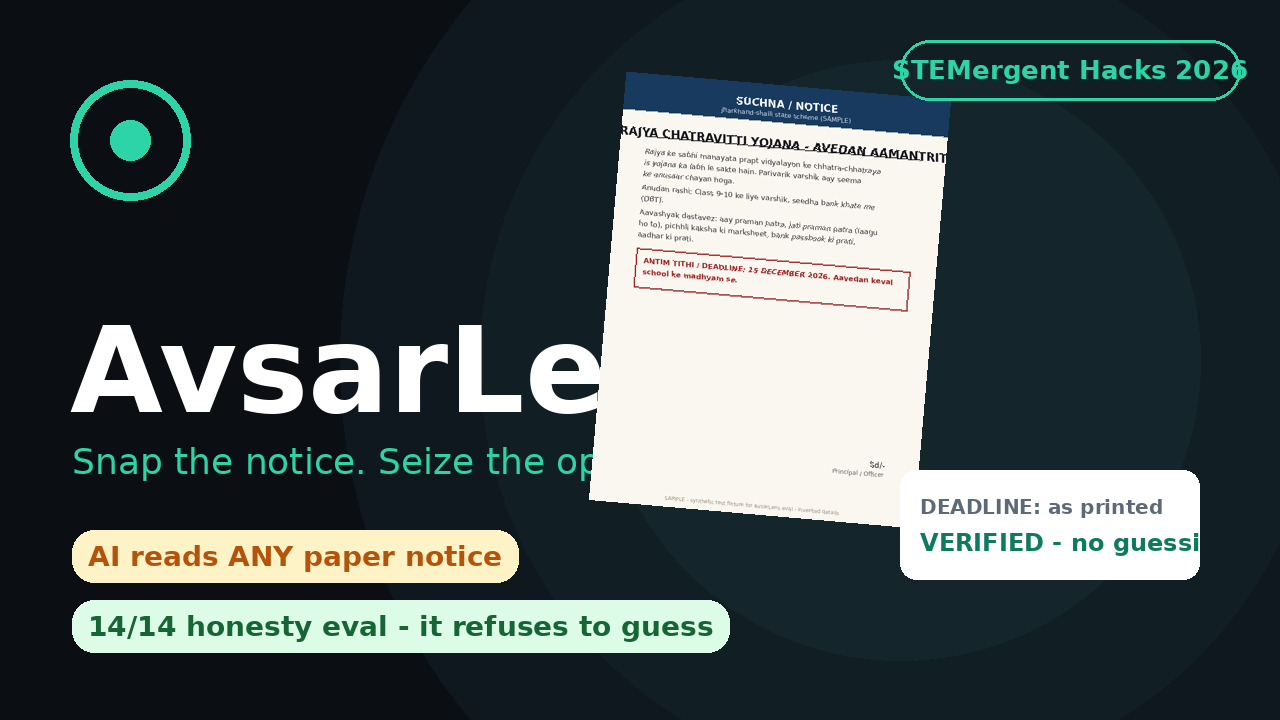
INSPIRATION In small-town India, opportunity still arrives on paper. Research shows 80% of rural students report no awareness of pre-matric scholarship schemes, and thousands of scholarships go unclaimed every year simply because students do not know they exist. The institution — the school notice board — is the single largest source of scholarship information, yet the paper notice assumes the reader can decode government language, remember deadlines, and assemble documents alone. First-generation learners and their parents lose at exactly that step. Existing AI scholarship tools are English-first search portals built for college students; none of them reads the physical notice where the information actually lives.
I am 15, from Bokaro, Jharkhand. I am that student. I built the tool I wished my school's notice board came with.
WHAT IT DOES
- Capture any notice — camera or upload, any language, bad print, glare, angles.
- Verified extraction (Gemini 2.5 Flash, BYOK): fixed output card — WHAT IS THIS / WHO CAN APPLY / DEADLINE (+ days left) / DOCUMENTS NEEDED / HOW TO APPLY / EXTRA DETAILS.
- "Can I apply?" — three questions generated from the notice itself, giving LIKELY ELIGIBLE / MAYBE — ASK SCHOOL / NOT ELIGIBLE, always ending with "final confirmation: contact the office listed on the notice."
- Tracker — saved notices with countdown and status (New / Asked school / Applied / Missed), stored only in your browser.
- Print view — a clean one-pager to hand to a parent or teacher.
It refuses to guess. No deadline printed means "VERIFY MANUALLY". Unreadable fields get amber low-confidence flags. Two notices in one photo get flagged, never merged. A missed opportunity hurts; a fabricated deadline hurts worse.
HOW IS THIS DIFFERENT FROM JUST ASKING AN AI CHATBOT?
- Output: a raw chatbot gives a different essay every time; AvsarLens gives the same verified card, every time.
- Deadlines: a chatbot can guess ("usually ends in March"); AvsarLens reads only what is printed, and flags when absent.
- Eligibility: a chatbot gives confident prose; AvsarLens uses rules from the notice plus a 3-question check with an ask-school fallback.
- Follow-through: a chat closes and everything is lost; AvsarLens keeps a deadline tracker with countdowns.
- Privacy: your photo on their servers vs. your key, your browser, nothing stored remotely.
- Built for: people who write perfect prompts vs. a 14-year-old with a cracked phone camera.
AI is the engine. AvsarLens is the vehicle.
HOW WE BUILT IT Solo, as an AI-native builder: I direct AI tools, review every line, and own the architecture, safety rules and testing. Vanilla HTML/CSS/JS single-page app — no framework, no backend, no account. Gemini 2.5 Flash (fixed model, Flash-only fallbacks) via the user's own API key stored in localStorage; the browser calls the API directly and no photo ever touches a server I control. Inline SVG icons, zero external resources, full-English UI. Deployed on Render.
Honest timeline: building started Oct 15, 2026 — before the competition window opened. The repository's commit history shows the entire journey with real dates; nothing was back-dated or faked.
CHALLENGES WE RAN INTO
- Designing for refusal: the easy product says something confident about every photo. The honest one must detect what it cannot read and flag it — deadline-never-invented tests are part of the eval harness, not an afterthought.
- Our own eval caught a real bug: the first full run scored 13/14. The failure was fixture-11 — two separate ads in one photo. The output was honest (both deadlines verbatim, nothing merged) but came back high-confidence with a double deadline and no flag: a student could follow the wrong one. We added a prompt rule (multiple notices means never merge, flag and lower confidence), shipped it the same day, and re-ran the full suite: 14/14. The harness fails us first — before any judge can.
- Real-world capture conditions: notice boards behind glass, folded circulars, faded newsprint, mixed Hindi/English. The 14-fixture synthetic set exists to test exactly this — torn, faded, glare, blur, handwritten, mixed-language.
- Question generation: "Can I apply?" questions must come from the notice itself, never from a generic template, or the check becomes theatre.
ACCOMPLISHMENTS THAT WE'RE PROUD OF
- A verification-first extraction pipeline with fixed output pattern and honest confidence flags
- An in-browser honesty eval harness (14 synthetic fixtures, runs with your own key, ships in the repo): run 1 = 13/14 (93%), caught a real edge case, fixed same day — full-suite re-run = 14/14 (100%)
- Deadline-never-invented behaviour verified on the no-deadline fixture: it refused to guess
- From zero to deployed live product in three days, solo, at 15 — including repo repair and deployment done from a phone via Termux git
- A privacy architecture a parent can understand in one sentence: "your key, your browser, nothing leaves your phone except the API call you own"
WHAT WE LEARNED
- The best AI products are not the ones that know everything — they are the ones that clearly say what they do not know.
- Research before building: one search killed my first idea (board-photo-to-notes has 5+ competitors) and the data pointed here — an empty format space on top of a documented 80% awareness gap.
- Testing the refusal path matters more than testing the happy path.
- An eval harness is not a deliverable you add at the end — it is the thing that makes every other claim in this description trustworthy.
WHAT'S NEXT FOR AVSARLENS
- Regional-language voice summary for parents who cannot read the card (opt-in, still no data leaves the device beyond the user's own API call)
- School mode: a teacher photographs the board's notices once, students' trackers sync via QR
- Offline fallback: on-device OCR for basic fields when there is no network
- Publishing the fixture set + eval harness so other student builders can test their own extraction tools
AI-USE DISCLOSURE (STEMergent requirement) AI tools were used for code generation, research assistance, fixture generation and demo narration under my direction. I reviewed and tested every component; the architecture, safety rules ("never invent a deadline"), eval harness and product decisions are mine. All synthetic demo notices are marked SAMPLE with invented details. Significant AI use is disclosed here per competition rules.

Log in or sign up for Devpost to join the conversation.