-
-
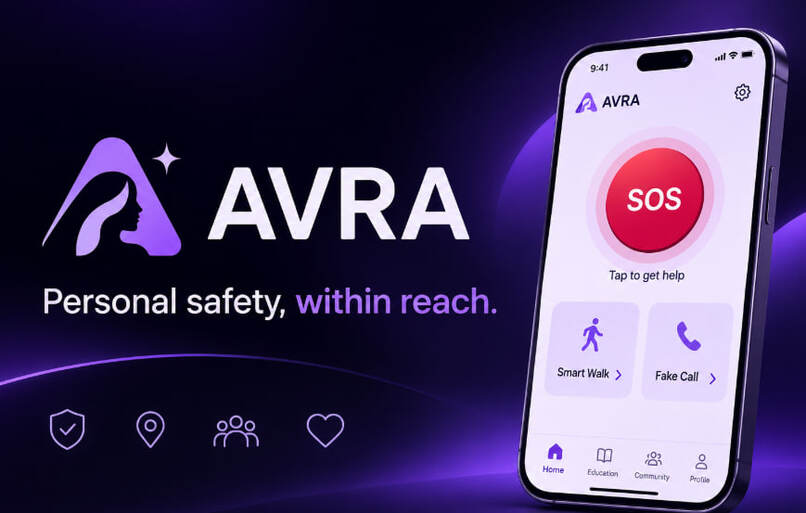
AVRA
Inspiration
AVRA started with a personal experience that made me think differently about women's safety. I realized that feeling unsafe is not always about being physically attacked. Sometimes, it is about walking alone, worrying about getting home safely, not knowing who to contact in an emergency, or feeling unprepared when something unexpected happens.
I began asking myself: What if women had a single place where they could access tools that help them feel more prepared, connected, and supported?
I didn't want to build another app that simply tells women to be careful. I wanted to create something practical that could help them take action. That idea became AVRA.
What It Does
AVRA is a women's personal safety application designed to make everyday safety tools more accessible.
The application brings several features together in one platform:
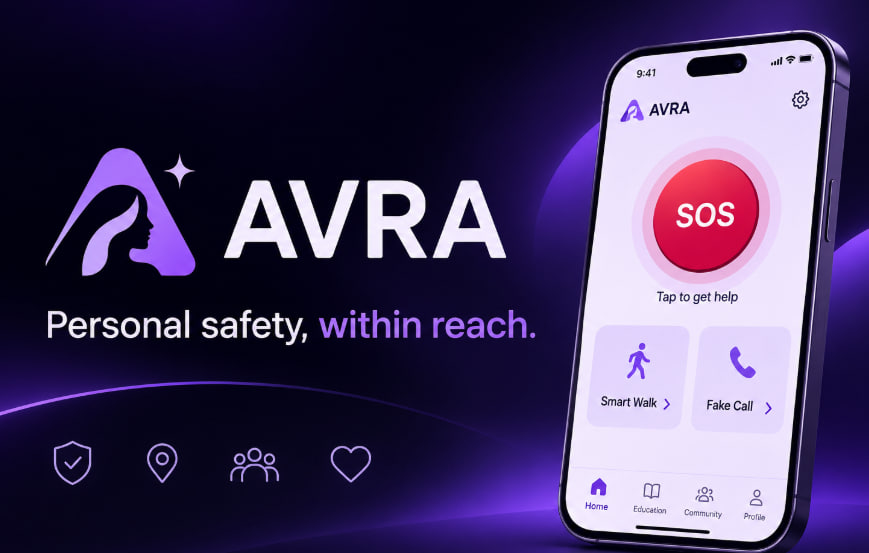
SOS: Helps users quickly alert trusted contacts during emergencies.
Smart Walk: Provides an additional layer of safety while users are walking alone.
Emergency Evidence: Organizes recorded emergency evidence with timestamps.
Safety Tools: Includes an alarm, flashlight, and fake call feature.
Safety Education: Gives users access to information that can help them make more informed safety decisions.
Community: Creates space for connection and support.
Instead of requiring users to switch between multiple applications, AVRA aims to bring essential safety tools into one accessible experience.
How We Built It
I developed AVRA over approximately five months in collaboration with my IT teacher.
My role was Founder and Product Lead. I worked on defining the problem, researching possible solutions, planning the application structure, designing the user experience, and deciding how each feature should function.
My IT teacher supported the technical development and helped turn these ideas into a working Android application.
We focused on building something functional rather than just presenting a concept. We developed the Android application, created its interface, implemented its core features, and built a website to introduce the project.
We also tested the application with 12 people to understand how they interacted with it.
One of our most important findings came from this testing. Initially, the homepage displayed eight different features. Users found the interface confusing because there were too many options competing for their attention. Based on their feedback, we simplified the homepage to four main features. The updated version was easier to navigate and received more positive reactions.
That experience changed how I approached product development: a feature is not useful simply because it exists. It must also be easy for someone to understand and use.
Challenges We Faced
One of our biggest challenges was balancing the number of features with simplicity.
At first, I wanted to include as many safety tools as possible. However, I gradually understood that adding more features does not automatically create a better product. We had to reconsider our priorities and focus on the user experience.
Another challenge was translating ideas into technical functionality. I could clearly imagine how I wanted AVRA to work, but turning those ideas into an actual application required technical learning, communication, testing, and multiple adjustments.
Working with limited resources also meant that we had to prioritize carefully. We could not build everything at once, so we focused on developing the Android version first and establishing a foundation for future improvements.
What I Learned
Building AVRA taught me that entrepreneurship is not just about having an idea. It is about identifying a real problem, understanding the people experiencing it, building a possible solution, and being willing to change your original plan when evidence shows that something is not working.
I also learned the importance of product thinking. Before AVRA, I thought that more functionality would make an application better. After testing it with real users, I understood that simplicity, accessibility, and usability are equally important.
Most importantly, I learned that I do not need to have every technical skill before starting to build something meaningful. I need to understand the problem, communicate my vision, collaborate with others, and keep learning throughout the process.
What's Next?
AVRA is currently developed as an Android application, with its website serving as its online presence.
Our next goals are to improve the existing features, continue collecting user feedback, strengthen reliability, and work toward expanding the platform to iOS.
We want AVRA to become more than an application with emergency buttons. Our vision is to build a practical digital safety platform that helps women feel more prepared, informed, and supported in their everyday lives.
AVRA is built around one simple belief: safety tools should be accessible before an emergency happens, not just after one.
What it does
How we built it
Challenges we ran into
Accomplishments that we're proud of
What we learned
What's next for AVRA
Built With
- android
- android-studio
- emergency-response
- figma
- firebase
- java
- kotlin
- location-api.com
- mobile-development
- personal-safety
- smsapi
- ux/uidesign
- xml

