INSPIRATION
Healthcare consultations are often limited by time, while patients may have a large amount of medical information spread across prescriptions, laboratory reports, discharge summaries, and previous records.
We were inspired by a simple question: What if the patient could provide their history and previous medical information before meeting the doctor, in a structured and easy way?
This led us to build AVENQRA AI, with a focus on making clinical information collection more organized, accessible, and useful for healthcare professionals.
WHAT IT DOES
AVENQRA AI helps collect and organize patient information before clinical consultation.
The platform combines:
- ADAPTIVE CASE TAKING through guided questions and branching based on patient responses
- VOICE, TEXT AND TOUCH based interaction
- MEDICAL DOCUMENT INTELLIGENCE for prescriptions, laboratory reports and discharge summaries
- OCR AND INFORMATION EXTRACTION to convert documents into structured information
- INFORMATION-GAP AND CONTRADICTION DETECTION
- RED-FLAG IDENTIFICATION for information requiring professional attention
- STRUCTURED CLINICAL SUMMARIZATION
- DOCTOR REVIEW AND SIGN-OFF
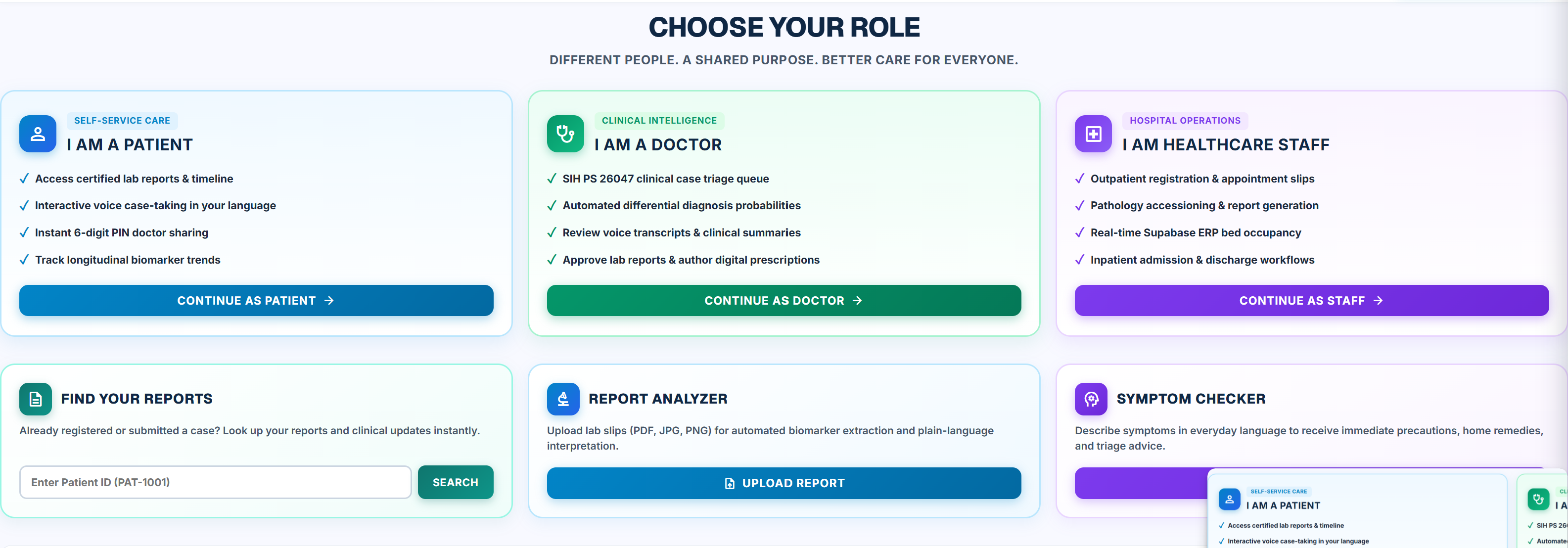
- PATIENT, DOCTOR AND HEALTHCARE STAFF WORKFLOWS
The goal is not to replace a doctor. AVENQRA AI organizes information so that healthcare professionals can review it and make the final clinical decisions.
HOW WE BUILT IT
We designed AVENQRA AI as a combination of PATIENT INTAKE, MEDICAL DOCUMENT PROCESSING, CLINICAL INFORMATION ORGANIZATION AND HUMAN-IN-THE-LOOP REVIEW.
The workflow is:
PATIENT → CASE TAKING → DOCUMENTS → INFORMATION EXTRACTION → CLINICAL SUMMARY → DOCTOR REVIEW
For case taking, we use structured clinical flows and branching questions rather than presenting every patient with one long fixed questionnaire.
For medical documents, the system accepts PDFs, images and scanned reports, extracts relevant information, and organizes it into a more useful clinical record.
The final summary is treated as an EDITABLE DRAFT, allowing the doctor to verify, correct and approve the information before it is used clinically.
CHALLENGES WE RAN INTO
Building for healthcare presented several challenges.
The first was STRUCTURING A NATURAL PATIENT STORY into clinically useful information without turning the experience into a complicated form.
The second was MEDICAL DOCUMENT PROCESSING, because prescriptions and reports can have different layouts, formats and levels of readability.
We also had to think carefully about MISSING AND CONFLICTING INFORMATION. Instead of silently assuming an answer, the system is designed to highlight information that needs attention.
Another major challenge was maintaining the right AI BOUNDARY. We wanted AI to assist with information collection and organization while keeping the DOCTOR IN CONTROL OF CLINICAL DECISIONS.
ACCOMPLISHMENTS THAT WE'RE PROUD OF
We are proud of bringing multiple parts of the clinical information workflow into one platform.
We built a working foundation that combines ADAPTIVE CASE TAKING, MEDICAL DOCUMENT INTELLIGENCE, STRUCTURED INFORMATION PROCESSING, CLINICAL SUMMARIZATION AND DOCTOR REVIEW.
We are particularly proud of the HUMAN-IN-THE-LOOP APPROACH, where AI-generated information remains reviewable and editable rather than being treated as an autonomous diagnosis.
We also designed separate workflows for PATIENTS, DOCTORS AND HEALTHCARE STAFF, making the platform broader than a simple patient chatbot.
WHAT WE LEARNED
This project taught us that building AI for healthcare is not only about making the AI smarter.
It is equally important to make the system TRACEABLE, REVIEWABLE, SIMPLE AND SAFE.
We learned how important it is to handle incomplete information, preserve the connection between extracted information and its source, design for different types of users, and keep healthcare professionals involved in the final workflow.
Most importantly, we learned that GOOD HEALTHCARE AI SHOULD SUPPORT HUMAN DECISION-MAKING, NOT TRY TO REPLACE IT.
WHAT'S NEXT FOR AVENQRA AI
Our next focus is to make AVENQRA AI more robust and scalable.
We plan to work toward BROADER LANGUAGE SUPPORT, DEEPER HOSPITAL SYSTEM INTEGRATION, STRONGER MEDICAL DOCUMENT PROCESSING, BETTER CLINICAL INFORMATION VALIDATION, AND MORE ACCESSIBLE PATIENT INTERACTION.
We also want to continue improving the platform based on real-world healthcare workflows and professional feedback.
Our long-term vision is simple:
MAKE PATIENT INFORMATION EASIER TO CAPTURE, EASIER TO UNDERSTAND, AND MORE USEFUL FOR THE PEOPLE PROVIDING CARE.
Built With
- clinical-informatics
- conversational-ai
- healthcare
- healthtech
- machine-learning
- medical-ai
- natural-language-processing
- node.js
- ocr
- postgresql
- python
- react
- typescript
- web


Log in or sign up for Devpost to join the conversation.