Aven
Small teams do not usually lose context because people fail to communicate. They lose it because communication stays trapped in conversation.
Someone says a deployment is blocked. Someone else changes the plan. A teammate promises to handle a customer issue tomorrow. Unless somebody stops working to record it, the team’s shared state becomes stale.
Aven turns those spoken updates into operational memory.
From conversation to team state
A teammate records a short voice update through an Apple Shortcut. Aven transcribes it, stores the transcript, and reconciles it against what the team already knows.
The Strands agent determines:
- What changed
- What was completed
- What is blocked
- What was decided
- Who committed to what
- Which deadlines matter
- Which facts are now obsolete
- Which situations need human judgment
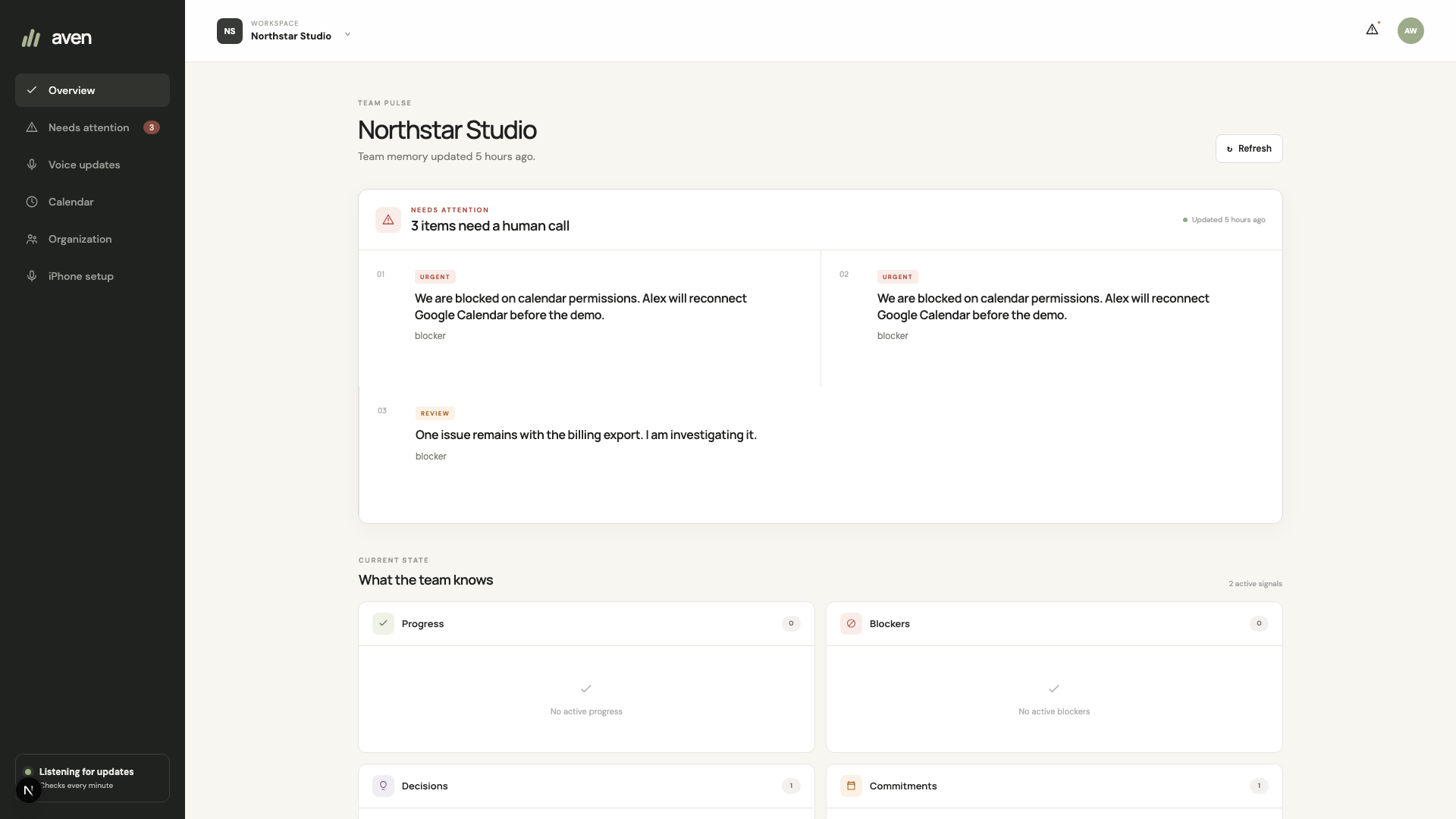
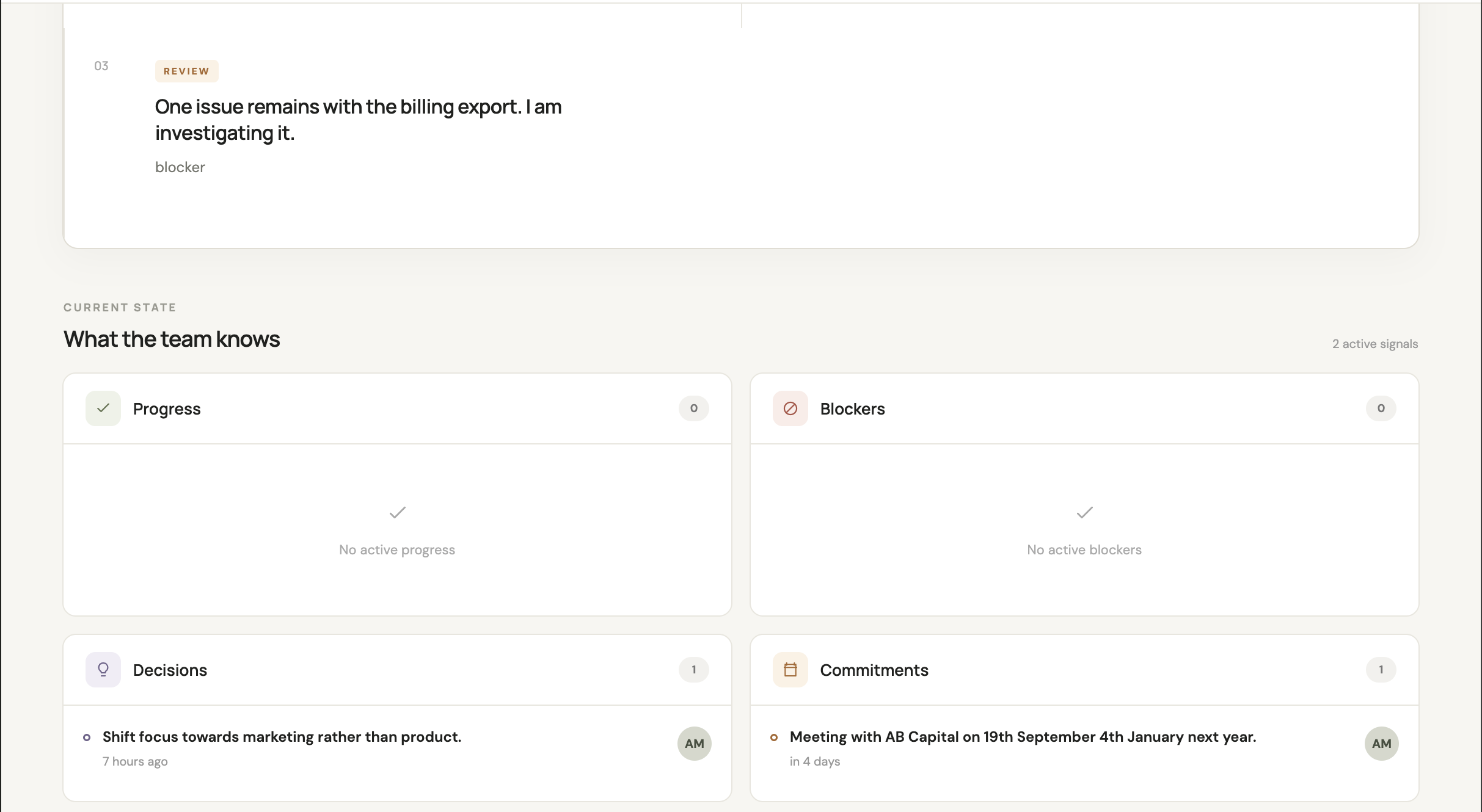
The result is a live team view of progress, blockers, decisions, commitments, deadlines, and conflicts.
Aven does not interrupt people for every update. It works in the background and surfaces attention only when something genuinely requires a human call.
Dated commitments can also become events in a dedicated Aven Google Calendar. This moves important context out of the transcript and into the team’s working schedule.
How it works
Aven is built with Next.js, TypeScript, PostgreSQL, Groq Whisper, Google Calendar, Web Push, and the Strands Agents SDK running with Amazon Bedrock.
The voice capture endpoint validates a signed team member credential. Audio is sent directly to Groq for transcription and is never persisted. Only the transcript becomes durable memory.
The reconciliation agent receives the current team state, new voice updates, and relevant Calendar context. It returns structured output constrained by a Zod schema. Every state entry keeps its source update IDs, so the team can trace where a fact came from.
The database uses update claims to prevent concurrent runs from processing the same transcript twice. Failed runs remain retryable. The dashboard continues showing the last known state while new updates are processed.
Google Calendar access is protected by a strict boundary. Aven creates or reuses a dedicated calendar and will not modify events in another calendar.
The difficult part was memory
The central challenge was not transcription. It was deciding how new information changes existing information.
A new update might confirm an earlier fact, complete it, contradict it, or make it irrelevant. Aven therefore does not treat every transcript as an isolated classification problem. It reconciles the whole batch against the current state and preserves history through completed, superseded, and resolved entries.
Calendar automation created a second challenge. An agent should be able to handle routine work, but external actions still need boundaries. Aven filters low confidence Calendar actions, validates event identifiers, and limits writes to its managed calendar.
We also designed the product around honest asynchronous behavior. Users see whether an update is queued, processing, processed, or failed. The interface never replaces unavailable live data with fake operational state.
What we are proud of
Aven demonstrates a complete voice to action loop:
A real voice update becomes a transcript. The transcript becomes structured team memory. That memory updates a live dashboard, creates Calendar actions when appropriate, and surfaces only the decisions that need human attention.
The project includes provenance, retryable failures, concurrency safe processing, encrypted OAuth sessions, an installable Apple Shortcut, mobile capture, Google Calendar automation, browser notifications, and 33 passing automated tests.
What we learned
A useful operational agent needs more than fluent responses. It needs controlled state transitions, evidence, and clear authority boundaries.
The best background agent is not the one that produces the most output. It is the one that quietly keeps reality synchronized, then knows exactly when to bring a human back into the loop.

Log in or sign up for Devpost to join the conversation.