-
-
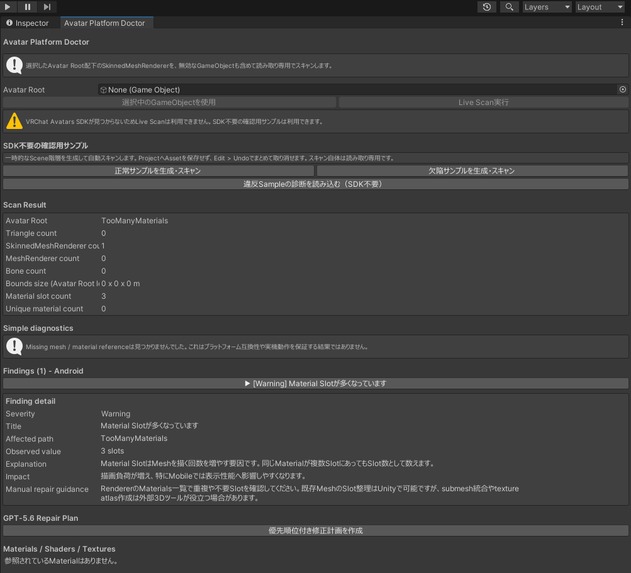
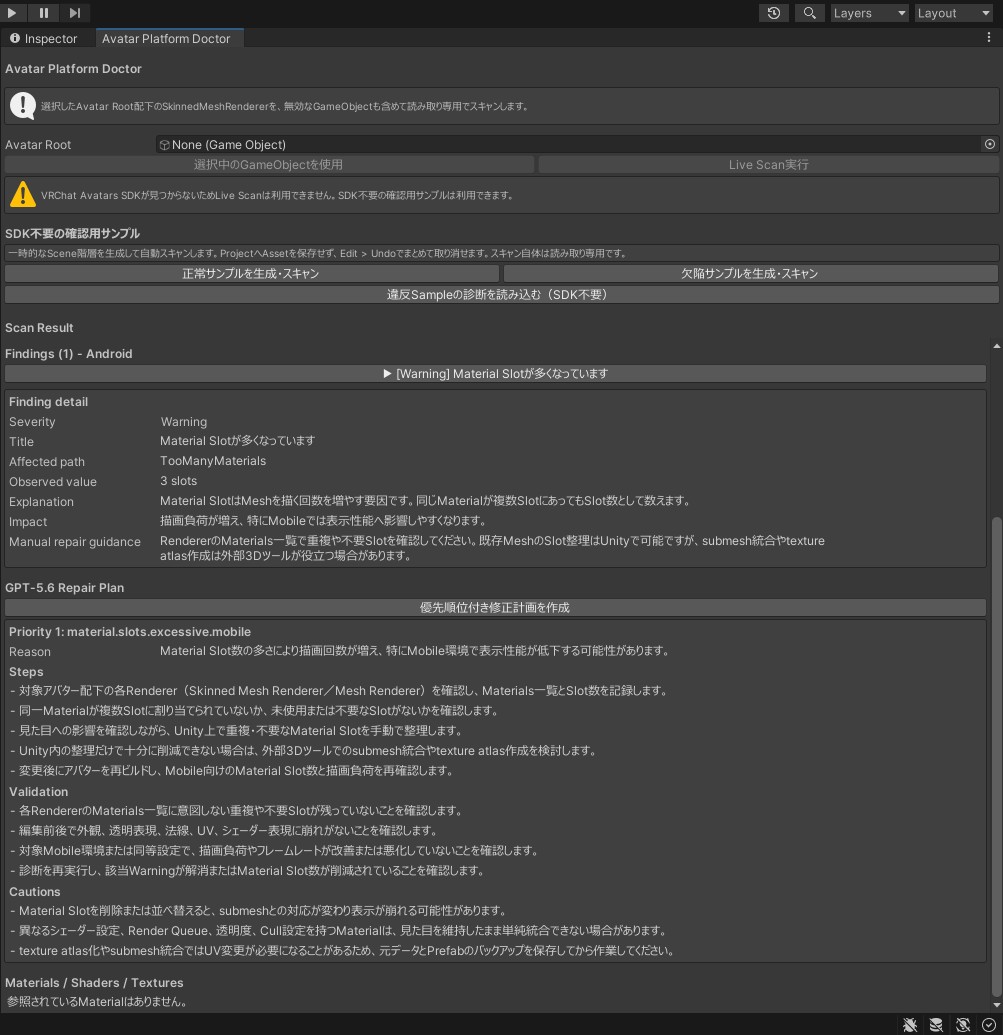
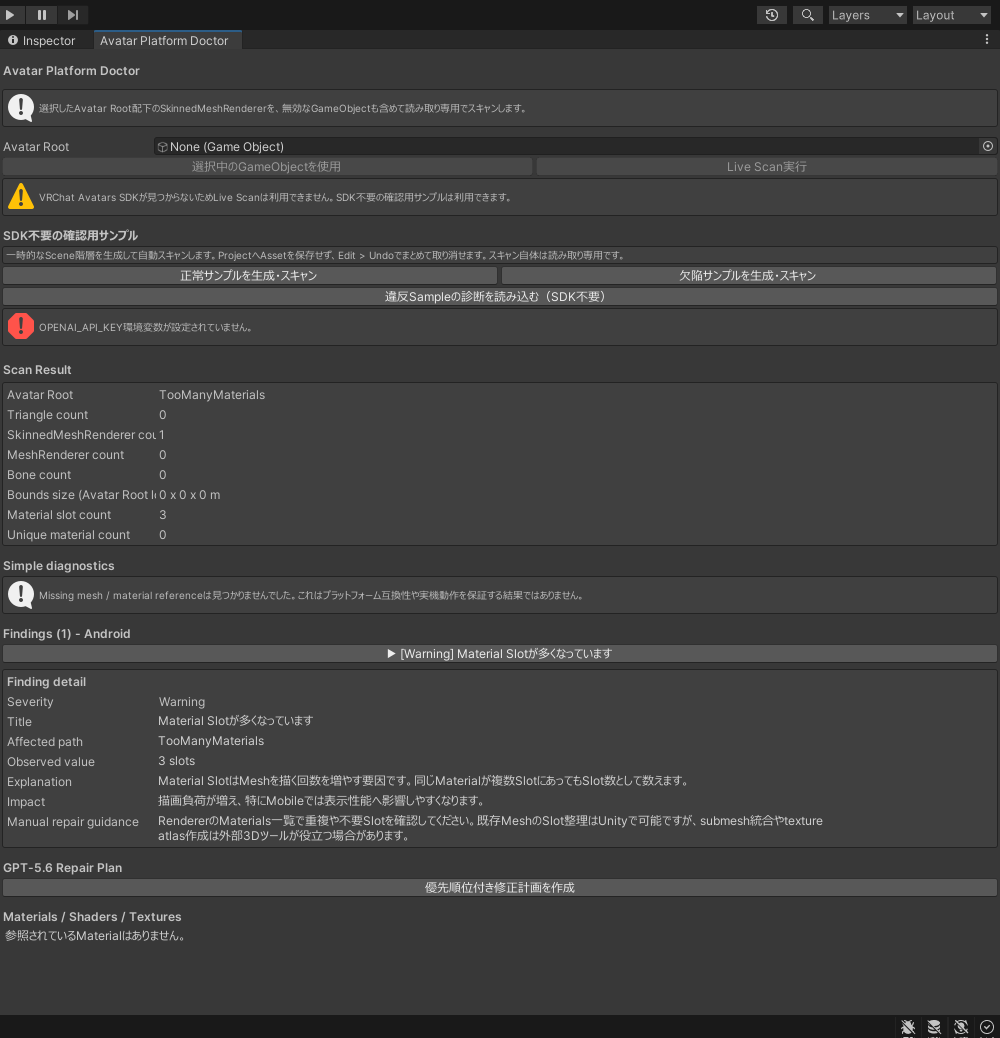
Local Findings explain what is wrong, why it matters, and how to repair it.
-
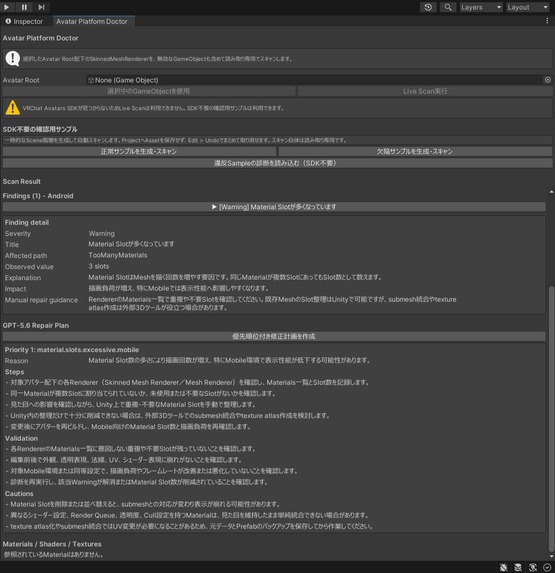
GPT-5.6 converts reduced Findings into a prioritized manual repair plan.
-
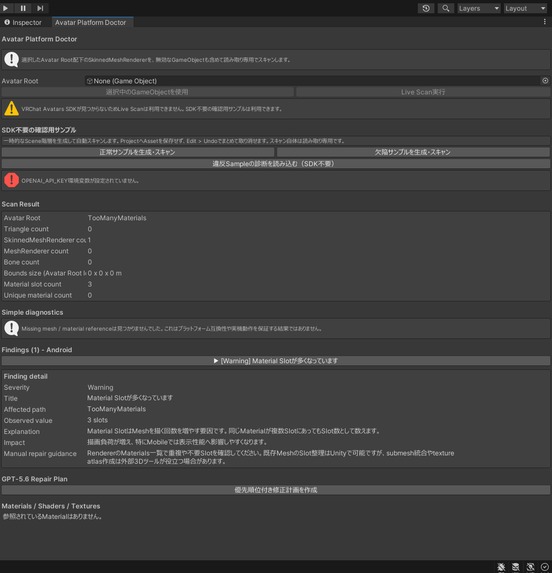
Local diagnostics remain available when the API is unavailable.
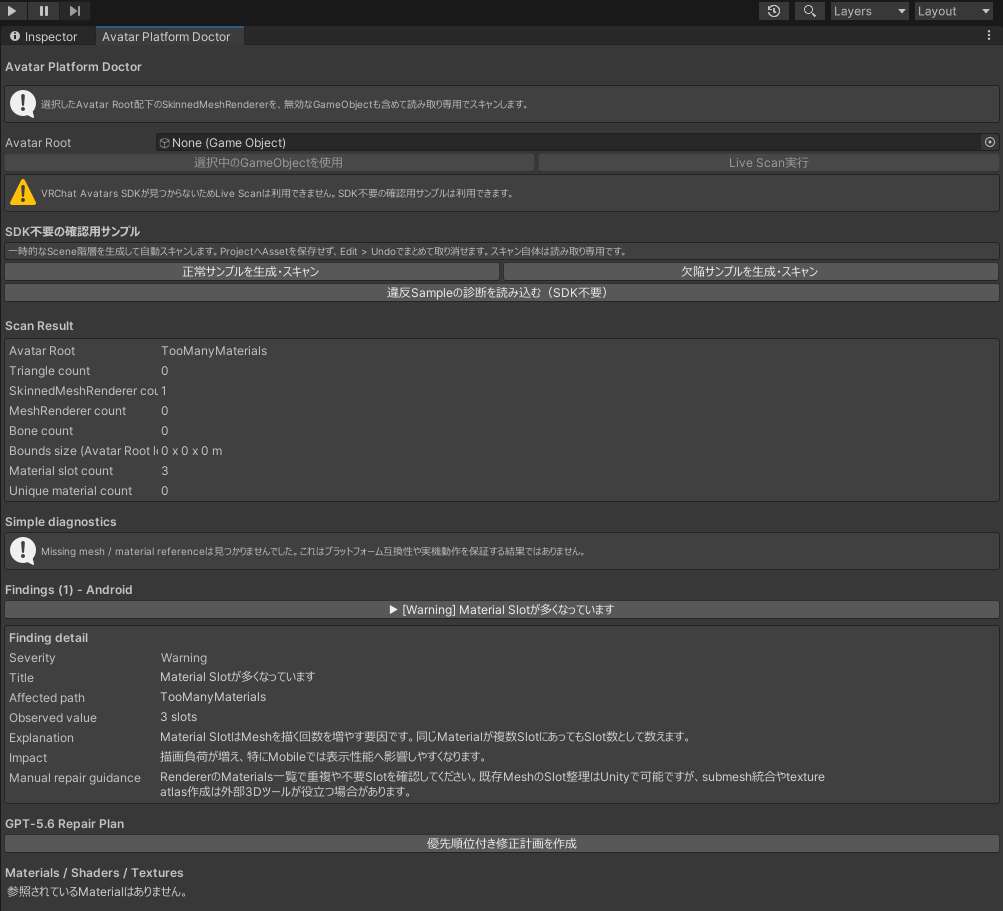
Inspiration
VRChat already provides avatar statistics and conversion tools, but raw numbers rarely answer the questions beginners actually have: What is wrong? Why does it matter? And what should I fix first?
Avatar Platform Doctor was created to bridge the gap between technical avatar data and clear, actionable repair guidance.
What it does
Avatar Platform Doctor is a Unity Editor extension that scans avatar data locally and converts technical observations into structured Findings.
Each Finding displays:
- Severity
- Title
- Affected path
- Observed value
- Explanation
- Likely impact
- Manual repair guidance
The current MVP detects issues such as missing meshes or materials, excessive material slots, large textures, unconfirmed mobile shader compatibility, and transparency-related cautions.
An SDK-free evaluator sample allows the diagnostic flow to be tested without a VRChat account, a commercial avatar, or the VRChat Avatars SDK.
When the user explicitly requests additional help, the tool can send a reduced Finding payload to the OpenAI Responses API. GPT-5.6 then returns a prioritized manual repair plan containing reasons, concrete steps, validation checks, and cautions.
The tool does not automatically modify the avatar. Local scanning and Findings remain available when the API key is missing or the API request fails.
How we built it
The project is implemented as a Unity Editor package with several separated layers:
- An SDK-independent Core scanner
- A conditional VRChat SDK adapter
- A deterministic RuleEngine
- A Unity EditorWindow for scan results and Finding details
- An OpenAI Responses API client
- Strict JSON Schema parsing for GPT-5.6 repair plans
- EditMode tests and repository validation scripts
The API client uses store: false and reads the key only from the OPENAI_API_KEY environment variable.
The reduced request excludes asset files, images, project code, affected paths, observed values, shader names, and the API key.
Codex accelerated implementation and review of the scanner, RuleEngine, Unity integration, Responses API client, structured-output handling, tests, and documentation.
The author defined the product scope, privacy boundaries, manual-only repair policy, and final Unity verification process.
Challenges we ran into
One major challenge was keeping the scanner useful both with and without the VRChat SDK installed. Separating the Core scanner from the conditional SDK adapter made the SDK-free evaluator possible.
Another challenge was deciding where deterministic diagnostics should end and generative assistance should begin. The local RuleEngine remains the source of Findings, while GPT-5.6 is used only to organize those Findings into a repair plan.
Privacy was also a core design constraint. The API request needed enough context to produce useful guidance without sending avatar assets or identifying project data.
Finally, the original project scope was too broad for the submission period. Features such as full Performance Rank reproduction, automatic fixes, and user-facing platform switching were deferred so the end-to-end MVP could be completed and verified reliably.
Accomplishments that we're proud of
- Completed a working
Scan → Findings → Repair Planworkflow - Preserved local diagnostics when the API is unavailable
- Added an SDK-free evaluator that judges can run without a VRChat account
- Kept normal avatar scans read-only
- Successfully displayed structured GPT-5.6 repair plans inside Unity
- Passed 97/97 EditMode tests in the SDK-free repository project
- Passed 115/115 EditMode tests in a VCC Avatar Project
- Verified that Live Scan does not mark the saved Scene as dirty
- Excluded API keys and commercial avatar data from the public demo
What we learned
Deterministic diagnostics and generative AI work best as separate layers. The scanner should establish observable facts, while the language model should help users understand priorities and next steps.
We also learned that a smaller, dependable workflow is more valuable than a large feature list that cannot be fully verified.
The SDK-free synthetic sample became especially useful because it makes the core experience reproducible without requiring external accounts or paid assets.
What's next for Avatar Platform Doctor
Planned post-MVP work includes:
- User-facing PC, Android, and iOS profile selection
- Broader diagnostic rule coverage
- More complete VRChat SDK component analysis
- Full Performance Rank estimation
- A preview of the reduced API payload
- Improved Finding search and navigation
- Public package and VPM distribution

Log in or sign up for Devpost to join the conversation.