-
-
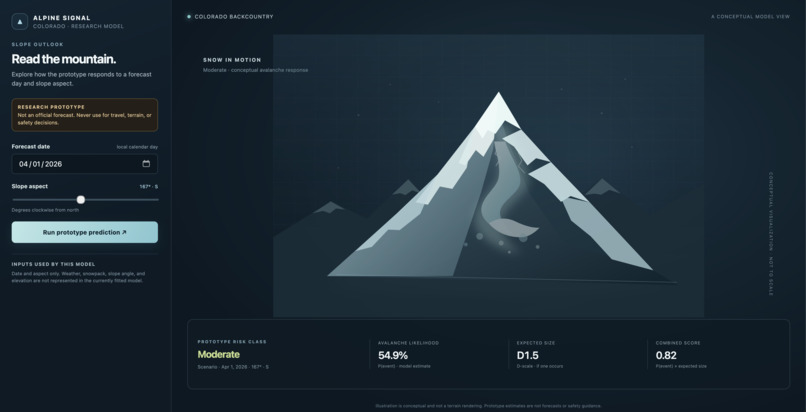
UI
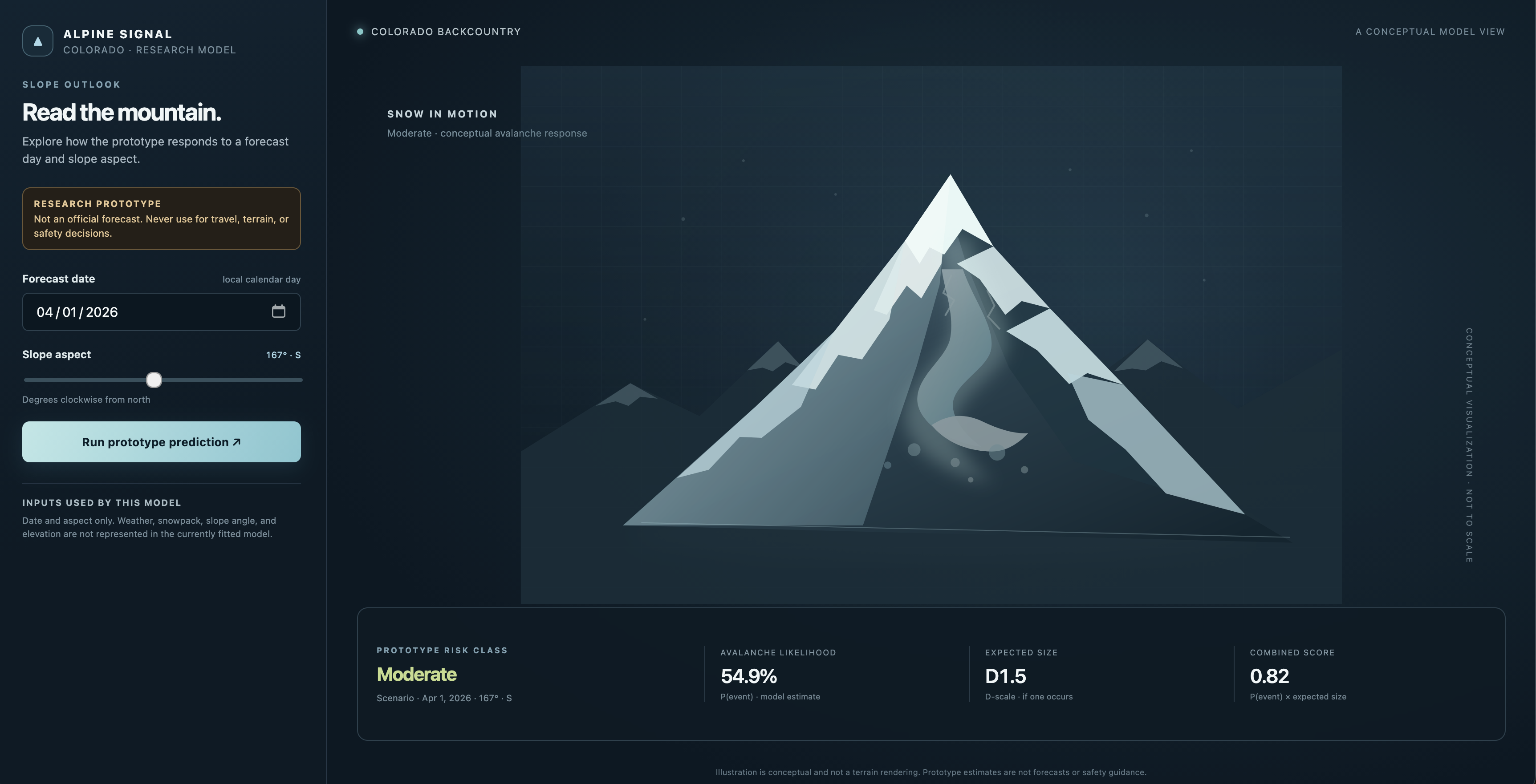
Inspiration
Avalanches are a serious mountaineering hazard. The Colorado Avalanche Information Center (CAIC) recorded 22 avalanche deaths in Colorado during the 2024–25 season, with a five-season average of 24.4 deaths per season. CAIC fatality statistics
We wanted to explore how avalanche observations might be communicated through an interactive model. AvAI is a research prototype, not a safety tool or a promise to prevent accidents.
What it does
Given a date and slope aspect, AvAI estimates avalanche likelihood and expected destructive size if an avalanche occurs. It combines them as:
Risk score = avalanche probability × expected D-size, given an avalanche.
A mountain illustration responds to the resulting risk category.
How we built it
We built a Python pipeline around manually downloaded CAIC avalanche observations, trained a two-stage model, and created a local web UI to run predictions. The current model uses date and aspect; its mountain graphic is an illustration, not real terrain.
Challenges we ran into
The mountain needed to communicate changing model outputs while remaining clear that it was conceptual. Evaluating the model was also difficult: unreported avalanches are not confirmed non-events, and the current dataset lacks useful features such as weather, snowpack, and slope angle.
Accomplishments that we're proud of
We connected the dataset, trained model, prediction script, and interactive UI into a working prototype. The UI presents likelihood and conditional size separately, alongside the combined score.
What we learned
A model's output is only as trustworthy as its data and evaluation. Sampled non-events can distort probabilities, and a random data split does not show whether predictions generalize to new seasons or locations.
What's next for AvAI
Improve the dataset with reliable weather, snowpack, and terrain features; evaluate on held-out seasons and locations; and assess calibration with avalanche experts. Any future version would need rigorous validation before it could be considered for safety-related use.
