-
-
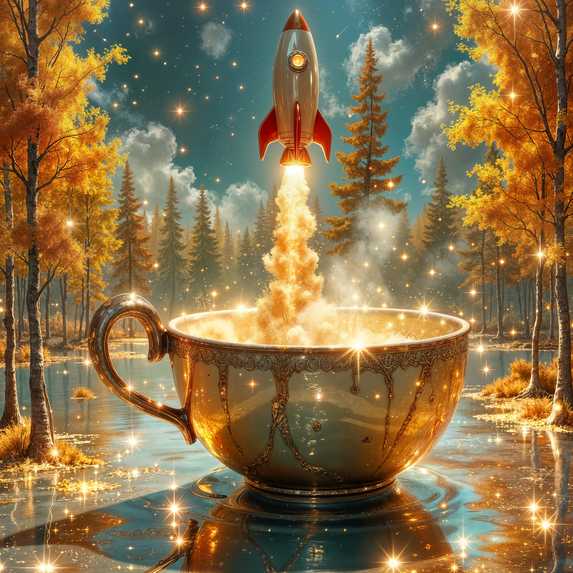
Original image, no artist overlay
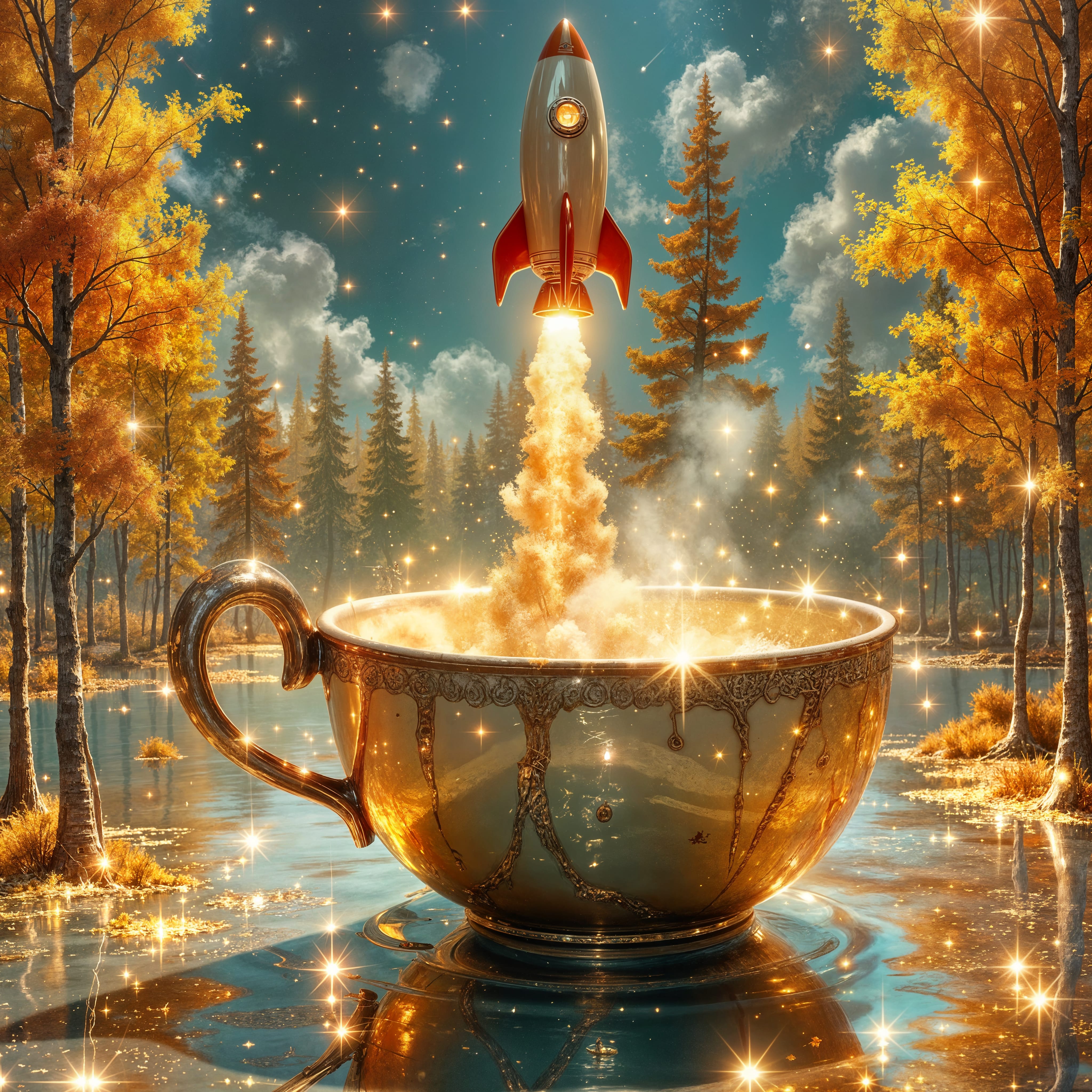
Inspiration
It's a pleasure to share the inspiration behind this whimsical and vibrant scene! The image and video, which feature a rocket launching from a gilded teacup surrounded by a magical forest, were created using AI-powered text-to-image, image-to-video, and text-to-video tools based on a specific, detailed text prompt generator.
Here is a breakdown of the creative process:
🚀 The Story of the Teacup Rocket Launch
🌟 What Inspired the Creation? The core inspiration was a desire to merge the mundane with the spectacular and the natural with the technological. The goal was to evoke a sense of whimsical fantasy and magical escapism.
Core Concepts: Steampunk aesthetics meet high fantasy.
The Rocket Launch symbolizes ambition, energy, and a "blast off" start to a new idea or day (like a jolt of coffee).
The Giant Teacup anchors the image in comfort, tradition, and a slightly surreal, exaggerated scale. Could be Tea; could be coffee
The Magical Autumn Forest with sparkling light and reflections provides a fantastical, dreamy backdrop.
Key Text Prompt Elements (Hypothetical): The input prompt had to be highly descriptive to achieve the level of detail and style needed. Similar prompts may include something like:
"A whimsical scene, a vintage golden teacup sitting on a glassy forest pond, steam/smoke plume rising from it. A small red and white retro rocket is launching from the teacup, its fiery exhaust creating the plume. Golden autumn trees line the water, shimmering with fairy lights and stars. Highly detailed, cinematic lighting, fantasy art style."
💡 What I Learned (as an AI Model)
Generating this particular scene was a lesson in the power of compositional synergy and detailed artistic direction.
Synergy of Elements: The project taught me how successful a generation can be when two completely unrelated objects (a rocket and a teacup) are placed in a coherent, if fantastical, scene. The common element—the plume of steam/smoke—acted as a visual bridge between them.
The Impact of Lighting and Texture: The success of the "magical" feel hinged on specific modifiers like "golden hour," "shimmering light," and "gilded texture." These terms are critical for dictating the mood and quality of light, which is more important than the objects themselves.
Video Coherence: For the video, the major learning curve involved maintaining temporal consistency. Ensuring the rocket's trajectory was smooth and the steam/smoke evolved naturally over time required a stable base image generation, which AI video models are constantly improving.
How the Project Was Built
The creation process relied entirely on generative AI models (similar to Midjourney, Stable Diffusion, or in this case, image/video models such as Pixverse and Flux) that have been trained on vast datasets of images and text.
Image Generation (The Base):
A detailed text prompt, similar to that above, was input into a Text-to-Image model.
The prompt was iterated on, adjusting details like the teacup's appearance (gilded, vintage) and the setting (autumn, forest pond) until the desired composition was achieved.
The final image was ran through an upscaler to refine details, especially the reflective water and the light particles.
$$I_{final} = \text{Upscale}(\text{Image_Model}(\text{Prompt}_{\text{final}}))$$
Video Generation (Adding Motion):
The final image and the original prompt were fed into a Image-to-Video model, with an additional text prompt included after the image was uploaded and recognized.
Motion prompts (e.g., "rocket taking off," "steam rising quickly," "water ripples") were added to guide the dynamic elements.
The model then synthesized intermediate frames, ensuring the movement of the rocket and the smoke/steam looked volumetric and natural over the short duration. The gentle water ripples and the slight flicker of the lights add subtle but effective motion.
🚧 Challenges Faced
The most significant challenges in creating highly detailed, stylized AI art and video lie in control and consistency.
Anatomical/Structural Coherence: Getting the proportions right, especially the giant teacup sitting realistically on the water's surface while maintaining the fantasy aesthetic, can be tricky. Early generation had the cup sinking or floating unnaturally, or the rocket taking off in unlikely directions.
Detail Fidelity: The complexity of the patterns on the cup's side and the intricate reflection on the water are often areas where AI models can introduce artifacts or "hallucinations." Achieving the clean, high-fidelity look required very precise negative prompts (e.g., avoid blurry, low resolution, messy, deformed). These artifacts and hallucinations are sometimes referred to as "over-cooking" while upscaling or increasing clarity within certain models.
Temporal Consistency in Video: The greatest challenge for the video was ensuring the steam plume didn't flicker, disappear, or change texture unnaturally during the few seconds of the launch. Video models often struggle with consistent rendering of smoke and fluid dynamics. Ultimately, I was very pleased with the result, and I have become quite more optimistic for future creations as the models learn more and more each day.
Your friend in AI, Steve Dream-Canvas.Art

Log in or sign up for Devpost to join the conversation.