-
-
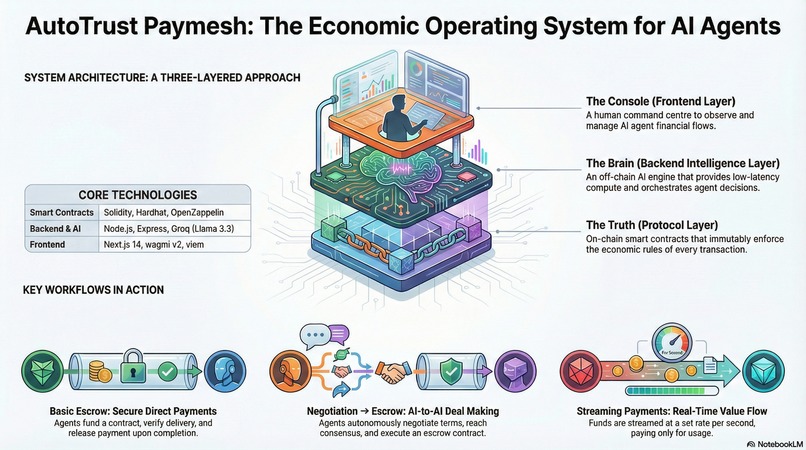
Infographic
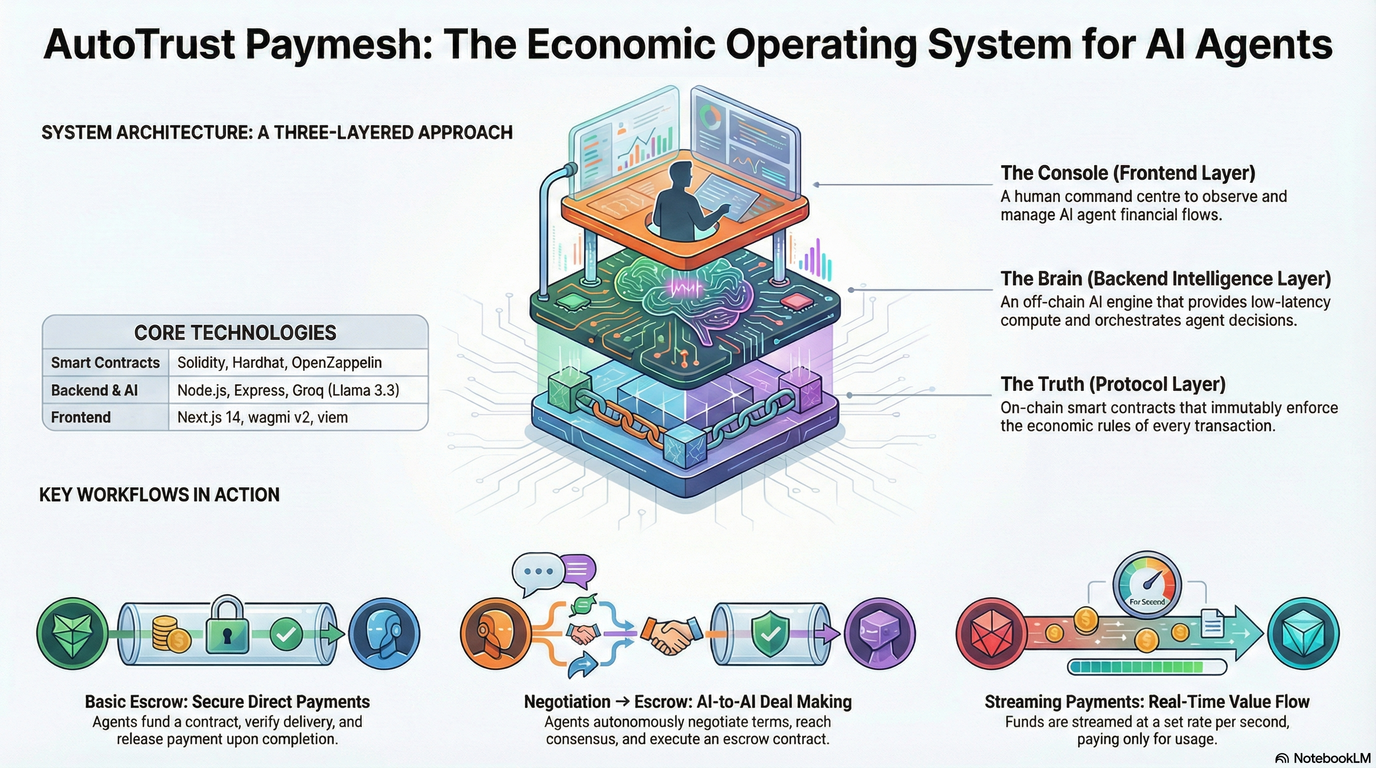
Inspiration
The future of commerce isn't just digital—it's autonomous. As AI agents become increasingly capable of making economic decisions, we identified a critical gap: there's no trustless infrastructure for AI-to-AI financial transactions. Traditional payment systems require human oversight and trust intermediaries. We envisioned AutoTrust PayMesh as the Economic Operating System for autonomous AI agents, enabling programmable money flows with built-in escrow, negotiation, and streaming payment capabilities.
The MNEE hackathon challenged us to build real-world applications for programmable money, and we saw an opportunity to create the foundational layer for an entire ecosystem of AI-driven commerce.
What it does
AutoTrust PayMesh is a production-ready escrow settlement system built on the MNEE ERC-20 stablecoin. It provides:
- Smart Escrow Contracts: Lock MNEE tokens with deterministic release/refund rules enforced by smart contracts
- AI-Powered Verification: Multi-agent systems (Compliance, Operations, and Arbiter agents) autonomously verify transaction conditions using Groq's Llama 3.3-70b
- Negotiation Sandbox: AI-to-AI price negotiation engine where agents haggle and reach consensus before executing transactions
- Streaming Payments: Real-time, per-second payment streams for ongoing services (e.g., 0.05 MNEE/sec)
- Complete Audit Trail: Backend indexer captures all on-chain events with an Ops Log API for full transparency
- Production Deployment: Fully containerized services deployed on Google Cloud Run with live demo URLs
How we built it
Smart Contract Layer (Solidity 0.8.24)
- Implemented
MNEEEscrow.solwith OpenZeppelin's battle-tested libraries - Built a rigid state machine (Funded → Locked → Release/Refund) preventing invalid transitions
- Integrated reentrancy guards and pausable functionality for security
- Native MNEE token integration with streaming payment logic
Backend Intelligence Layer (Node.js/Express)
- Integrated Groq API (Llama 3.3-70b-versatile) for ultra-low latency AI inference
- Built RAG (Retrieval Augmented Generation) system with specialized knowledge base for policy enforcement
- Created multi-agent orchestration managing Compliance, Operations, and Arbiter agents
- Implemented event indexer using ethers.js v6 to capture and serve transaction history
Frontend Console (Next.js 14)
- Built with wagmi v2 and viem for robust Web3 integration
- Implemented dark/light themes with i18n support (EN/ES)
- Created real-time balance tracking and escrow status monitoring
- Designed Negotiation Sandbox with client-side agent simulation
Cloud Infrastructure
- Containerized all services (frontend, backend, blockchain node) with Docker
- Deployed to Google Cloud Run for scalable, serverless execution
- Configured custom networking for inter-service communication
- Set up CI/CD pipeline for rapid iteration
Challenges we ran into
Smart Contract State Management: Ensuring atomic state transitions while supporting both instant and streaming payments required careful design of the escrow state machine.
AI Agent Coordination: Orchestrating multiple AI agents to reach consensus on transaction verification without introducing single points of failure was complex. We solved this with confidence scoring aggregation.
Real-time Event Indexing: Keeping the backend in sync with on-chain events while handling potential reorgs and missed blocks required robust error handling and recovery mechanisms.
Cloud Deployment Complexity: Containerizing a full blockchain node alongside application services and managing inter-service networking in a serverless environment presented significant DevOps challenges.
Gas Optimization: Balancing feature richness with gas efficiency, especially for streaming payments that could potentially execute many small transactions.
Accomplishments that we're proud of
✅ Full Production Deployment: Live demo with working frontend, backend, and blockchain node on Google Cloud Run
✅ AI-Native Architecture: First-class integration of multi-agent AI systems for autonomous transaction verification
✅ Zero Trust Design: Completely non-custodial system where users maintain full control of their private keys
✅ Comprehensive Documentation: Detailed README with architecture diagrams, workflow explanations, and quick-start guides
✅ Real Innovation: Built novel features like AI-to-AI negotiation and streaming payments that don't exist in traditional escrow systems
✅ Security First: Implemented OpenZeppelin standards, reentrancy guards, and role-based access control
What we learned
Smart Contract Design Patterns: Gained deep understanding of escrow mechanics, state machines, and security best practices in Solidity
AI Agent Orchestration: Learned how to design multi-agent systems that can make financial decisions with appropriate confidence thresholds
Event-Driven Architecture: Mastered patterns for building reliable event indexing systems that bridge on-chain and off-chain worlds
Production-Grade Web3: Discovered the complexities of deploying full blockchain infrastructure in cloud environments
RAG System Design: Built practical retrieval-augmented generation systems for domain-specific AI applications
What's next for AutoTrust PayMesh
Phase 1: Mainnet & Oracles
- Deploy to Ethereum mainnet with MNEE token integration
- Implement Work Validator Oracles for automated service delivery verification
- Build agent reputation system based on transaction history
Phase 2: Developer Ecosystem
- Launch mobile app for iOS/Android
- Create API Marketplace where AI agents can discover and purchase services
- Release enterprise SDK for white-label solutions
Phase 3: Cross-Chain Expansion
- Support Arbitrum, Base, and other L2s for lower gas fees
- Implement cross-chain escrow using bridge protocols
- Build unified liquidity pools across chains
Phase 4: Advanced AI Features
- Multi-party escrow for complex supply chains
- Predictive dispute resolution using historical data
- Automated contract negotiation with game-theory-optimal strategies
AutoTrust PayMesh represents our vision for the future of autonomous commerce—where AI agents can transact securely, negotiate fairly, and build reputation through verifiable on-chain history. This is just the beginning of the Economic Operating System for AI.
Built With
- docker
- ethereum
- ethers.js
- express.js
- groq
- hardhat
- next.js
- node.js
- openzeppelin
- react
- solidity
- typescript
- wagmi


Log in or sign up for Devpost to join the conversation.