-
-
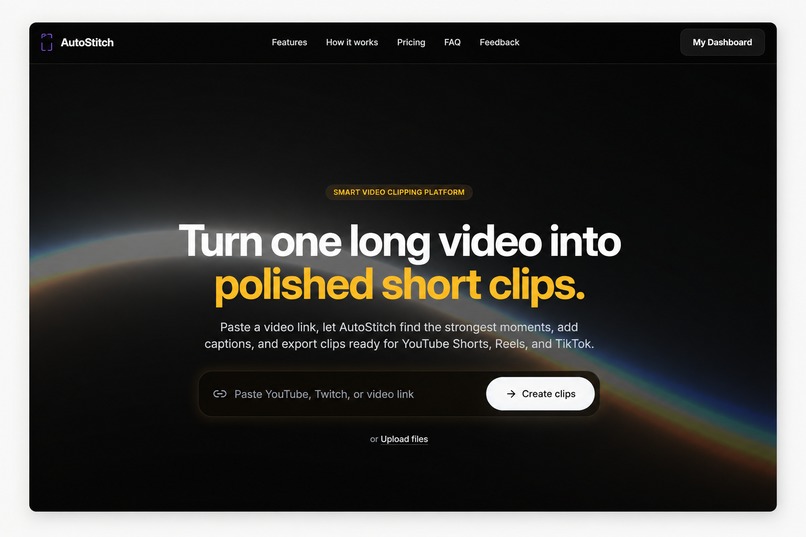
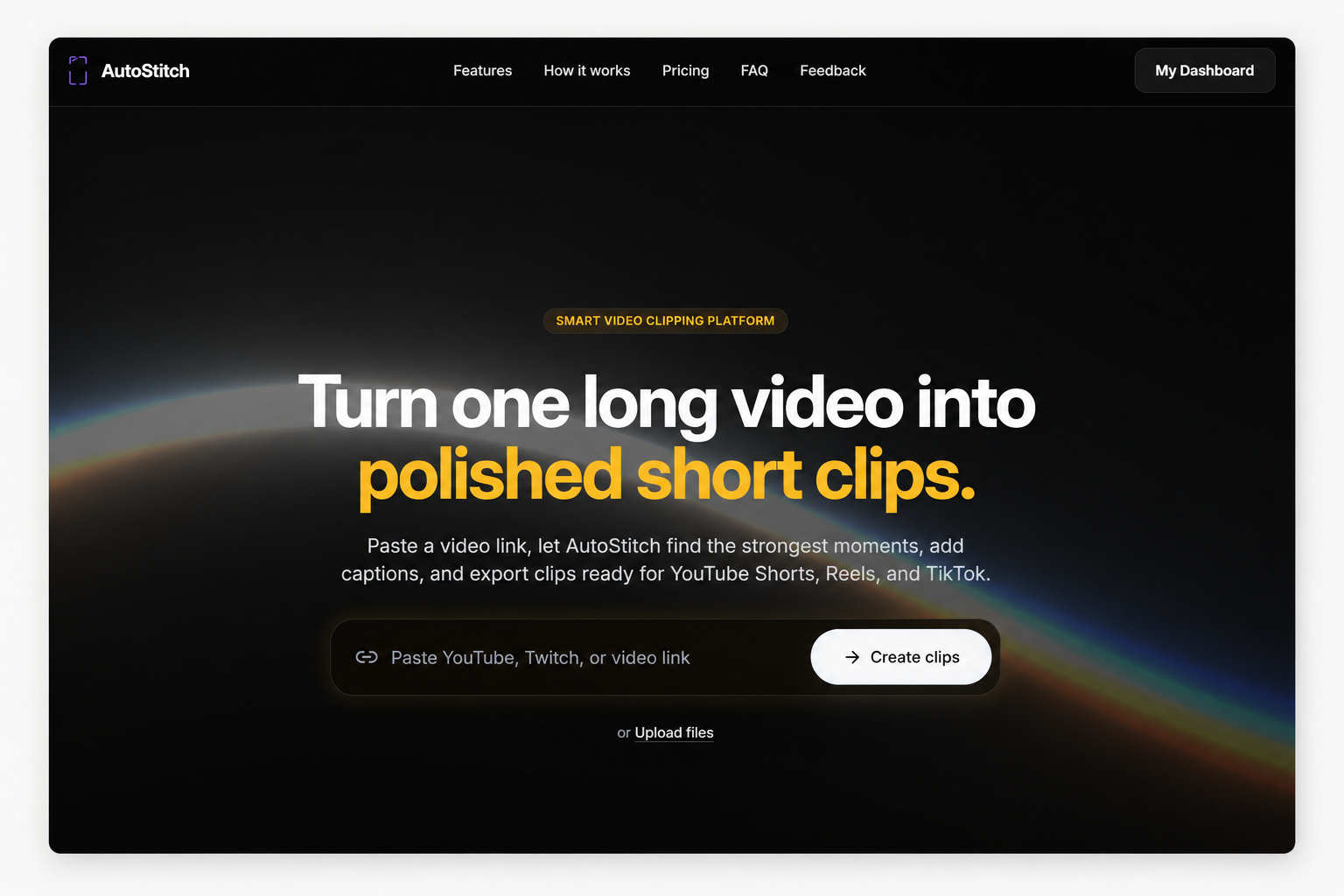
Landing page
-
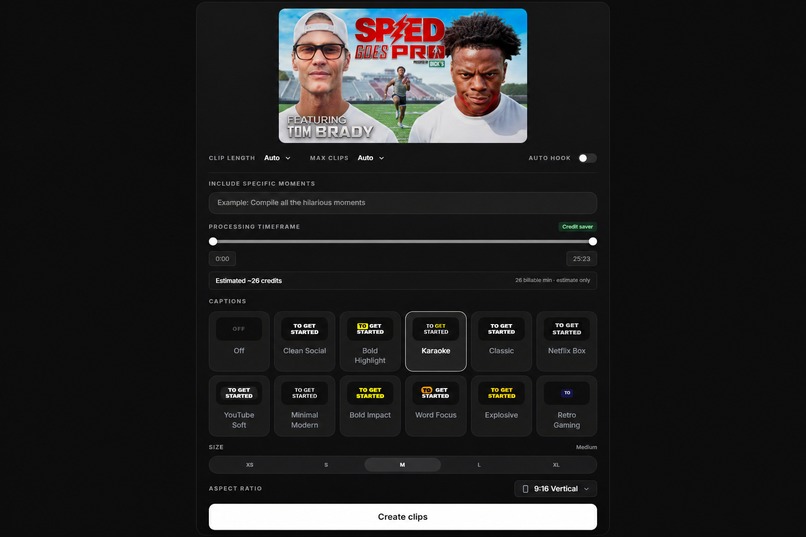
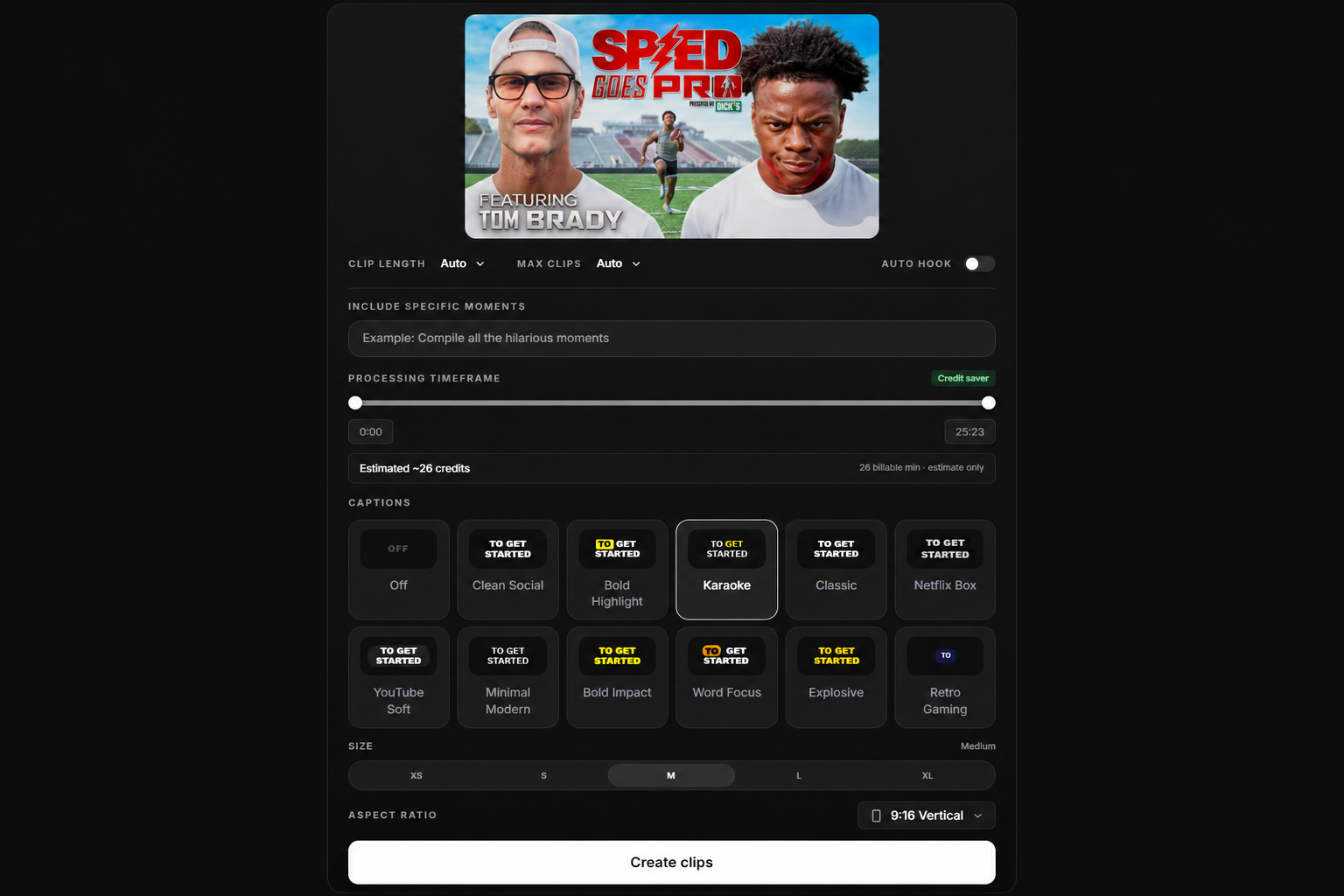
Create clips workflow
-
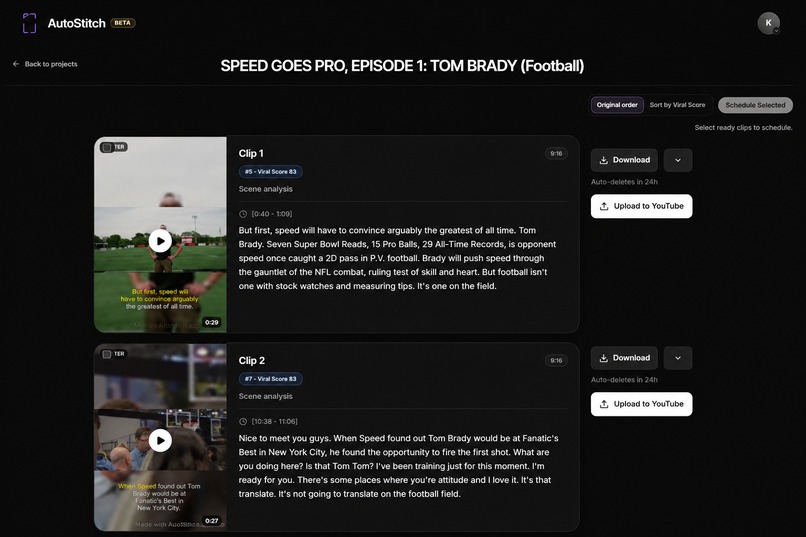
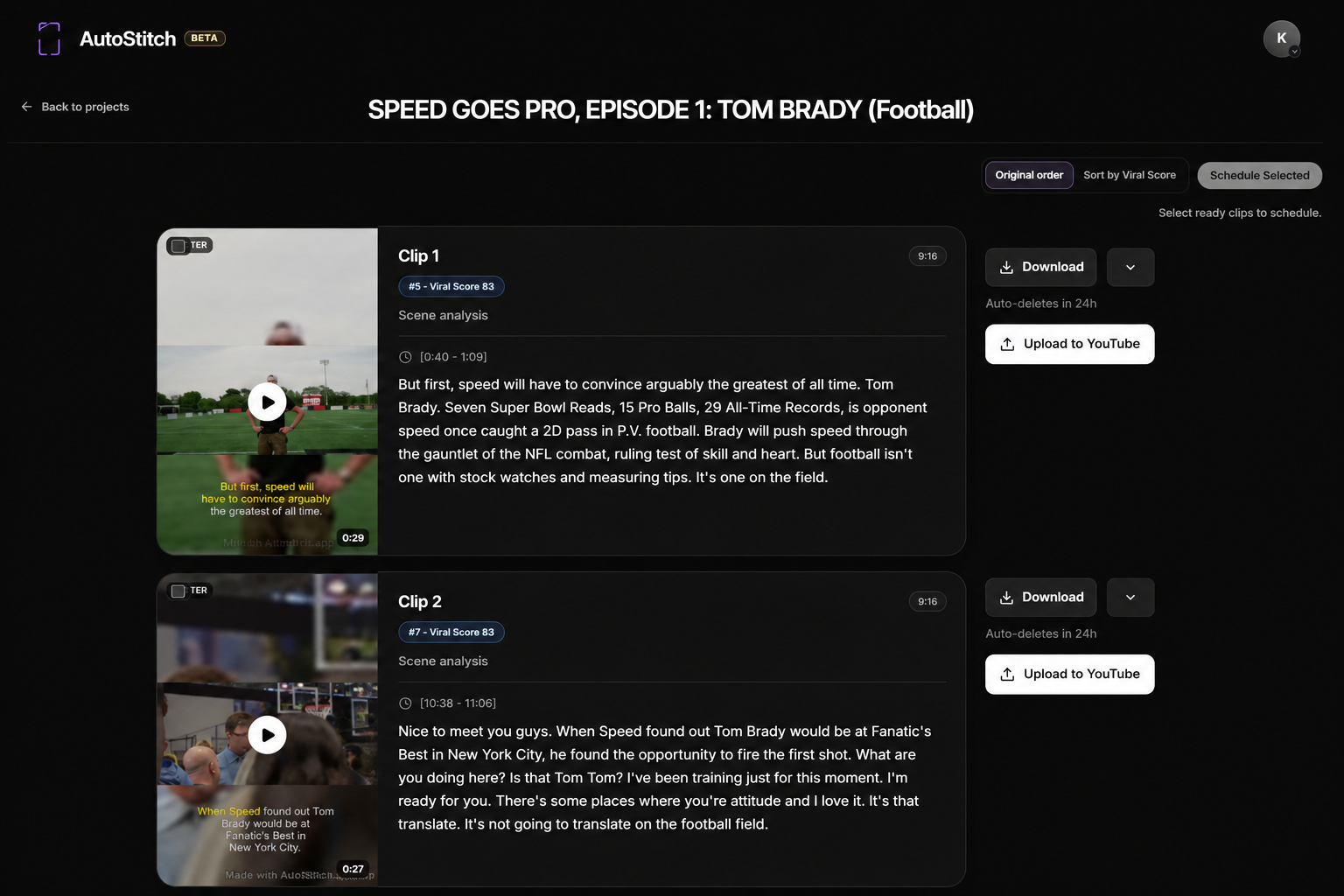
Clip results page
-
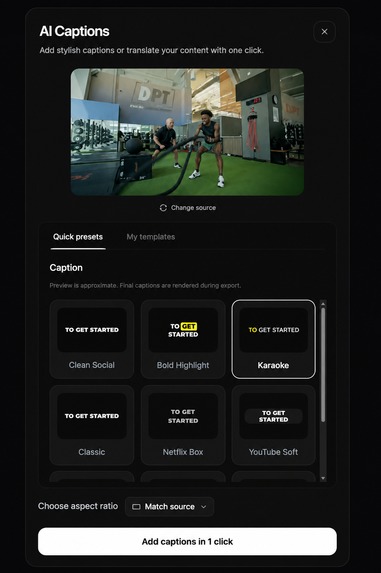
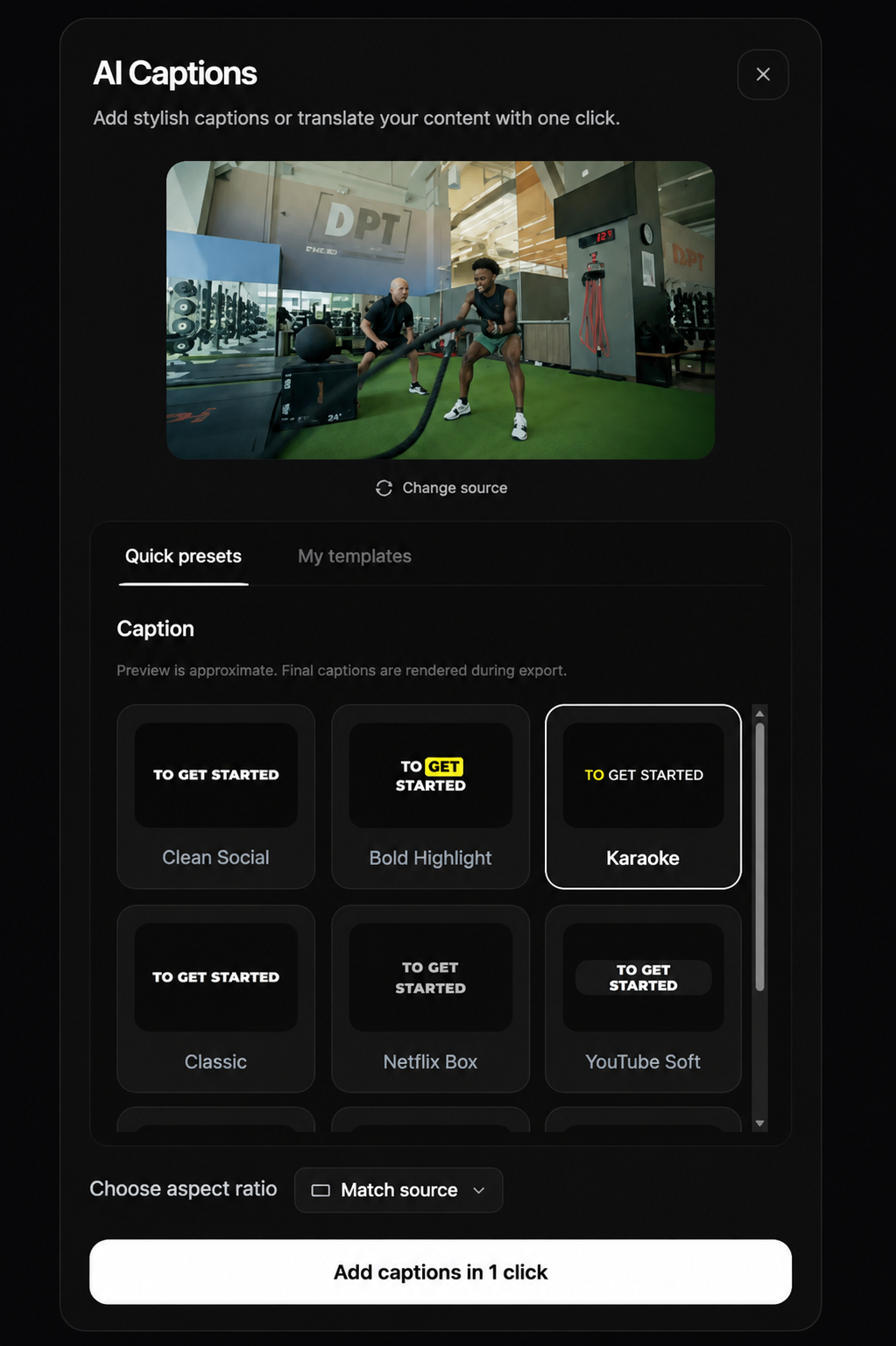
AI Captions
-
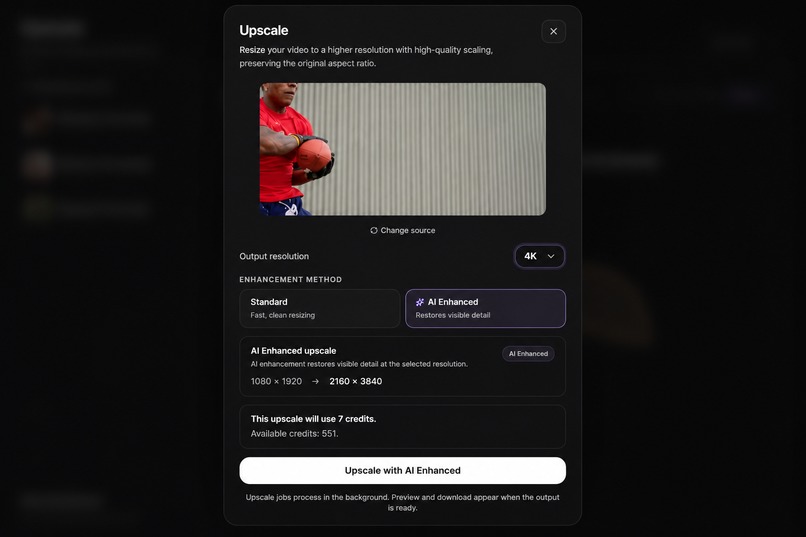
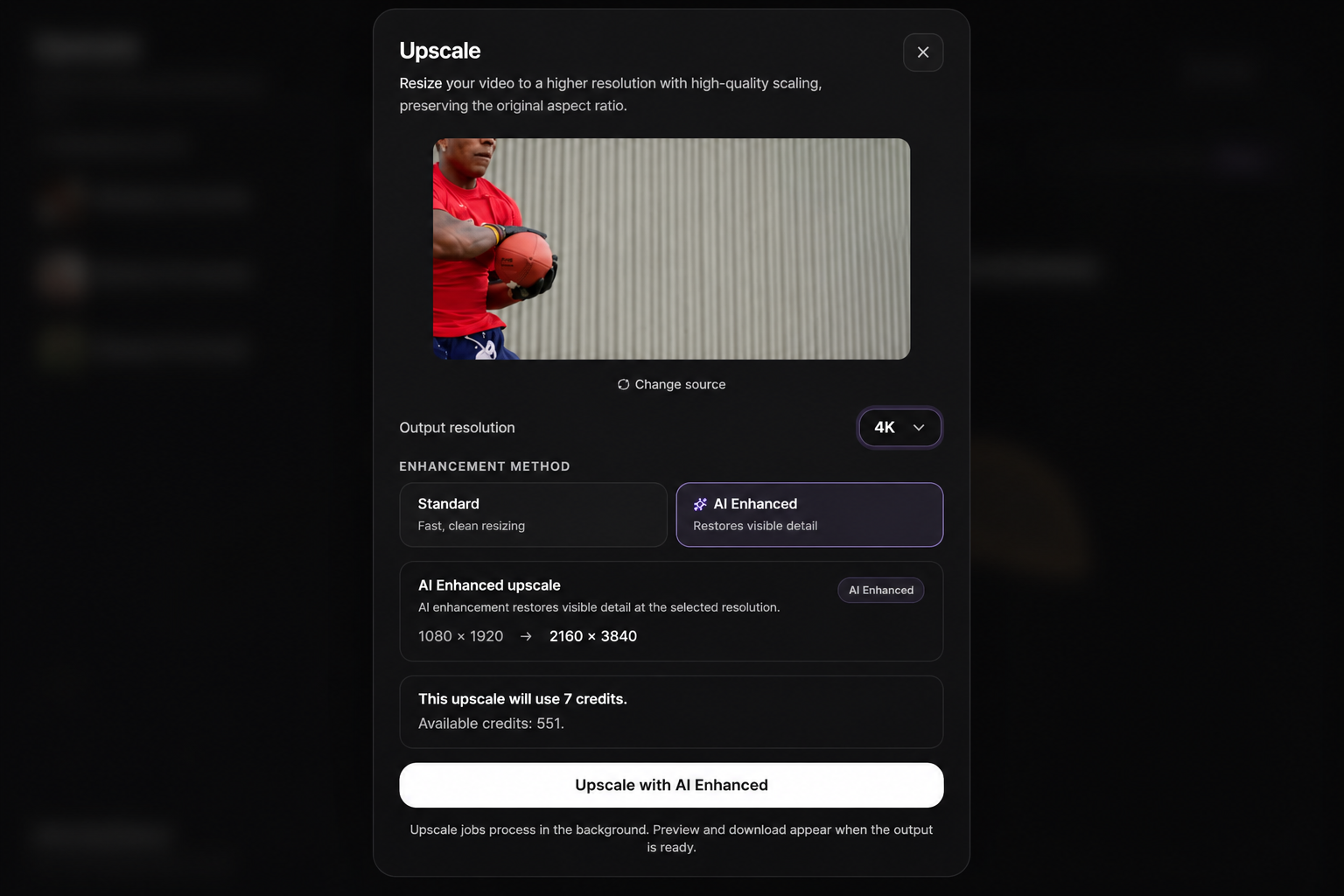
AI Upscale
-
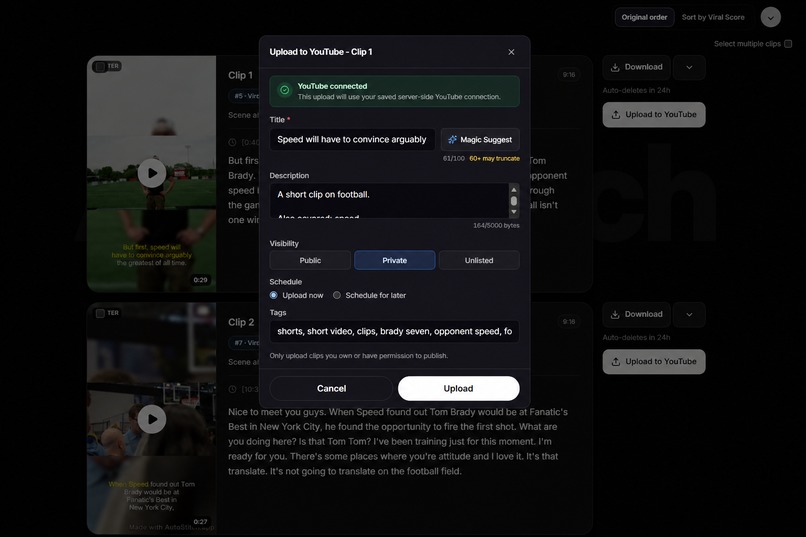
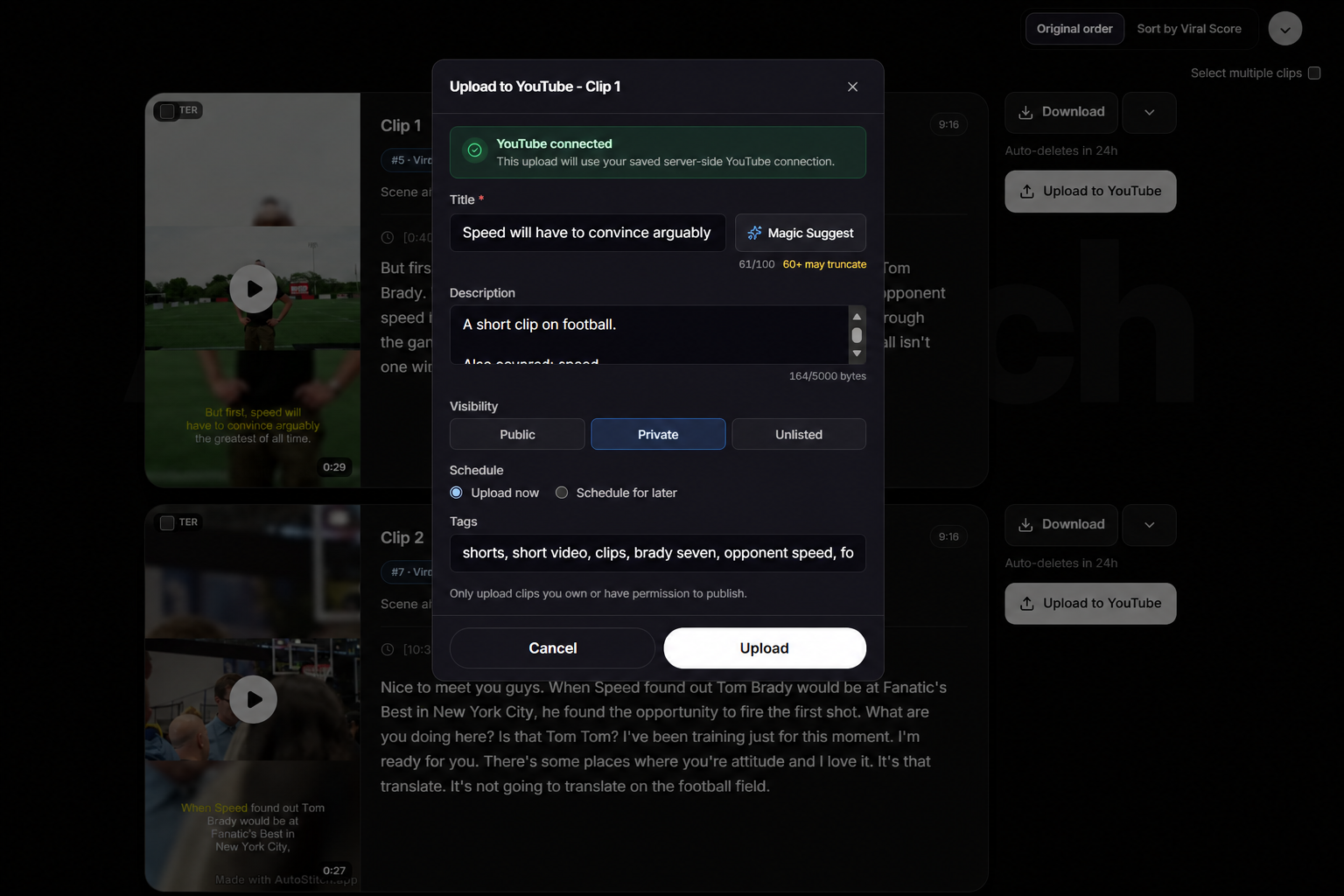
Upload to YouTube
-

Billing / credit packs

Inspiration
Long-form creators already have the content. The difficult part is turning a one-hour podcast, interview, stream, webinar, or tutorial into short videos that are actually ready to post.
When I started looking at automated clipping tools, one problem kept standing out. They could find moments and create vertical clips, but the editing often still felt automated in the wrong way. A conversation could move between speakers, a screen share could become important, or the visual focus could change while the crop stayed almost the same.
That pushed me to build AutoStitch.app.
I wanted to create an AI video editor that does more than cut long videos into smaller pieces. I wanted it to identify strong moments, understand what is happening visually, follow the conversation, generate captions, improve video quality when needed, and give creators an end-to-end workflow with less repetitive work.
I built AutoStitch as a solo project across the frontend, backend, machine learning, computer vision, GPU video processing, billing, testing, and deployment.
The product is live at https://autostitch.app.
What it does
A creator can upload a video or provide a supported video link, then AutoStitch handles most of the repurposing workflow.
I trained a custom machine-learning model to rank candidate moments for short-form potential. The goal is not to promise virality. It is to give creators a stronger starting point by finding moments that are more likely to work as standalone clips.
AutoStitch then combines face tracking, active-speaker information, screen-state analysis, and visual signals to decide how each clip should be framed.
One of the main differences is that the crop can change while the video is playing. If the conversation moves between speakers or important screen content appears, the layout can adapt instead of holding one static crop throughout the clip.
The product also includes:
- AI clipping and ML moment ranking
- speaker-aware Auto Reframe and Zoom
- AI Captions with multiple presets and word-level timing
- transcription
- a manual video editor
- GPU-accelerated AI upscaling and enhancement
- YouTube publishing and scheduling
- uploads and supported video-link ingestion
- authentication, billing, credits, and subscription infrastructure
Users can buy credits based on how much source video they process, and the product also supports recurring subscription plans.
How I built it
The frontend is built with React and TypeScript. A Node.js and Express backend manages product logic, billing, credits, queues, and jobs. Python services handle machine learning and computer vision, while FFmpeg, CUDA, and NVENC handle video processing and GPU-accelerated rendering.
I deliberately separated AI recommendation from final execution.
The ranking model identifies promising moments. The vision pipeline analyzes the scene. The layout system plans the edit. A separate safety layer can reject risky framing decisions, and the rendered result can be checked against the original plan.
If AutoStitch does not have enough confidence in an edit, I would rather have it choose a safer fallback than confidently produce a bad clip.
How I used Gemini and Google Antigravity
AI was also part of how I built the business itself.
I used Gemini for research and ideation, especially when comparing technical approaches, exploring model choices, investigating computer-vision problems, thinking through edge cases, and planning future ML directions.
I did not treat Gemini output as the final engineering answer. I used it to explore more possibilities quickly, then validated the important decisions with code, measurements, tests, and real video.
I also used Google Antigravity as part of my accelerated engineering workflow. As a solo developer, it helped me understand larger areas of the codebase, plan multi-file changes, implement scoped work, debug failures, improve tests, review regressions, and document technical decisions.
My workflow became:
Research -> Plan -> Implement -> Test -> Measure -> Review -> Ship
AI helped me work faster, but I kept responsibility for architecture, validation, and final product decisions.
Challenges I ran into
The hardest problem was not making AI produce one impressive result. It was making the system trustworthy across real videos.
For example, I evaluated person-detection approaches for better multi-person editing. They worked in many cases, but deeper testing showed that a visual detector could confuse a real participant with a photograph, poster, or background image.
Instead of shipping the feature because the demos looked good, I stopped relying on that path until I had stronger evidence.
I learned the same lesson with performance optimization. A lower-resolution analysis approach looked safe on a small test set, but broader testing showed that it changed editing decisions more often than expected.
That taught me that in an AI product, faster is not better if the decisions become less reliable.
What I learned
The biggest lesson was that useful AI needs to know when it might be wrong.
A bad automated edit can make an otherwise strong clip unusable. That is why AutoStitch is built as several specialized systems that challenge and verify one another instead of trusting one model with every decision.
The creator still has final control.
Economic opportunity
I see AutoStitch as infrastructure for creators and small media businesses.
A solo podcaster can produce more content without hiring a full editing team. A small agency can process more client videos without multiplying repetitive editing work. Human editors can spend more time on storytelling, creative direction, branding, and client strategy instead of mechanical cropping, captioning, and exports.
My goal is not to remove people from creative work. It is to give small teams production capacity that previously required more time, money, or staff.
What's next
The next step is to make AutoStitch learn from what happens after a clip is published.
With creator permission, I want to connect editing decisions with real outcomes such as watch time, retention, engagement, shares, and whether the creator actually chose to publish the clip.
That can improve the next generation of the ranking model and eventually support:
- multimodal ranking using transcript, audio, visual, pacing, and speaker signals
- creator-specific editing preferences
- AI-generated clip variants and A/B testing
- an AI editing agent with human review controls
- multilingual localization
- creator and brand opportunities
- creator collaboration and community tools
The long-term loop is simple:
Create -> Publish -> Measure -> Learn -> Personalize -> Improve
My goal is for AutoStitch to become an AI editor that learns what works, learns how each creator prefers to work, and removes more repetitive production effort over time while keeping the creator in control.
Built With
- bullmq
- computer-vision
- cuda
- express.js
- ffmpeg
- gemini-api
- google-antigravity
- google-gemini
- machine-learning
- node.js
- nvenc
- oauth
- onnx-runtime
- postgresql
- python
- react
- redis
- render
- stripe
- typescript
- vercel

Log in or sign up for Devpost to join the conversation.