Inspiration
What it does
Inspiration
Every carmaker, supplier, fleet operator and dealer group must track three things that change weekly:
- vehicle recalls across regulators (NHTSA, EU Safety Gate, DVSA, Transport Canada...);
- regulation changes (UNECE WP.29, EU type-approval, GSR2, Euro 7, the EU Battery Regulation, cybersecurity R155/R156);
- supplier risk (shortages, insolvencies, quality escapes).
Today this is done by people reading regulator websites and newsletters. Items get missed. Defect signals sit in public owner-complaint databases for months before a recall is announced.
A chatbot doesn't solve this. It only answers when asked, has no memory of what you already reviewed, can't check 2,000 VINs, and can't run statistics on official complaint data. I wanted a system that works for a compliance or quality team every day without being asked.
What it does
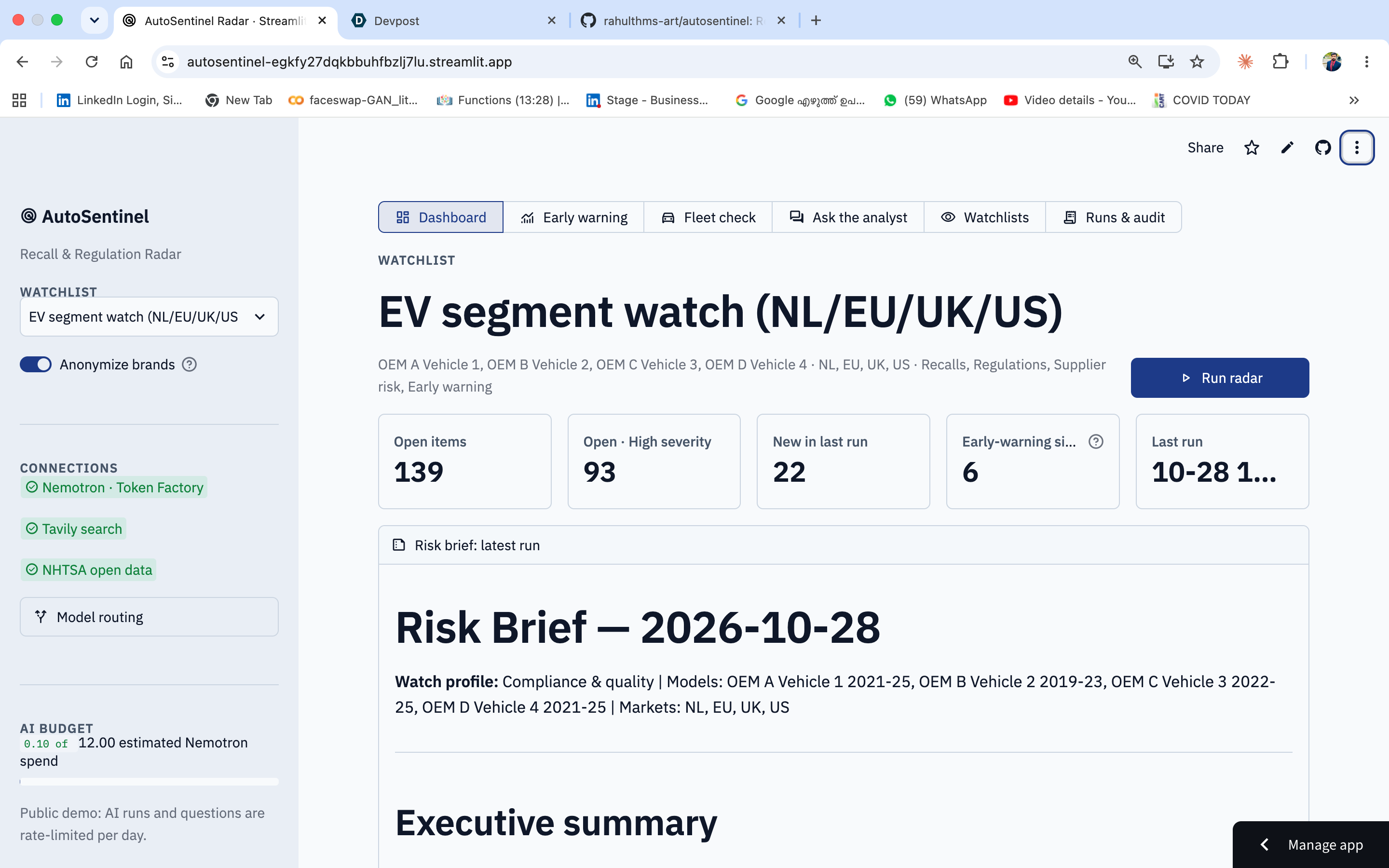
AutoSentinel is an agent platform built around watchlists: vehicles and model years, markets, components and suppliers to watch.
- Radar runs (on demand or scheduled):
- collect official recalls from the RDW recall register (Netherlands) and the NHTSA API (US); Nemotron summarises the Dutch recall texts in English;
- search the web with Tavily, limited to regulator and trade-press domains per market (
ec.europa.eu,eur-lex.europa.eu,unece.org,gov.uk, Transport Canada, Reuters...); - de-duplicate against earlier runs, so the team sees only what is new.
- Triage by Nemotron Nano: relevance score, type, severity, affected scope and a recommended action for every item. Rule-based safety floors (e.g. NHTSA "park outside") cannot be lowered by the model. Irrelevant items are dismissed automatically.
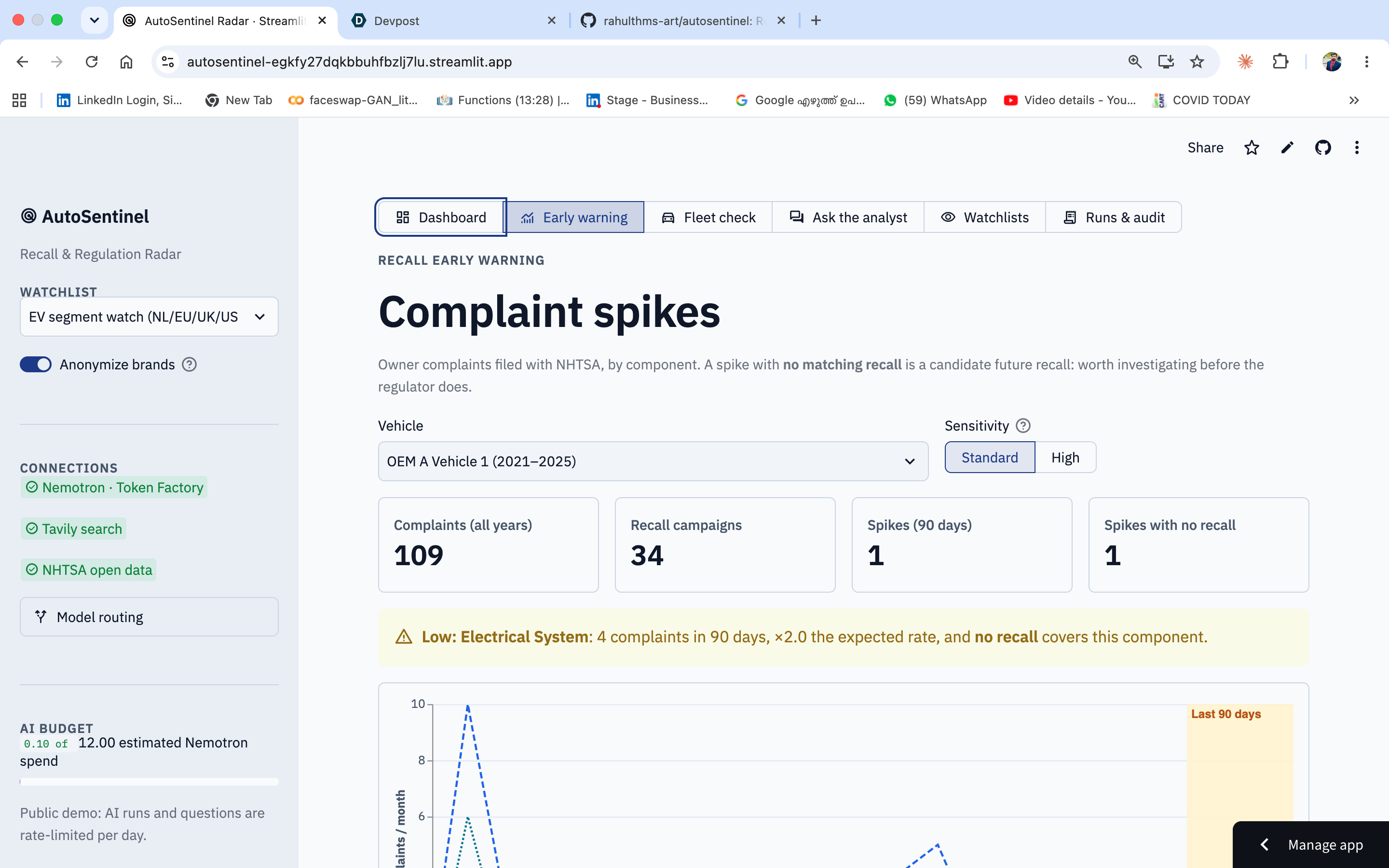
- Recall early warning: detects abnormal spikes in owner complaints per component and flags those with no matching recall. Nemotron Ultra reads the complaints and names the likely failure mode, the risk and the next step. Alerts are ranked Priority / Watch / Low.
- Risk brief by Nemotron Ultra: a cited executive summary, a risk table and a watch list. Every claim links to a finding or signal.
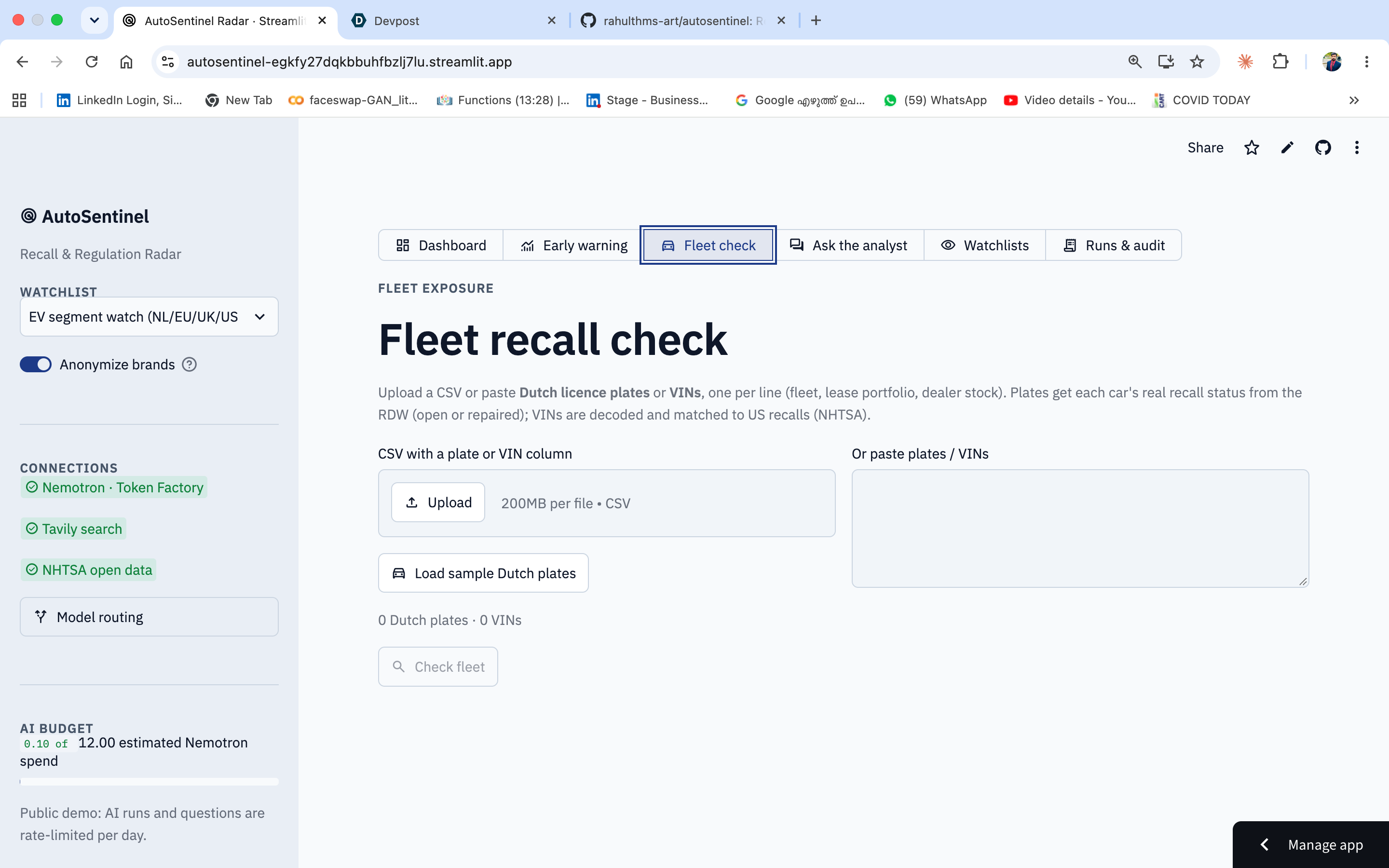
- Fleet check: paste or upload Dutch licence plates to get each car's real recall status from the RDW (open or already repaired), or VINs to match US recalls. A lease company can check thousands of plates in seconds.
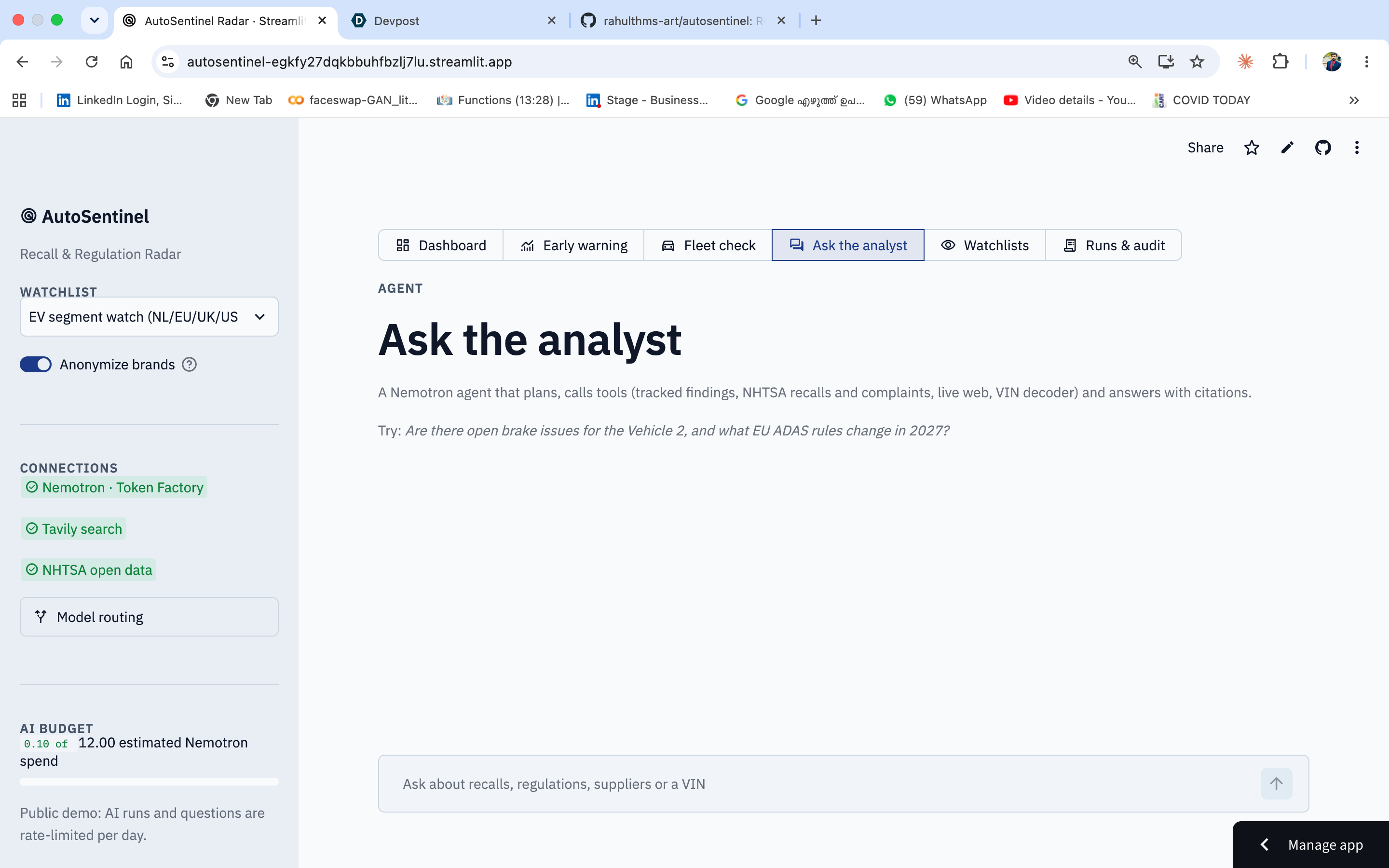
- Ask the Analyst: a tool-using Nemotron agent over the tracked findings, NHTSA recalls and complaints, live web search and a VIN decoder. It cites its sources, and when a recall or regulation doesn't exist it says so rather than inventing one.
- Operations:
- a findings workflow (new ‚Üí acknowledged ‚Üí actioned ‚Üí dismissed);
- Slack/Teams alerts for Priority items;
- a full audit log of every model call (model, latency, tokens, cost);
- a spend budget with a hard stop.
Note on the demo video: it is recorded with AutoSentinel's built-in brand-neutral display mode. Vehicle makes, models, suppliers, VINs and recall reference numbers appear as neutral labels ("OEM A · Vehicle 1"). This avoids showing third-party trademarks and avoids implying anything about named manufacturers. The data and the AI analysis underneath are real public records. The live demo uses the same mode by default.
How we built it
- NVIDIA Nemotron on Nebius Token Factory, using its OpenAI-compatible API, with tiered routing:
- Nemotron 3 Nano for high-volume structured work: search planning and batched triage, run with reasoning switched off (about 16√ó fewer tokens per call);
- Nemotron 3 Ultra for reasoning-heavy work: failure-mode analysis, risk briefs and the multi-step analyst agent.
- A typical radar run makes about 19 model calls and costs about $0.05.
- Tavily for live, domain-restricted research per market. It falls back to trade press only, never the open web.
- RDW open data (Netherlands): the recall register, recall status per licence plate, and the national vehicle register.
- NHTSA open data (US): recalls, owner complaints and VIN decoding. US complaints act as an early signal for global platforms, since no European regulator publishes complaints.
- Python + Streamlit + SQLite, with a headless job runner (
python -m jobs.run_watchlists) for cron or Nebius Serverless Jobs, GitHub Actions CI and Docker. - Reliability engineering:
- every triage verdict is validated: it must align with its item and be non-empty, and anything skipped is retried, first in smaller batches, then with reasoning on;
- the agent uses a portable JSON tool protocol;
- interrupted runs are detected and marked;
- every model call is budget-checked before it is made.
Measured accuracy (reproducible: python -m evals.run_evals, python -m evals.backtest)
| Area | Result |
|---|---|
| Triage: relevance, severity, type (3 repeated runs) | 115/117 (98%) |
| Analyst: factual answers vs NHTSA | 12/12 |
| Analyst: refuses to invent non-existent recalls or rules | 9/9 |
| Brief citations that point to real sources | 38/38 |
| Fleet check vs NHTSA | 7/7 |
| Early-warning backtest (16 vehicles, 354 recalls, about 25,800 complaints, tuned on 8 vehicles, reported on 8 held out) | 27% of recalls flagged up to 120 days early (original detector: 17%). Priority alerts were followed by a recall 22% of the time, about 2√ó the base rate and 5√ó the "Low" tier |
Challenges we ran into
- Data plumbing that silently broke matching. NHTSA writes commas inside category names ("SERVICE BRAKES, HYDRAULIC"), so brake and fuel recalls never matched complaints. Driver-assist recalls are filed under "ELECTRICAL SYSTEM:ADAS". Fixing the taxonomy did more for accuracy than any model or threshold change.
- Nano reliability with reasoning off. Our evaluation caught Nano returning lazy or misaligned JSON in roughly 1 in 3 batches, including a 10/10 relevance score on an aviation story. Alignment checks plus a reasoning-on retry fixed it, and accuracy over 3 runs reached 98%.
- Honest evaluation. Several ideas did not improve the held-out backtest: a Poisson significance gate, a fleet-growth adjustment, and a Nemotron screen of the complaint text, which called most spikes "strong". We measured and dropped them instead of shipping them.
- Cost control for a public demo, which led to the priced audit log, the hard budget stop, daily limits and a preloaded demo snapshot.
Accomplishments that we're proud of
- An end-to-end product, not a notebook: watchlists, a workflow, alerts, an audit log, budgets, tests and CI.
- A recall early-warning signal validated on held-out vehicles, with honest numbers.
- Cited, checkable AI output with zero invented citations in our evaluation.
- A brand-neutral display mode, so it can be demoed and shared safely.
What we learned
- In compliance AI, data plumbing and evaluation matter more than prompts.
- Tiered model routing (Nano for volume, Ultra for judgment) gives quality and low cost at the same time.
- Measure, then keep only what survives a held-out test.
What's next
- More EU structured recall feeds (EU Safety Gate, KBA, DVSA) alongside RDW and NHTSA.
- Scheduled radar runs on Nebius Serverless Jobs and serving through Serverless Endpoints.
- Using a company's own data (warranty claims, field reports) for far stronger early-warning signals.
- Multi-team deployment (Postgres, single sign-on, roles).
Built during the hackathon
AutoSentinel was created from scratch during the Submission Period (October 2026). It did not exist before.
Try it
- Live demo: https://autosentinel-egkfy27dqkbbuhfbzlj7lu.streamlit.app (brand-neutral by default; Early Warning and Fleet Check work instantly, AI runs are rate-limited per day)
- Code (MIT): https://github.com/rahulthms-art/autosentinel

Log in or sign up for Devpost to join the conversation.