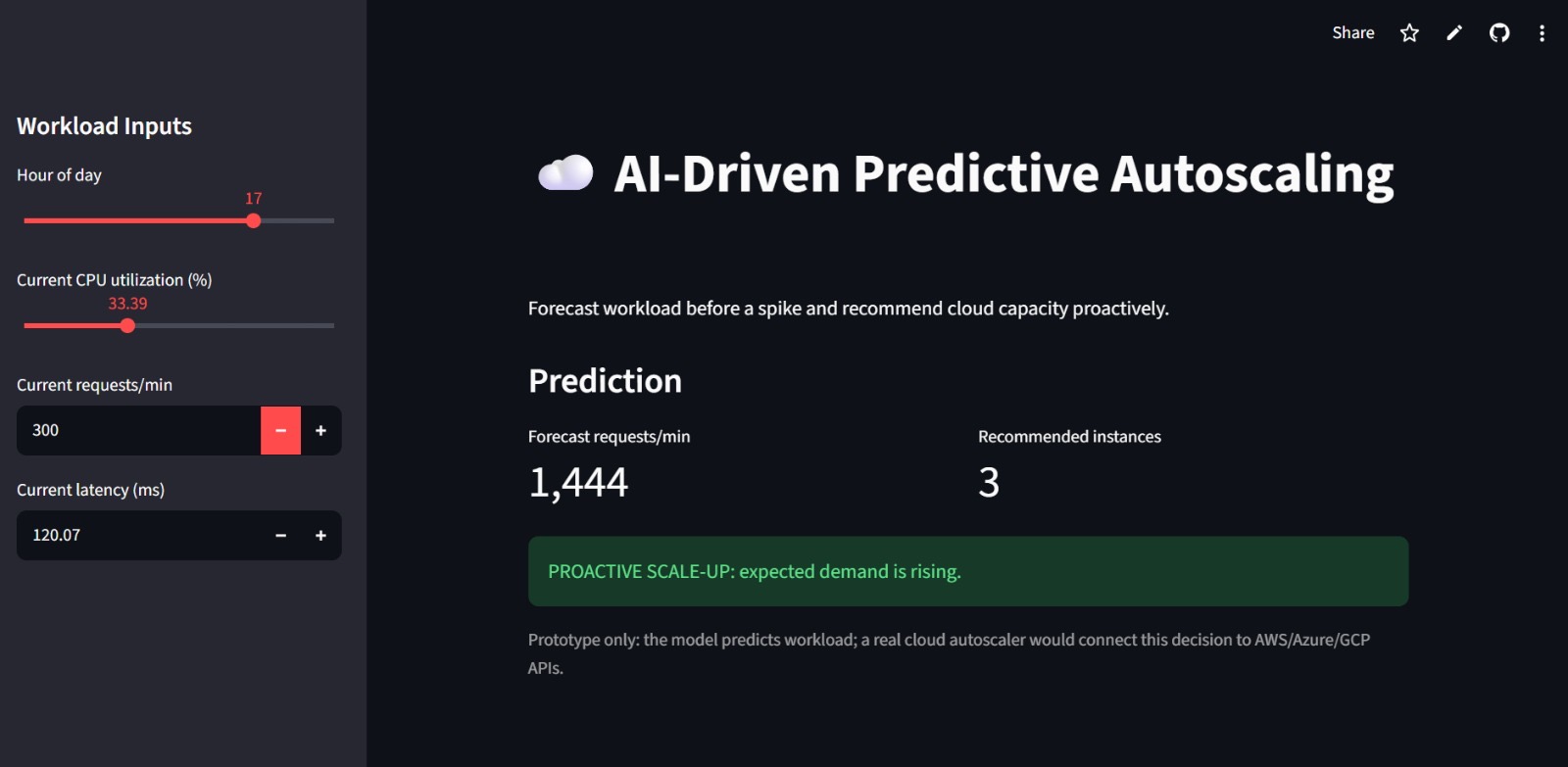
Inspiration Traditional cloud infrastructure relies on reactive autoscaling—waiting until CPU or memory metrics cross a threshold before taking action. This delay leads to latency spikes, SLA violations, and expensive over-provisioning during lower demand. We wanted to build a solution that transforms cloud operations from reactive management into predictive resource allocation. What it does AutoScaleIQ is an AI-driven cloud management platform that continuously monitors system telemetry and forecasts workload demands before spikes occur. Key capabilities include: Predictive Autoscaling: Pre-provisions resources ahead of traffic surges to prevent performance bottlenecks. Smart Load Balancing & Scheduling: Dynamically places workloads across cloud nodes to optimize cluster throughput. Cost & Energy Optimization: Consolidates underutilized capacity to lower cloud spending and carbon emissions. Proactive Fault Prevention: Analyzes telemetry trends to identify potential system failures before they cause downtime. How we built it We engineered an autonomous feedback loop consisting of four core components:
- Telemetry Pipeline: Collects real-time and historical compute metrics (CPU, memory, latency, and traffic patterns).
- AI Forecast Engine: Runs time-series ML models to project future workload demand.
- Decision Engine: Evaluates forecasts against resource policies to determine scaling and scheduling actions.
- Cloud Integration Layer: Automatically executes instance provisioning and workload rebalancing across cloud instances. Challenges we ran into Model Drift: Fine-tuning AI models to maintain high prediction accuracy as workload patterns change over time. Handling Sudden Traffic Anomalies: Designing safeguards to minimize the impact of prediction errors or unexpected spikes. Data Quality: Cleaning and processing noisy telemetry metrics without adding latency to the prediction loop. Accomplishments that we're proud of Built a continuous feedback loop that achieves proactive scaling while outperforming static threshold rules. Demonstrated measurable reductions in cloud costs and idle server capacity without sacrificing SLA compliance. Seamlessly combined forecasting, dynamic scheduling, and policy-driven automation into a single cohesive workflow. What we learned Shifting from reactive threshold rules (e.g., scaling after (CPU> 70%) to predictive AI models significantly reduces service latency and operational risk. A continuous telemetry feedback loop is essential for self-optimizing, adaptive cloud systems. What's next for AutoScaleIQ Integrating Deep Reinforcement Learning (DRL) for multi-objective, dynamic workload scheduling. Enhancing anomaly detection and fault prediction models to preempt hardware failures. Advancing toward fully autonomous, self-healing, and self-optimizing cloud infrastructure.

Log in or sign up for Devpost to join the conversation.