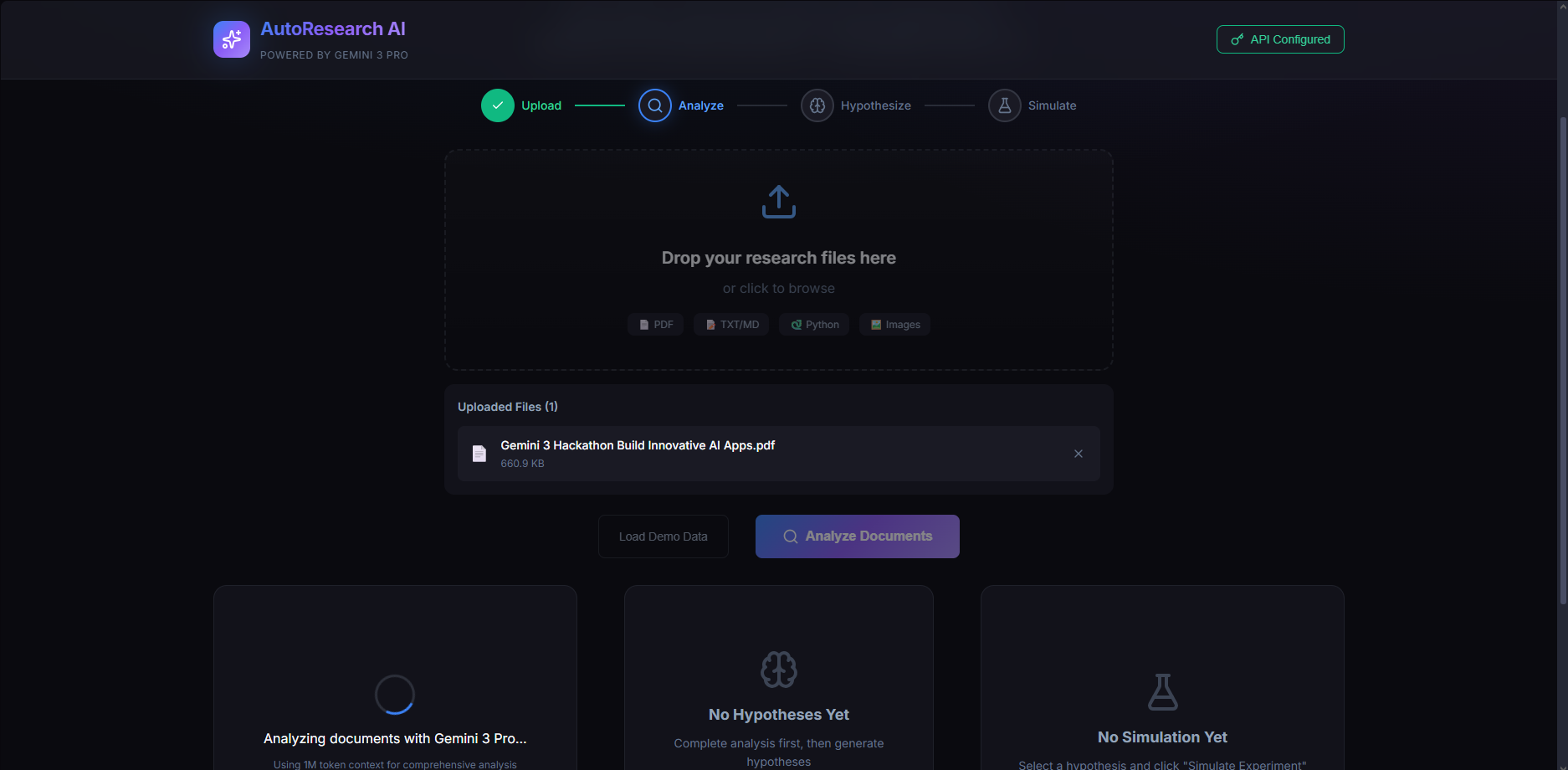
Inspiration
I built Auto Research AI to harness the full power of Gemini 3 Pro and redefine what autonomous research can achieve. At its core, the system uses Gemini’s massive 1 million token context window to process entire codebases and thousands of pages of scientific literature. This allows me to enable deep contextual reasoning that traditional models simply cannot reach. With this capability, AutoResearch AI can:
- Generate hypotheses
- Design experiments
- Run simulations all without human intervention.
What I Learned
During this project, I learned how to fully leverage Gemini 3’s advanced features:
- Long-context reasoning to handle entire codebases and large datasets.
- The use of Thought Signatures and Thinking Levels to maintain continuity across multi-step workflows.
- Multimodal analysis to interpret text, diagrams, and structured data.
- The critical role of orchestration layers in managing autonomous workflows.
- How to design verification loops using Vibe Engineering to ensure the system’s reliability.
How I Built It
- Frontend: I built the user interface in Google AI Studio for easy interaction.
- Core Engine: I integrated the Gemini 3 API to power reasoning and hypothesis generation.
- Simulation Layer: I developed a Python-based engine to run experiments and validate results.
- Architecture: [User Interface] → [Orchestration Layer] → [Gemini 3 API | Simulation Engine | Data Storage]
Challenges I Faced
- Managing autonomy: Designing a system that can run for hours or even days without any human intervention was challenging.
- Context handling: Efficiently using the 1 million token window to process large datasets required careful prompt engineering and system design.
- Verification: Building robust self-correction loops to prevent cascading errors was complex but essential.
- Integration: Seamlessly combining multimodal reasoning with simulation workflows required thoughtful architecture and testing
Built With
- antigravity
- gemini-3-pro

Log in or sign up for Devpost to join the conversation.