-
-
Dashboard
Inspiration
Radioligand therapies already cure some cancers, yet each new one is discovered slowly and by hand, because it means optimizing a targeting molecule, a chelator, and a radioactive isotope together while the isotope decays. Three things have changed: frontier models can now reason about chemistry, self-driving labs are real, and theranostics gives a built-in feedback signal. I wanted to find out whether an autonomous research loop could be turned loose on molecules.
What it does
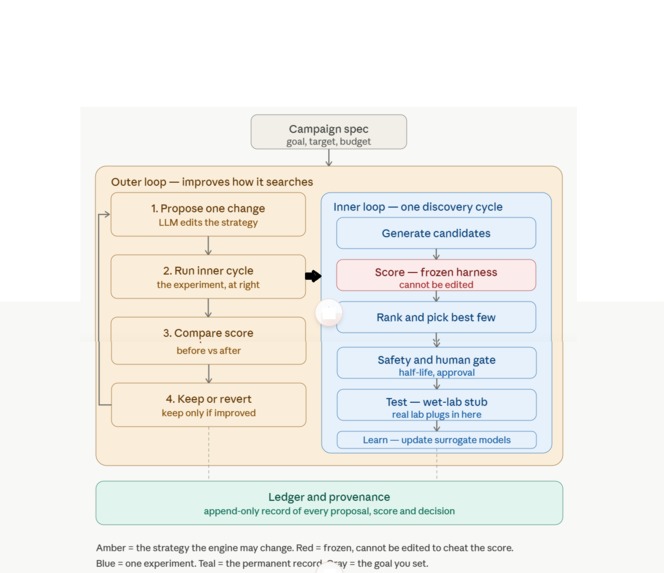
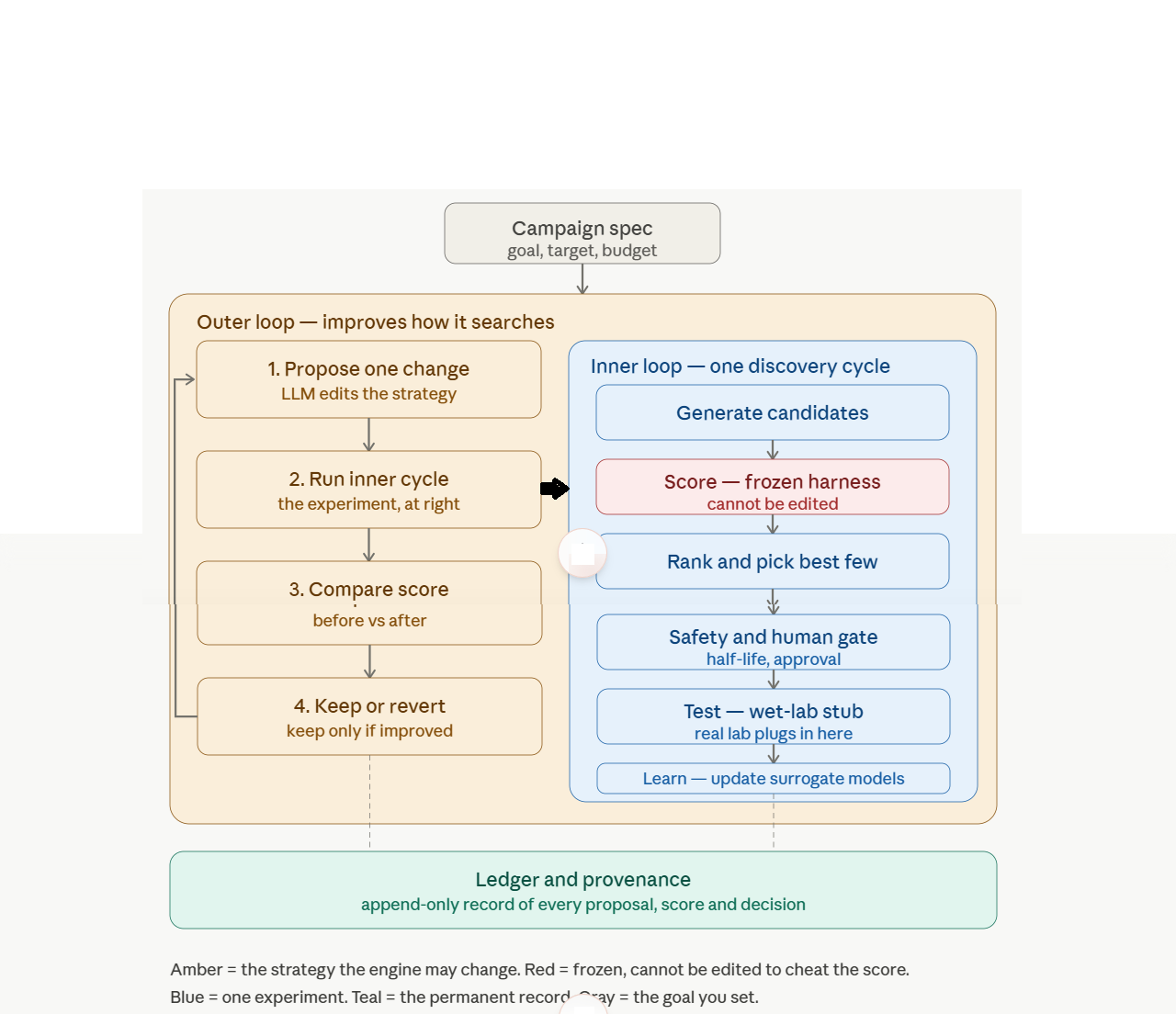
AutoRadionuclide is an AI-native discovery engine for radioligand cancer therapies. It proposes candidate constructs, scores them against several objectives at once, decides which are worth making and testing next, and learns from each result, recording every decision in a replayable ledger. It runs two nested loops. An inner loop proposes, scores, and ranks molecules. An outer loop improves the search strategy itself, keeping a change only when it raises the score and reverting it otherwise. A live dashboard shows a real recorded run.
How we built it
The engine is Python, with a model-agnostic interface and a deterministic mock provider so it runs offline. It uses RDKit for molecular features, Gaussian-process surrogates for prediction, and an append-only SQLite ledger for provenance. The evaluation harness is frozen so the engine cannot improve its own grade by editing the test. The dashboard is Next.js and Tailwind on Vercel, rendering a static export of a real run. The whole thing was built with Claude Code. https://github.com/alessoh/AutoRadionuclide PREPRINT: https://www.researchgate.net/publication/405356766_AutoRadionuclide_An_AI-Native_Closed-Loop_Discovery_Engine_for_Radioligand_Therapies_with_In-Silico_Evaluation?channel=doi&linkId=6a179ce6354c5b070065bd19&showFulltext=true
Challenges we ran into
Public radioligand data is scarce, so we refused to fabricate chemical structures and kept anything unverifiable as honest fallbacks. The candidate generator initially ignored each campaign's building blocks, so runs quietly fell back to zeros. The reporting mixed stale runs together. And standard molecular descriptors do not capture the metal coordination at the heart of a radioligand, which we had to state plainly rather than paper over.
Accomplishments that we're proud of
A working closed loop with provenance and integrity guards, a real approved agent featurized to full quality, the outer loop visibly keeping and reverting strategy changes, 216 passing tests, and a live demo, all built without overclaiming a single result.
What we learned
The loop was the easy part. The hard part is data. Freezing the evaluation harness prevents self-deception, flat and reverted results are real signal rather than failure, and in-silico scoring cannot yet beat experts without real measurements.
What's next for AutoRadionuclide
Replace the heuristic scoring with models trained on real data, grow the benchmark from public trial and approval records, and partner with a wet lab, an isotope supplier, and national-lab chemists to feed the loop genuine measurements and finally close it.
Built With
- anthropic-claude
- claude-code
- fastapi
- gaussian-processes
- github
- next.js
- numpy
- pydantic
- python
- rdkit
- react
- scikit-learn
- sqlite
- tailwindcss
- typescript
- vercel

Log in or sign up for Devpost to join the conversation.