-
-
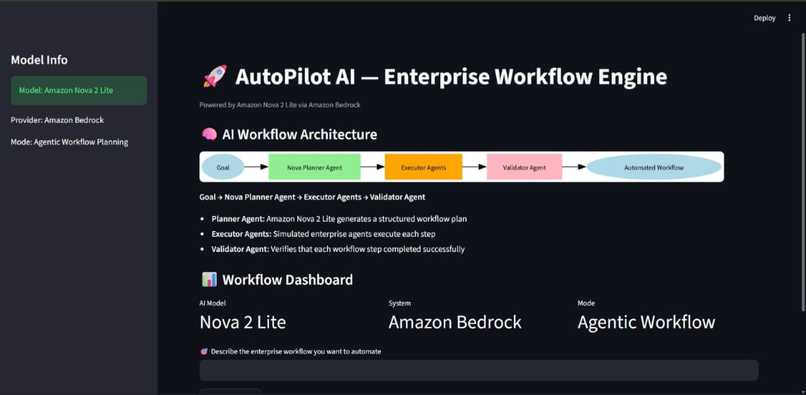
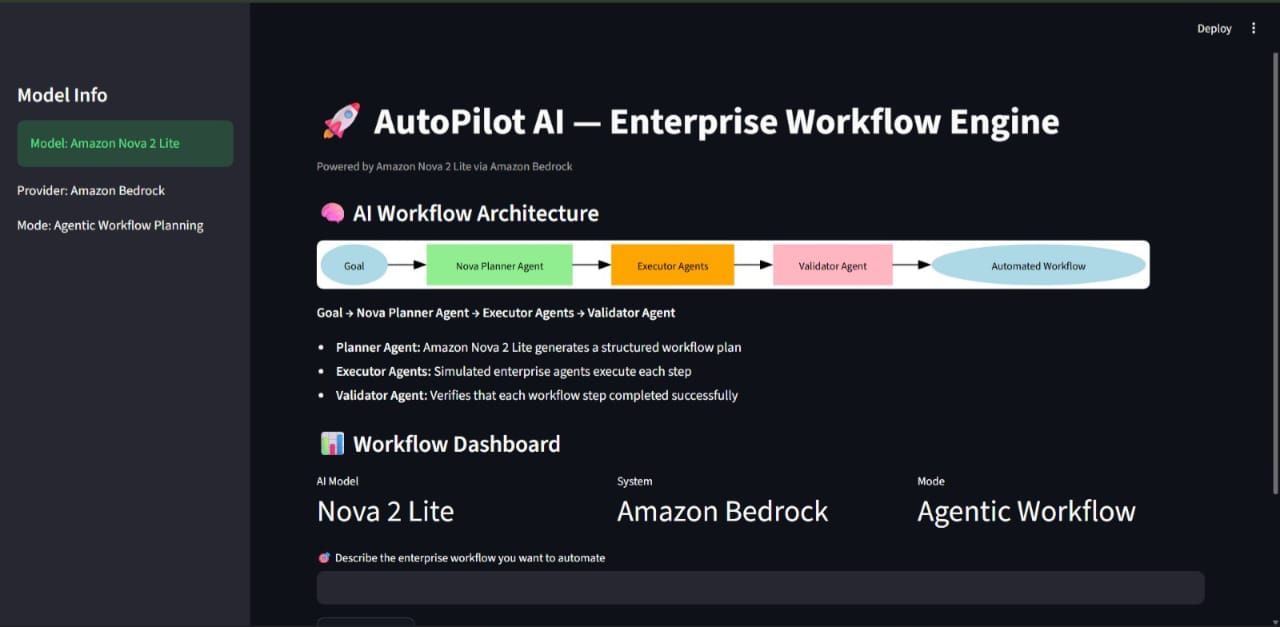
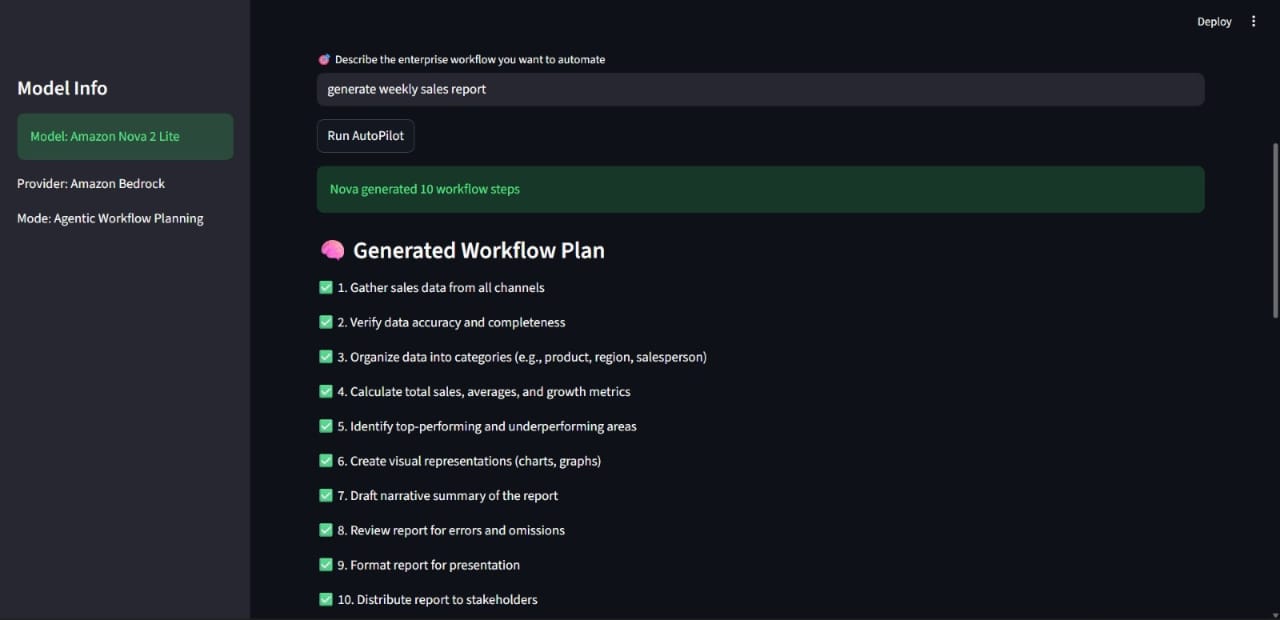
AutoPilot AI interface where users enter enterprise workflow goals.
-
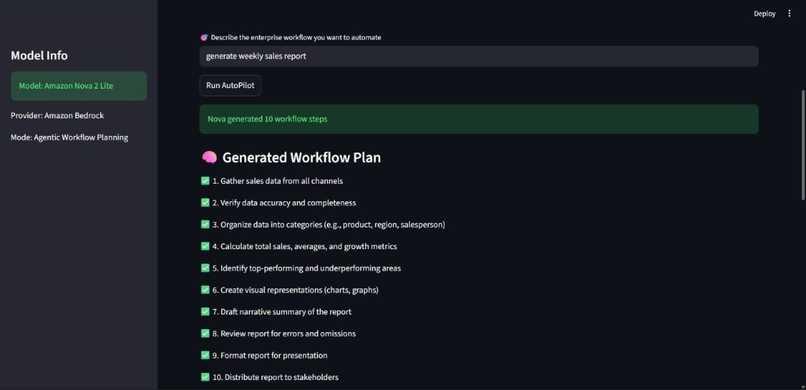
Amazon Nova generating a structured workflow plan from a user goal.
-
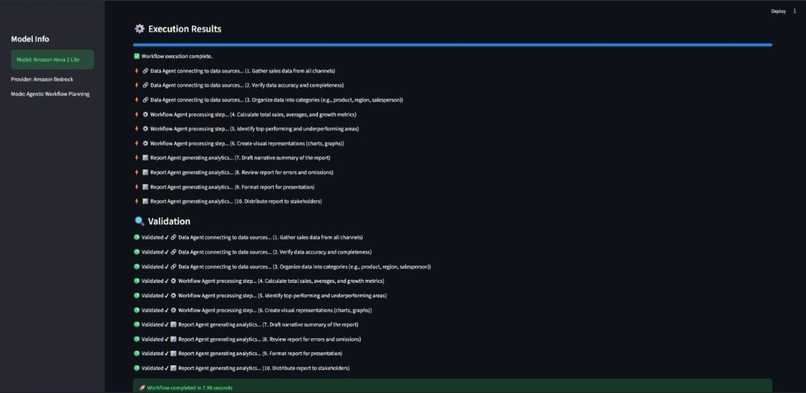
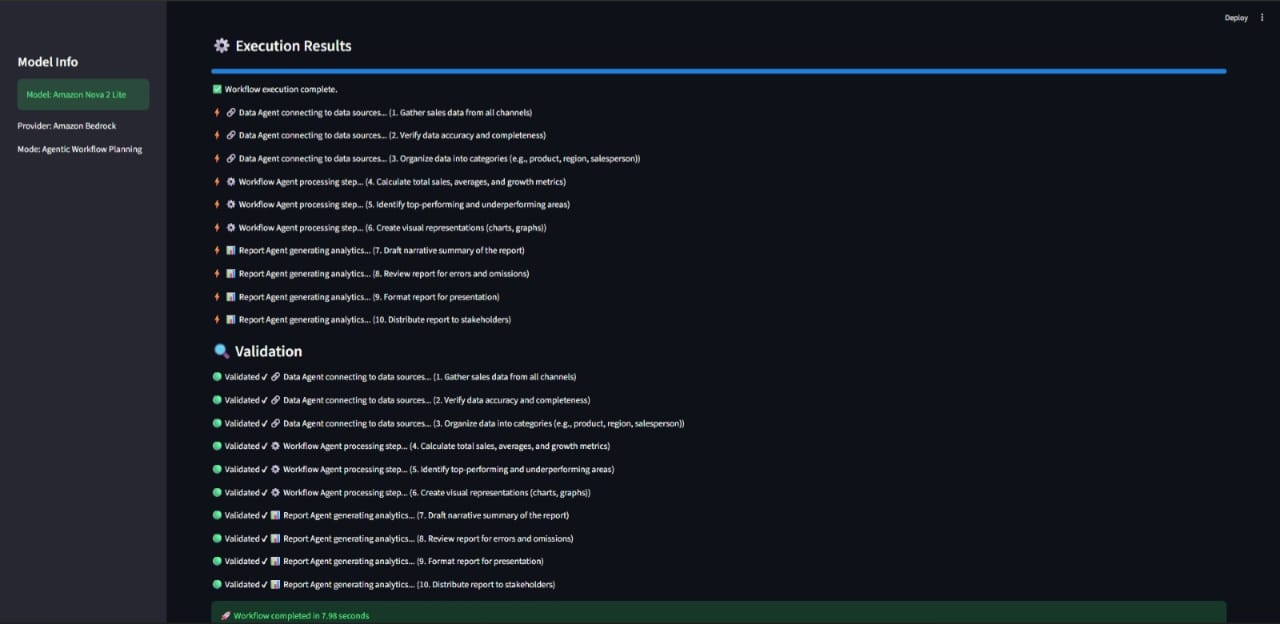
Executor agents running workflow steps and validator confirming completion.
Inspiration
Enterprise workflows may consist of several steps like gathering data, processing the data, preparing reports, checking the results, and finally sharing the results. These enterprise workflows in most organizations are still done manually or through some automated process that requires a lot of engineering.
The concept of AutoPilot AI was to see if an AI system could be used to automatically transform a high-level business goal into a workflow. With the use of Amazon Nova, the system is able to interpret a goal such as “Generate weekly sales report” and automatically create the steps involved in performing the task.
What it does
AutoPilot AI is an autonomous enterprise workflow engine.
Users simply describe a goal, such as: "Generate weekly sales report"
The system then:
- Uses Amazon Nova 2 Lite to generate a structured workflow plan
- Executes each workflow step using specialized execution agents
- Validates the outputs to ensure the workflow completed successfully The system transforms a high-level objective into a fully executed workflow pipeline.
How we built it
AutoPilot AI is built using a modular agent-based architecture.
The workflow is divided into three major components:
Planner Agent
Powered by Amazon Nova 2 Lite through Amazon Bedrock.
This agent converts a high-level goal into structured workflow steps.
Executor Agents
Simulated enterprise agents that execute each step in the workflow such as retrieving data, generating reports, or processing information.
Validator Agent
Ensures that each step was executed successfully and verifies workflow completion.
The interface was built using Streamlit, allowing users to interact with the workflow engine through a simple UI.
Challenges we ran into
One of the biggest challenges was to make sure that the steps of the workflow were produced in a consistent and structured manner by the AI. Since large language models have the capability of producing unstructured text, it was necessary to design the prompt in such a way that the response was a clean numbered workflow. Another challenge was to design the architecture in such a way that the steps of workflow planning, execution, and validation were well-separated. This made it easier to maintain the system.
Accomplishments that we're proud of
We successfully built a working prototype that demonstrates how Amazon Nova can act as the intelligence layer of an enterprise workflow engine.
The system is capable of:
• Converting high-level goals into structured workflows
• Executing each step through specialized agents
• Validating the results of the workflow
This demonstrates the potential of agentic AI systems for real-world enterprise automation.
What we learned
This project highlighted the importance of combining AI reasoning with system architecture. Amazon Nova proved effective for transforming high-level goals into structured plans, which can then be executed by specialized agents. We also learned how multi-agent architectures can enable AI systems to orchestrate complex workflows instead of only generating text responses.
What's next for AutoPilot AI: Autonomous Enterprise Workflow Engine
Future improvements could include:
• Integration with real enterprise APIs and data systems
• Autonomous monitoring of workflows
• Dynamic agent creation based on workflow complexity
• Multi-model orchestration for specialized tasks
The long-term vision is to create an AI-powered workflow orchestration platform where businesses can automate complex operational processes simply by describing their goals.
Built With
- ai-agents
- amazon-bedrock
- amazon-nova-2-lite
- python
- streamlit
- workflow

Log in or sign up for Devpost to join the conversation.