-
-
AutoParkX by Team TechXel
-
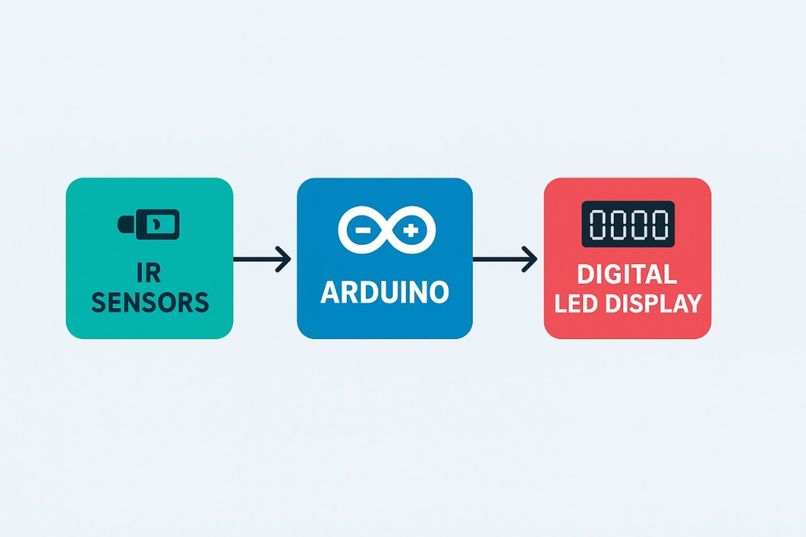
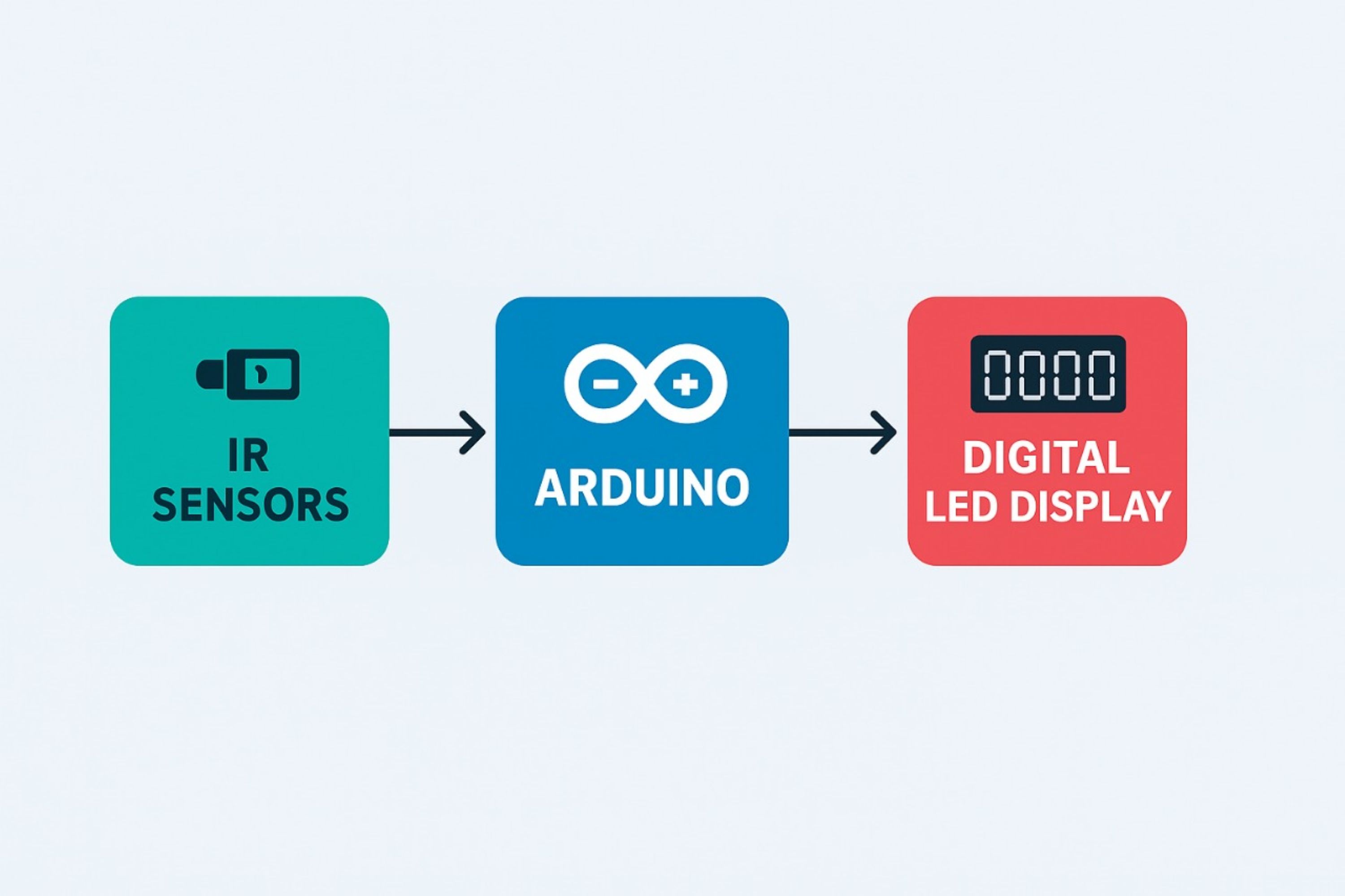
working flow of AutoParkX
-
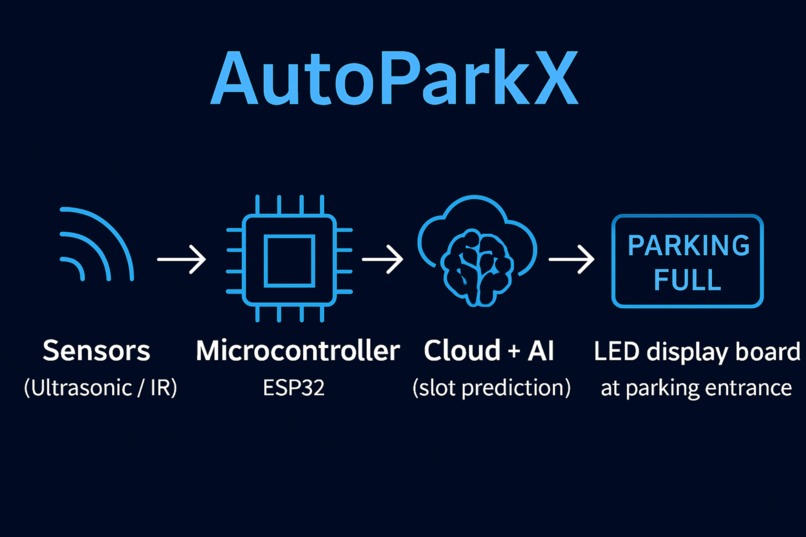
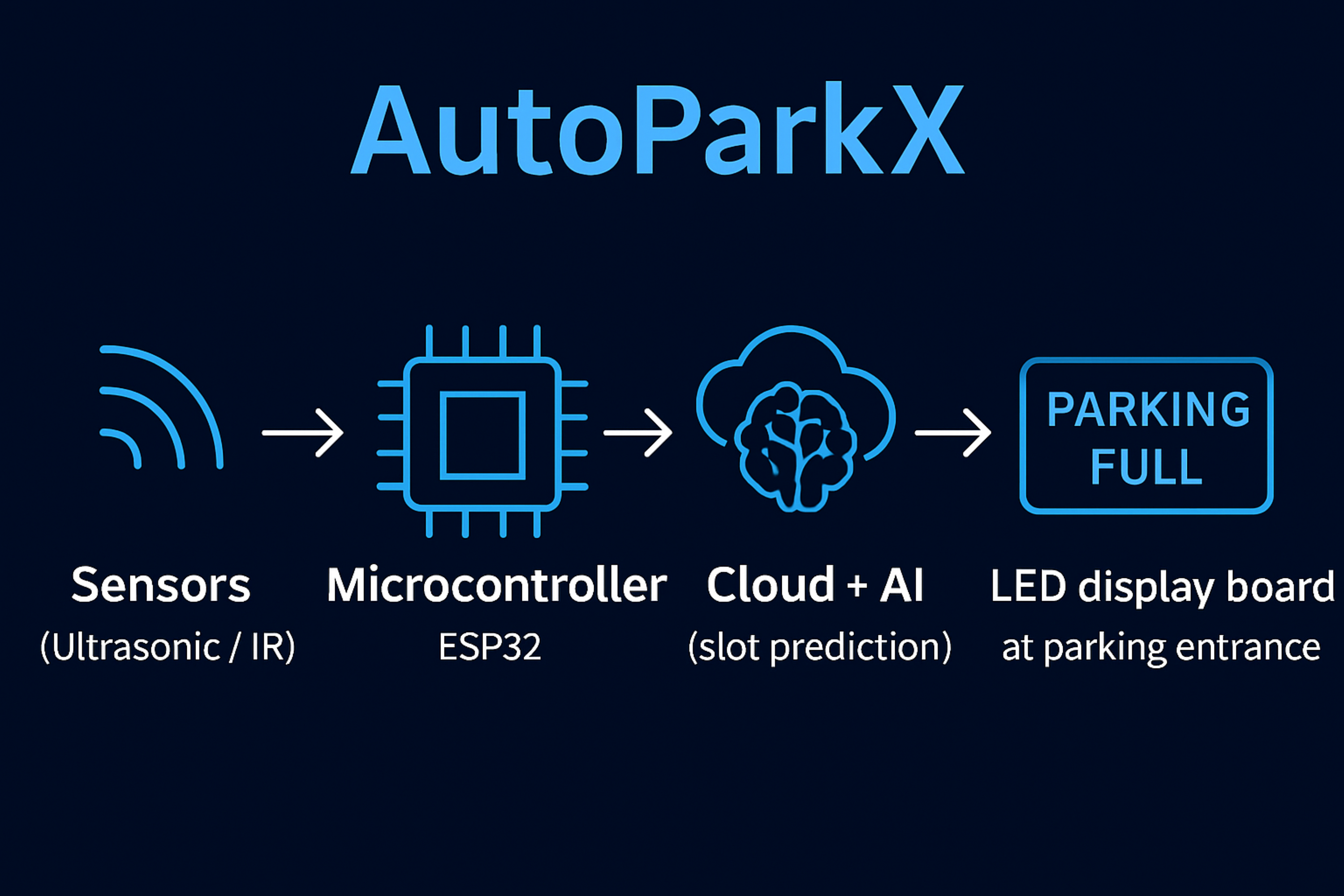
Future implementation flow of AutoParkX
Inspiration 🌟
Parking is one of the most common daily frustrations. People enter parking lots without knowing if space is available — wasting time, fuel, and causing mini traffic jams. For suppose, during a weekend visit to a mall, we notice drivers entering blindly, security guards manually signaling “full/empty”, cars circling inside while people get stressed.
We realized: There’s a board that says "Parking", but nothing that says "Parking Full / Available" before entering.
We wanted to design a solution that solves this before the driver even enters the parking space.
And then came the spark —
What if parking status was visible right at the entrance?
What if the system could predict future availability using AI?
That single thought became AutoParkX.
What it does 🚗
AutoParkX is an IoT-based smart parking status display system that:
- Detects whether a vehicle is present or absent in the slot by sensing the reflected IR signal.
- Receives occupancy status from each IR sensor and processes it using Arduino microcontroller.
- Displays real-time availability of parking slots to incoming drivers on an LCD board at the entrance, helping them find a free spot quickly.
🔌➡ 📟 ➡ 📱🖥
How we built it 🔧
Hardware components:
AutoparkX uses an Arduino microcontroller, ultrasonic/IR sensors, and a digital LED display to showcase real-time parking slot availability.
The workflow:
- Sensors detect whether each parking slot is occupied or free.
- Arduino collects data from all sensors.
- Data is sent to a local server or cloud platform (if implemented).
- Display board at the entrance shows: - Number of empty slots - Parking status: Full / Available
We also planned an AI-powered extension:
- Using historical occupancy data to predict peak hours using regression models : $$ y=mx+c $$
- Future enhancement: mobile app alerts in real-time.
Software Tools:
- Arduino IDE for programming Arduino
- C/C++ for firmware development
- Markdown + LaTeX formatting for documentation
Challenges we ran into ⚠️
| Challenge | How We Solved It |
|---|---|
| Couldn’t find ESP32 hardware | Simulated the prototype and documented future implementation |
| Sensors gave unstable readings | Tuned sensitivity using potentiometer |
| Too many wires & connections | Switched to I2C → reduced pins (16 pins → 4 pins) |
| Hackathon time constraints | Prioritized core feature: display at entrance |
Accomplishments that we're proud of 🏆
- Built a working IoT-based smart parking prototype using sensors + microcontroller + LCD display.
- Successfully detected vehicles and updated slot count in real-time.
- Designed a compact, low-cost architecture that can be scaled to apartments, malls, and offices.
- Converted a simple idea into a functional solution that reduces time, fuel, and congestion.
- Learned how to integrate hardware + software + display systems in a single project.
- Created future scope with AI prediction, cloud connectivity, and mobile notifications.
- Developed a clear technical diagram and pitch deck showcasing end-to-end workflow.
What we learned 📚
- Integration of IoT + electronics + software.
- Working with real-time data and microcontroller communication.
- Basics of AI predictive modeling.
- How to convert a raw idea into a functional MVP prototype.
What's next for AutoParkX 🚀
- Build mobile app for viewing and notifying slot availability and direction to the empty slot.
- Add QR code-based slot reservation.
- AI prediction of free slots using cloud analytics
- Increasing scalability from apartments → campuses → malls → cities
Built With
- ai(planned)
- apis(future)
- arduino
- c/c++
- cloud(planned)
- esp32-(future-scope)
- firebase-(planned)
- iot
- latex
- liquidcrystal-i2c.h
- machine-learning
- markdown
- servo.h


Log in or sign up for Devpost to join the conversation.