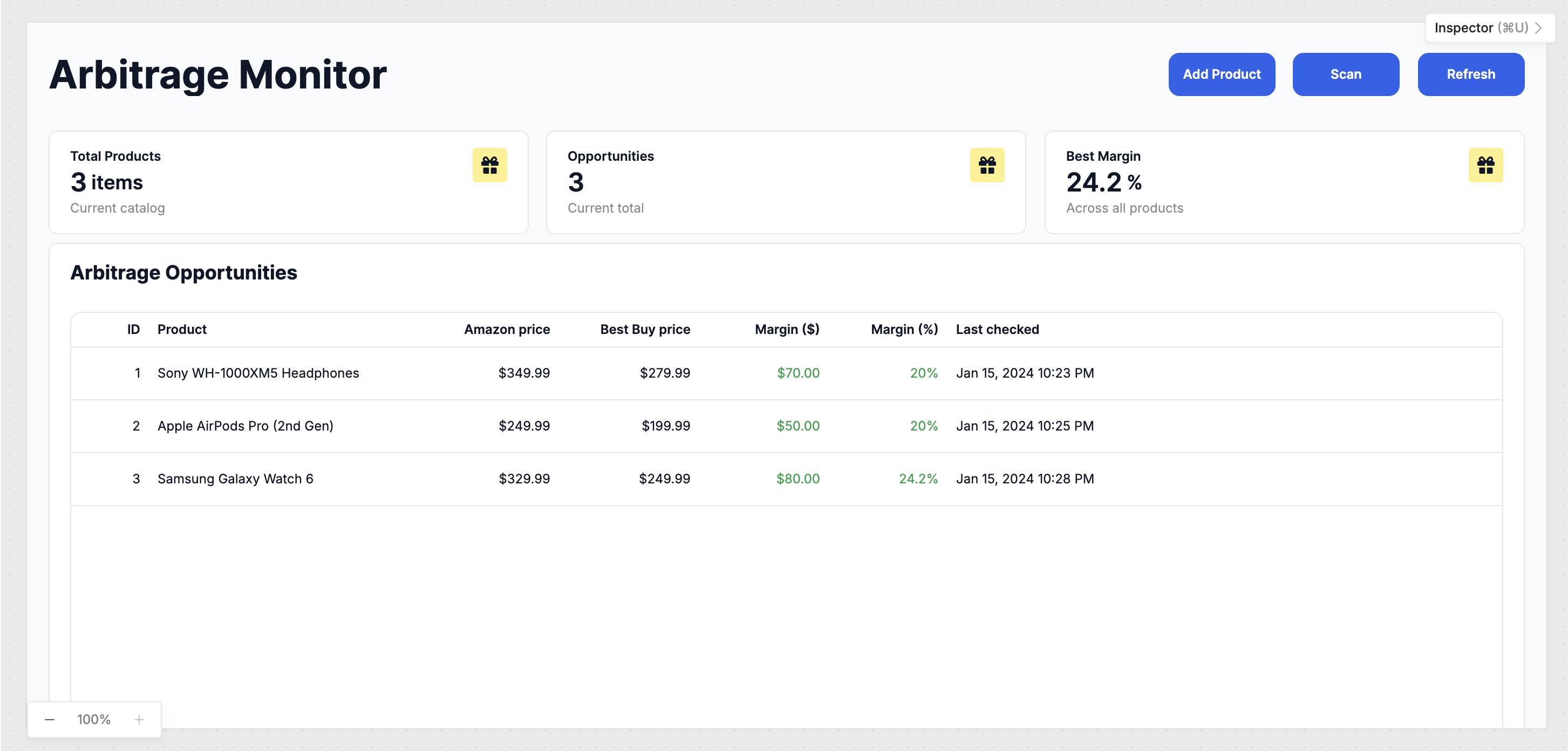
The Genesis of the Arbitrage Agent
The inspiration for the Autonomous Price Arbitrage Finder came from a simple observation: the "Buy Low, Sell High" mantra is easy to understand but incredibly difficult to execute manually. In the hyper-volatile world of e-commerce, a $10 profit margin on a consumer electronic can vanish in minutes. I wanted to build a system that didn't just track prices, but hunted them.
How I Built It
The architecture focuses on event-driven autonomy. Most scrapers run on rigid schedules, which means they are almost always looking at stale data. I built this pipeline to be reactive:
- The Trigger: I used Yutori as the "nervous system." It monitors specific SKUs and only alerts my FastAPI backend via webhooks when a price actually changes.
- The Intelligence: Once triggered, the backend dispatches TinyFish agents. TinyFish acts as the "eyes," navigating complex DOM structures on Amazon and Best Buy to extract clean, structured JSON.
- The Interface: I used Retool to build a command center that visualizes the spread and allows for quick management of tracked products.
The Math of Profit
To ensure the agent only surfaces viable deals, the backend calculates the Arbitrage Spread ($S$) using the following logic:
$$S = (P_{sale} - F_{platform}) - (P_{buy} + C_{ship})$$
Where:
- $P_{sale}$: Current listing price on the target marketplace.
- $F_{platform}$: Estimated referral and fulfillment fees (typically $\approx 15\%$).
- $P_{buy}$: Lowest price detected by TinyFish.
- $C_{ship}$: Calculated shipping cost.
Challenges Faced
The biggest hurdle was anti-bot mitigation. Major retailers employ sophisticated blocks against scrapers. Initially, my backend was flagged immediately. By offloading the heavy lifting to TinyFish, I leveraged their residential proxy rotation and browser fingerprinting, allowing the agent to "blend in" as a normal shopper.
Another challenge was data normalization. Amazon might list a price as $1,299.00, while Best Buy uses different HTML tags or currency symbols. I implemented a robust cleaning service within the FastAPI models to ensure the mathematical calculations remained precise.
What I Learned
This project taught me that latency is the enemy of arbitrage. By moving from a polling architecture to a webhook-based architecture, I reduced the "detection-to-data" window by over 80%. It’s a testament to how small, specialized AI tools—Yutori for monitoring, TinyFish for extraction, and Retool for visualization—can be orchestrated to perform complex market analysis at scale with zero human intervention.
Built With
- fastapi
- python
- retool
- tinyfish
- yutori

Log in or sign up for Devpost to join the conversation.