-
-
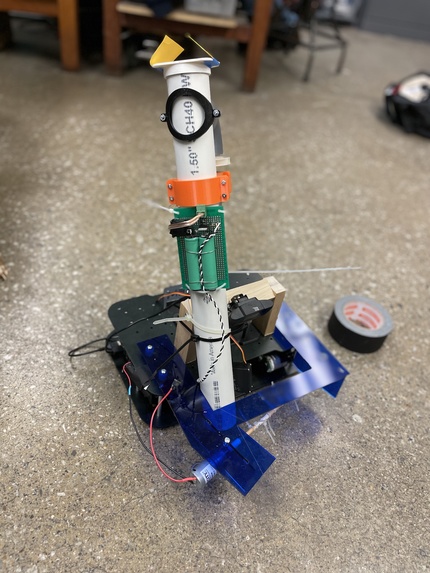
The Back of the Robot
-

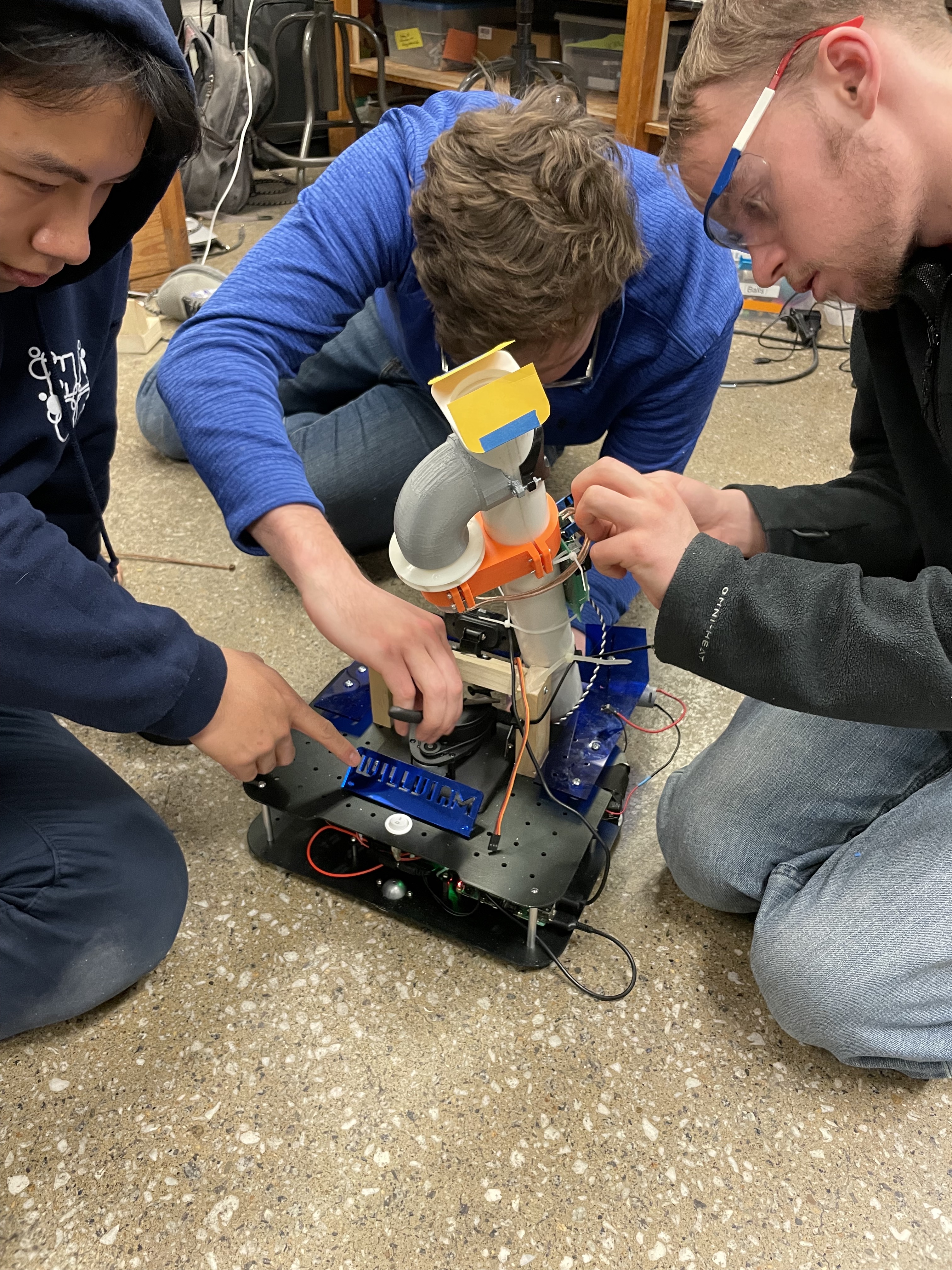
Us working on the front of the robot

Inspiration:
We love playing ping pong, but one of the worst parts is having to pick up the balls after they've fallen on the floor. We wanted to combine our love for robotics and our love for ping pong to create a ping pong recovery robot.
What it does
We wanted this robot to autonomously navigate on the floor. It uses computer vision object recognition to find the ping pong balls. We use an onboard camera to identify what objects are around it and the robot is then able to drive to the ball using a basic bang bang control scheme. We created a feeder system to intake the balls and finally, we created a vacuum pump launcher to launch the balls in the air.
How we built it
The drivetrain of the robot was created with the Viam base. We worked for countless hours trying to get it set up and configure it to be used. There were lots of technical difficulties, but eventually we figured it out. We coded python scripts to run the computer vision code and drive the robot. The intake system was created by laser cutting and designing a custom trough with a motor feed system that would not only funnel in ping pong balls, but it would push them all to a particular side. The cannon launcher was prototyped and built over several design iterations. We disassembled a household vacuum and created a custom 3D printed housing for it. It worked through creating a low pressure chamber in a pvc pipe. The vacuum launcher was created with our own custom power supply.
Challenges we ran into
There were many challenges, but three stick out. Our first major challenge was trying to get started with the Viam base. It was incredibly difficult to download all the necessary software and get the machine set up. Another difficult challenge was creating the vacuum launcher. It was incredibly difficult to get the mechanism correct and took lots of prototyping. Finally, it was a major challenge trying to account for our physical hardware limitations. Our raspberry pi didn't have a high enough refresh rate which meant we had to create code that could make up for it . We even spent lots of time trying to get it to work with a Jetson nano.
Accomplishments that we're proud of
We were incredibly proud of getting the individual components to work- the vacuum launcher, the computer vision recognition software, and the collection mechanism. But, our proudest moment was integrating everything together.
What we learned
We learned so much- especially about how to use the Viam platform to deploy code to a robot. We learned lots about computer vision, electronics, and some mechanical principles .
What's next for Autonomous Ping-Pong Ball Recovery Robot
Our next steps are integrating with a Jetson Nano to have higher quality computer vision performance, to improve the overall weight balance of thee robot, and to write further code to track and shoot balls at people using computer vision.
Built With
- 3d-printing
- ai
- cv
- fluid-dynamics
- laser-cutting
- machine-learning
- python
- raspberry-pi
- sensors
- viam


Log in or sign up for Devpost to join the conversation.