-
-
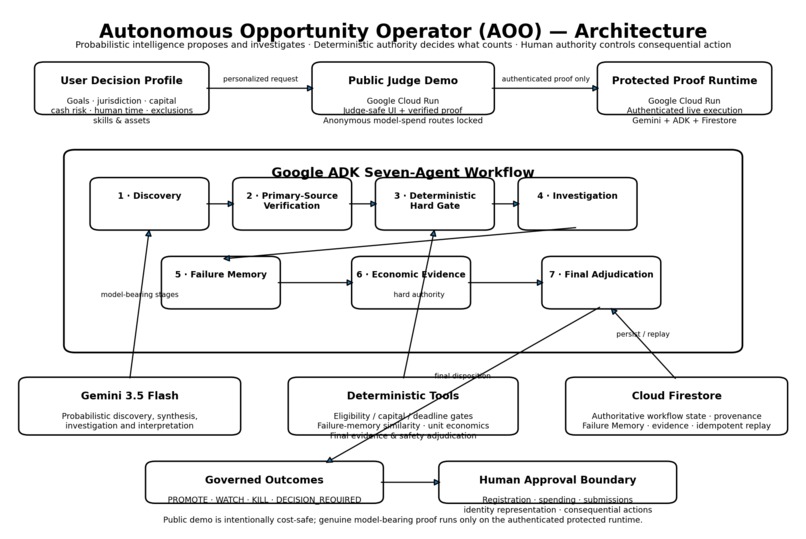
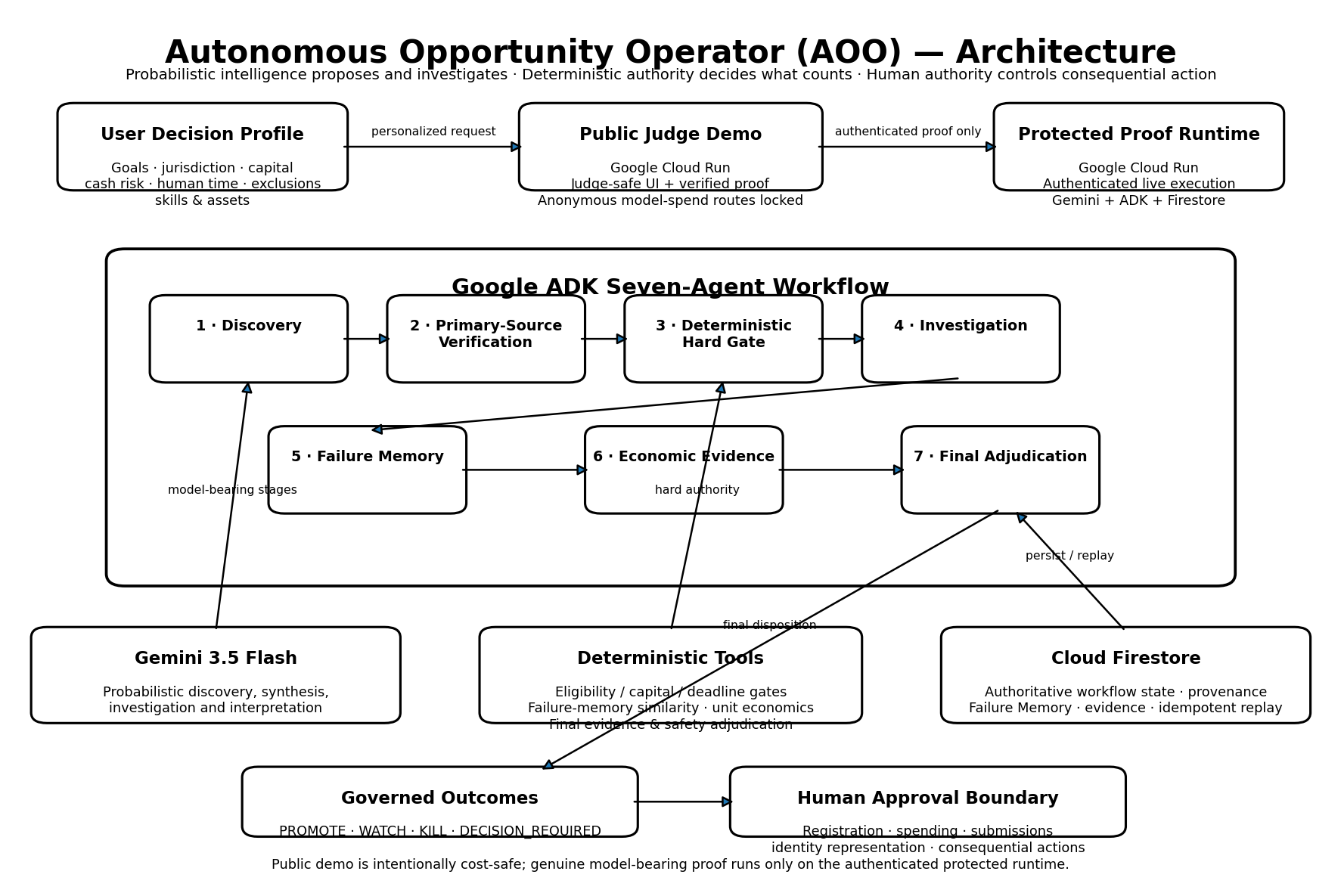
AOO architecture diagram
Inspiration
Finding opportunities is easy. Knowing which ones are actually worth pursuing is much harder.
People are surrounded by business ideas, grants, competitions, automation opportunities, software products, and other ways to make money or save time. The bottleneck is not generating more possibilities. It is investigating them properly without wasting time, money, model calls, or human attention.
I wanted an agent that could do more than suggest ideas.
I wanted one that could say:
- “This looks promising, and I verified why.”
- “This still needs evidence.”
- “We already disproved this thesis.”
- “The technology works, but the economics do not.”
- “Stop. Do not spend more resources here.”
That became Autonomous Opportunity Operator (AOO).
What it does
AOO takes a user decision profile — goals, jurisdiction, available capital, maximum cash spend, available human time, exclusions, skills, and other constraints — and turns it into an autonomous opportunity-evaluation workflow.
AOO can:
- discover opportunities that already exist;
- synthesize new opportunity hypotheses;
- verify primary-source evidence;
- apply deterministic eligibility and resource constraints;
- investigate feasibility;
- consult Failure Memory for previously disproven theses;
- evaluate economic evidence and unit economics;
- preserve unknown facts as UNKNOWN instead of guessing;
- produce a governed final disposition such as PROMOTE, WATCH, KILL, or DECISION_REQUIRED.
The goal is not to maximize the number of ideas.
The goal is to eliminate weak opportunities cheaply and concentrate human attention on the few that survive.
The agent workflow
AOO uses a specialized seven-agent Google ADK workflow powered by Gemini 3.5 Flash.
The workflow includes:
- Discovery
- Primary-source verification
- Deterministic hard-gate evaluation
- Investigation
- Failure Memory
- Economic Evidence
- Final Adjudication
Model-based reasoning handles probabilistic tasks such as discovery, synthesis, investigation, and interpretation.
Deterministic tools retain authority over facts and constraints that should not depend on model confidence, including hard eligibility gates, failure-memory checks, unit economics, and final evidence/safety adjudication.
The core operating principle is:
Probabilistic intelligence proposes and investigates.
Deterministic authority decides what is allowed to count.
Human authority controls consequential action.
Proof of Action
The demo video contains a genuine, fresh, authenticated Google ADK + Gemini execution on the protected Google Cloud runtime.
The workflow evaluates the real Google All Things Agentic Hackathon opportunity from its primary source.
The live run is not replayed evidence. It proceeds through primary-source verification, deterministic gates, investigation, Failure Memory, economic evidence, and final adjudication.
The final result is DECISION_REQUIRED.
Why?
Because registration, creation of cloud resources, and external submission are consequential actions that require explicit human approval.
AOO can investigate autonomously, but it cannot silently cross that authority boundary.
Architecture
AOO is built with:
- Gemini 3.5 Flash for model-based agent reasoning;
- Google Agent Development Kit (ADK) for the seven-agent workflow;
- Google Cloud Run for deployed application and proof runtimes;
- Google Cloud Firestore for authoritative workflow state, evidence, provenance, Failure Memory, and replay;
- Python 3.13;
- FastAPI for the application/API layer.
The architecture deliberately separates the public judge-safe application from the protected proof runtime.
The public demo lets judges explore the product and verified technical evidence without allowing anonymous users to trigger unrestricted model spend or consequential actions.
The protected runtime executes the genuine Gemini-powered workflow with authenticated access.
Completed authoritative workflows can also be replayed for inspection without pretending that a new model execution occurred or paying to repeat identical model work.
Failure Memory and economic evidence
One of the most important design decisions was teaching AOO that technical success is not economic success.
A technical mechanism can work perfectly and still be a bad economic opportunity.
AOO therefore continues beyond technical feasibility into economic evidence and unit economics.
Failed theses are preserved in Failure Memory with their evidence and reconsideration conditions. This prevents the system from repeatedly spending model calls, engineering time, and human attention rediscovering the same structural failure.
Safety and human authority
Consequential external actions are deliberately outside autonomous model authority.
Exploration and investigation do not automatically authorize spending money, creating accounts, registration, applications, submissions, identity representation, or other consequential actions.
The model may propose and investigate.
Deterministic gates decide whether evidence is sufficient.
The human remains the authority for consequential execution.
This boundary is part of the architecture, not an afterthought.
Challenges
The hardest part was not getting agents to generate ideas. It was making the system skeptical enough to stop.
Several engineering challenges shaped the final architecture:
- separating model confidence from deterministic authority;
- preserving UNKNOWN instead of allowing plausible guesses to become facts;
- distinguishing technical success from economic success;
- maintaining durable state and replay semantics;
- preventing repeated investigation of structurally failed theses;
- exposing a useful public demo without allowing anonymous cost-bearing Gemini execution;
- keeping consequential external actions behind explicit human approval.
What I learned
The biggest lesson was that an autonomous agent becomes more useful when it is rewarded for stopping.
Early systems naturally optimize for activity: discover something, investigate it, build something, and continue.
But activity is not the same as value.
A stronger autonomous system needs to know:
- when evidence is sufficient;
- when evidence is missing;
- when more engineering is irrational;
- when a thesis has already failed;
- and when the next action belongs to a human.
Failure Memory also changed the economics of the agent itself. A failed investigation becomes reusable evidence instead of wasted work.
The result is an agent designed not merely to act autonomously, but to allocate attention and resources more intelligently.

Log in or sign up for Devpost to join the conversation.