-
-
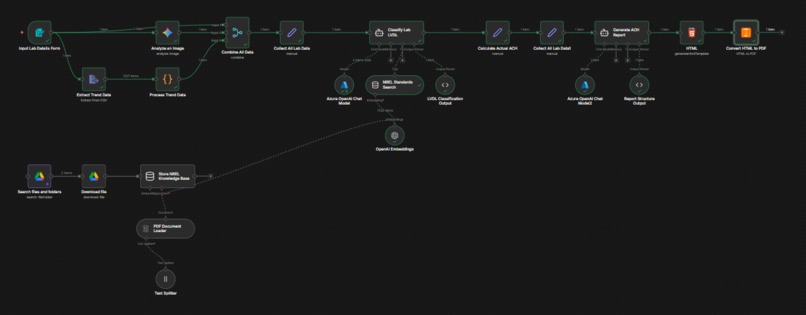
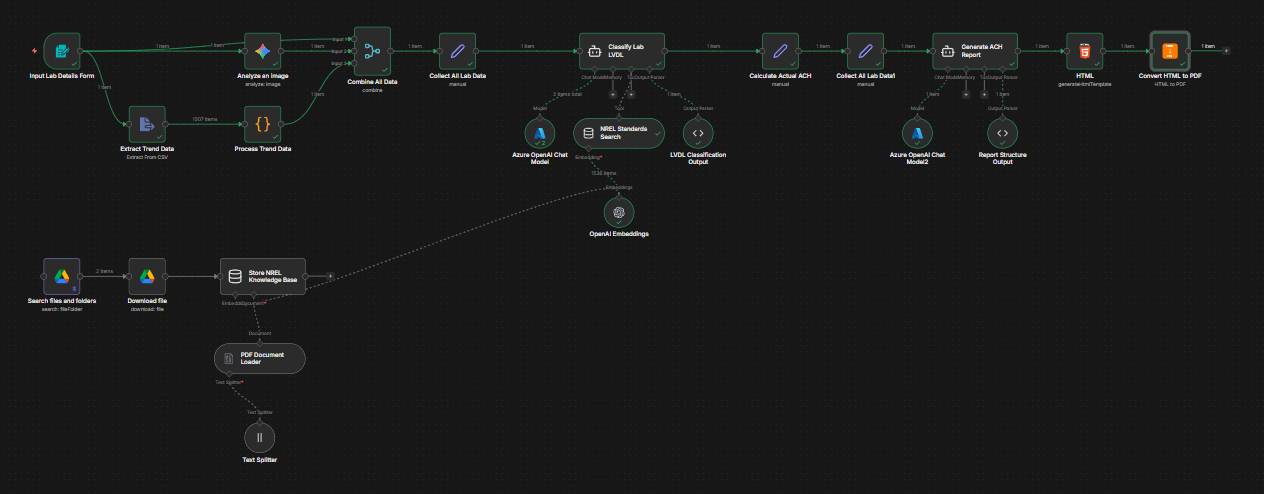
n8n workflow
Inspiration University labs are massive energy sinks. Most run at "worst-case scenario" ventilation rates 24/7, even when they’re empty or holding low-risk chemicals. Manually auditing these rooms takes hours of engineering time that facilities teams just don’t have. I wanted to automate the boring math so we can actually start saving energy.
What it does The workflow collects chemical data, room dimensions, and trend data to run a deterministic risk assessment. Instead of guessing, it calculates the exact Air Changes per Hour (ACH) and volumetric flow (CFM) needed to stay safe while cutting unnecessary waste.
How we built it I used n8n to coordinate the logic, with Azure OpenAI acting as the "brain" to interpret NREL safety standards and Gemini Vision for the image processing.
RAG Pipeline: Searches a vector database of NREL toolkits and ANSI/ASHRAE standards to ensure every recommendation is code-compliant.
Math Engine: Custom nodes handle the ACH-to-CFM conversions.
Auto-Reporting: It finishes by generating a professional PDF memo ready for a facilities manager’s desk.
Challenges we ran into Teaching an AI to respect strict engineering multipliers (like the 14x hazard weight) was tough. Early versions hallucinated "safe" numbers, so I had to build a rigid output parser to keep the math grounded in reality. Another challenge was being able to accurately image process a complex blueprint, as many things were in the way, but giving Gemini a more specific prompt enabled it to ignore obstructions
Accomplishments that we're proud of I turned a 4-hour manual engineering audit into a 10-second automated process. Seeing the system cut over 1,300 CFM in a single room—while staying 100% safe—shows just how much "green" potential is hiding in our campus buildings.
What we learned Low-code tools like n8n aren't just for simple tasks; they can run complex, regulated engineering workflows if you build the right guardrails.
What's next I want to use this tool to do the whole science building, as it currently uses the most energy, and reducing it with n8n will save a lot of time. The goal is to move from static audits to a living, breathing, energy-efficient campus.


Log in or sign up for Devpost to join the conversation.