-
-
Results
Autonomous Incident Commander
Inspiration
Modern systems generate an overwhelming amount of operational data. When a critical incident occurs, engineers often spend valuable time switching between dashboards, searching logs, correlating events, building timelines, and manually identifying root causes before they can even begin fixing the problem.
The irony is that organizations have more observability data than ever before, yet incident investigations remain largely manual.
We asked ourselves a simple question:
What if the machine could become the incident commander?
Instead of building another chatbot that answers questions about infrastructure, we wanted to build a system that actively investigates incidents, reasons through evidence, identifies root causes, and generates actionable reports without requiring a human to drive the process.
That idea became Autonomous Incident Commander.
What It Does
Autonomous Incident Commander is an AI-powered incident response platform built on Splunk that transforms raw operational data into complete incident investigations.
When an alert is triggered, the platform automatically:
- Collects logs, events, and telemetry from Splunk
- Correlates data across multiple services
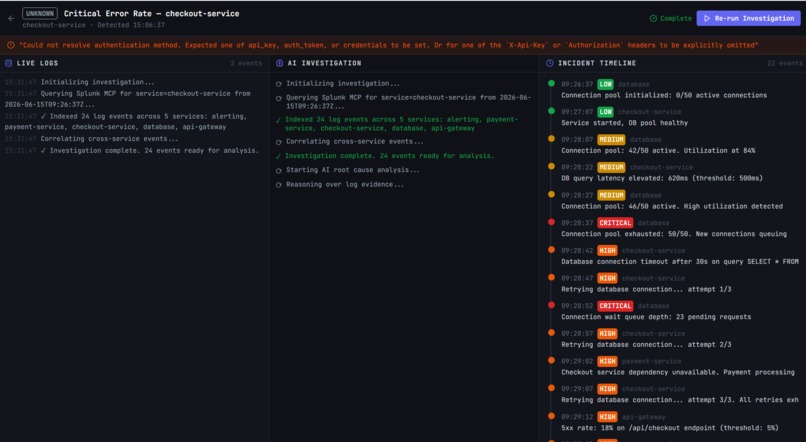
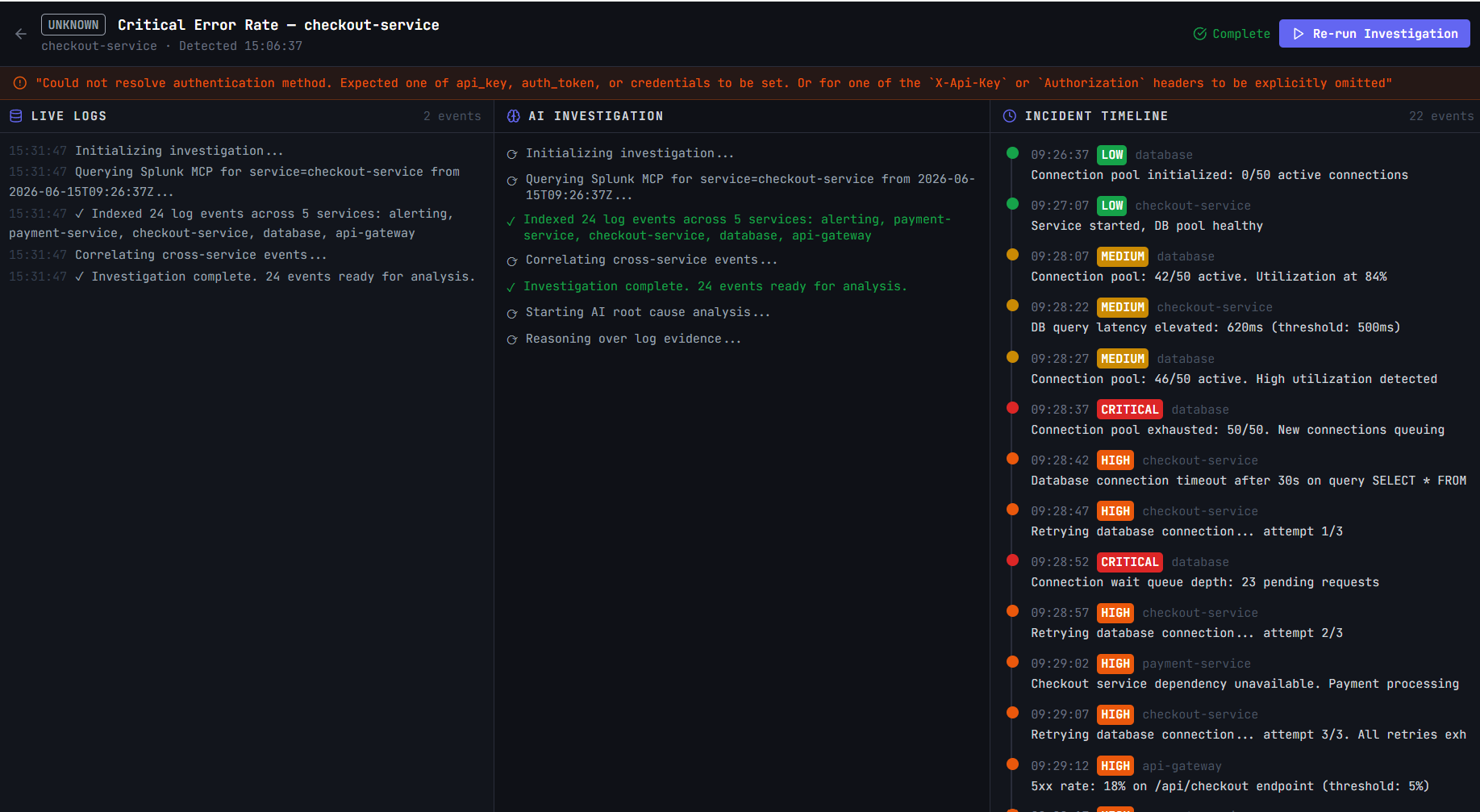
- Constructs a chronological incident timeline
- Identifies the most probable root cause
- Calculates a confidence score
- Generates remediation recommendations
- Produces an executive-ready incident report
Instead of asking an engineer to manually investigate an outage, the system performs the investigation autonomously and presents the findings in minutes.
The result is a dramatic reduction in Mean Time To Resolution (MTTR) and faster operational response.
How We Built It
The platform is built using a multi-agent architecture where each AI agent has a dedicated responsibility.
Investigation Agent
Retrieves incident-related logs, events, and telemetry from Splunk using Splunk MCP integrations.
Timeline Agent
Analyzes the collected events and reconstructs the sequence of failures that led to the incident.
Root Cause Agent
Reasons over the evidence and identifies the most likely source of failure while generating supporting explanations.
Severity Agent
Determines incident criticality based on impact, affected services, and system behavior.
Remediation Agent
Generates immediate, short-term, and long-term recommendations to resolve and prevent the issue.
Report Agent
Synthesizes all findings into a structured incident report that can be shared with engineering and leadership teams.
Technology Stack
- Splunk Enterprise
- Splunk MCP Server
- Anthropic Claude
- FastAPI
- Python
- Next.js
- TypeScript
- TailwindCSS
- PostgreSQL
- Server-Sent Events (SSE)
The frontend streams investigation progress in real time, allowing users to watch each agent contribute to the investigation as it unfolds.
Challenges We Ran Into
Turning AI Into an Investigator Instead of a Chatbot
Many AI systems are designed to answer questions when prompted. Our challenge was building agents that proactively investigate incidents and collaborate with one another without human intervention.
Correlating Events Across Services
Real incidents rarely originate from a single log line. We had to design workflows that connect failures across databases, APIs, payment systems, and application services to reconstruct the complete story.
Structured Agent Collaboration
Each agent produces structured outputs that are passed to downstream agents. Designing reliable interfaces between agents was critical to maintaining consistency and reducing hallucinations.
Creating Explainable Results
Engineers need evidence, not just conclusions. Every root cause determination had to be backed by actual logs and observable events so users could trust the system's findings.
Real-Time User Experience
We wanted the investigation to feel alive. Streaming logs, timelines, reasoning, and reports in real time required careful orchestration between the backend agents and frontend interface.
What We Learned
Building Autonomous Incident Commander taught us that the future of observability is not simply providing more dashboards—it is enabling systems to reason about operational data autonomously.
We learned how to:
- Build multi-agent AI workflows
- Integrate AI systems with operational telemetry
- Design explainable AI outputs for engineers
- Orchestrate real-time streaming experiences
- Use Splunk MCP as a bridge between AI agents and observability data
Most importantly, we learned that AI becomes significantly more powerful when it is given a clear operational role rather than functioning as a general-purpose assistant.
Why It Matters
Every minute spent investigating an outage can translate into lost revenue, degraded customer experience, and increased operational stress.
Traditional incident response follows a manual process:
Alert → Investigation → Root Cause Analysis → Reporting
Autonomous Incident Commander transforms that workflow into:
Alert → Autonomous Investigation → Actionable Resolution
By allowing AI agents to perform the investigative work, organizations can focus on solving problems rather than searching for them.
What's Next
Our vision extends beyond incident investigation.
Future versions could:
- Automatically create Jira tickets
- Trigger Slack and PagerDuty workflows
- Execute approved remediation actions
- Detect anomalies before alerts fire
- Learn from historical incidents
- Coordinate multiple AI agents across security and observability domains
Ultimately, we envision a future where operational systems are capable of understanding, explaining, and responding to incidents with minimal human intervention.
Autonomous Incident Commander is a step toward that future.
Built With
- ai-agents
- anthropic-claude
- fastapi
- incident-management
- incident-response-automation
- log-analysis
- multi-agent-ai
- next.js
- observability
- postgresql
- pydantic
- python
- react
- real-time-streaming
- root-cause-analysis
- server-sent-events
- splunk-enterprise
- splunk-mcp-server
- splunk-rest-api
- sqlalchemy
- tailwindcss
- telemetry-correlation
- typescript

Log in or sign up for Devpost to join the conversation.