-
-
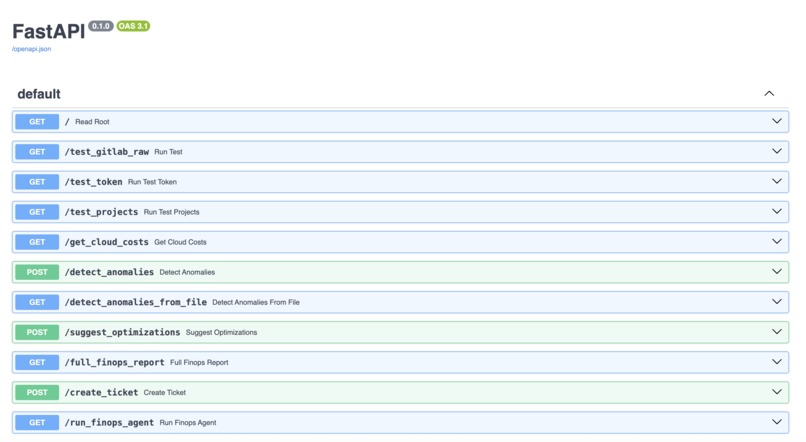
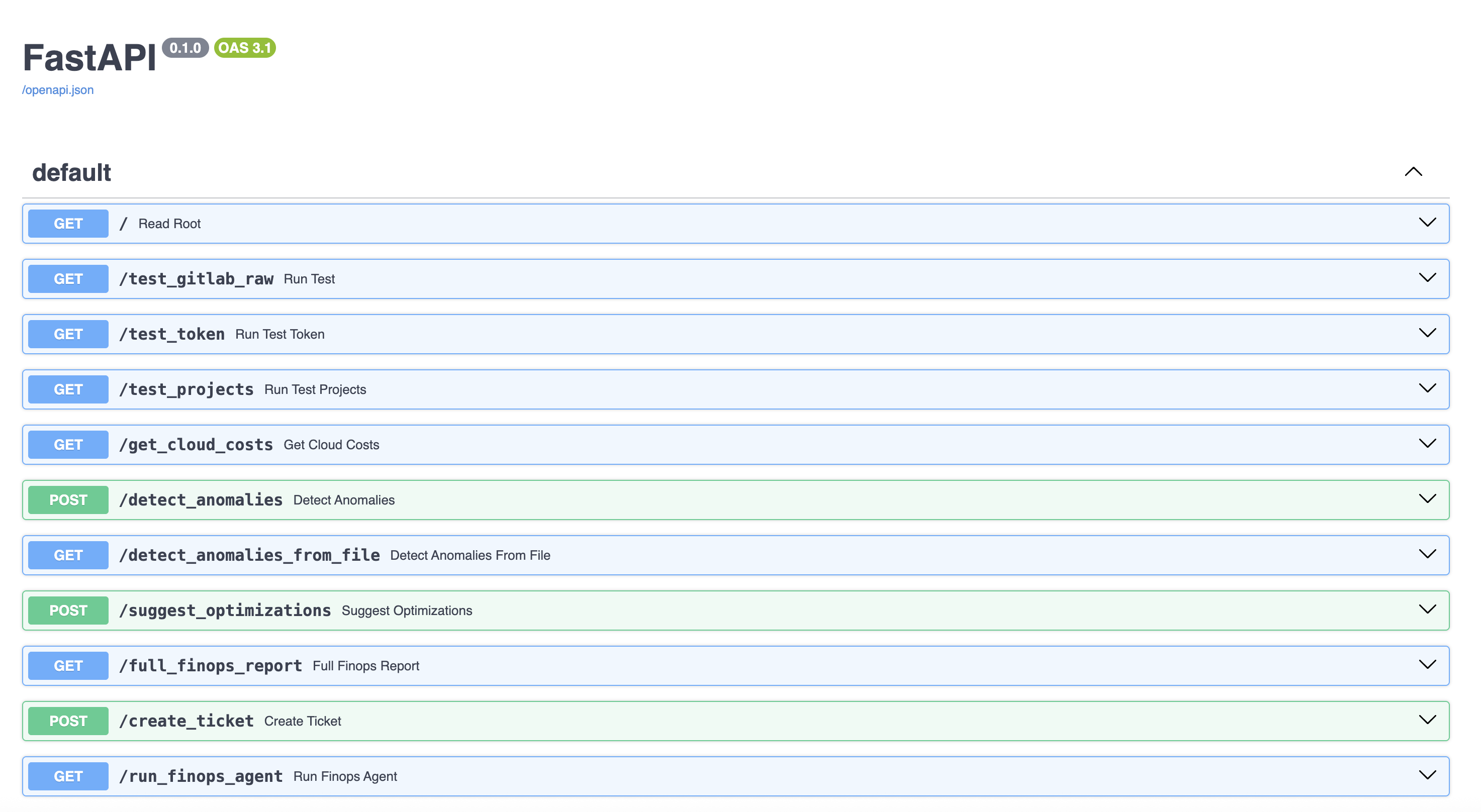
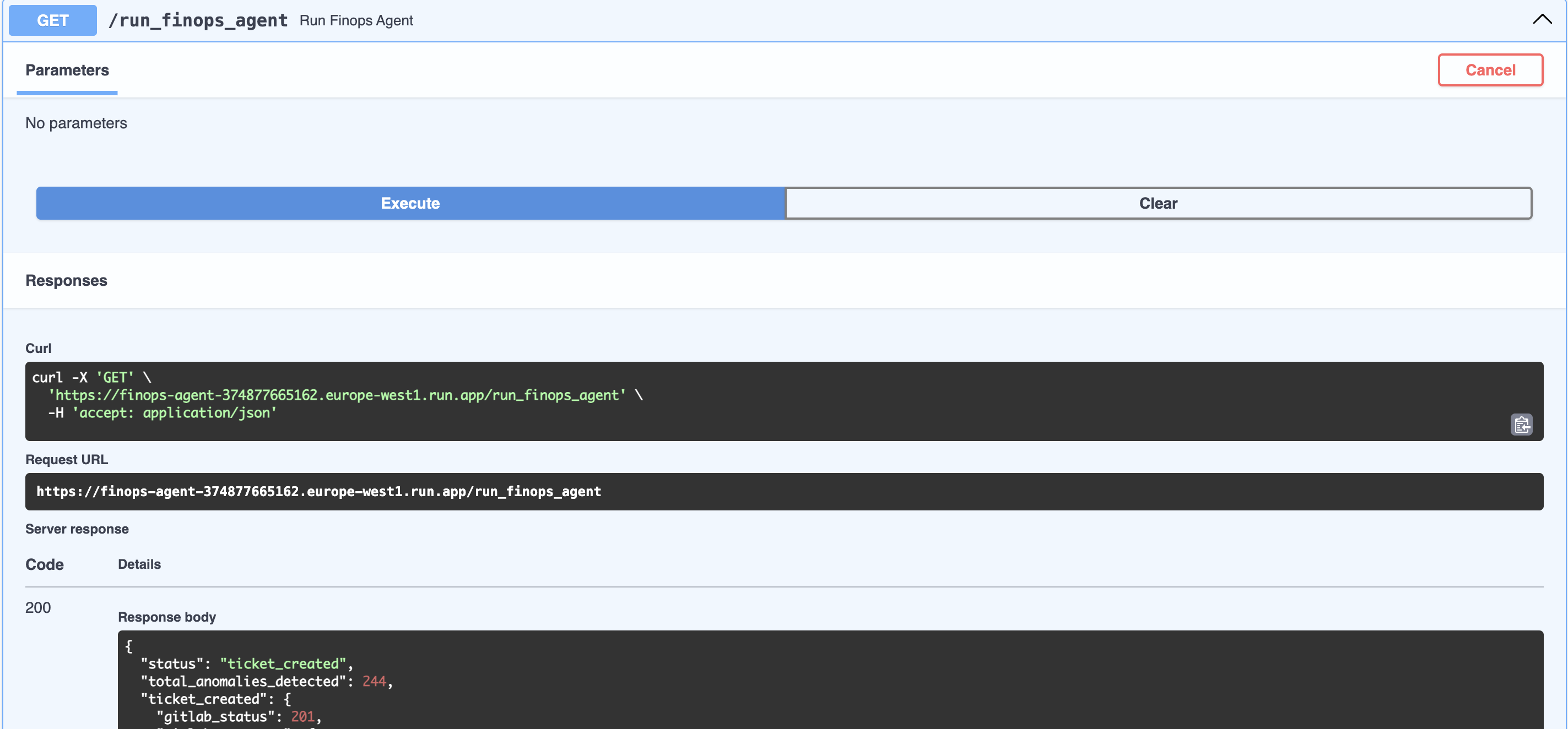
FinOps Agent API
-
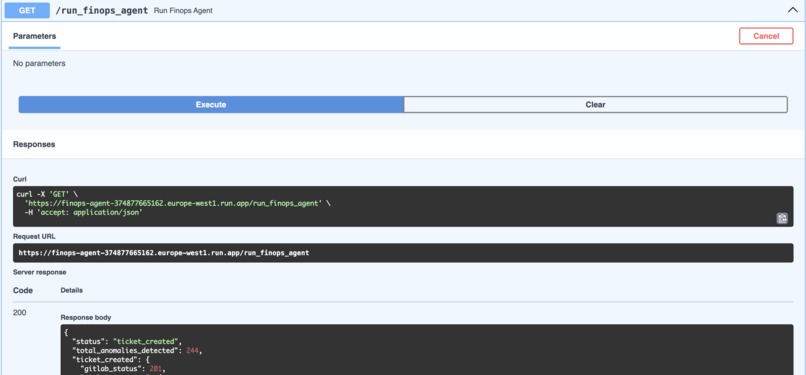
Run FinOps Agent
-
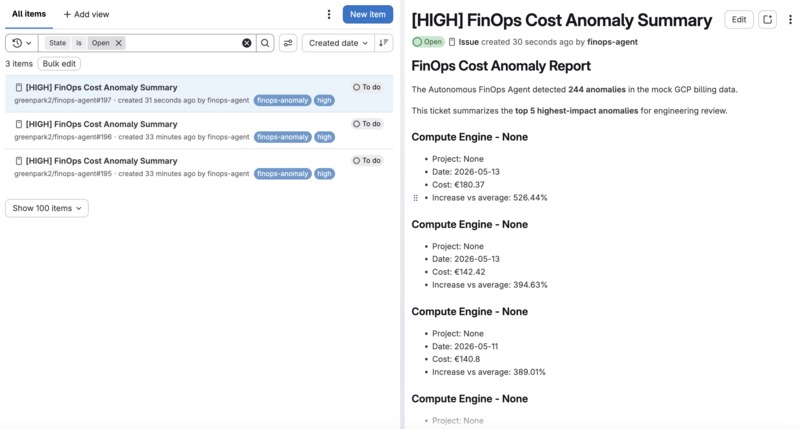
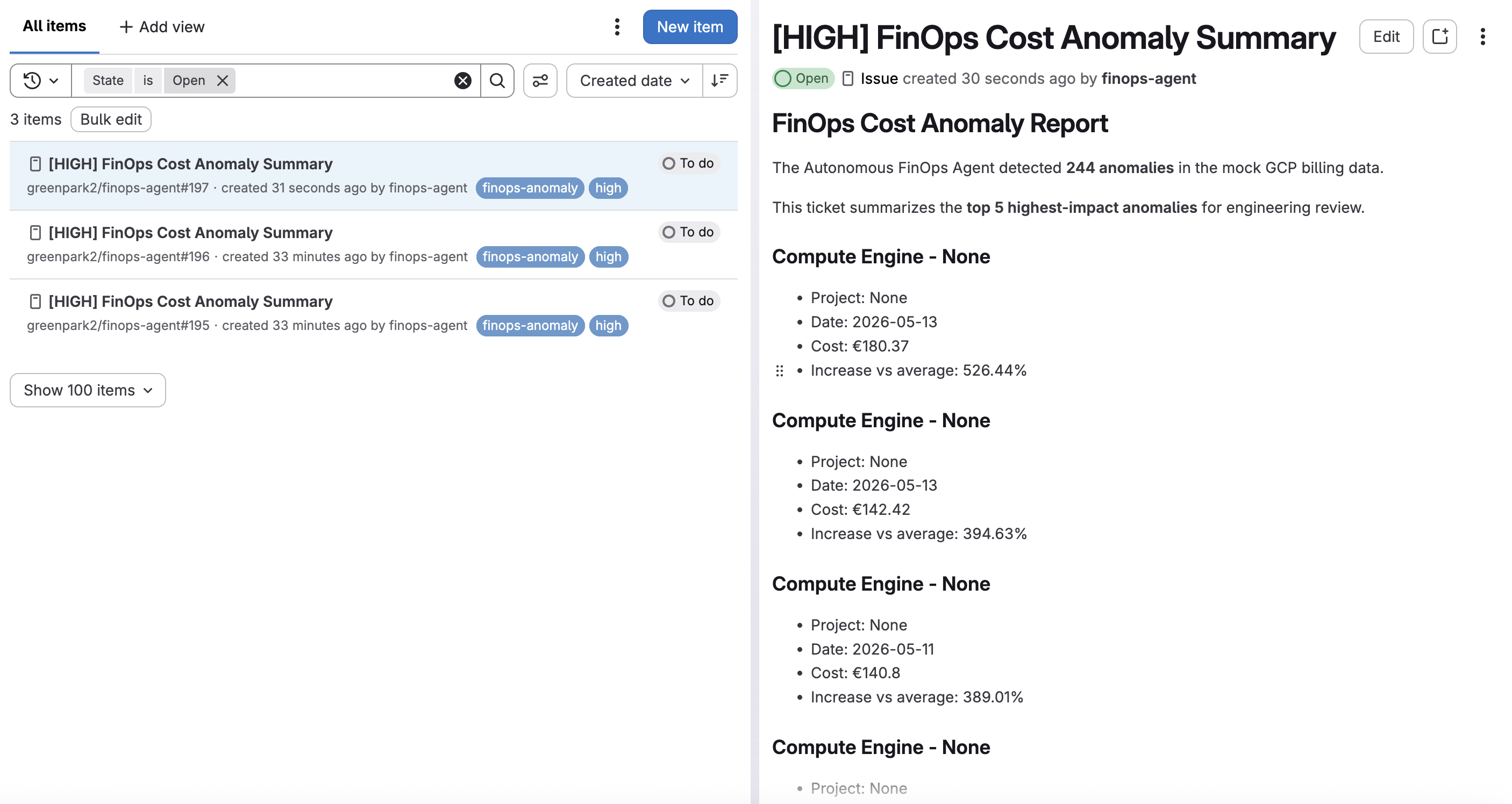
Gitlab ticket created by the agent
Inspiration
Cloud has transformed IT spending from predictable CAPEX into dynamic, consumption-based OPEX. While this flexibility enables innovation, it also creates a new challenge: cloud costs can grow unexpectedly and often go unnoticed until after the bill arrives.
Finance teams are expected to become strategic partners, yet they frequently rely on manual analysis and delayed reporting. Engineering teams, meanwhile, lack visibility into the financial impact of their architectural and operational decisions.
We asked ourselves:
What if a FinOps analyst didn't just identify cloud cost problems—but could automatically take action to resolve them?
What it does
Autonomous FinOps Agent: From Cloud Analysis to Cost Actions is an AI-powered agent that transforms cloud cost insights into engineering actions.
The agent:
- Analyzes cloud billing data
- Detects abnormal cost spikes and anomalies
- Identifies the most significant cost drivers
- Generates optimization recommendations
- Summarizes findings in business-friendly language
- Automatically creates actionable GitLab issues for engineering teams
Instead of simply highlighting problems, the agent closes the loop between cloud cost visibility and remediation.
Insight → Decision → Action
How we built it
We built a tool-augmented autonomous agent powered by Gemini.
Core components:
- Gemini → reasoning, planning, and decision-making
- MCP server → structured tool interface
- GitLab → execution (automated ticket creation)
- FastAPI → tool interface and agent services
- Google Cloud Run → scalable deployment platform
- Google Secret Manager → secure credential management
- Pandas → cloud cost analysis and anomaly detection
- Mock GCP Billing Dataset → realistic SKU-level cloud cost data
Agent workflow:
Plan → Analyze → Detect → Decide → Act
Custom tools:
- get_cloud_costs
- detect_anomalies
- suggest_optimizations
- create_ticket
- run_finops_agent
The agent first analyzes cloud cost data, identifies unusual spending patterns, generates optimization recommendations, and automatically creates a GitLab issue containing a structured remediation plan for engineering teams.
Challenges we ran into
- Designing a truly agentic workflow instead of a simple chatbot
- Building reliable tool orchestration between analysis and action
- Integrating GitLab issue creation securely using Secret Manager
- Simulating realistic cloud billing scenarios with meaningful anomalies
- Converting technical cloud metrics into business-relevant recommendations
- Preventing alert fatigue by avoiding excessive ticket creation
One of the biggest challenges was integrating GitLab issue creation reliably. Although the API token and project appeared to be configured correctly, issue creation initially failed with project access and API errors.
To troubleshoot, we adopted a systematic approach:
- Validated the GitLab token independently
- Verified project visibility and permissions through the GitLab API
- Tested project access separately from issue creation
- Confirmed Secret Manager integration and Cloud Run permissions
- Isolated and validated each API call step-by-step
This debugging process helped us build a more robust integration and reinforced the importance of validating each component independently when building autonomous systems that interact with external platforms.
One particularly interesting challenge was balancing automation with practicality. Early versions generated a ticket for every anomaly, which resulted in over 100 issues. We redesigned the workflow to generate a single prioritized remediation ticket instead.
Accomplishments that we're proud of
- Built an end-to-end autonomous FinOps workflow
- Successfully connected cloud cost analysis with engineering execution
- Deployed a working agent on Google Cloud Run
- Integrated secure secret management and GitLab automation
- Created a realistic FinOps use case with clear business value
The agent successfully demonstrates:
- Automated cloud cost anomaly detection
- AI-generated optimization recommendations
- Automatic GitLab issue creation
- End-to-end execution from insight to action
We moved beyond "Here's the problem" to "Here's the action plan, and it's already in the engineering backlog."
What we learned
- Agents need tools and structure, not just prompts
- Memory is key to building compounding intelligence
- The biggest value comes from automation of decisions and actions
- Framing outputs in business impact terms is critical
- Real-world use cases outperform generic AI demos
- Agents become significantly more useful when connected to real tools
- The highest value comes from completing workflows, not generating reports
- FinOps is a strong domain for agent-based automation because it combines data analysis with operational actions
- Security and governance are critical when agents interact with external systems
- Business users care about outcomes and savings, not just technical metrics
What's next for Autonomous FinOps Agent
- Integrate real cloud billing APIs (AWS, GCP, Azure)
- Add predictive cost forecasting and anomaly prevention
- Real-time FinOps dashboard
Expand into:
- performance optimization
- sustainability (carbon-aware FinOps)
- Build a real-time dashboard for visibility and control
Our vision:
A digital FinOps analyst that continuously monitors cloud spend, identifies risks, recommends optimizations, and drives action automatically—helping organizations control cloud costs at scale while enabling engineering teams to move faster.


Log in or sign up for Devpost to join the conversation.