-
-

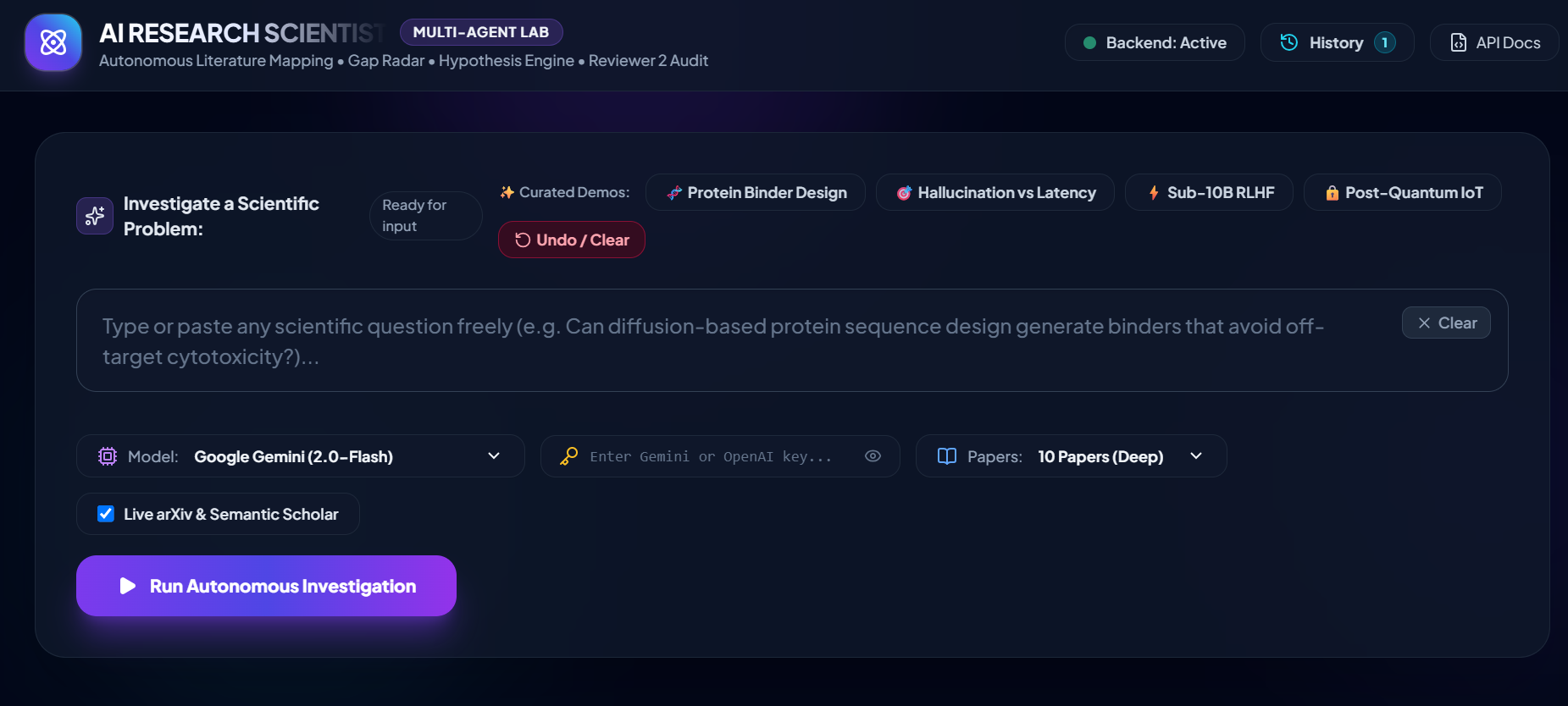
Interactive query console with curated scientific presets and multi-model configuration.
-
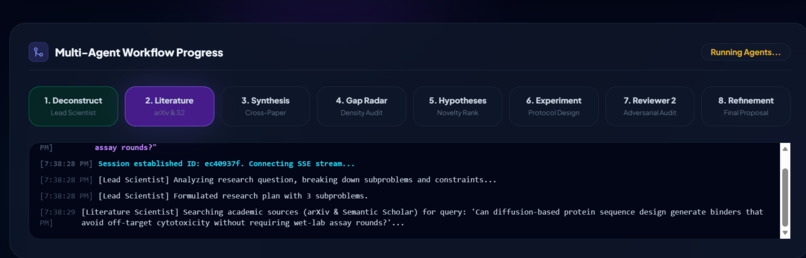
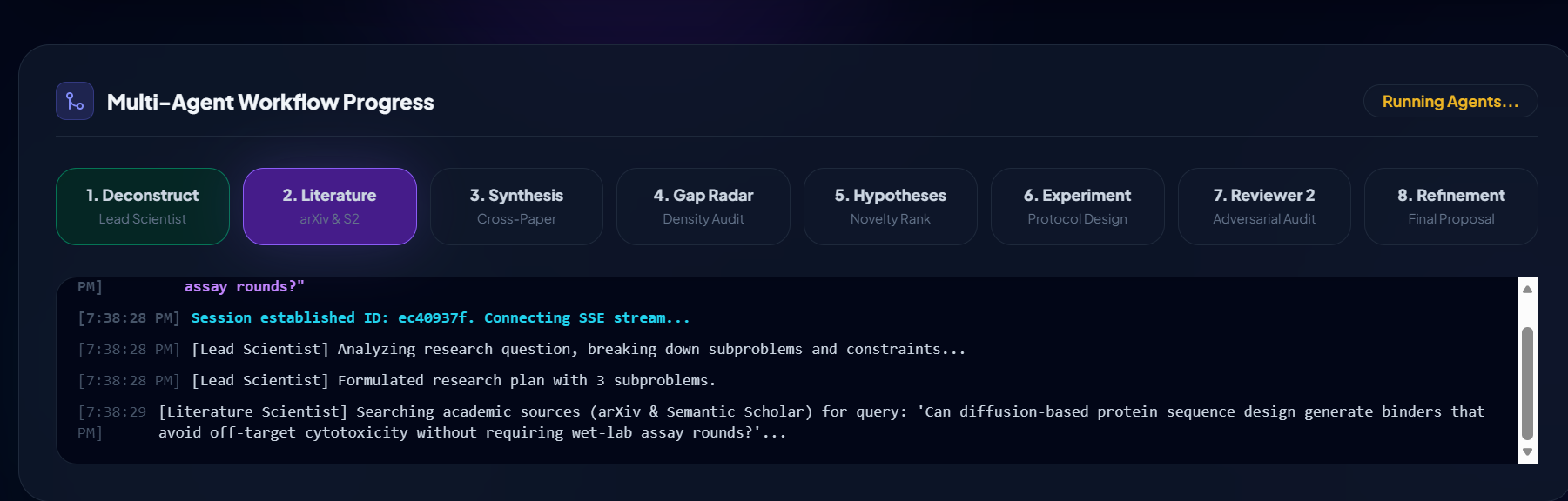
8-stage autonomous multi-agent pipeline with real-time execution trace streaming.
-
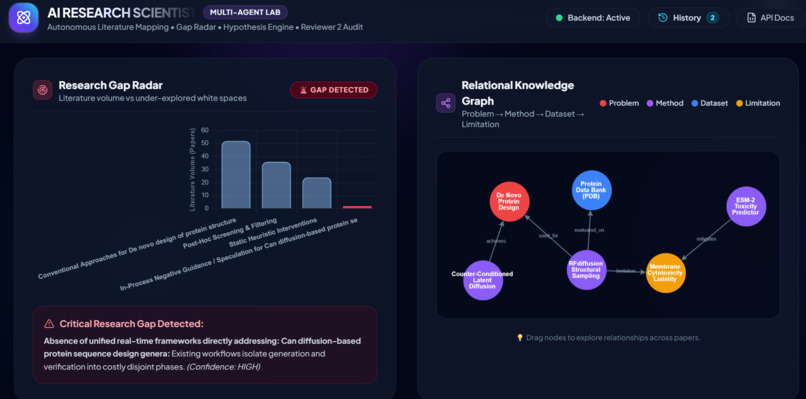
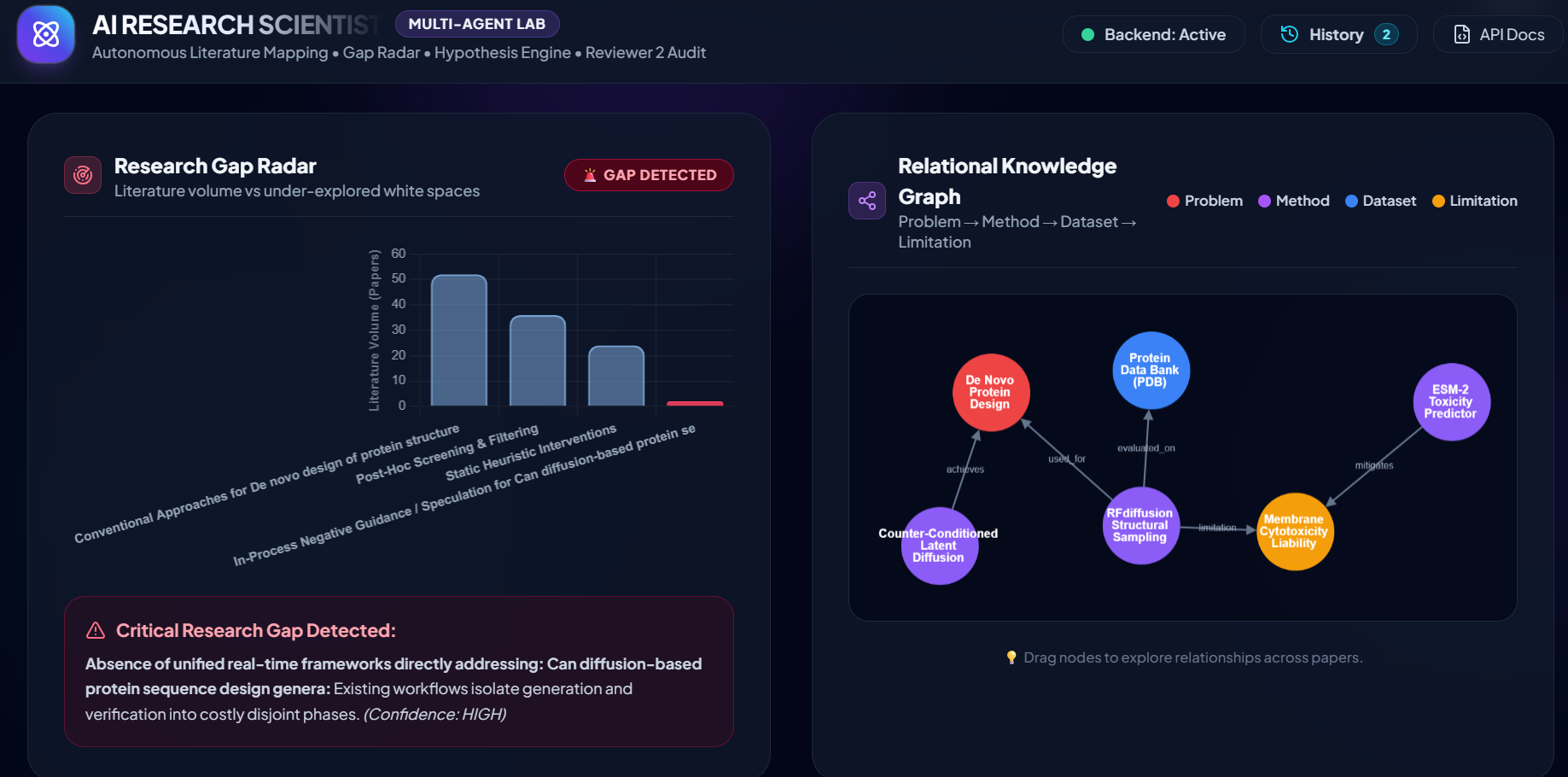
Literature Gap Radar and interactive Knowledge Graph mapping scientific white spaces.
-
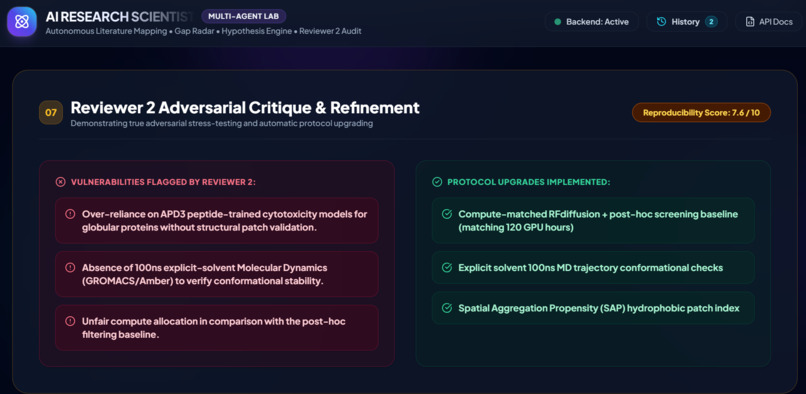
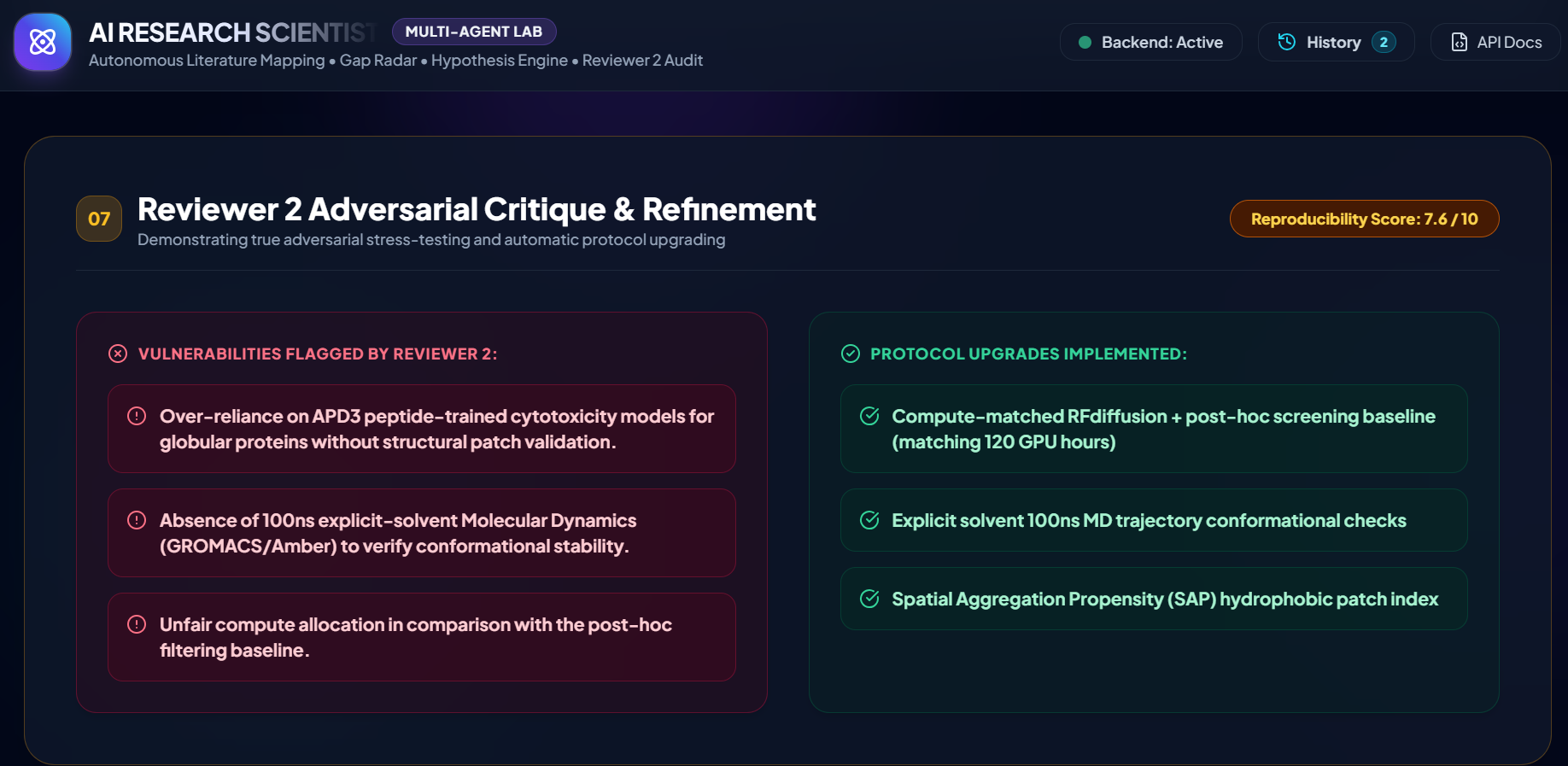
Reviewer 2 adversarial audit flagging methodological flaws and auto-upgrading protocols.
Inspiration
Formulating a breakthrough scientific research proposal takes months of grueling literature review, manual citation analysis, and trial-and-error experimental design. Even after weeks of effort, researchers frequently run into blind spots, uncalibrated baseline comparisons, or fatal flaws flagged by the notorious "Reviewer 2".
We asked: What if an autonomous AI research lab could deconstruct any complex scientific question, synthesize peer-reviewed literature, pinpoint high-value research gaps, generate falsifiable hypotheses, design rigorous experimental protocols, and subject the entire plan to an adversarial peer-review audit—all in under 60 seconds?
That vision led us to build Autonomous AI Research Scientist.
What It Does
Autonomous AI Research Scientist is a full-stack, multi-agent autonomous scientific reasoning platform. When given an open-ended scientific problem, it launches an 8-stage collaborative agent pipeline:
- Lead Scientist (Deconstruction): Systematically deconstructs the research question into core subproblems, mathematical constraints, and required empirical evidence.
- Literature Search Agent: Connects live to academic repositories (arXiv & Semantic Scholar) to retrieve relevant publications, abstracts, and quantitative benchmarks.
- Synthesis Scientist (Knowledge Graph): Extracts comparative methodology matrices and generates an interactive relational Knowledge Graph linking Problems → Methods → Datasets → Limitations.
- Gap Radar Analyst: Analyzes publication density across subfields to mathematically detect under-explored white spaces and critical research gaps.
- Hypothesis Engine: Generates novel, falsifiable scientific hypotheses and evaluates them across 5 multi-criteria scoring dimensions (Novelty, Scientific Plausibility, Evidence Strength, Testability, and Expected Impact).
- Experimental Scientist (Protocol Design): Designs a reproducible laboratory protocol with isolated Independent, Dependent, and Control variables, inclusion/exclusion criteria, train/val/test splits, and SOTA baselines.
- Reviewer 2 (Adversarial Audit): Acts as a ruthless peer reviewer, stress-testing the methodology for dataset selection bias, data leakage, unnormalized baseline comparisons, and statistical power flaws.
- Protocol Refinement & Upgrading: Re-engineers the experimental design to resolve every flaw flagged by Reviewer 2, producing:
- Executive Interactive Cards: Color-coded, spacious cards designed for instant executive review.
- Full Academic Markdown Paper: Complete publication-grade report with citations, tables, and export options (.md).
- Investigation History Drawer: Slide-over drawer with 1-click restoration of any past investigation.
How We Built It
- Multi-Agent Orchestrator: Built with Python and FastAPI, managing an asynchronous pipeline that streams real-time agent execution traces via Server-Sent Events (SSE).
- Domain-Adaptive Reasoning Engine: Powered by Google Gemini 2.0 Flash and OpenAI GPT-4o, paired with a specialized domain simulation engine that tailors reasoning across genomics, structural biology, post-quantum cryptography, and multimodal AI.
- Academic Grounding: Live search APIs integration with arXiv and Semantic Scholar.
- Interactive Visualizations:
- Cytoscape.js: Interactive force-directed network knowledge graph visualization.
- Chart.js: Dynamic radar chart tracking literature density vs. under-explored gap opportunities.
- Frontend Architecture: Single-page modern glassmorphism interface built with TailwindCSS, Lucide Icons, and localStorage session synchronization.
Challenges We Ran Into
- Domain-Specific Depth vs. Hallucination: Generic LLM prompts often output superficial or repetitive answers. We engineered strict schema-driven epistemic grounding that forces agents to separate established facts, evidence-based inferences, and testable hypotheses.
- Authentic Adversarial Auditing: Engineering "Reviewer 2" to uncover genuine methodological vulnerabilities (such as un-synchronized GPU wall-clock latency, lack of explicit solvent molecular dynamics, or homology leakage across chromosomes) rather than surface
Built With
- arxiv-api
- asyncio
- chart.js
- css3
- cytoscape.js
- fastapi
- gemini-api
- generative-ai
- html5
- javascript
- llm
- meta-science
- openai
- pydantic
- python
- semantic-scholar
- sse
- uvicorn


Log in or sign up for Devpost to join the conversation.