Inspiration
Enterprise automation teams spend significant time investigating failed RPA processes. A single automation failure often requires multiple teams to review logs, classify the incident, perform root cause analysis, validate the proposed fix, prepare regression test cases, and document the incident before the automation can be deployed again.
We wanted to demonstrate how UiPath Maestro and AI Agents can orchestrate these activities as a collaborative, autonomous workflow. Our inspiration was to move beyond traditional RPA by creating an intelligent incident management platform that reduces manual effort, standardizes investigations, and accelerates enterprise operations.
What it does
AgentOps Maestro is an AI-powered autonomous incident management platform built using UiPath Maestro, UiPath AI Agents, UiPath Orchestrator, Queues, and RPA.
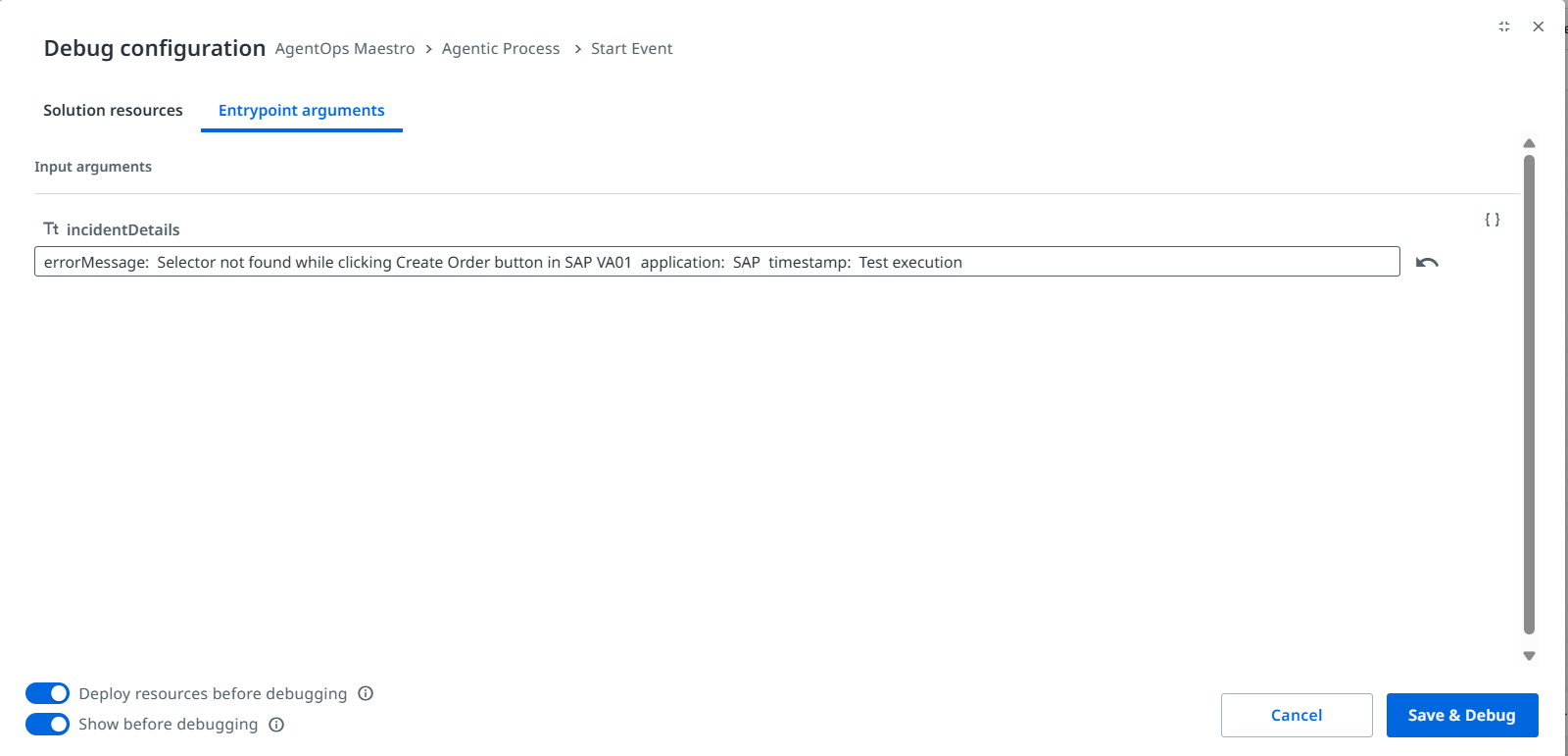
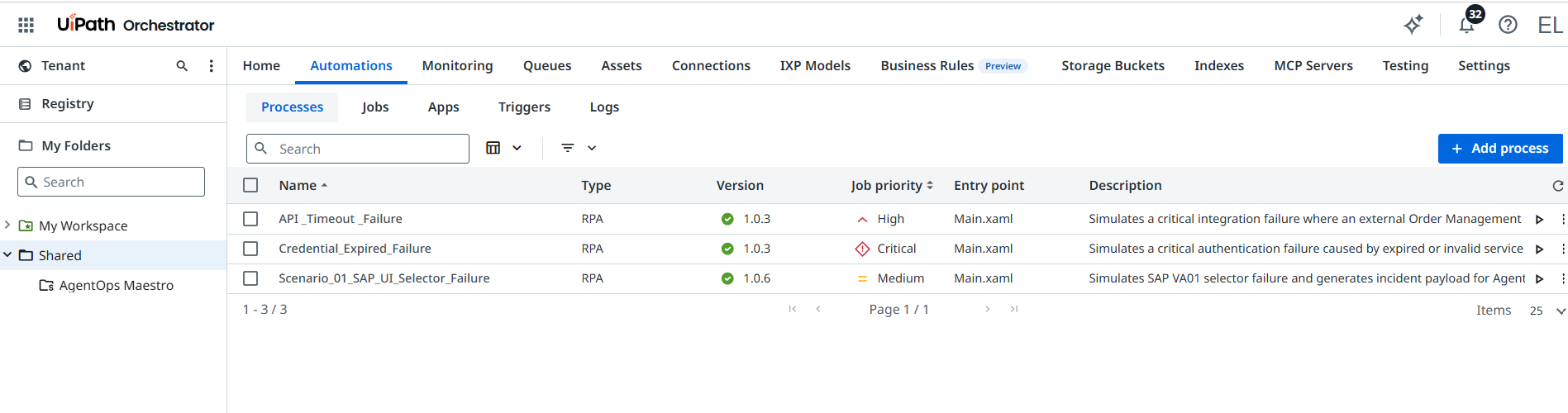
The solution simulates real enterprise automation failures such as:
- SAP UI Selector Failure
- API Timeout Failure
- Credential Expired Failure
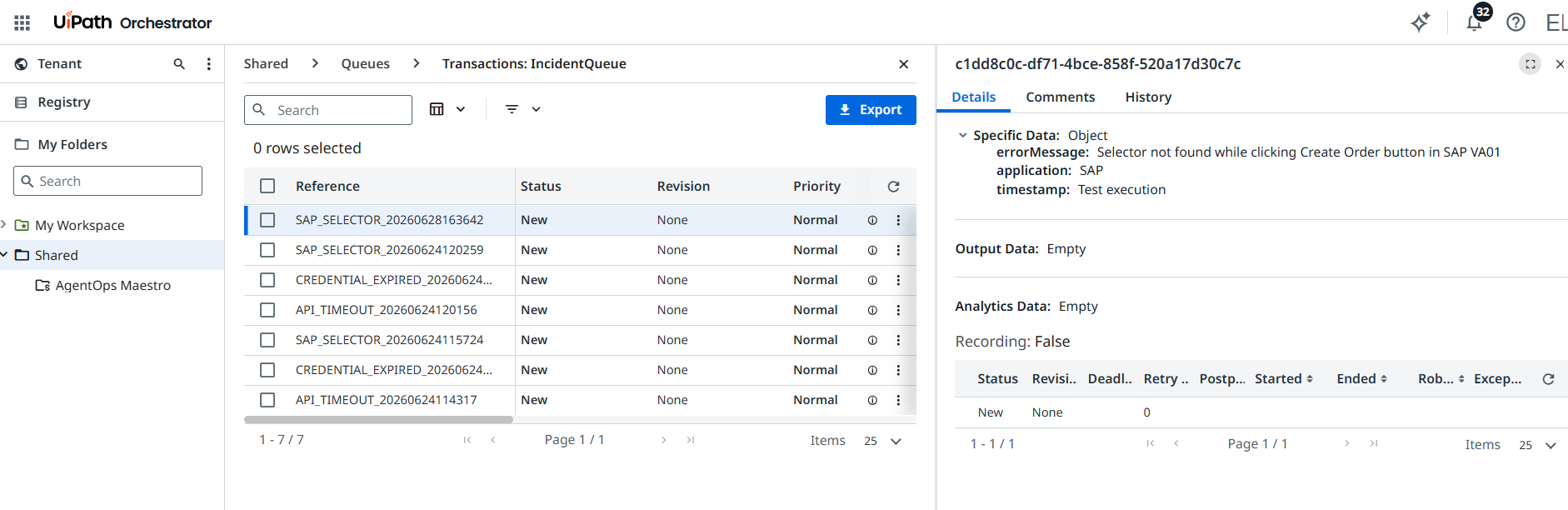
Each failed automation automatically creates an incident and stores it in an Orchestrator Queue.
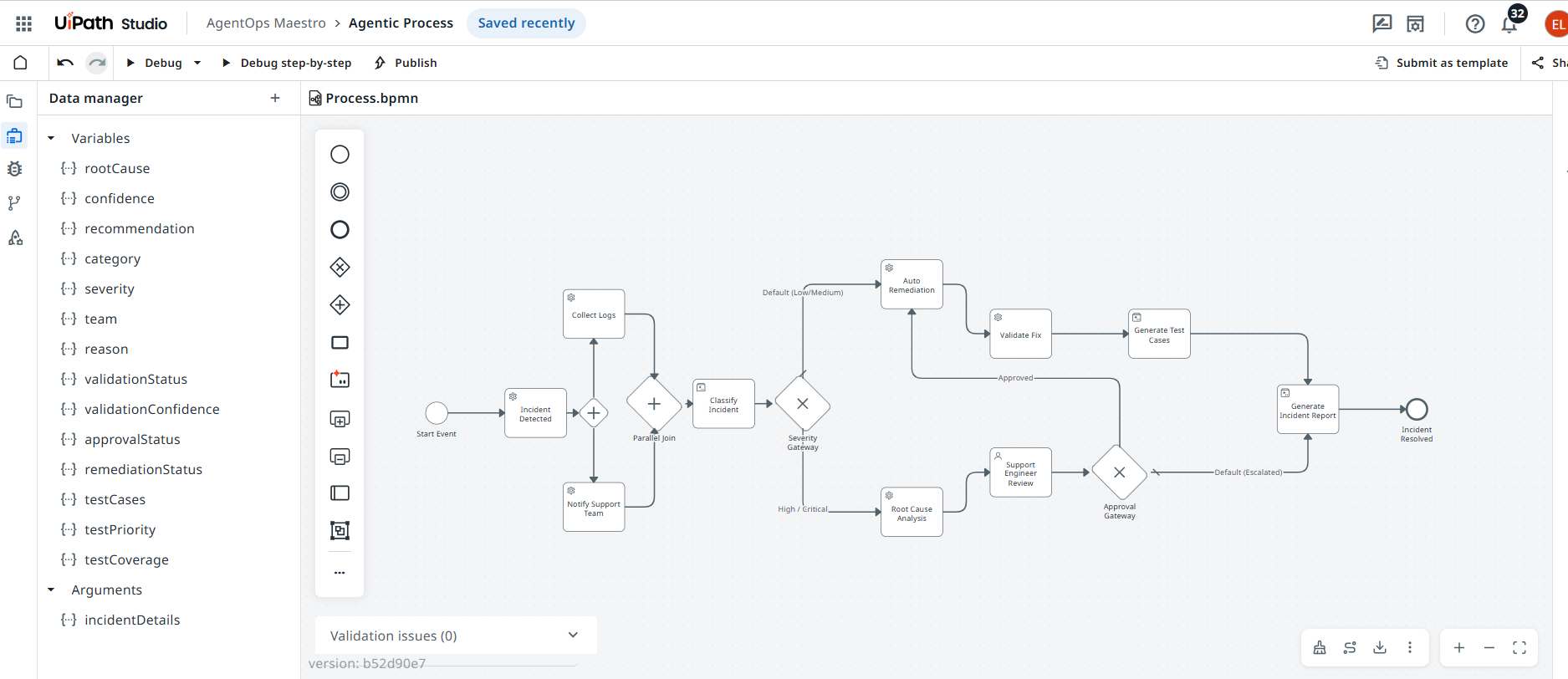
UiPath Maestro orchestrates multiple AI Agents that collaboratively perform:
- Incident Detection
- Log Collection
- Incident Classification
- Severity Assessment
- Root Cause Analysis
- Validation
- AI-generated Regression Test Cases
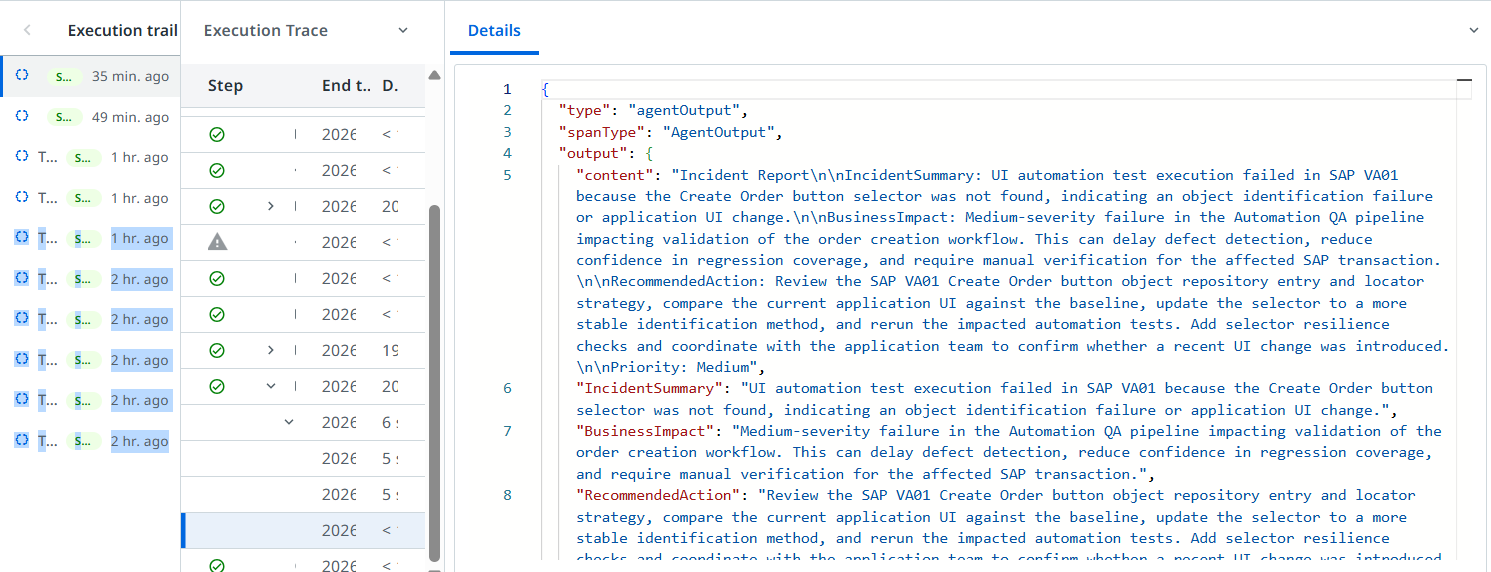
- Executive Incident Report Generation
The result is a standardized AI-assisted incident response workflow that significantly reduces manual investigation effort.
How we built it
The solution consists of multiple independent components working together.
Three UiPath RPA processes simulate realistic enterprise failures and publish structured incident payloads to an Orchestrator Queue.
UiPath Maestro orchestrates the complete incident lifecycle using BPMN.
Multiple AI Agents were developed for specialized responsibilities:
- Incident Classification Agent
- Root Cause Analysis Agent
- Validation Agent
- Test Case Generation Agent
- Incident Report Generator Agent
Each agent receives structured inputs, produces domain-specific outputs, and passes contextual information to the next stage of the workflow.
The architecture combines unattended automation, AI-driven decision making, human review where required, and standardized reporting into a single orchestration.
Challenges we ran into
One of the biggest challenges was designing a workflow where multiple AI Agents could collaborate while maintaining clear responsibilities and data flow between BPMN activities.
Another challenge was configuring UiPath Maestro variable mappings between agents and ensuring outputs from one agent became reliable inputs for downstream agents.
We also worked through unattended robot configuration, Orchestrator queues, package publishing, runtime allocation, and incident routing based on severity.
Prompt engineering was another significant challenge. We refined each agent to generate enterprise-quality outputs that were relevant, consistent, and practical for real-world automation teams.
Accomplishments that we're proud of
- Successfully built a complete AI-driven incident management workflow using UiPath Maestro.
- Implemented five collaborating AI Agents with clearly defined responsibilities.
- Integrated UiPath Orchestrator Queues with unattended RPA processes.
- Demonstrated multiple enterprise failure scenarios using realistic incident payloads.
- Automatically generated regression test cases based on validated remediation recommendations.
- Produced executive-ready incident reports summarizing business impact and recommended actions.
- Designed a modular architecture that can be extended with additional enterprise integrations.
What we learned
This project demonstrated that AI Agents become significantly more powerful when orchestrated together rather than operating independently.
We learned how UiPath Maestro enables structured collaboration between AI Agents, RPA processes, queues, and human decision points using BPMN.
We also gained practical experience in designing enterprise-grade AI workflows, prompt engineering, agent orchestration, unattended automation, and AI-assisted incident response.
Most importantly, we learned that automation should not stop at task execution—it should also assist organizations in diagnosing, validating, documenting, and continuously improving automation reliability.
What's next for Autonomous AI Incident Management using UiPath Maestro
Our vision is to evolve AgentOps Maestro into a fully autonomous operations platform.
Future enhancements include:
- Queue-triggered automatic Maestro execution
- ServiceNow and Jira integration
- Real-time operational dashboards
- AI-powered predictive incident analytics
- Multi-application support for SAP, Salesforce, Oracle, and web platforms
- Integration with monitoring platforms such as Splunk and Datadog
- Autonomous self-healing using coding agents that can analyze failures, repair selectors or automation logic, execute regression tests, and prepare deployment-ready changes for human approval
We believe this architecture can serve as a foundation for the next generation of intelligent enterprise automation, where AI Agents collaborate not only to automate business processes but also to continuously monitor, improve, and recover those automations autonomously.
Built With
- agentic-ai
- bpmn
- enterprise
- gpt-5.4
- json
- uipath-ai-agents
- uipath-maestro
- uipath-orchestrator
- uipath-queues
- uipath-robots
- uipath-studio
- uipath-studio-web
